By Dhruva Jaishankar and Ylli Bajraktari
The United States and India now have a major opportunity to cooperate more closely on AI. But they must move beyond the rhetoric of shared values to building shared infrastructure.

Edited Volume
By Rachel Rizzo, Clemens Chay, Kartik Bommakanti, Vasabjit Banerjee, Aleksei Zakharov, Soumya Bhowmick, Arya Roy Bardhan, Jhanvi Tripathi, and Samriddhi Vij
Editors: Sharon Stirling and Eszter Karacsony
By Udaibir Das
More moves of this kind should be expected, extending beyond energy into critical minerals, technology standards, industrial policy, and cross-border finance. The UAE’s decision is not an outlier. It is a marker — not of fragmentation, but of redefinition.
By Dhruva Jaishankar and Ylli Bajraktari
The United States and India now have a major opportunity to cooperate more closely on AI. But they must move beyond the rhetoric of shared values to building shared infrastructure.
Special Report No. 10
By Piyush Verma, Caroline Arkalji, and Telmen Altanshagai
By Dhruva Jaishankar and Ylli Bajraktari
The United States and India now have a major opportunity to cooperate more closely on AI. But they must move beyond the rhetoric of shared values to building shared infrastructure.
By Dhruva Jaishankar
For countries around the world — whether allies, partners, or competitors of the United States — there are important and immediate questions of how much and to what degree they will accommodate, or hedge against, the United States’ new approach to the world.
By Dhruva Jaishankar
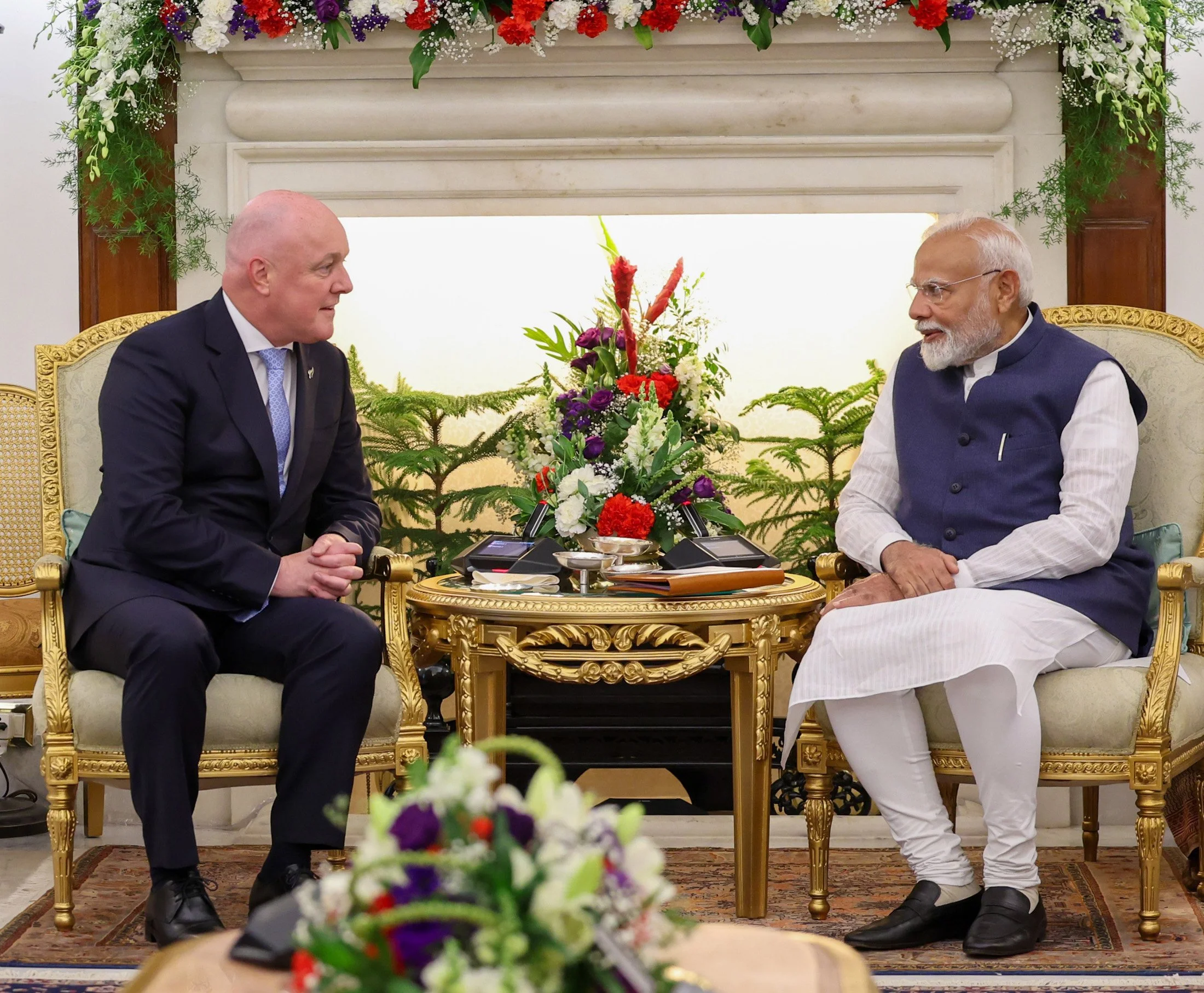
For both India and New Zealand, their trade agreement represents, more than anything else, a risk mitigation strategy. Concerned about over-dependence on China and the United States as both producers and consumers — and the failure of multilateral trade negotiations at the World Trade Organization — New Delhi and Wellington have opted to bet on each other and bring a modicum of certainty to an uncertain world.
Edited Volume
By Dhruva Jaishankar, Anit Mukherjee, Anirban Sarma, Mannat Jaspal, Nilanjan Ghosh, and Sunaina Kumar
Editors: Sharon Stirling and Eszter Karacsony
By Dhruva Jaishankar and Ammar Nainar
Once a quiet backstage function of the armed forces, defence diplomacy has emerged as one of India's sharpest tools of statecraft. From joint exercises and training missions to disaster relief and maritime surveillance, India's military now operates far beyond the battlefield: building trust, shaping partnerships, and projecting the country's strategic interests on a rapidly shifting global stage.
By Dhruva Jaishankar
A strong transatlantic bond that for almost eight decades had evolved into a highly integrated defense and economic system among the world’s leading industrial economies – institutionalized under the North Atlantic Treaty Organization (NATO) and G7 – now faces new stresses.
By Dhruva Jaishankar
In its diplomacy, India has reprioritized its near neighborhood, extending financial, developmental, and trading benefits to other South Asian countries and revitalizing more productive regional institutions.
By Dhruva Jaishankar
For India, navigating U.S. export controls remains a challenge 20 years since the civilian nuclear agreement was signed.
By Dhruva Jaishankar
Learnings from Delhi’s past should help in shaping the future as India bets big on new critical technologies.
By Dhruva Jaishankar
The EU and India both have apprehensions about China’s economic and manufacturing supremacy threatening employment and businesses at home.
By Dhruva Jaishankar
Trump and Modi announced a wide-ranging agenda to take the bilateral relationship forward. It included efforts that built upon the progress made during the Biden administration, particularly in terms of technology, defense, and regional cooperation.
By Dhruva Jaishankar
Understandably, Germany will be preoccupied in the short term with Europe’s eastern and southern flanks, the transatlantic relationship, and the Middle East, but Berlin has important economic and security interests in the Indo-Pacific.
"Rebalancing Globalization: Perspectives from the Global South" attempts to provide a framework for the next phase of globalization that is rebalanced and sustainable and can address issues that matter to the Global South.
Edited Volume
By Anit Mukherjee, Dhruva Jaishankar, Alan Gelb, Pamla Gopaul, Marta Bengoa, Shayak Sengupta, Aude Darnal, Elizabeth Sidiropoulos, Udaibir Das, Veronica Jijon, and Lorrayne Porciuncula
Editors: Anit Mukherjee and Dhruva Jaishankar
While there is no shortage of analysis and speculation of China’s capabilities and behavior today, it is imperative to keep an eye on longer-term developments and remain open to uncertainties that could shape China’s strategic outlook.
Joint Report
By Shikha Aggarwal, Divyank Chaudhary, Lily McElwee, Aaron Glasserman, Keshav Kelkar, Kento Mashiko, Takuya Matsuda, Helen Mitchell, Philip Rogers, Rena Sasaki, David Saultry, and Neil Thomas
Editors: Dhruva Jaishankar and Greg Brown
By Dhruva Jaishankar
While the direct implications for India might be less than for others, the 2024 U.S. presidential election will undoubtedly have indirect effects on India.
By Dhruva Jaishankar
Why should Indo-Pacific nations pay attention to the U.S. presidential election and what will a change in leadership mean for existing partnerships?
Observer Research Foundation America, 1100 17th St. NW, Suite 501, Washington DC 20036 USA