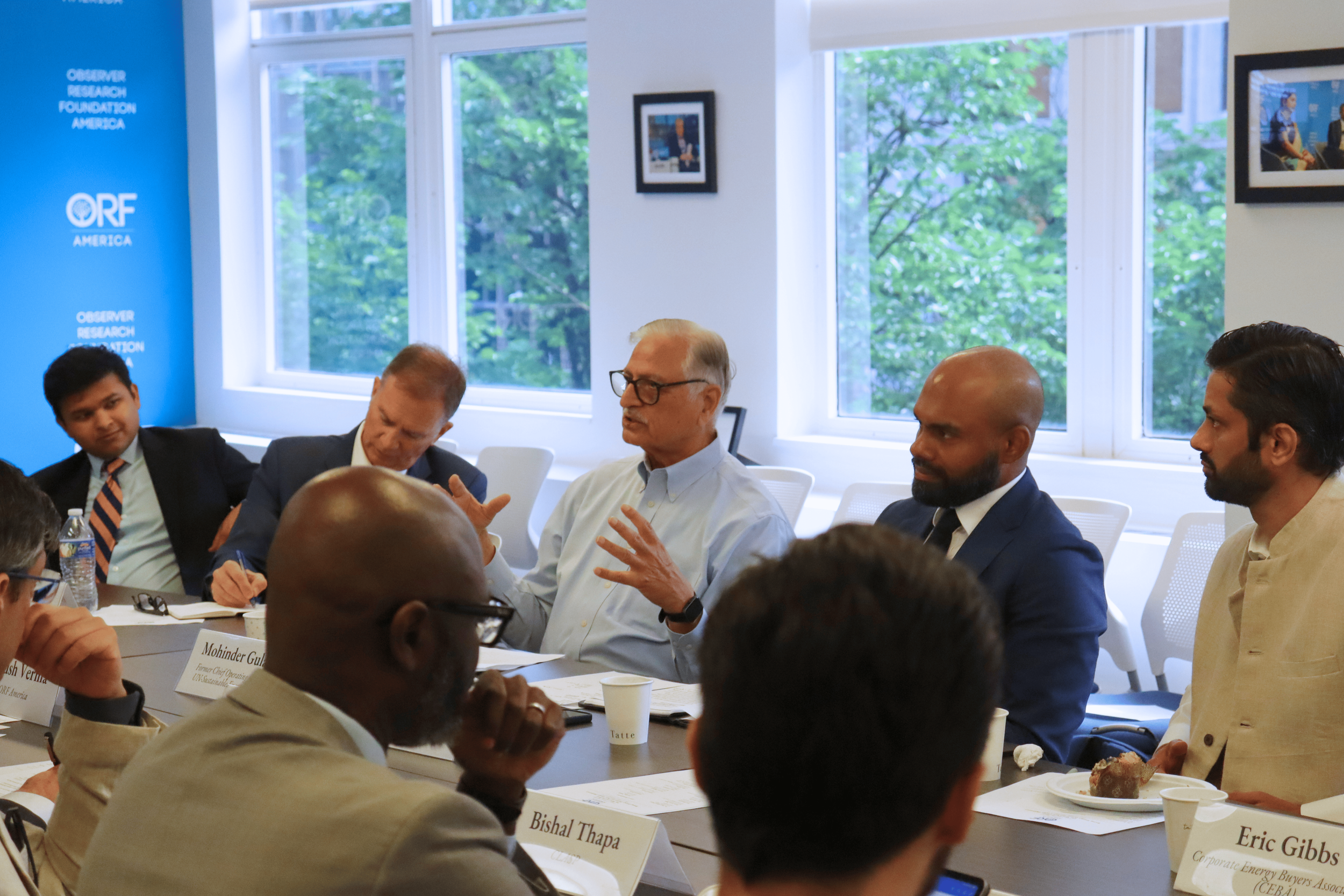
On June 11, ORF America convened the fifth edition of its Future of Energy Breakfast series, bringing together senior leaders from government, industry, finance, and policy for a closed-door dialogue on how global disruptions, new energy powers, and shifting geopolitical strategies are reshaping energy diplomacy and the global energy order.
The global energy system is no longer organized primarily around access to oil and gas resources. A new generation of energy powers is emerging across both fossil and non‑fossil energy systems. At the same time, the relationship between ‘the West and the Rest’ is becoming significantly more complex and fragmented. Advanced economies are not responding uniformly to these shifts. Similarly, ‘the Rest’ is far from a single bloc. Emerging economies across Asia, Africa, Latin America, and the Middle East are pursuing increasingly diverse energy and geopolitical strategies. These shifts are unfolding alongside renewed concerns over maritime chokepoints, strategic infrastructure, and supply chain vulnerabilities. The implications extend far beyond energy markets alone. The emerging energy order will shape global trade, industrial competitiveness, technological leadership, investment flows, economic resilience, and geopolitical influence for decades to come.
Key takeaways included:
The assumptions underpinning the global energy system for three decades are being fundamentally reassessed. What was once organized around globalization, efficiency, and market integration is increasingly shaped by geopolitics, industrial strategy, and national security. The IEA estimated roughly $3.4 trillion in global energy investment in 2026, with nearly two-thirds flowing to renewables, efficiency, grids and other low-carbon sources and around 60% of new global energy demand now being met by clean energy. The shale revolution in the United States and the rise of Chinese renewable manufacturing have already redrawn the map of energy power — and the transition is accelerating.
China's dominance in the emerging electron economy is structural and far-reaching. Its total solar capacity is five times that of the United States and around ten times that of India, with similar dominance in wind, hydro, and solar manufacturing. On rare earths, China controls approximately 70% of mining production and roughly 90% of processing and refining capacity, while it controls approximately 90% of the world’s processing capacity for critical minerals. Beijing has demonstrated its willingness to deploy this leverage through export controls, with far-reaching consequences for the entire clean energy supply chain.
The shift from molecules to electrons is reordering the strategic logic of energy. Electrons are far less tradable than molecules, and renewables are inherently local, creating a natural tendency toward energy independence. Storage (batteries and grid infrastructure) is becoming the new strategic reserve, replacing oil stockpiles as the measure of energy resilience. These dynamics are pushing the world toward multipolarity faster than geopolitics alone, and a potential nuclear revival alongside early-stage thorium breakthroughs could further reshape long-run assumptions about fuel supply.
Traditional chokepoints have not been superseded; they have been joined by new ones. Recent disruptions in the Red Sea and around the Strait of Hormuz have demonstrated that shipping lanes and hard energy infrastructure remain as geopolitically consequential as ever, echoing the 1973 oil shock. At the same time, critical minerals, computing infrastructure, and electricity grids are emerging as a new layer of chokepoints — and with global data center electricity consumption expected to roughly double between 2024 and 2030, firm clean electricity is becoming the binding constraint on AI development and a source of decisive strategic advantage for countries such as Canada that can offer it at scale.
These converging pressures are prompting a fundamental reframing of energy security itself. Participants questioned whether the concept remains adequate, or whether "industrial systems security" — including manufacturing, semiconductors, digital infrastructure, and electricity as an integrated whole — is now the more accurate lens. The migration of power from barrels to electrons and computing powers, participants noted, constitutes the largest supply chain disruption in history.
The West and the Rest are each more fragmented than the binary suggests. Advanced economies are pursuing overlapping but distinct approaches on LNG, critical minerals, and technology leadership, while emerging economies like India, Vietnam, the UAE, Brazil, and Indonesia seek strategic autonomy rather than alignment with any single camp. Several states are practicing "variable geometry": for instance, the UAE is managing relationships with Washington and Beijing simultaneously while signing an AI and quantum investment agreement with Canada. Trade, once a foundation of cooperation, has been reframed as a risk — a trust deficit participants identified as one of the defining challenges of the new energy order.
Corporations have emerged as major non-state actors in energy diplomacy, alongside NGOs, civil society, and new threat vectors. U.S. firms have procured over 150 GW of clean energy over the past decade, de-risking renewable projects in ways government policy alone has not. In Asia, the prospect of attracting corporate investment is generating competitive pressure to accelerate clean energy deployment, thus fostering a potential race to the top. Meanwhile, cyber threats and state-sponsored infrastructure attacks have expanded the definition of energy security well beyond supply alone.
Access to cooling has become as existential as access to heating, and the efficiency agenda has slowed down. Although four billion new air conditioning units are projected to be sold between 2018 and 2050, this is still insufficient to meet total need. Inefficient units displaced in advanced economies are routinely exported to lower-income markets in Africa and Asia, a problem that existing efficiency standards could address. The barrier is political will, not technical capacity. Energy efficiency more broadly represents the most accessible near-term gains available, yet has quietly vanished from diplomatic and policy conversations.
Private capital and household savings remain underutilized levers in the transition. Households in major economies collectively hold trillions of dollars in low‑yield savings instruments that are only intermittently connected to low‑carbon investment opportunities. Mobilizing a larger share of that capita l —alongside the corporate off‑taker models that have already proven effective in scaling clean energy — represents a significant, still underdeveloped opportunity. At the same time, the principle of common but differentiated responsibilities must remain central to climate‑finance frameworks, so that transition costs are allocated in line with historical responsibility and capacity rather than falling disproportionately on those least responsible for the problem.
The world remains in the middle of a hard transition, and today’s institutions are poorly equipped for what comes next. Roughly four‑fifths of global primary energy still comes from fossil fuels, even as power shifts toward electrons, minerals, storage, and compute. The next great energy shock may not come from an oil chokepoint, but from a disruption to mineral processing, electricity grids, or digital infrastructure. The diplomacy of the coming decade will be shaped not only by the largest powers, but by hedging states, middle‑power coalitions and non‑state actors already filling the void left by a post‑1945 architecture that is struggling to adapt. In a world where a billion people are present at every negotiating table, the new energy diplomacy will be judged by whether it delivers affordable, reliable, and clean energy to the global majority.
Speakers:
Opening Remarks: Dhruva Jaishankar, Executive Director, ORF America
Ambassador Robert F. Cekuta, Former U.S. Ambassador to Azerbaijan; Former Principal Deputy Assistant Secretary, Bureau of Energy Resources, U.S. Department of State
Mohinder Gulati, Former Chief Operating Officer, UN-Sustainable Energy for All and Former Energy Advisor - Europe and Central Asia Region, World Bank
Michael Paramathasan, Former Director of Policy and Legislative Affairs to Canada's Minister of Artificial Intelligence; Former Director, Office of the President of the Treasury Board of Canada
Moderator: Piyush Verma, Senior Fellow, ORF America
Participants:
Dr. Raul Alfaro-Pelico, Non-Resident Fellow, ORF America
Caroline Arkalji, Junior Fellow, ORF America
Parth Sarthi Bajaj, Research Associate, The Johns Hopkins University
Kurt Donnelly, Adjunct Professor, American University
Eric Gibbs, SVP, Global Programs, CEBA
Jamie Kern, Policy Officer - Energy, European Union
Maximo Miccinilli, Senior Partner, FleishmanHillard EU
Medha Prasanna, Program Coordinator and Junior Fellow, ORF America
Stephen Rahaim, Director, Datamuse LLC
Avishkar Sabharwal, CEO, Satya Carbon
Sharad Sharma, Climate Change Specialist, World Bank
Ricardo Smith, External Advisor, Georgetown University
Bishal Thapa, Chief Strategy and Impacts Officer, CLASP
Shohei Yoshida, Director, Sumitomo