

Background Paper No. 40
BY Udaibir Das and PIETRO ZECCA
I. RESOURCE MOBILIZATION AND ABSORPTION
Official development assistance fell by 23.1 percent in real terms in 2025, the largest annual contraction on record in the Organisation of Economic Cooperation and Development (OECD)’s preliminary data. The immediate fiscal and social costs are severe in many developing countries; if aid shortfalls persist, spillovers to global trade and financial stability are likely. Debates in donor countries have since focused on how to defend, supplement, or replace aid flows, including through blended finance, guarantees, private capital mobilization, and multilateral development bank (MDB) reform. In other words, how can aid-dependent developing economies raise more capital, lower its cost, and improve incentives?

Meanwhile, the developing world has focused on a second set of issues including reform of the international financial system itself, spanning debt architecture, the channeling of multilateral funds, concessional access, sovereign ratings, taxation, and financial governance. Sovereign debt restructuring is central because many low-income countries are currently in, or at high risk of, debt distress, which constrains their fiscal space. Rechanneling special drawing rights (SDRs) is contested because much of the roughly $650 billion allocated in 2021 accrued to countries for which liquidity was not a binding constraint, reducing their value for the poorest states. Sovereign credit ratings also attract criticism, particularly for the models and conventions that amplify perceived fragility and penalize countries for structural features beyond their control. Concessional access, global tax governance, and institutional reform International Monetary Fund (IMF) quotas, World Bank shareholding, African representation in standard-setting bodies, and a voice for small states are further areas of focus. Both sets of discussions focus on mobilizing more resources and directing them into developing economies.
But equally important is the question of absorption. How can capital be used more productively, particularly when its supply is constrained? More external resources, more domestic financing, better concessional access, and more sophisticated de-risking do not automatically convert into durable productive capacity. This is the absorption dilemma: financing can rise while the capacity to deploy it stands still, and the flows meant to build capacity return as debt service on assets that never materialize. The challenge is that success feeds the failure each mobilization gain that deployment cannot match widens the gap between capital raised and capacity created. The conversion chain from capital mobilization to development runs through project selection, market development, and sustainable balance sheets. Every link in this chain determines whether finance flows into firms, farms, housing, supply chains, human capital, and infrastructure. Yet discussion of absorption remains scattered across separate disciplines and literatures. It has not been integrated into a single framework at the center of the development finance debate.
Earlier work on economic development did not ignore the absorption challenge in low-income economies. The mainstream development economics literature correctly identified several weaknesses in the current system, including shallow local markets and mispriced sovereign risk. Private capital has not been mobilized at the scale once promised. Guarantees and blended finance can mobilize capital but typically fail to scale because they do not resolve underlying market failures or build sustainable local intermediation. The international system often prices risk in ways that deepen development constraints rather than reduce them. Global uncertainty compounds these constraints. When trade policy, geopolitics, and interest rates move together, risk premiums widen most where buffers are thinnest, and the cost of capital rises precisely for the countries least able to bear it.
IMF research on scaled-up aid flows and public investment management, work by the OECD on local-currency finance, MDB evaluations, and micro, small, and medium-sized enterprise (MSME) finance studies each recognized parts of the problem." The OECD's 2025 work on local capital markets highlights structural barriers and the role of domestic markets in closing investment gaps. Indeed, there has long been debate over allocating assistance to more productive sectors in developing economies. That debate has run through the G20 Common Framework after 2020, the IMF's 2021 SDR allocation, the MDB capital adequacy review reported in 2022, and other financing-for-development processes.
The deficiency is that mainstream literature treated the components of absorption separately. MSME finance was treated as a firm-level constraint, while the sovereign-bank nexus was treated as a financial stability or fiscal dominance issue. Local-currency market depth was viewed as a measure of capital-market development. The literature treated public investment efficiency as a component of public financial management. Sovereign balance sheet opacity was treated as a transparency or fiscal risk issue. In fact, they all reflected the same problem: a domestic system's inability to deploy capital, retain its returns, and compound them through the economy.
II. THE CHALLENGES TO ABSORPTION
Mobilization gains, whether public or private, do not automatically translate into productive transformation for three main reasons. First, work on public investment management has repeatedly shown large efficiency losses in planning, allocation, and implementation. Earlier IMF work put the average public investment efficiency gap at around 30 percent. The October 2025 Fiscal Monitor puts it near 39 percent for growth-supporting public spending in low-income developing countries — a broader measure. The same diagnostics point to an absorptive ceiling: beyond a threshold, implementation inefficiency and rising unit costs prevent additional spending from producing commensurate output. In a sample of road projects in developing countries, IMF researchers find that unit costs rise once public investment approaches about 10 percent of gross domestic product (GDP), and that the threshold falls to around 7 percent in countries with low investment efficiency.
Second, guarantees and blended finance often shift mispriced risk onto public balance sheets without correcting the underlying weakness. Guarantees serve broader purposes, namely covering real credit and political risks, but the development case for scaling them rests on a theory of mispriced risk. Sovereign and project risk premiums in low-income markets often exceed what fundamentals justify, so public balance sheets absorb the mispricing to attract private capital. Mispriced risk is also a tax on fiscal space because every excess percentage point of spread diverts revenue from investment to debt service. But a guarantee does not, by itself, correct the source of the mispricing. It transfers the cost to a public or multilateral balance sheet and leaves the underlying structure unchanged. Shallow markets, narrow investor bases, thin credit information, and weak project systems remain. The next transaction faces the same risk. And risk transferred to the public balance sheet does not always stay visible there. Contingent liabilities are often off-balance sheet or poorly disclosed, obscuring the true fiscal risk. Senegal's experience illustrates this. A February 2025 audit in Senegal brought previously off-balance sheet borrowing and support into the central government accounts, raising reported central government debt at end-2023 from 74.4 to 99.7 percent of GDP.
Third, development finance has neglected the missing mid-layer which includes productive intermediation into firms, farms, housing, supply chains, and small- to medium-scale infrastructure. At this layer, local financial systems must bear credit risk on the capital they allocate. It is a middle because capital is mobilized above it, in sovereign finance and international architecture, and needed below it, in firms and projects. It is missing because the systems that should connect the two are too shallow to bear the risk. Absorption operates through this intermediation layer: when local intermediaries can bear credit risk at productive maturities, mobilized capital finances capacity; when they cannot, funds concentrate in short-term sovereign instruments, and the dilemma takes hold. Its operational marker is local-currency financing with maturities of one to five years, matching project cash flow profiles and reducing currency mismatch risk for borowers. Local-currency instruments carry tradeoffs: liquidity and term premiums remain substantial in shallow markets, and where foreign investors participate, exchange rate risk shifts to them. That is the case for building the market rather than bypassing it: without depth, hedging, and a wider investor base, local-currency instruments reprice the same fragility. Much of the current Global South development finance agenda focuses on sovereign and multilateral instruments and therefore operates largely above this intermediation layer. As a result, the agenda often fails to address the structural constraints-intermediation capacity, market infrastructure, and institutional incentives that limit local absorption. In fact, it often treats the constraint as a documentation and bankability problem. This treatment mistakes symptoms for the structural cause.
Other trends reinforce these constraints. In many low-income economies, domestic banks hold a large share of their assets in sovereign instruments, which receive favorable capital treatment. Sovereign paper is a legitimate liquidity and collateral asset; the problem is concentration beyond prudential logic, sustained by zero risk weights and banks' position as captive buyers. The result is familiar: less credit reaches firms and households. Guinea and Ghana illustrate this concentration particularly clearly. In Ghana, banks carried enough government paper that the 2022-23 domestic debt exchange consumed a large share of the sector's capital; the concentration was visible in routine data long before restructuring forced the point. Local-currency markets in many low-income economies are short-term and sovereign-dominated, with little capacity for maturity transformation. Finally, institutional investor bases are thin: pension funds and insurers are often small, narrowly mandated, and concentrated in sovereign holdings. Together, these factors mean low-income financial systems finance the sovereign more effectively than productive investment.
The fiscal side reinforces the pattern. Non-distortionary taxation is the cheapest capital a country can raise. Unlike domestic debt, it does not feed the sovereign bank nexus. Yet few low-income countries collect more than 15 percent of GDP in taxes and social security contributions; estimates suggest improved administration and base broadening could mobilize several additional percentage points of revenue. When revenue weakens, the services that build human and institutional capacity are cut first, and with them the capacity to absorb. Debt service tightens the squeeze, crowding out the maintenance and complementary spending on which investment efficiency depends.
These flow-side dynamics have a stock-side counterpart in poorly measured and underutilized public assets. The development finance debate remains heavily focused on debt and liabilities, while low-income contexts inadequately measure the asset side of the sovereign balance sheet. Public corporations, concession rights, land, mineral assets, and sovereign equity holdings are often off-balance sheet or poorly valued in fiscal, credit rating, or debt-sustainability frameworks. For example, the IMF's 2018 Fiscal Monitor argues that governance and return on assets matter for fiscal strength and applies its balance sheet approach even in data-constrained settings such as The Gambia. The task is to translate improved asset visibility into deployment decisions that prioritize returns, maintenance, and fiscal resilience.
III. THE SOLUTION: DEPLOYMENT SUSTAINABILITY ANALYSIS (DEPSA)
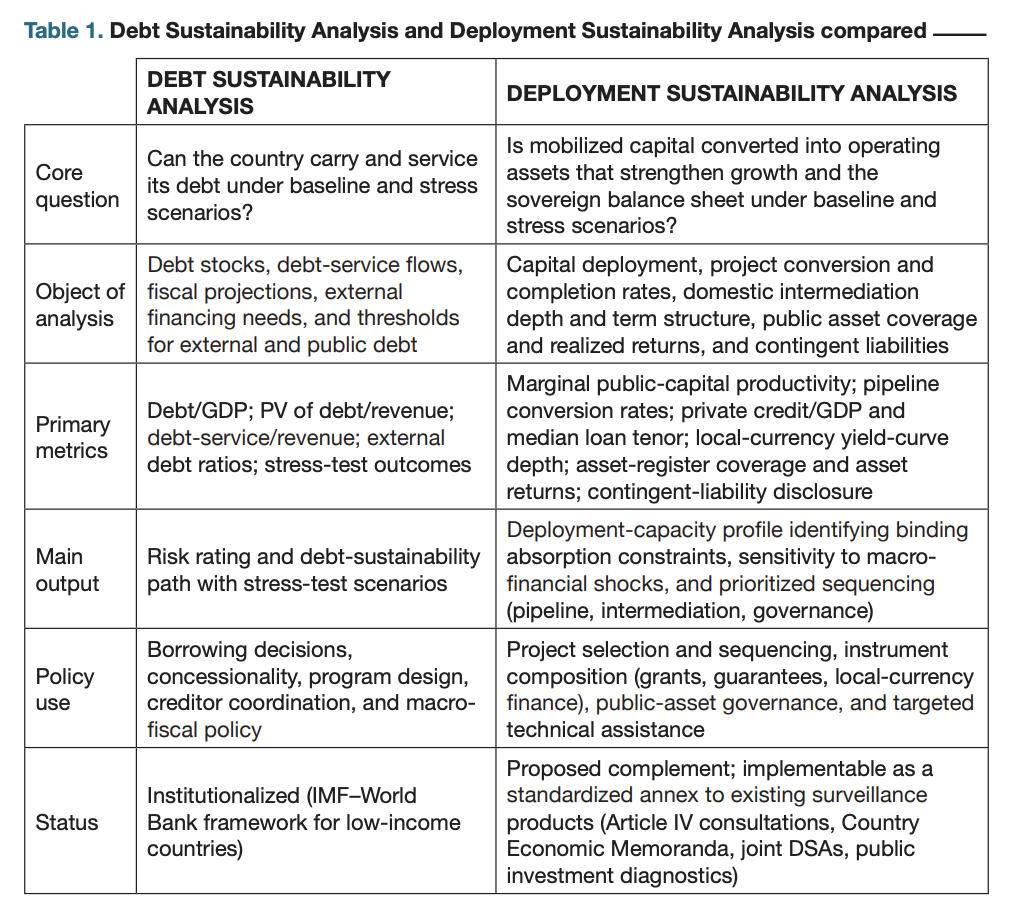
Debt Sustainability Analysis (DSA) is among the most institutionalized instruments in international finance. The IMF-World Bank Debt Sustainability Framework for Low-Income Countries underpins concessionality decisions, program design, and creditor coordination. The framework centers on a key question: can the country carry and service its debt under baseline and stress scenarios? It classifies debt-carrying capacity and tracks debt ratios against indicative thresholds. Its realism tools already examine the link between public investment and growth. DSA does what it was built to do: it assesses debt-carrying capacity on the liability side. It does not evaluate whether mobilized financing will be productively deployed to generate asset returns that strengthen the sovereign balance sheet.
Addressing that side requires a Deployment Sustainability Analysis (DepSA). DepSA is a structured complement to DSA, not a replacement. Nor is it a substitute for near-term liquidity management: rollovers, arrears, and crisis finance. Unresolved liquidity stress erodes absorptive capacity through stalled projects and unpaid suppliers. This is another reason liquidity management and deployment analysis must run together. DepSA would apply the same logic to the deployment side. Where DSA assesses liability-side carrying capacity, DepSA would assess deployment capacity — the ability to absorb mobilized capital and convert it into operating assets that strengthen the sovereign balance sheet. Where deployment capacity is high, the case for additional finance strengthens, and where it is weak, the profile points to a response that differs in composition, not merely in volume.
Operationally, DepSA would ask whether mobilized capital is generating productive capacity that can compound growth and strengthen the sovereign balance sheet over time. It should be built around four observables. First, the marginal productivity of public capital. Second, project pipeline conversion. Third, domestic intermediation depth. Fourth, sovereign balance-sheet productivity. The first measures whether public investment produces capacity. The second assesses whether projects move from plans to operating assets. The third determines whether finance can reach productive users the missing mid-layer made measurable. The fourth analyzes whether the state's asset base supports future fiscal and productive capacity.
None of these is exotic. The first can draw on efficiency scores from IMF public invest-ment management diagnostics. The second can draw on pipeline completion rates and distributions of cost and time overruns in project monitoring. The third can draw on private credit depth and the maturity structure of local-currency lending, the yield curve, and median loan tenor. The fourth can draw on the coverage of public asset registers against market valuations, and the realized asset returns they report.
But a proxy is not the concept. Efficiency scores are evidence on marginal productivity, not a measure of it; register coverage establishes visibility, not yet productivity. The rule for a first annex is to match the inference to the proxy, and claim no more. Volatility is the condition against which all four are read: unstable exchange rates and interest rates raise project costs, shorten intermediation horizons, and depress measured returns. The profile should therefore be stress-tested against exchange-rate, interest-rate, and commodity-price scenarios. The domestic revenue position frames the profile: fiscal weakness reaches all four observables through the channels already described.
Consider a stylized case. Public investment runs at 7 percent of GDP with efficiency scores in the bottom quartile; fewer than half of approved projects reach operation on schedule and budget; bank credit to firms sits below 15 percent of GDP with shortening maturities; the asset register covers a fraction of known holdings and reports no returns. The reading is direct: at these settings, additional capital buys assets faster than it builds capacity, and the profile points to a response different in composition — pipeline completion and intermediation capacity first — not volume.
DepSA would not require a new institution. It could begin as an annex to existing surveillance and analytical products. Examples include IMF Article IV consultations, World Bank Country Economic Memoranda and Country Partnership Frameworks, joint debt sustainability analyses, and public investment management diagnostics with harmonized templates and a common set of metrics. Its purpose would be diagnostic: to discipline the analysis, not the borrower aligning creditor and borrower expectations by exposing deployment constraints and trade-offs, not by imposing conditionality. What is new is not the data but the integration: no existing surveillance or analytical product assesses these components together as a single deployment profile set against financing decisions. The marginal cost of a first annex is modest because it brings together existing staff arrive work; the larger costs reconciliation, interpretation, country engagement with scale, which further argues for starting small. Institutional interest is evident in the IMF's own spending-efficiency work.
DepSA is not intended as covert conditionality. Rather, it creates a verifiable sovereign asset documented deployment capacity that can improve a country's bargaining position by reducing information asymmetries. A finance ministry that can demonstrate high deployment efficiency and a documented intermediation gap holds a stronger negotiating position with creditors than one that can present only a favorable DSA risk rating. The channel is deliberately informational, not mechanical. DSA carries weight because it conditions access to finance; DepSA would carry weight by changing what creditors and investors can assume about a borrower. Markets will read the profiles; that is the point. The boundary is not between information and consequence but between informing judgment and triggering predetermined outcomes. Without that use, an annex joins the shelf of unread diagnostics; with mechanical consequences, it becomes the instrument this paper disavows.
DSA answers the creditors' question: can the country service its debt? DepSA answers the question borrowers should be able to ask: can additional capital be productively absorbed? Bridgetown-aligned governments have already called on the IMF and World Bank to reform DSA frameworks to better reflect climate and development investments as drivers of long-term growth. DepSA operationalizes that demand more broadly.
An obvious hurdle is that DepSA's data demands appear to fall precisely on the institutions it diagnoses as weak: a finance ministry that cannot track project conversion cannot complete a deployment annex either. But DepSA observables draw on data the IMF, the World Bank, MDBs, and central banks already collect. Where ministries lack project-monitoring or asset-register systems, the annex begins by aggregating diagnostics from MDBs, central banks, and line ministries, and flags the gaps as explicit findings that direct capacity building. Ghana's pre-crisis concentration, noted above, is the kind of signal a deployment profile is designed to surface early.
Another objection is political. The reforms DepSA points toward sure, changes to investor mandates, and adjustments to the capital treatment of sovereign exposures create distributional winners and losers, and therefore require calibrated sequencing. The arrangements they target are not oversights waiting on better information. The nexus pays its incumbents: banks earn safe carry, treasuries keep a captive buyer, and new projects are announced more readily than pipelines are maintained. Measurement does not dissolve such an equilibrium, but it changes what can be defended. An arrangement that survives on opacity is harder to sustain once its costs are on the record. That is the argument for disclosure first. In practice, sequencing matters: begin by disclosing banks' sovereign exposures, and let capital treatment respond to concentration as markets deepen, with financial stability safeguards.
A few principles should guide implementation. First, DepSA produces a profile, not a rating. The observables are read together, against a country’s own trajectory and stated benchmarks, not against a peer league table; cross-country comparison belongs in contextualized bands, not single-score rankings. That design also blunts the incentive to manage any single number, and it requires transparent methods and the disclosure of revisions and proxies. Second, the profile works in both directions. A strong profile is evidence for additional finance while a weak one directs attention to intermediation architecture, asset visibility, and pipeline development. Third, each indicator should require at least two consecutive years of comparable data, or a credible proxy. Where only a single year exists, the indicator is labeled provisional. The fourth principle concerns use. DepSA annexes should inform joint country diagnostics, instrument choice, and the targeting of technical assistance. They should not feed mechanically into risk pricing or lending conditions. That principle marks the boundary between a diagnostic a country has reason to want and a surveillance instrument it has reason to resist.
IV. RECOMMENDATIONS: SUSTAINING DEPLOYMENT
Development finance today is not only under-mobilized, it is also under-absorbed. The next phase hinges on bringing absorption into a debate that has so far remained fixed on mobilization. The argument is structural rather than cyclical: even if aid recovers, additional capital will flow into systems that lack the institutional and financial capacity to convert it into sustained productive assets. The shift is not from mobilization to absorption — both are required — but financing should be calibrated. Do not withhold support, yet tailor instrument mix, tenor, and concessionality to a country’s measured deployment capacity.
First, develop Deployment Sustainability Annexes through country-led pilots, with IMF-World Bank technical support, using data from Article IV consultations, Country Economic Memoranda, and other reports. Financing decisions should reflect both deployment capacity and repayment capacity. Finance ministries would lead, bringing debt-management, budget, and public-investment functions together with central-bank and supervisory data; debt managers would link the profile to borrowing strategy, and budget authorities to revenue and expenditure plans. The first step is to pilot annexes in four to six countries with different levels of debt distress, market depth, and public investment capacity, with a two-year learning cycle.
Second, establish Public Wealth Disclosure Standards: a reporting framework, not a financing instrument, for sovereign asset positions and their productivity relative to the cost of sovereign liabilities, with economic and social returns reported separately; public assets need not generate cash income to be productive. It would require visibility, not asset sales, because assets cannot be managed productively if they are not measured. The first step is a voluntary reporting template for material sovereign assets, developed by the IMF and World Bank with participating finance ministries; both institutions already compile sovereign balance sheet data.
Third, set design principles for local-currency productive finance. No new global facility is proposed: local instruments should avoid reinforcing sovereign-bank concentration, be denominated in local currency where feasible, and channel domestic institutional investors' capital into productive uses. Existing MDB instruments are ingredients, not architecture. The World Bank and regional development banks, together with finance ministries, central banks, capital market regulators, and institutional investors, should produce operational guidance — specifying maturity targets, risk-sharing templates, currency-exposure rules, and investor-eligibility criteria and pilot these against existing instruments.
The research agenda is as concrete as the policy one. Four lines of work would ground the framework. First, validate the proxies against outcomes: whether efficiency scores and conversion rates in fact predict realized asset returns and growth. Second, extend the absorptive-ceiling estimates beyond road projects, across sectors and country groups. Third, test in panel data whether intermediation depth at productive maturities predicts firm-level capital formation. Fourth, construct retrospective deployment profiles for countries that later entered debt distress Ghana and Senegal among them establish whether the observables would have signaled stress early. Each is tractable with existing data, and each would sharpen the annexes the pilots produce. to
None of this requires a new global institution. It requires existing institutions, including the IMF, the World Bank, regional development banks, finance ministries, standard-setters, and rating agencies to measure a different problem. They are also the natural champions: each is already invested in the underlying diagnostics, and the MDB reform agenda gives them the opening. The timing is opportune: the OECD DAC’s measurement review, the IMF–World Bank review of the Low-Income Country Debt Sustainability Framework, and the IMF’s independent evaluation of its engagement on debt in low-income countries create a window to harmonize disclosure standards and deployment templates across institutions.
The future of low-income economies will turn less on how much capital is mobilized than on whether domestic systems can absorb it, deploy it, and compound it into durable capacity.
ACKNOWLEDGMENTS
The authors would like to thank Dhruva Jaishankar, Alan Gelb, Anit Mukherjee, and Jeffrey D. Bean for their review, comments, and suggestions of an earlier draft of this paper. This background paper reflects the personal research, analysis, and views of the authors and does not necessarily reflect positions or policies of ORF America, its affiliates, or partners.
Cover image courtesy istockphoto user umesh negi.
Note: Citations and references can be found in the PDF version of this paper available here.