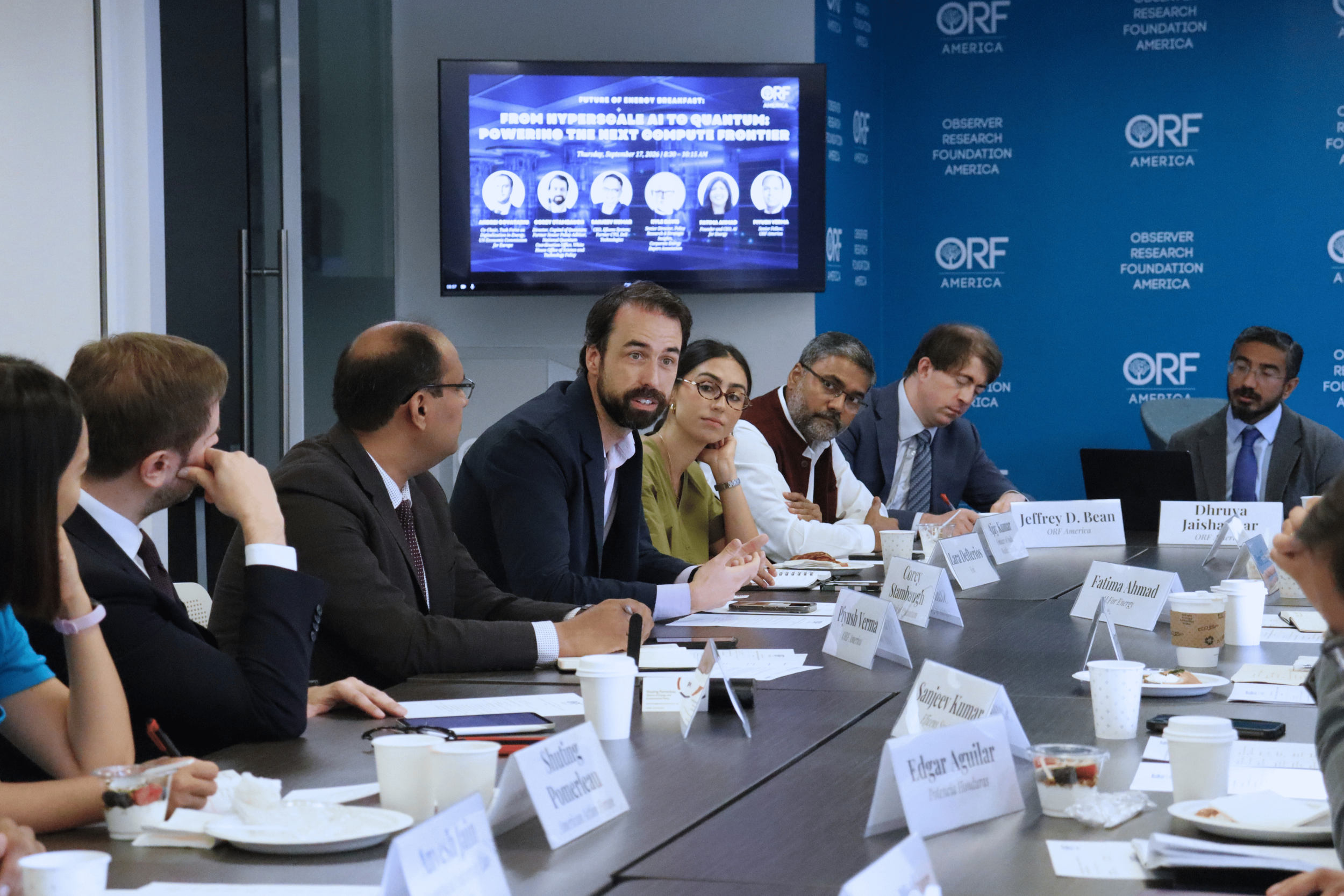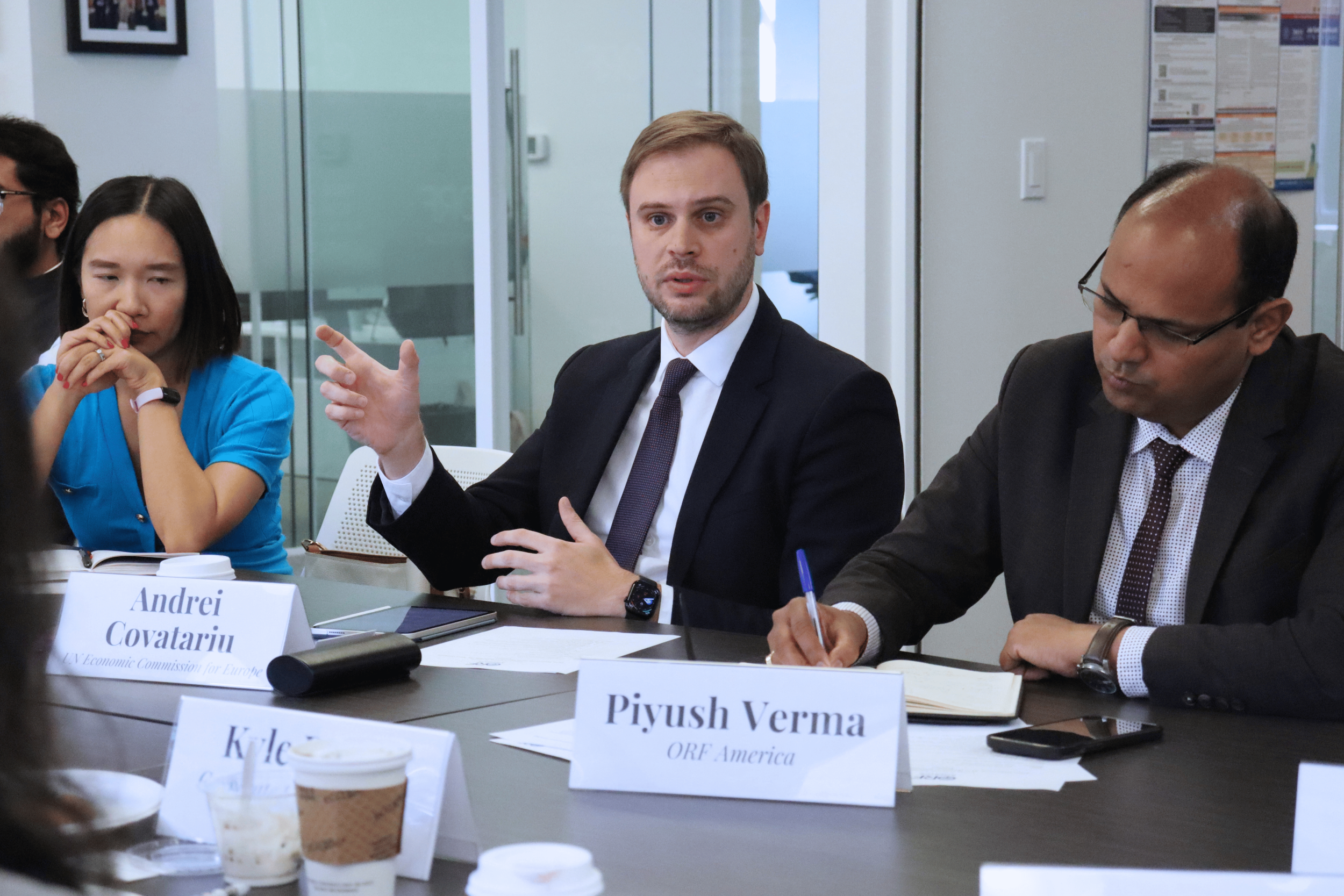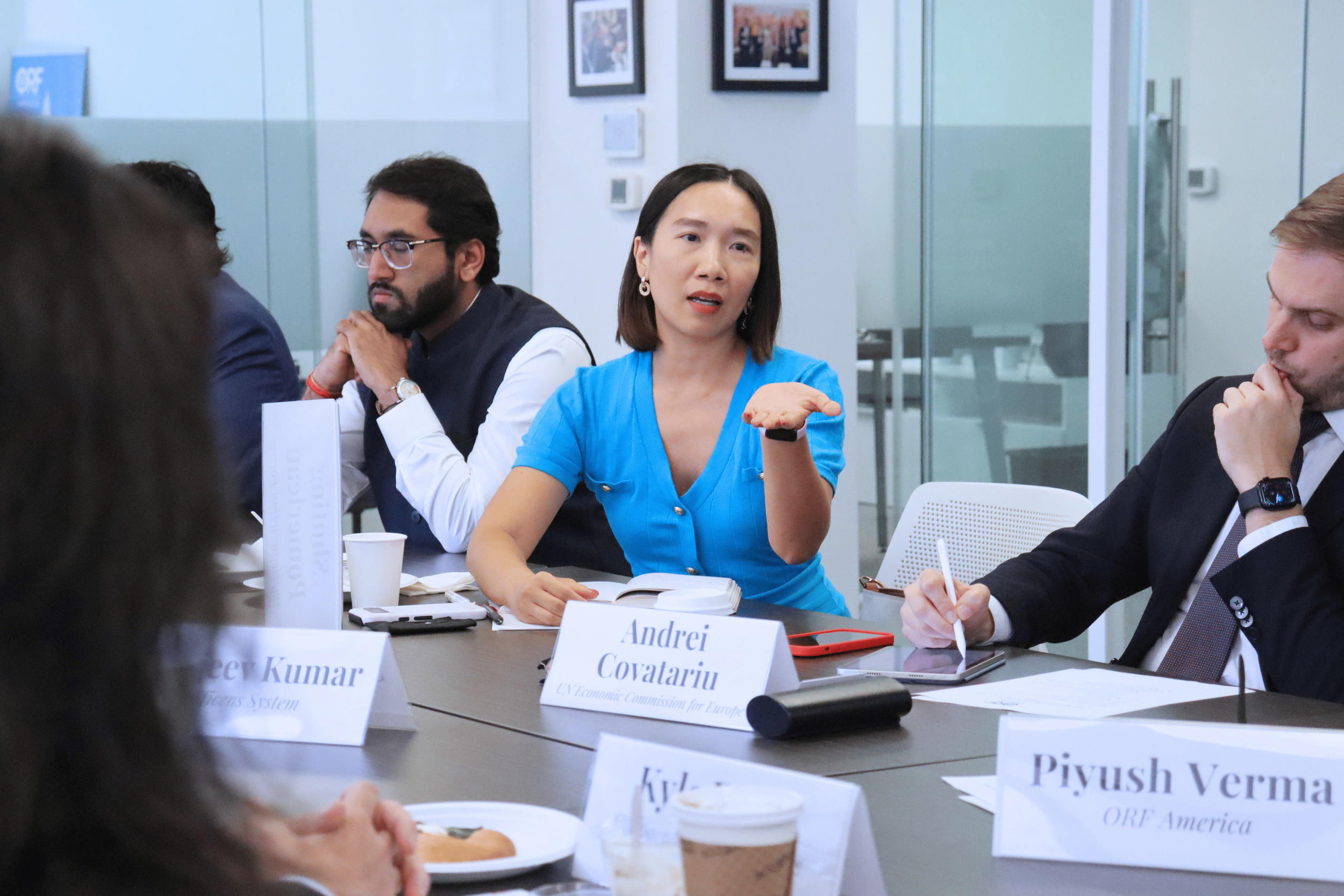

On September 17, ORF America convened the sixth edition of its Future of Energy Breakfast series, bringing together senior leaders from government, industry, technology, finance, and policy for a closed-door dialogue. The discussion examined what the current AI build-out is teaching us about the relationship between energy and computing; how the infrastructure requirements of quantum may differ; and what governments and industry should be thinking about today as they prepare for the next frontier of advanced computing.
In just a few years, AI and data centers have become an increasingly important driver of electricity-demand growth, grid investment, and generation planning. Quantum computing presents a very different, and much earlier-stage, energy question. Its electricity footprint today is far smaller than that of hyperscale AI infrastructure, but some leading quantum architectures depend on continuous cryogenic cooling, specialized control equipment, and highly specific supply chains. As these systems scale, quantum could become a distinct kind of energy and infrastructure customer, with implications for facility design, siting, power requirements, and grid planning. The infrastructure now being built for AI could help accelerate the next generation of computing — or concentrate capital and capacity in ways that make it harder for other emerging technologies to compete.
The discussion made clear that these are not two points on the same curve. The energy questions raised by quantum are different in kind from those raised by hyperscale AI, and the approaches now being developed for large AI and data-center loads may not map neatly onto the next generation of computing.
Key takeaways included:
Quantum inverts the AI energy problem: quantity of power versus quality and continuity. The constraint on hyperscale AI is how much power can be delivered and how quickly. For quantum, the challenge may increasingly be how stable and uninterrupted that power is. AI and quantum are symbiotic technologies, with distinct energy needs. In many quantum architectures, particularly superconducting systems, much of the electricity draw comes from keeping the supporting infrastructure running, including cryogenic cooling and control electronics. This makes quantum a more rigid energy customer, prioritising conditioned, stable, and uninterrupted power. A disruption can require recalibration and lengthy cooling and restart processes. This rigidity means that scaling quantum could require new infrastructure and reliability standards to accommodate its highly specific operating conditions. The closest existing parallel may not be the data center but semiconductor fabrication, which has long required highly reliable power and specialised equipment to protect sensitive processes. Future computing will likely adopt a hybrid approach, incorporating both AI and quantum. Power standards will therefore need to accommodate facilities with very different operating requirements, creating challenges that do not exist at scale today. Notably, quantum’s energy requirements have received far less attention in policy debates than its research, security, and commercial potential, suggesting that governments and other stakeholders may not yet be fully prepared for its infrastructure needs.
Quantum is a relatively rigid energy consumer, arriving just as the grid is placing greater value on flexibility from large users. One emerging approach between large consumers and grid operators is faster connection in exchange for a commitment to reduce grid withdrawals when the system is under stress. Flexible interconnection, pre-arranged switching to backup power, and shifting demand into periods of spare capacity are among the approaches being explored to make better use of existing infrastructure. Quantum facilities may have much less room to provide that flexibility, particularly where continuous cooling and tightly controlled operating conditions are required. A consumer that cannot readily reduce its load has less ability to offer the flexibility grid operators increasingly value and may instead need to invest in additional resilience: on-site generation, backup power, batteries, power-conditioning equipment, or redundant supply. Reliability that the grid cannot guarantee therefore has to be secured elsewhere, and that can be expensive.
Quantum becomes an energy security issue before it becomes a power-demand issue. Long before quantum facilities become material loads on the grid, quantum computing could affect the security of the grid itself. Many grid assets being built today are designed to run for the next 30–60 years. The cryptography protecting those systems has a much shorter transition timeline. The federal government has set 2035 as the deadline for completing migration to post-quantum cryptography, while newer guidance calls for prioritized migration by 2030 and broader transition thereafter. The infrastructure now being approved will therefore still be operating long after its cybersecurity architecture needs to change. Energy infrastructure that is not designed for cryptographic agility could require costly retrofits or replacement later, creating both operational and security risks. These considerations should therefore be built into infrastructure planning decisions today.
The grid is becoming a gatekeeper to AI scale and potentially a new source of digital inequality. Access to abundant and reliable electricity is increasingly becoming a prerequisite for large-scale AI deployment. The uneven geographic concentration of data centers makes this particularly important: the United States and China account for around 70% of data-center electricity consumption today and nearly 80% of projected global growth to 2030. Europe remains another major center, while Africa currently has the lowest data-center electricity consumption per capita. This raises an important question for emerging economies, including India and countries across Africa: could access to reliable, scalable electricity become a determinant of where AI investment and capability concentrate? Without sufficient energy infrastructure to accommodate large new loads, existing technological inequalities could widen. As quantum moves toward commercial deployment, it could add a different set of infrastructure requirements to this divide.
Large-load growth has elevated the social-license question amid growing community pushback. Communities have raised concerns about environmental impacts, electricity costs, noise, and whether the local benefits justify the burden of hosting large facilities. Participants noted that some backlash also reflects the role of third-party developers, whose incentives may favor speed to power over sustained community engagement. Backup diesel generation can add further concerns around local noise and air pollution. At the same time, attribution is difficult: grid costs associated with resilience, storms, wildfires, and new large-load connections can appear on the same electricity bill, making it hard for consumers to distinguish what is driving increases. This makes technically accurate explanations about individual facilities politically insufficient. Participants emphasized the importance of concrete local benefits and trusted messengers rather than technical explanations alone, noting that quantum technologies already underpin applications such as medical imaging and satellite navigation. The underlying question remains: who pays for integrating large loads into the grid? Clear cost allocation, community benefit agreements, and better communication were seen as essential to maintaining public confidence.
Supply chain exposure is a critical bottleneck alongside the grid, and AI and quantum are constrained by different inputs. U.S. policy has increasingly prioritised domestic manufacturing and friend-shoring, while Foreign Entity of Concern (FEOC) rules restrict certain suppliers in battery supply chains linked to federal incentives. The practical difficulty is traceability: companies may not always know their supply chains down to the component or material level. Similar challenges under forced-labour enforcement have delayed solar imports while companies and customs authorities worked through documentation requirements. Quantum faces a narrower but potentially critical constraint. Conventional critical minerals may not be the immediate bottleneck at current volumes; for some superconducting systems, helium-3 used in dilution refrigeration could be. Helium-3 is extraordinarily scarce, its supply is concentrated, and scaling quantum could put increasing pressure on availability even as researchers pursue alternative cooling technologies and new sources.
Efficiency gains are emerging at two levels: the grid and the compute stack. AI can improve load forecasting and demand management, while flexible data-center loads, storage, and onsite generation could enable a more dynamic relationship between data centers and the grid. At the compute level, the next frontier may include hybrid systems in which classical AI and quantum processors work together on particularly computationally demanding problems. Participants differed, however, on whether these efficiency gains will ultimately reduce energy demand. One view held that every efficiency improvement enables a harder problem, creating a loop in which demand keeps expanding. Another pointed to rapidly falling energy use per AI task, narrower domain-specific models, and edge computing as evidence that demand could become more efficient. A third argued that forecasts may still be understated as AI expands into robotics and automation at scale.
Underlying all of this is a mismatch of timescales that remains unresolved. AI capability advances in months, while generation, transmission, and permitting move in years, sometimes decades. Data centers can take roughly three to four years to build; the transmission infrastructure needed to serve them often takes far longer. Whether the energy system can adapt quickly enough to serve the next generation of computing — and on whose terms, and at whose cost — remains the central open question.
Speakers:
Opening Remarks: Dhruva Jaishankar, Executive Director, ORF America
Andrei Covatariu, Co-Chair, Task Force on Digitalization in Energy, UN Economic Commission for Europe
Corey Stambaugh, Director, Capital of Quantum; Former Senior Policy Advisor, National Quantum Coordination Office, White House Office of Science and Technology Policy
Sanjeev Kumar, CEO, Eficens System; Former CTO, Dell Technologies
Kyle Davis, Senior Director, Policy Research & Strategic Insights, Corporate Energy Buyers Association
Fatima Ahmad, Founder and CEO, AI for Energy
Moderator: Piyush Verma, Senior Fellow, ORF America
Participants:
Edgar Aguilar, Principal Energy Specialist, Potencia Honduras
Raul Alfaro-Pelico, Non-Resident Fellow, ORF America
Caroline Arkalji, Junior Fellow, ORF America
Jeffrey Bean, Fellow, ORF America
Abhishek Chhikara, Attorney (CA, DC, SCOTUS), Advocate (India), Independent
Lara Defterios, Junior Policy and Advocacy Specialist, Eni
Anvesh Jain, National Security Law Scholar, Georgetown University Law Center
Suhani Jaggi, Energy and Climate Intern, ORF America
Sanjeev Kumar, CEO, Eficens System
Ajay Kumar, Minister (Commerce), Embassy of India, Washington DC
Vikrum Mathur, Senior Director, Tata Group
Anamika Mishra, Counsellor (Science & Technology), Embassy of India, Washington DC
Lucas Myers, Assistant Director, CUSP, University of Maryland
Anit Mukherjee, Senior Fellow, ORF America
Satvik Pendyala, Research Associate, American Enterprise Institute
Shuting Pomerleau, Director of Energy and Environmental Policy, American Action Forum
Medha Prasanna, Program Coordinator, ORF America
Siddharth Sharma, Associate, McLarty Associates
Corey Stambaugh, Director, Capital of Quantum
Deric Tilson, Senior Nuclear Analyst, The Breakthrough Institute
Seaver Wang, Director, Climate and Energy, The Breakthrough Institute
Pietro Zecca, Graduate Student, American University
Shresht Venkatraman, World Bank