
The global development finance debate has focused heavily on how developing countries can mobilize more resources as traditional development assistance declines. Yet raising capital is only part of the challenge. More external financing, domestic resources, concessional access, and private investment do not automatically translate into productive capacity if countries lack the institutions, financial systems, project pipelines, and technical capabilities needed to deploy those resources effectively. This gap between resource mobilization and implementation is becoming increasingly important as developing countries face tighter fiscal conditions and growing investment needs.
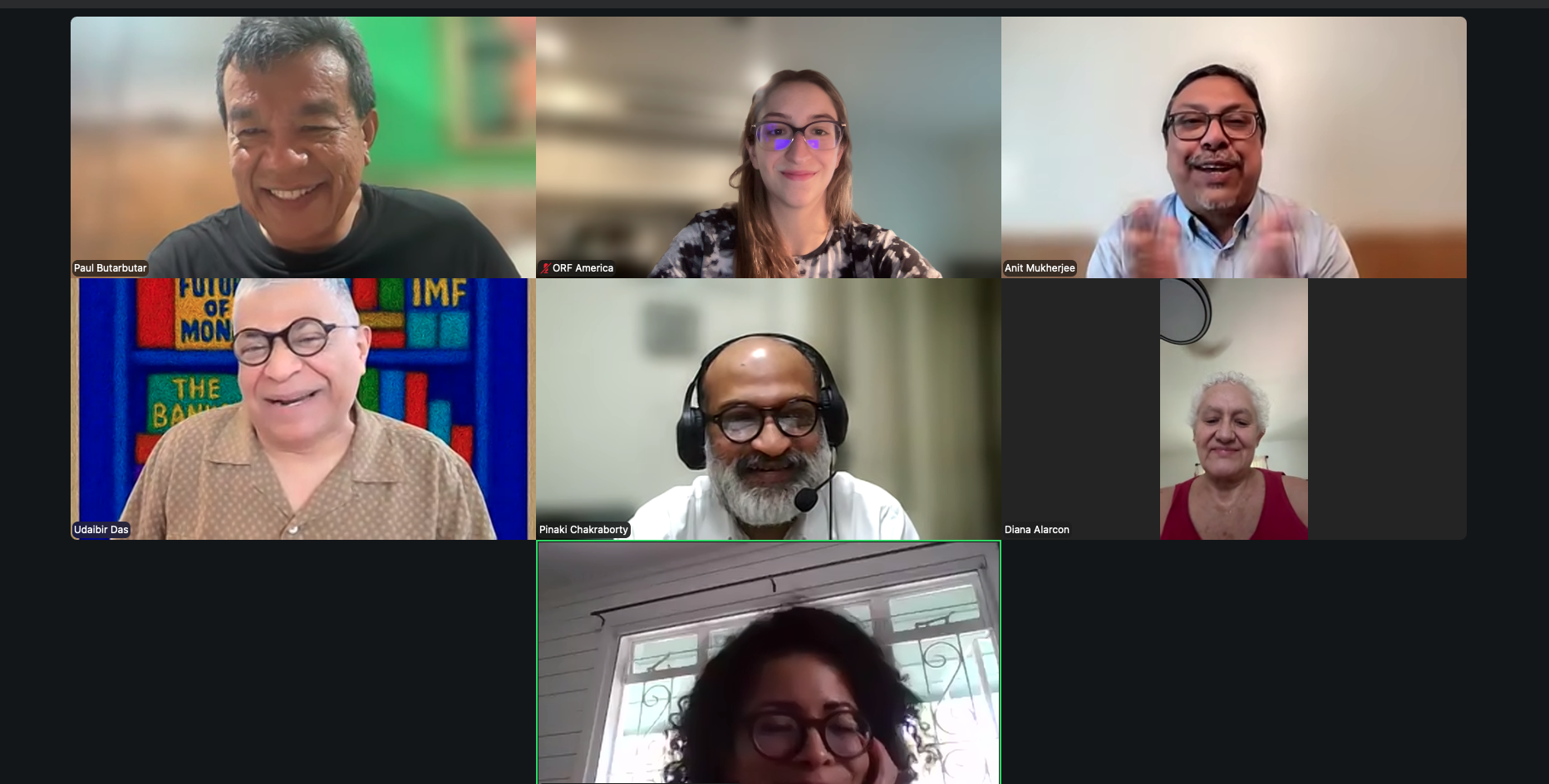
On September 18, ORF America convened the second virtual meeting of the Global South Expert Working Group to discuss resource mobilization, absorption, and deployment in the Global South. The discussion centered on ORF America’s forthcoming paper, Overcoming the Absorption Dilemma: The Need for Deployment Sustainability Analysis in an Era of Aid Contraction, presented by Udaibir Das.
The paper argues that mobilization and absorption should be treated as complements. While Debt Sustainability Analysis (DSA) assesses whether countries can carry and service debt on the mobilization side, there has not been an equivalent measure on absorptive capacity. The proposed Deployment Sustainability Analysis (DepSA) would examine whether mobilized capital is being converted into productive assets. DepSA was presented as a diagnostic profile rather than a rating, intended to inform financing design and technical assistance without automatically determining access to finance.
Participants emphasized that improving absorption requires more than conventional capacity-building programs. Country experiences highlighted the importance of political commitment, fiscal discipline, capable technical teams, stronger institutions, and better project preparation. Participants also discussed the need to connect project preparation more closely with financing and implementation, including by strengthening the link between bankability constraints, enabling policies, and available financial instruments. Several members stressed that practical capabilities are often built through implementation itself, rather than through stand-alone training programs.
The discussion also broadened the question of development finance beyond aid. Participants highlighted domestic resource mobilization, trade, taxation, procurement, fair pricing and contracting, and the management of natural-resource revenues as important parts of a future development framework. Experiences from Mexico and Indonesia illustrated how weaknesses in project preparation, institutional design, and the allocation of borrowed resources can limit development outcomes even where financing is available. The discussion also highlighted the importance of ensuring that revenues from finite natural resources contribute to long-term productive and social assets rather than being absorbed primarily by current expenditure.
The group further discussed the role of the private sector and domestic financial systems in translating available capital into productive investment. This included the need to strengthen local financial intermediation, improve project development, and create mechanisms that can attract longer-term institutional capital while allowing financial institutions to recycle their balance sheets into new investments. The discussion reinforced the broader argument that the challenge is not simply to mobilize more capital, but to strengthen the systems through which that capital reaches firms, infrastructure, and other productive uses.
Finally, South-South cooperation was highlighted as an important avenue for strengthening countries’ capacity to absorb and deploy resources. Rather than focusing only on transfers of finance, future cooperation could facilitate the exchange of practical experience in project development, public investment management, domestic financial systems, institutional reform, and technology adoption. These discussions will inform the next phase of ORF America’s work on new forms of development cooperation among countries of the Global South.
Speakers:
Opening Remarks: Dhruva Jaishankar, Executive Director, ORF America
Moderator: Anit Mukherjee, Senior Fellow, ORF America
Presentation: Udaibir Das, Distinguished Fellow, ORF America, and co-author of Overcoming the Absorption Dilemma: The Need for Deployment Sustainability Analysis in an Era of Aid Contraction
Working Group Members:
Diana Alarcon, Executive Director (EDS 18), The World Bank
Pepukaye Bardoille, Director, Bridgetown Initiative
Paul Butarbutar, Executive Director, Indonesia Center for Renewable Energy Studies
Pinaki Chakraborty, Visiting Distinguished Professor, National Institute of Public Finance and Policy, New Delhi
Rodrigo Salvado, Global Head, Strategic Financing Partnerships, HSBC