
The following piece originally appeared in The Post on July 13, 2026.
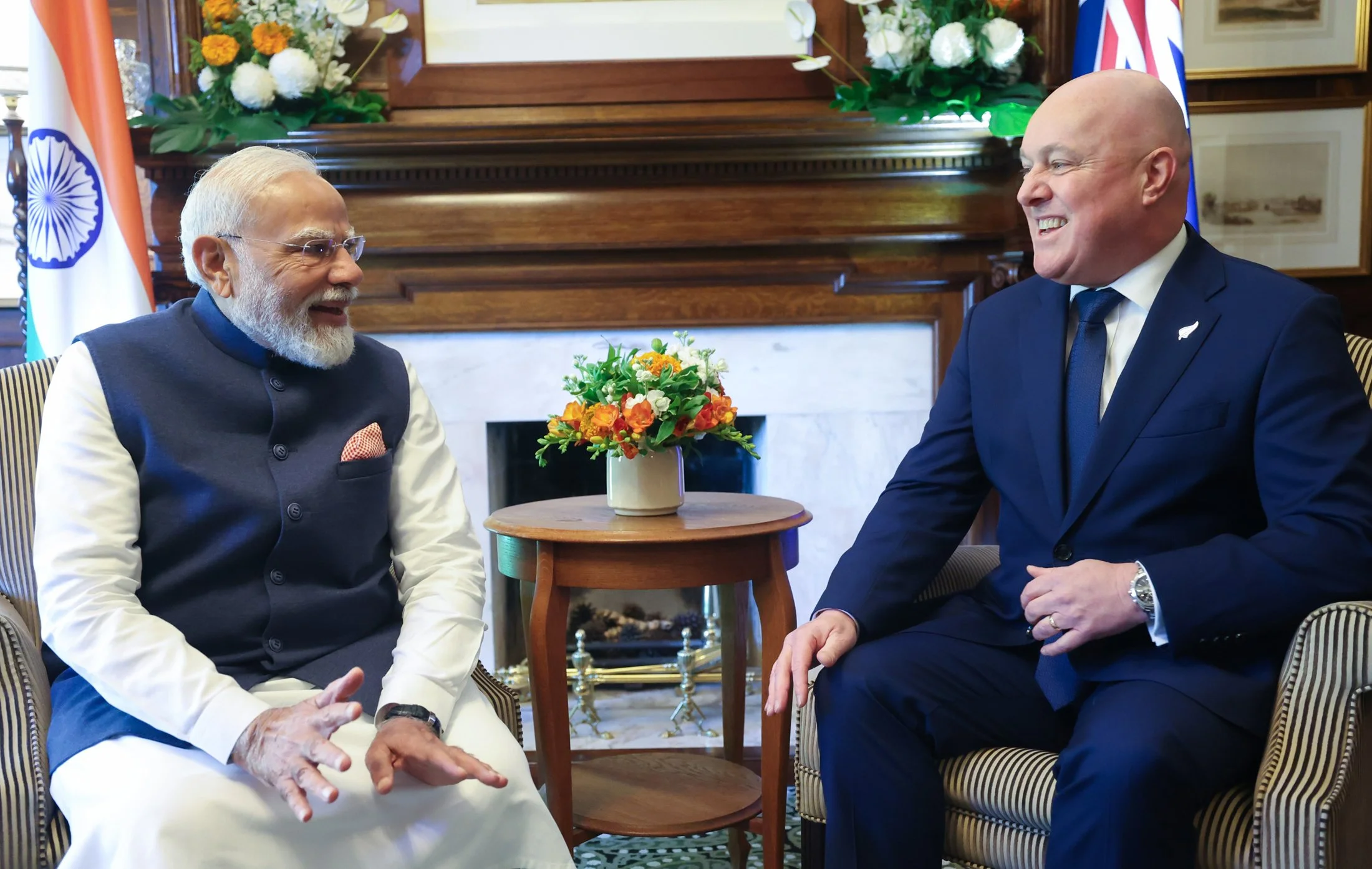
Narendra Modi’s visit to New Zealand this month marked the first by an Indian prime minister in four decades and comes at a time of rapid change in the India-New Zealand relationship. It built on a state visit by India’s President Droupadi Murmu to New Zealand in August 2024. And last March, New Zealand Prime Minister Christopher Luxon traveled to India, where he launched negotiations towards a free trade agreement and a mobility arrangement for skilled workers.
Although commercial ties were often deemed central to India-New Zealand relations, trade for many decades remained modest and marked by sharp differences over agricultural subsidies. Recent years have seen a small surge in bilateral trade, including an increase in dairy, agricultural, and forestry products being exported from New Zealand to India, and pharmaceuticals, petroleum products, and services contributing to growing Indian exports to New Zealand. The rapid conclusion of negotiations toward a free trade agreement (FTA) between the two countries earlier this year is indicative of the new seriousness with which the two governments are engaging each other. But important as it is, there remains considerable potential for cooperation that goes well beyond an FTA.
People-to-people ties increasingly lie at the heart of relations between New Delhi and Wellington. Indians are a large and fast-growing part of New Zealand’s population. Their numbers have almost doubled in less than a decade and include skilled migrants and students, particularly in the Auckland area. With about 300,000 people — almost 6% of New Zealand’s population — the number of Indian-origin and Indian-born people in New Zealand has surpassed the Chinese community in size. Growing people-to-people ties present greater opportunities for collaboration — particularly in services, finance, education, and creative industries — but will also require a better cultural and political understanding of India and New Zealand in each other’s countries. Structured partnerships between educational institutions offer the potential for research, as in health, that can benefit both countries.
Recent geopolitical, economic, and technological developments have revealed further areas of potential cooperation between the countries ranging from energy and technology to strategic cooperation. The need for bilateral energy cooperation, for example, has been underscored by the Iran War and closure of the Strait of Hormuz. India is a major refiner and exporter of petroleum products and New Zealand’s import vulnerabilities will necessitate further diversification. Cooperation on emerging technologies and their applications would benefit from complementarities between New Zealand’s highly-developed economy and Indian technical talent. Similarly, there are strong prospects for clean energy technology collaboration that leverages New Zealand’s priorities on emissions and India’s growing renewable energy deployment.
While geography and other factors must be considered, there is also greater potential for strategic cooperation between New Delhi and Wellington. Collaboration between the two countries on maritime domain awareness and cyber security is already underway, along with some basic military engagement. But there is also scope for better alignment in the South Pacific, where New Zealand has important interests and where India has a growing footprint. Three editions of a Forum for India-Pacific Islands Cooperation (FIPIC) summit, involving the leaders of 14 Pacific Island countries, have been held, the last in May 2023 in Port Moresby. Even outside of Fiji, which is home to a sizeable ethnic Indian community, the Indian government has invested in development assistance initiatives in the South Pacific focused on education, health, disaster relief, solar energy, and infrastructure. Better alignment on what is an important region of the world gives the relationship a strategic logic that has often been found wanting.
Both New Zealand and India are confronting similar concerns about over-exposure to their traditional trade and security partners, necessitating diversification. A world in which freedom of navigation or energy supplies can be imperiled by the actions of others will require more international partnerships. A consolidation of relations between the governments of India and New Zealand makes eminent sense in this context. While an FTA is a welcome development, it remains just one step toward what can be a much more broad-based and mutually-beneficial partnership.
Dhruva Jaishankar is Executive Director of ORF America and a 2026 Senior Fellow with the Asia New Zealand Foundation.
Image: 213012. PM holds bilateral talks with the Prime Minister of New Zealand, Mr. Christopher Luxon at Auckland, in New Zealand on July 11, 2026. Courtesy of the Government of India Press Information Bureau, via pib.gov.in.