
Joint Report
Authors: Craig Kafura and Dhruva Jaishankar
The United States and India, the world’s two largest democracies, have sought to deepen their relationship over the past two and a half decades during both Republican and Democratic administrations. However, there are still significant points of friction between Washington and New Delhi. Under the second Trump administration, trade and tariff issues, differences over Pakistan and Russia, and changing U.S. immigration policies have posed significant challenges to bilateral ties.
The 2026 Chicago Council Survey, fielded July 10-21, 2026, finds that Americans’ overall views of India are improving after a sharp decline in the past three years. Yet opinions are also more politically polarized than in the past, with Democrats and Independents expressing more positive views of India than Republicans, while being more supportive of high-skilled immigration from India and reducing tariffs on Indian goods. Republicans are more supportive than Democrats of joint military cooperation.
Key Findings
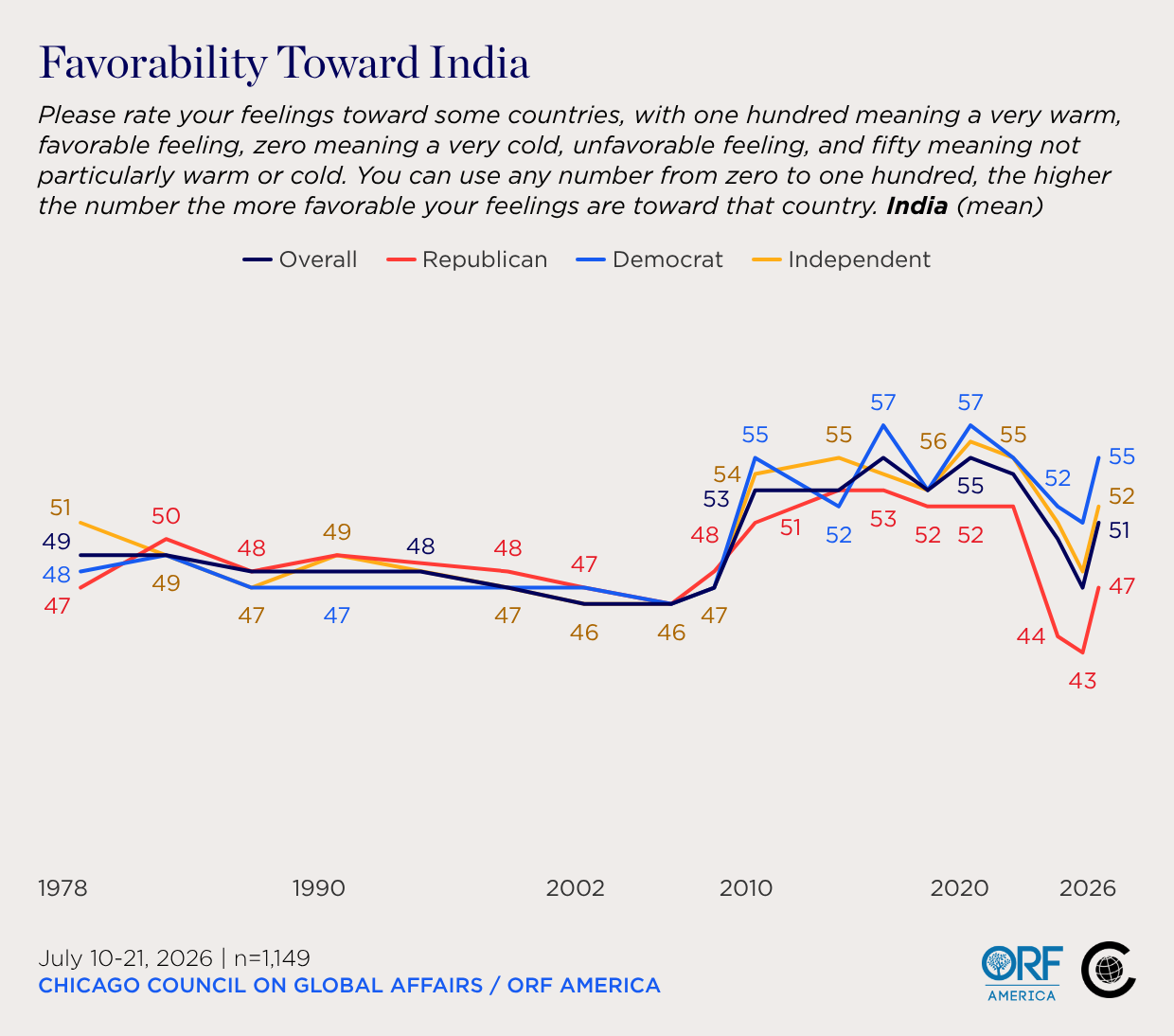
On the Council’s 0-100 feeling thermometer, where 100 is the warmest possible reading, Americans rate India an average of 51, up from 47 in October 2025.
Americans tend to view India as an ally (10 percent) or a necessary partner for the United States (41 percent), though many (37 percent) say they do not know how to characterize the U.S.-India relationship.
Views of India are more partisan than in the past, with Democrats (55) and Independents (52) rating India more warmly than Republicans (47).
In general, Americans are more likely to support than oppose policies that would increase U.S.-India trade (48 percent), boost technological (38 percent) and military (35 percent) cooperation, and allow for high-skilled immigration from India (36 percent), though many respond that they do not know enough to say.
I. American Views of India See Slight Rebound
Today, on a zero to 100 scale where zero represents a very negative feeling and 100 a very positive feeling, Americans rate India an average of 51, up from a relative low of 47 in October 2025. That rating was the lowest recorded in Chicago Council polling since 2008, prior to a significant and otherwise lasting improvement in American views of India. This decline in views of India is particularly concentrated among younger Americans. Those aged 18-29 rate India an average of 47, down from an average of 55 in 2022. Older Americans — those over 60 — are more likely to view India warmly, rating India an average of 54 (similar to their 2022 rating of 55).
The decline in U.S. public favorability toward India in the last three years was consistent with other recent surveys of American attitudes to India. The Pew Research Center’s 2026 Global Attitudes Survey found half of Americans hold an unfavorable view of India (50 percent, 45 percent favorable), down from 51 percent favorable in 2023. Gallup polling also found a decline over a similar period (61 percent favorable, down from 77 percent in 2022). Meanwhile, in India, public attitudes toward the United States have also declined in the last year. This year’s Pew survey indicated only 45 percent of Indians had a favorable view of the United States, down from 54 percent in 2025.
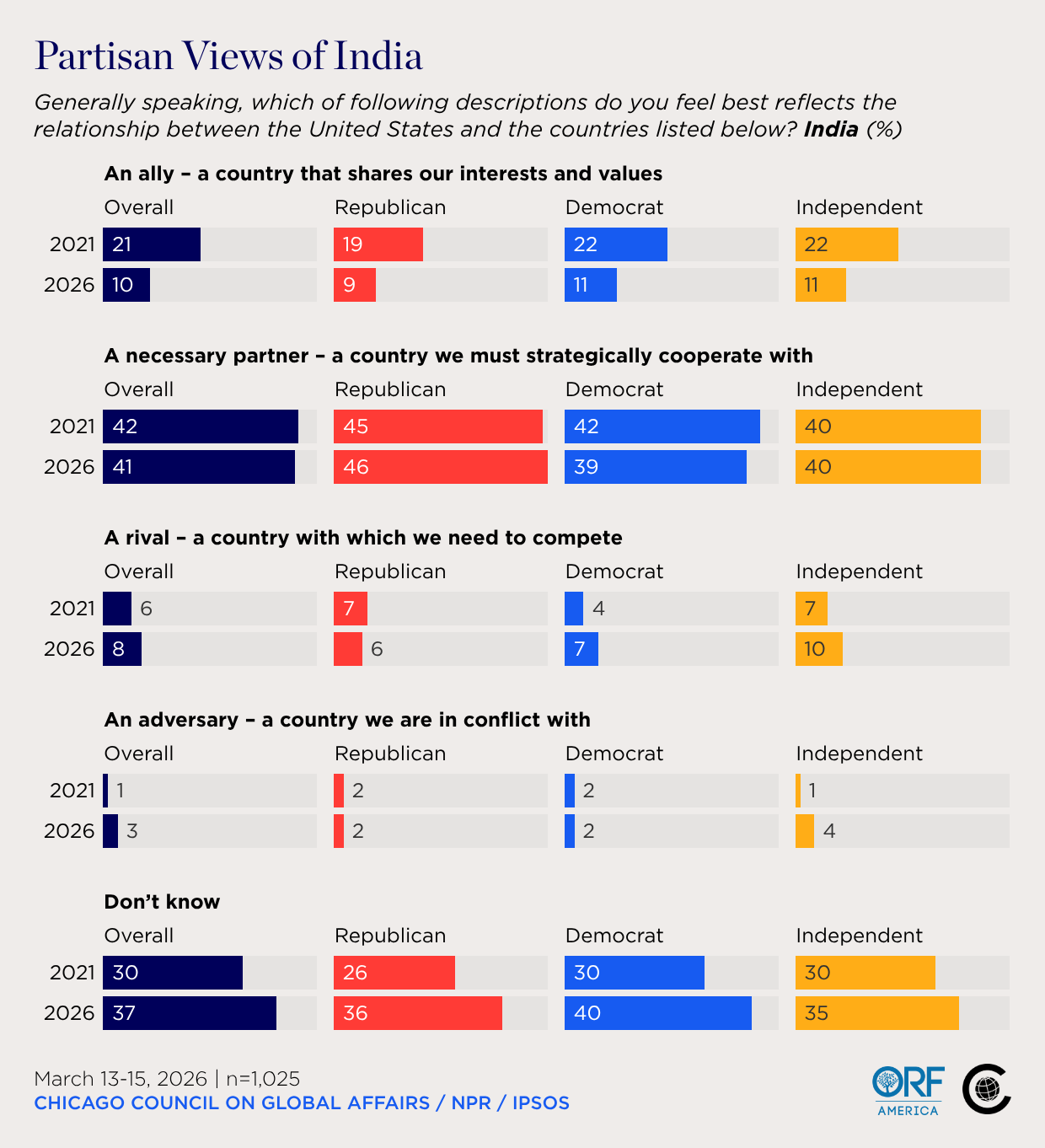
Overall, Americans tend to view India as an ally (10 percent) or a necessary partner for the United States (41 percent) rather than a rival with which the United States needs to compete (8 percent) or an adversary (3 percent), though a significant portion (37 percent) say they do not know how to characterize the U.S.-India relationship. However, Americans are less likely now than in 2021 to view India as an ally (10 percent, down from 21 percent).
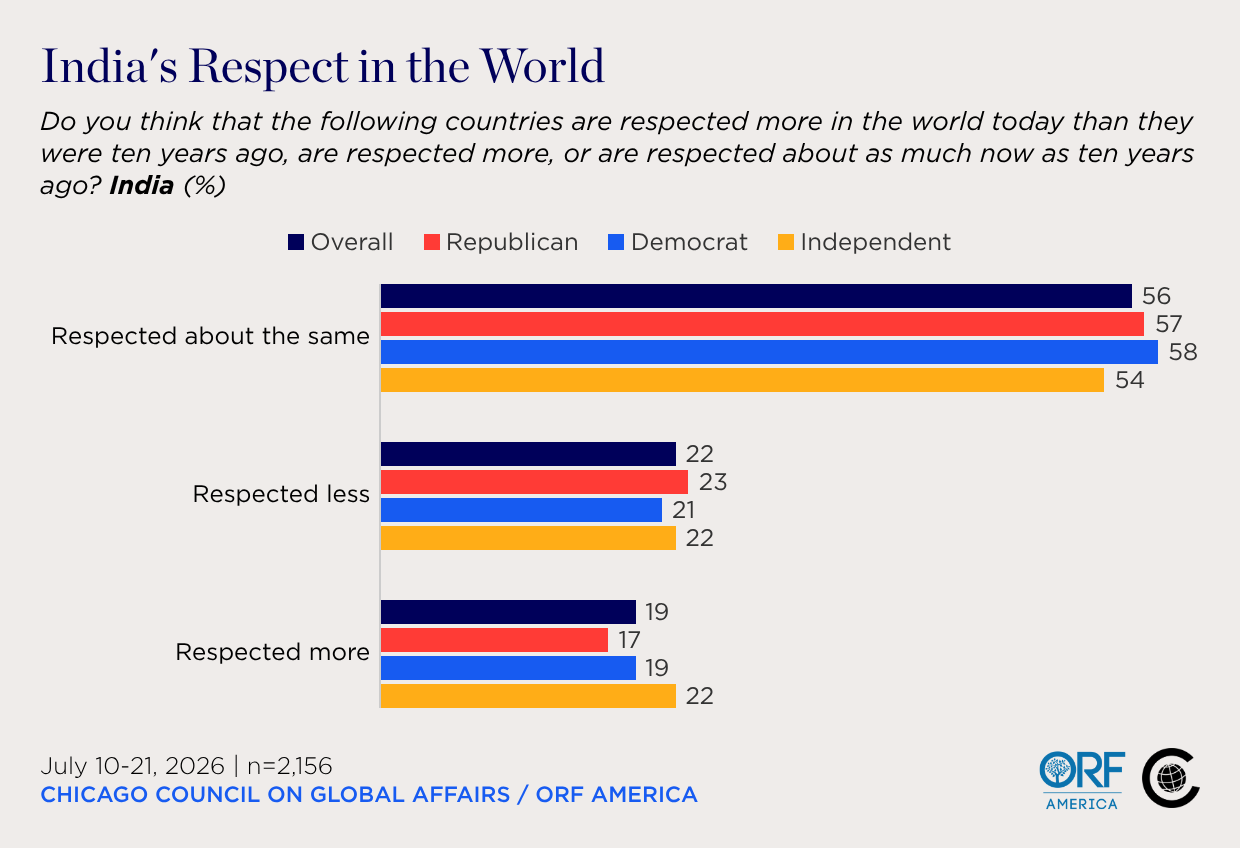
A majority of Americans also believe India is as respected now as it was a decade ago. Around two in 10 say India is respected less (22 percent), and a similar proportion (19 percent) say it is respected more now than it was 10 years ago.
II. Growing Partisan Divides
Americans’ general feelings toward India have become more differentiated by partisanship in recent years. Over the past decade, Democrats have generally been more favorably inclined toward India than Republicans, a gap that is larger today than in the past. It has also notably expanded since 2022, when Democrats (55), Independents (55), and Republicans (52) all rated India above the midline of the feeling thermometer. Today, Democrats’ feelings remain slightly warm (55), as do Independents (52)—but Republicans remain on the cooler side of the ledger (47). This is slightly up from an all-time low of 43 in 2025.
However, the views of India as an ally, partner, rival, or adversary are broadly shared across partisan lines, with little difference in how Republicans, Democrats, and Independents view the U.S.-India relationship. On views of India as an ally, Democrats and Independents have declined 11 points since 2021 (from 22 percent to 11 percent today) and Republicans have declined 10 points (from 19 percent to 9 percent today). However, views of India as a necessary partner have remained stable.
III. Americans Tend to Support Greater U.S.-India Cooperation
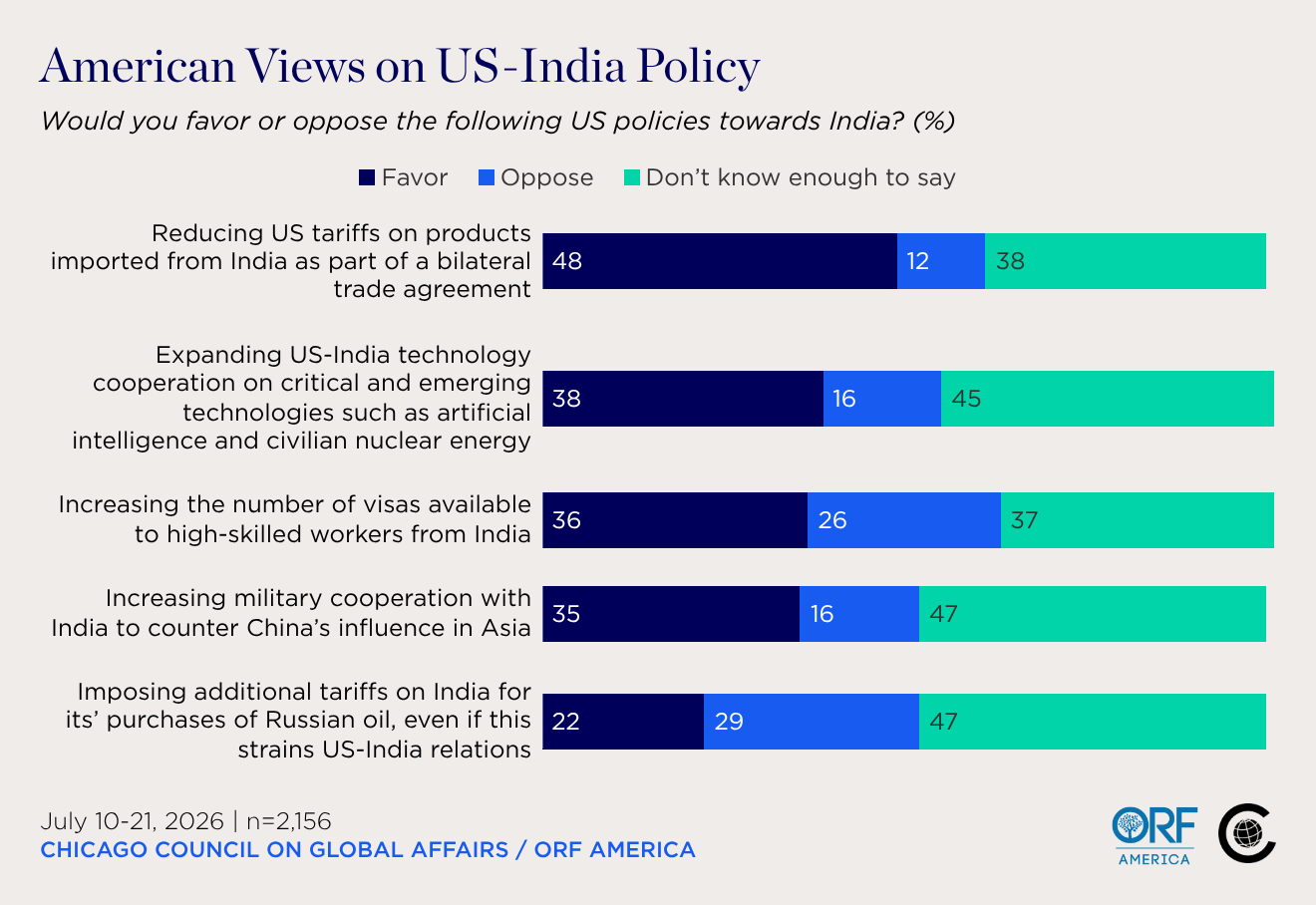
When asked about a variety of U.S.-India policy issues, a plurality of Americans tend to say they do not know enough to say. There is one exception to this pattern: a plurality of Americans (48 percent) favor reducing U.S. tariffs on imports from India as part of a bilateral trade agreement, while four in 10 (38 percent) do not know enough to say and 12 percent oppose doing so.
Among those Americans who offer an opinion on U.S.-India policies, most express more support than opposition. For example, at least twice as many Americans favor (38 percent) rather than oppose (16 percent) expanding U.S.-India technological cooperation. Similarly, more favor (35 percent) than oppose (16 percent) increasing U.S.-India military cooperation to counter China’s influence in Asia. Americans are also more likely to favor (36 percent) than oppose (26 percent) increasing the number of visas available to high-skilled Indian workers. Finally, Americans are more likely to oppose (29 percent) than favor (22 percent) imposing additional tariffs on India for its purchases of Russian oil even if this strains U.S.-India relations (47 percent do not know enough to say).
Democrats (58 percent) are significantly more likely to favor reducing U.S. tariffs on imports from India than Independents (49 percent) or Republicans (37 percent), though all partisan groups are more likely to favor than oppose reducing tariffs. Similarly, Democrats (43 percent) and Independents (40 percent) are more supportive of expanded U.S.-India technology cooperation than Republicans (31 percent), though this too is net-positive across the political spectrum. And while Republicans are more supportive of increased U.S.-India military cooperation (40 percent, vs. 35 percent of Independents and 31 percent of Democrats), this is a third policy that is net-positive among all partisan groups.
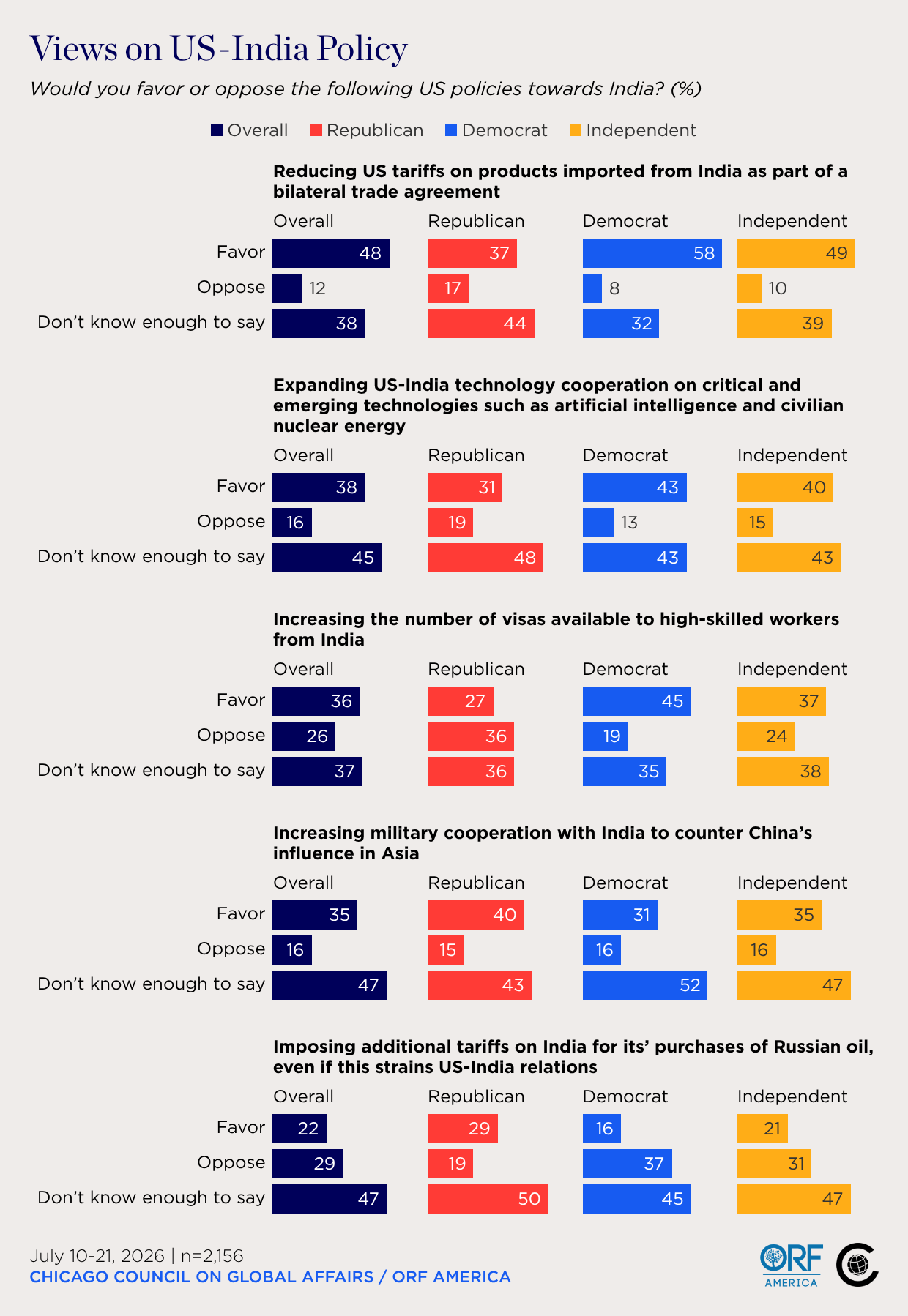
Two policies break this trend of general partisan alignment. Democrats at 45 percent and Independents at 37 percent are more supportive of increasing the number of visas available to high-skilled workers from India, while Republicans tend to oppose doing so (36 percent oppose, 27 percent favor). And Republicans are more likely to favor (29 percent) than oppose (19 percent) imposing additional tariffs on India for purchasing Russian oil, while Democrats and Independents tend to oppose doing so (37 percent and 31 percent, respectively). Republicans’ greater support for tariffs in this instance matches their generally higher evaluations of tariffs as a tool for U.S. foreign policy, as the Council’s 2026 survey research has found.
Methodology
This analysis by the Chicago Council on Global Affairs and the Observer Research Foundation America (ORF America) is based on data from the 2026 Chicago Council Survey of the American public on foreign policy, a project of the Lester Crown Center on US Foreign Policy.
The 2026 Chicago Council Survey was conducted July 10-21, 2026, by Ipsos using its large-scale, nationwide, online research panel (KnowledgePanel) in English and Spanish among a weighted national sample of 2,156 adults 18 or older living in all 50 U.S. states and the District of Columbia. The margin of sampling error for the full sample is ±2.2 percentage points, including a design effect of 1.04.
The data were weighted to adjust for gender by age, race and ethnicity, education, census region by metropolitan status, household income, and language dominance. The demographic benchmarks came from the 2025 March supplement of the U.S. Census Bureau’s Current Population Survey (CPS). Additionally, language dominance benchmark was obtained from the 2024 American Community Survey (ACS).
Gender (Male, Female) by Age (18–29, 30–44, 45-59, and 60+)
Race/Hispanic Ethnicity (White Non-Hispanic, Black Non-Hispanic, Other Non-Hispanic, Hispanic, 2+ Races Non-Hispanic)
Education (Less than High School, High School, Some College, Bachelor’s degree or higher)
Census Region (Northeast, Midwest, South, West) by Metropolitan status (Metro, non-Metro)
Household Income (Under $25,000, $25,000-$49,999, $50,000-$74,999, $75,000-$99,999, $100,000-$149,999, $150,000+)
Language Dominance (English Dominant Hispanic, Bilingual Hispanic, Spanish Dominant Hispanic, Non-Hispanic)
Partisan identification is based on how respondents answered a standard partisan self-identification question: “Generally speaking, do you think of yourself as a Republican, a Democrat, an Independent, or what?”
The 2026 Chicago Council Survey is made possible by the generous support of the Crown family, the Dr. Scholl Foundation, and the Observer Research Foundation America.
For More Information
If you would like more details on the data in this report, please contact the authors:
Craig Kafura | ckafura@globalaffairs.org
Dhruva Jaishankar | djaishankar@orfamerica.org
About the Chicago Council on Global Affairs
The Chicago Council on Global Affairs is an independent, nonpartisan membership organization that provides insight—and influences the public discourse—on critical global issues. We convene leading global voices, conduct independent research, and engage the public to explore ideas that will shape our global future. The Council is committed to bringing clarity and offering solutions to issues that transcend borders and transform how people, business, and governments engage the world. Learn more at globalaffairs.org.
About the Lester Crown Center on US Foreign Policy
Established in 2018 with a transformative gift from the Crown Family, the Lester Crown Center on US Foreign Policy is driven by the belief that the public plays a critical role in determining the direction of U.S. foreign policy and that an informed and engaged public is critical for effective policymaking. The centerpiece of the Lester Crown Center is its annual survey of American public opinion and U.S. foreign policy, the Chicago Council Survey, which has been conducted since 1974.
About the Observer Research Foundation America
The Observer Research Foundation America (ORF America) is an independent, non-partisan, and nonprofit organization in Washington DC dedicated to addressing policy challenges facing the United States, India, and their partners in a rapidly changing world. ORF America produces research, curates diverse and inclusive platforms, and develops networks for cooperation between the developed and developing worlds based on common values and shared interests. Its areas of focus are international affairs and security, technology policy, energy and climate, and economic development. Established in 2020, ORF America is an overseas affiliate of the Observer Research Foundation (ORF), India’s premier non-government think tank.
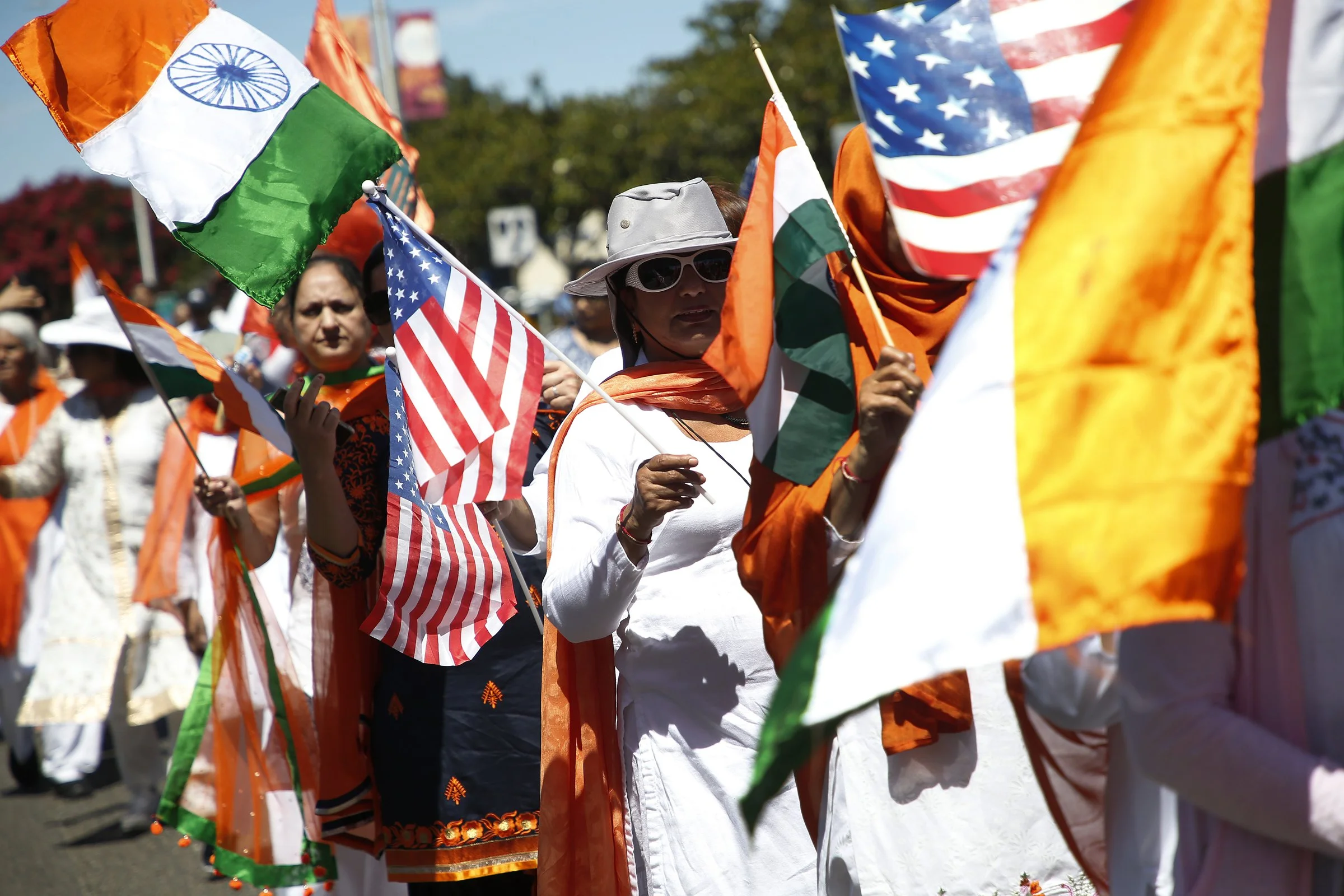
Cover image courtesy of Getty Images contributor MediaNews Group/Bay Area News.
Note: Citations and references can be found in the PDF version of this paper available here.