
The following piece originally appeared in the Asia New Zealand Foundation’s Asia in Focus - Explainer on February 15, 2026.
The conclusion in December 2025 of an India-New Zealand free trade agreement is part of a new trend in India's approach to international trade. Since 2021, India has concluded at least eight trade agreements after concluding none over the previous decade. There are important reasons for this sudden turnaround related to India's trade policy, which are tied to its overall economic prospects, desire for market access, the breakdown of multilateral negotiations, and concerns about supply chain security.
India has a reputation for being a protectionist economy. This is true insofar as India has among the highest tariffs on goods imports of any major economy under most favored nation (MFN). But as a consumer- and services-driven economy, India has also been among the largest net goods importers, after the United States and United Kingdom.
Foreign manufacturers enjoy large market shares in several sectors, whether Japanese auto companies or Korean electronics manufacturers, and India's relatively high tariffs overshadow a greater openness to foreign businesses along many other indicators relative to other developing and even developed economies. Nonetheless, India's attempts at concluding free trade agreements between 2002 and 2015 met with disappointing results.
Talks with the European Union stalled in 2013. Agreements with Japan, South Korea, and the Association of Southeast Asian Nations (ASEAN) were negotiated and concluded between 2009 and 2014 but had only a limited impact on bilateral trade or India's exports. Indeed, these experiences diminished the public and business appetite in India for trade agreements.
A set of inflection points occurred after 2019, when India withdrew from Regional Comprehensive Economic Partnership (RCEP) negotiations. Contrary to much commentary at the time, India’s withdrawal was primarily driven by concerns about lax rules of origin and Chinese overcapacity. This was followed by the Covid-19 pandemic, which exposed supply chain vulnerabilities in health and other sectors, as well as clashes between India and China and, shortly after, the Russian invasion of Ukraine. Together, these events compelled India to take concrete steps towards an industrial and manufacturing policy, which included offering large subsidies in key sectors and embarking upon steps to facilitate investment and seek better market access for its exports.
Consequently, after 2021, India concluded trade agreements with Mauritius, the United Arab Emirates, Australia, the European Free Trade Association (EFTA, consisting of Norway, Switzerland, Iceland, and Liechtenstein), Oman, the United Kingdom, New Zealand, and now the European Union. Last week, US President Donald Trump announced a trade agreement with India, slashing US tariffs on Indian imports to 18 percent. The common thread for many of these new commercial partners is that they are deemed “complementary”, being developing economies that do not compete directly with India on wages and employment.
For both India and New Zealand, their trade agreement represents, more than anything else, a risk mitigation strategy. Concerned about over-dependence on China and the United States as both producers and consumers — and the failure of multilateral trade negotiations at the World Trade Organization (WTO) — New Delhi and Wellington have opted to bet on each other and bring a modicum of certainty to an uncertain world.
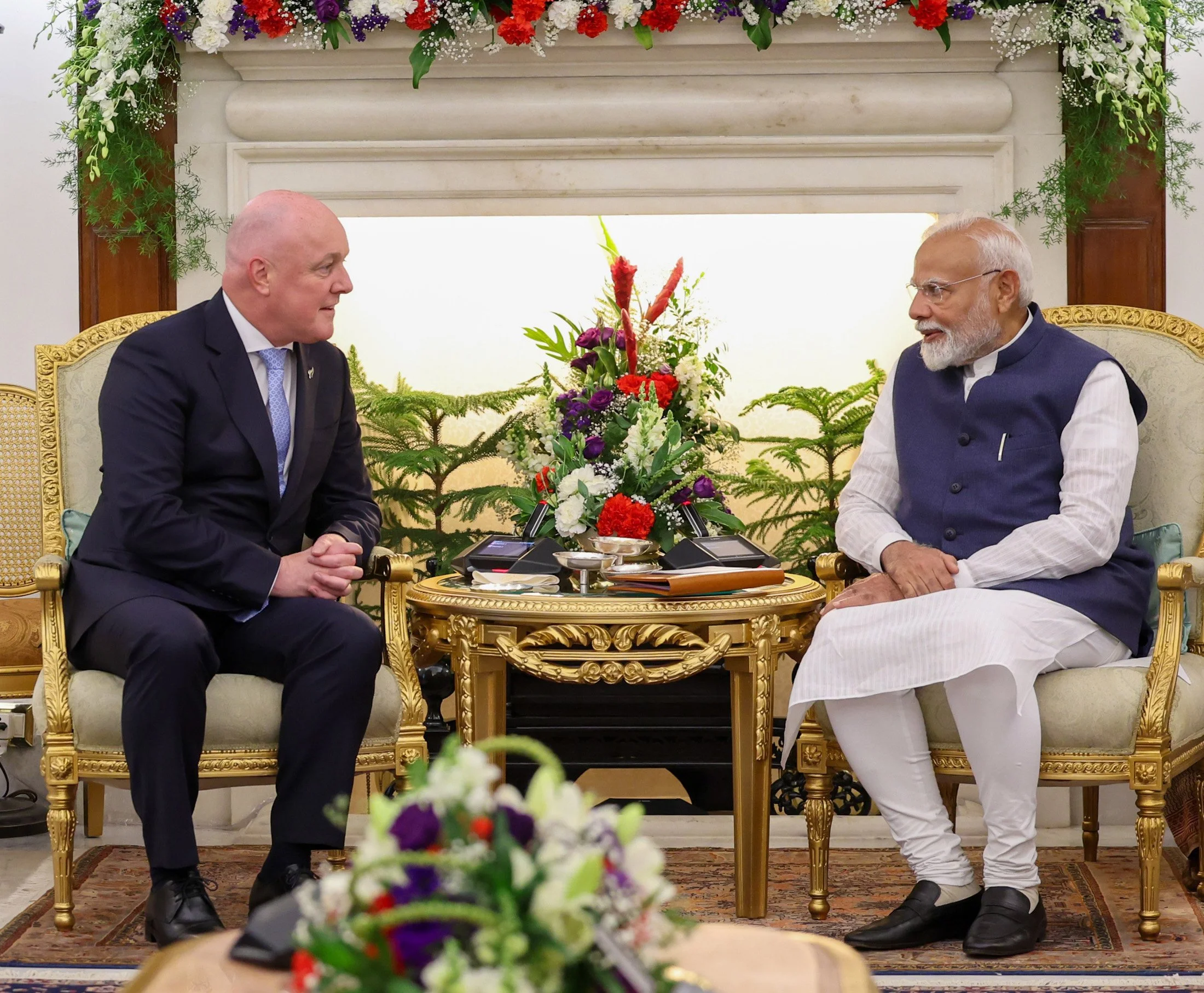
Image: 180469. PM meets the Prime Minister of New Zealand, Mr. Christopher Luxon at Hyderabad House, in New Delhi on March 17, 2025. Courtesy of the Government of India Press Information Bureau, via pib.gov.in.