
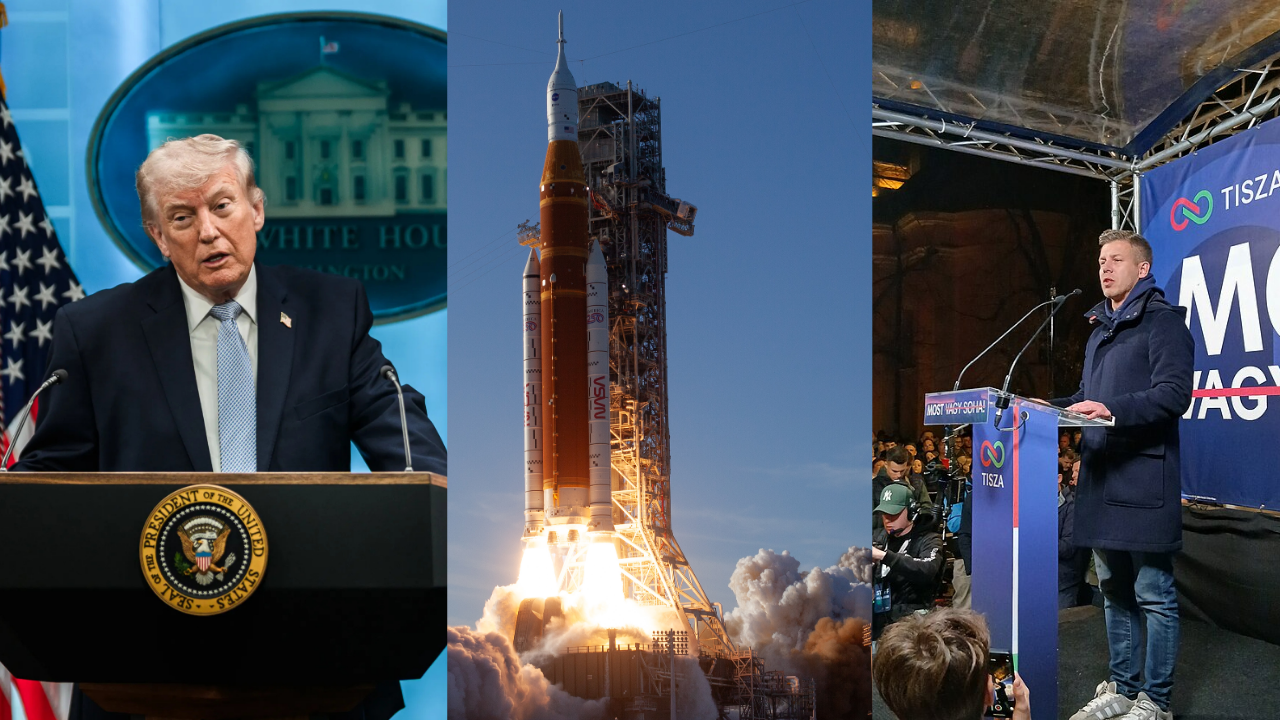
April 10, 2026 — In this week’s episode of Around the World, hosts Dhruva Jaishankar and Rachel Rizzo break down a last-minute ceasefire between the United States and Iran, exploring what drove the sudden de-escalation and what to watch as negotiations unfold. They then turn to the recent launch of the Artemis II mission and the broader revival of the global space race, before wrapping up with a preview of Hungary’s upcoming elections and what they could signal for European politics.
Available on Spotify and Apple Podcasts.
Image: The White House, Public Domain, via WhiteHouse.gov
Image: NHQ202604010263. Artemis II Launch, via NASA
Image: Goty98, CC0, via Wikimedia Commons
.jpg)
sneak peak
Dhruva Jaishankar: On this week's episode.
Rachel Rizzo: Trump's tweets that he had made on Truth Social, first on Easter Sunday talking about these guys have to open the effing straight, and then basically saying an entire civilization will die tonight if Iran doesn't come to the table and so he really set himself up I think for a moment that either would result in a massive show of military might or some sort of climb down. But the reality, I think, right now is that this is tenuous at best.
Dhruva Jaishankar: There is an Outer Space Treaty, which was negotiated in 1960s. 118 countries, I believe, are party to the treaty, including most of the major space players as well. And the key elements of that included no nuclear weapons in space, the peaceful uses of the moon and other celestial bodies. But there's actually quite a lot of room. even within the scope of that treaty for weaponization of space.
Rachel Rizzo: The story between Péter Magyar and Viktor Orbán is actually really interesting. They've been close since the early 90s, actually. And Péter Magyar was part of the Fidesz party and held important positions within the Orbán government. And he's ahead in the polls right now. And so I think it gives you a sense of maybe where Hungary has been heading.
welcome to around the world
Dhruva Jaishankar: Hello, I'm Dhruva Jaishankar.
Rachel Rizzo: And I'm Rachel Rizzo. Welcome to the Around the World podcast. Your essential guide to understanding the forces shaping our world today. We cut through the noise to bring you clear, insightful analysis of the most important developments in geopolitics.
Dhruva Jaishankar: Whether it's security challenges in Europe, great power competition in Asia, domestic politics in the United States, or regional developments in Latin America or the Middle East, we make sure you're up to speed on what's happening and more importantly, why it matters.
Rachel Rizzo: Thanks as always for tuning in. And be sure to like and subscribe to the Around the World podcast on Youtube, Spotify and Apple Podcasts. Onto the show.
what a ceasefire actually means
Rachel Rizzo: Hey, Druva.
Dhruva Jaishankar: Hi Rachel, how are you?
Rachel Rizzo: Good, good, lots going on this week. I was saying before we started recording that I just had my first encounter with a huge monkey on my terrace here in India, just jumped from the tree right in front of me. So that was super fun. First timer for that.
Dhruva Jaishankar: Yeah, always a first time. But a lot's been happening in the last couple of weeks, I guess. We've been a lot happening around the world. It's just been dizzying, including in the last 24 hours. So a lot to talk about this episode.
Rachel Rizzo: Yeah, some good, some bad, but lots to discuss. I think the first thing I think on the docket for us is obviously the very last minute Iran ceasefire.
Dhruva Jaishankar: Yes. So we are recording this on a Wednesday, morning U.S. time and evening India time. So about 12 hours ago, a little over 12 hours ago, which was the deadline imposed by Donald Trump for what he threatened was going to be some sort of major destruction of infrastructure in Iran. We get this announcement of a ceasefire in the Iran war. And we discussed this on an episode two weeks ago that a ceasefire might be forthcoming. There were some rumbles even then about the scope of that. There'd been an exchange between the US and Iran through an intermediary Pakistan in that evening two weeks ago. But it appears like we've had this sort of choreographed climb down that suits all sides for the moment. Trump this morning has said, that this shows peace through strength, essentially his threats seem to have worked. Iran, the regime survives and is already messaging domestically that they were successful, at least in, you know, again, bringing Trump to the negotiating table, including through the closure of the Strait of Hormuz and showcasing their resilience. And Pakistan plays up its role as a mediator, which has benefits domestically for the army and for the prime minister there. So what's your sense of how this is shaped up?
Rachel Rizzo: Yeah, I mean, it was interesting. I was talking to some folks from work last night at an event, and it seemed like Trump's tweets that he had made on Truth Social, first on Easter Sunday talking about these guys have to open the effing straight, and then just 24 or 48 hours after that basically saying an entire civilization will die tonight, you know if Iran doesn't come to the table. And so he he really set himself up I think for a moment that either would result in a massive show of military might or some sort of climb down. And I don't really know whether to read it as he was serious about this all the time. Maybe there was obviously diplomacy happening in the background. Or if this woke people up and got them scrambling at the very last minute. I'm sure it's a little bit of a mix of both. But the reality, I think, right now is that this is tenuous at best.
Dhruva Jaishankar: Mm-hmm.
Rachel Rizzo: And Iran has now pitched a 10 point plan, obviously extremely maximalist as these plans always are, but it's a working point that Trump says he can begin with in terms of discussing some sort of ⁓ negotiation. I think one of them is that Iran now, permanently controls the in and out of the Strait of Hormuz. And I wonder how that's gonna play with this administration, honestly.
Dhruva Jaishankar: Yeah, I mean, the terms of the 10 point plan, again, are pretty maximalist. They've asked for reparations. They've asked for pretty sweeping sanctions relief, a right to enrich uranium, the withdrawal of U.S. forces from the Middle East, and then this revenue sharing of shipping going through the Strait of Hormuz with Oman. Also, I wonder if this is also partly a bid also to sow dissent within the GCC as well, like, you know, if you can get Oman, which would benefit from this financially. And then one more thing is also no attacks on Iranian proxies, including presumably in Yemen and Lebanon. And, so that, I mean, that's going to be interesting because again, these are pretty maximalist terms. I think for the United States, the Strait of Hormuz issue is going to not go away for the Gulf Arab states, it's also not going to go away. I mean, they're now going to be dependent on Iran effectively for their exports of going forward. So I'm not sure like, you know, the UAE and Saudi Arabia and Qatar are going to be too happy with that arrangement. Israel certainly is not. In fact, this morning after the ceasefire announcement, there has been a bombing of southern targets in southern Lebanon by Israel so that hasn't ceased. So I think that again all of that suggests that this is a very tenuous peace for now.
Rachel Rizzo: Yeah, and so the initial ceasefire is for two weeks. And so I guess for us, we'll watch closely over the next couple of weeks at what sort of developments happen in terms of discussions through third party intermediaries between the United States and Iran. Again, that's a very interesting role, as you mentioned, for Pakistan. so we'll see how that develops. And I've mentioned this on a couple of other episodes, but I think it's worth repeating move forward, how the European’s move forward, I think, is going to be something to watch closely. You know, hopefully, the markets are reacting today. There is a rise in the stock market, and it seems like oil prices perhaps are or could be stabilizing. But again, the knock-on effects of this war, especially in energy costs, isn't something that just happens overnight. It happens over the course of weeks or even months. In some cases. So things might be fine now, but really depending on what happens in the next two or three weeks, that will indicate where we go this summer in terms of potential energy costs. And that's important, I think, for the Europeans to think closely. So we'll, again, watch it.
Dhruva Jaishankar: Yeah, I think so. Three other things I think to look out for one not coincidentally, I think yesterday the S &P 500 ended on a five day high, right? So was just the announcement came just before markets closed and or there was indications that it was going to be possible ceasefire. And so it does seem like the really high oil prices and stock market depreciation may have played a role in Trump's calculations. Secondly, it'll be interesting to see what effect, if any, this has on Israeli politics. They are up for general elections later this year, I think in October of this year. And already you've seen the opposition sort of take advantage of the ceasefire and criticize Netanyahu for saying you were not at the table when the Yair Lapid, the opposition leader, has kind of criticized Netanyahu saying, you you started this war. He's quite careful not to criticize the military or the people of Israel and their resilience, but he does criticize Netanyahu and says kind of basically this ceasefire is sort of the worst of all outcomes for you
Rachel Rizzo: Yeah.
Dhruva Jaishankar: and it was a political issue. I think the third thing I think would be to look at the actual negotiations that are underway. Pakistan again seems to have worked primarily through Steve Witkoff. And again, this is somebody who Iran previously had said sort of that's not somebody we want to as our primary negotiator. There are reports that JD Vance weighed in on this issue, but also China possibly, we had Pakistan's foreign minister go to China a little while ago. China may have also weighed in with the Iranians as well. So it'll be interesting to see sort of the composition of the negotiating teams from Iran and the United States in particular, who are the major interlocutors and whether again, they can reach a deal because again, as of now, and things have changed, the Israeli and I'm sorry, the US and Iranian negotiating positions seem pretty far apart,
Rachel Rizzo: Yeah, they're pretty far apart.
Dhruva Jaishankar: particularly on the issue of governing this trade. So all of those, I think, are amongst the things to watch out for, but there a lot of those uncertainties now at this point of time.
returning to the moon…and staying there?
Rachel Rizzo: And then, so I think with that, again, we have a couple of weeks of this ceasefire that we'll watch and then we'll come back and hopefully have good news, better news for everyone. Who knows? This is a live issue that doesn't seem to be going anywhere anytime soon. But there's also fun news this week. It doesn't really seem like we ever get to talk about fun news. But if you have been on social media, if you've been on NASA's Instagram account,
Dhruva Jaishankar: Mm-hmm.
Rachel Rizzo: you have definitely been inundated with the coolest pictures coming back from the Artemis II mission, which launched last week and really represents the next step in the U.S. sending a manned mission to the moon. I this is the first time that anyone has flown to or by the moon since the late 70s. They did... Yeah, I think it was, I think I read it today, was it 1979?
Dhruva Jaishankar: Early 70s, think. I think it was early 70s. Yeah, yeah, yeah, yeah..
Rachel Rizzo: Early 70s, 72, that's right, that's right. I'm getting my dates confused with the Iranian Revolution of 1979, which that's been what we've been reading about. So did a loop around, and then there's plans actually for Artemis IV to land on the moon in 2028. So that's gonna be maybe not coincidentally around the time of the next U.S. presidential election.
Dhruva Jaishankar: That's correct.
Rachel Rizzo: So, you know, I'm curious, like, how are you looking at this? Why do you think this has become so important in the past decade? Are there lower costs involved in space flight, space exploration now, new toys that we get to play with that make it more accessible? Like, what’re you, what's going on?
Dhruva Jaishankar: You know, in some ways we're in the midst or the early stages of a new space age, which is very exciting. And again, there are lot of reasons to be sort of positive and optimistic and inspired by what we're seeing. But again, this is a podcast about international relations. And so there's very much also a slightly more cynical reason for a lot of this, right?
Rachel Rizzo: Yeah.
Dhruva Jaishankar: In some ways, we're also in a new space race, akin to what we saw between the US and Soviet Union in the 50s, 60s and 70s. And part of it is, think, the reason for both of those things is that space has become more important and more affordable. And the last few years has seen just a radical change to this. So last year alone, almost 5,000 objects were launched into space. And that's all as many objects that were launched into space until 1997. So essentially about one fifth of all objects launched into space were launched just last year. And that just shows you the kind of almost exponential increase in countries' capabilities of launching objects into orbit. So I think again, it's happening for two main reasons. One is the cost has really come down. So the cost is about one fifth to one sixth per kilogram or per any kind of weight of what it was in the year 2000. So it's become more affordable. And secondly, satellites in particular have become much more useful and not just useful, integral to a lot of things in national security, but people's day-to-day lives. So communication satellites are the most important. We see this with like the power wielded in some ways by Elon Musk and his network of satellites are able to provide information to battle spaces and things like that. Earth observation has become very important and including for developing countries, For an agriculture tracking changes to climate and the environment. So things like that. Navigation is important GPS. We all use it, but it's becoming more precise and more important. And scientific research of various kinds in space. So a combination of those and other factors is really making space integral from a use perspective, but also, again, more it's becoming more affordable as well.
Rachel Rizzo: Yeah. And there's also a geopolitical aspect to this. I've just actually been writing about this a little bit. It mostly comes down, of course, to the U.S. and China. You know, last year, China conducted, I think it was 68 space launches, this was in 2024, which placed 260 payloads into orbit. And it has its Guowang constellation, which is this state-owned low-Earth orbit project, which currently has under 200 satellites in orbit. But the plan is to increase that number to 13,000 by the early 2030s. Now when you compare that to a company like Starlink or SpaceX, which runs Starlink, another constellation, it already has over 10,000 satellites in orbit. So it just goes to show that private companies are playing a major role in this too. But I'm curious, there are obviously, I just talked about the US and China, but there's more players here. Japan is one. India is a major player in the space race, the UAE, Taiwan. So what kind of launch and satellite capabilities do these specific countries possess?
Dhruva Jaishankar: Yeah, so I this is an example. You mentioned a few countries, Israel, the UAE, even Rwanda has a space agency now. So like you have like, I think about 50 countries or thereabouts that have now space programs of various kinds, Singapore, others as well. Again, for all the uses that I mentioned as well. That being said, the, you know, I think this is a tiered approach to this. The US and China now account for over 90% of launches and Russia still has a pretty capable sort of sizable capability as well. Beyond those, think it's basically Japan, India, and some of the European countries, including France, that have a sort of independent launch capability. So you have, again, still relatively few, you have a lot of space programs, relatively few that have a launch capability. And so those countries often have to cooperate with those, you know, so Singapore, for example, launches lot of its satellites through India, to just give one example. So again, there is a sort of two or three tiered, approach to space. Some others are trying to get into the game, like Australia, private companies are starting to launch out of Australia. But really, it's just a few. And then an even smaller group of countries have a human spaceflight capability, US, essentially US, Russia, and China. are now trying to sort of work with them through the Artemis Accords, which the US is championing. We have a Canadian astronaut on the current Artemis 2 mission, for example. So again, I think the geopolitics is also layered as well. The US and China have a pretty commanding lead in many, in most space technologies. Russia has some legacy capabilities. And then really, you know, Japan, India, Europe, and then a lot of other countries are now starting again the game in various ways.
Rachel Rizzo: OK. And we're kind of talking about the geopolitics of it and the exploration part of it, the satellite part of it. But there's also been more and more on the weaponization of space. In April of 2025, the US Space Force released its space warfighting framework, which basically and explicitly talks about offensive and defensive actions to help achieve space superiority. You have China's ground-based laser weapons that can't just disrupt satellite sensors, but it can physically threaten them. They have so-called dogfighter satellites capable of pushing or pulling other satellites out of orbit. Russia is developing an anti-satellite system with nuclear explosion to create weapons effects that could potentially threaten every satellite by every country and every private company in space. So the weaponization of it is also something that is being taken very seriously by national governments around the world.
Dhruva Jaishankar: Yeah, right. And this is partly a consequence of the undergovernance of space, right? So there is an Outer Space Treaty, which was negotiated in 1960s. 118 countries, I believe, are party to the treaty, including most of the major space players as well. And the key elements of that included no nuclear weapons in space, the peaceful uses of the moon and other celestial bodies. But there's actually quite a lot of room even within the scope of that treaty for weaponization of space. In 2007, China conducted an anti-satellite test, which showed, from the ground was able to blow up a satellite and others, the US and India have subsequently also done so in lower Earth orbit. And so in fact, we actually had, I think in 2023, the first military action in space, which was an Israeli arrow missile shooting down a Houthi missile coming out of Yemen. And it was the first, I think, essentially combat in space. Who would have thought it would have been with a non-state actor? But that shows you in some ways the creeping weaponization. And you mentioned many other steps that are underway that are indicating, again, the growing weaponization of space, both from ground-based systems, but also within space as well.
Rachel Rizzo: And then just kind of bringing it back to the Artemis II mission. Recently, the NASA administrator and the White House actually have been really emphasizing these plans to stay on the moon, colonize the moon. What's with the newfound interest in this? I mean, I think...That particular goal has been somewhat politicized just based on people's personal feelings about someone like Elon Musk, for example.
Dhruva Jaishankar: Mm-hmm.
Rachel Rizzo: Who's been a leader in this space. It seems as though the desire of space exploration has sort of to this, fallen victim to politicization and to personal feelings about private companies and private individuals. But there's something big about this. So what has the NASA administrator said and what is with the new found interest in specifically going back to the moon?
Dhruva Jaishankar: So, I mean, I think going back to the moon, I think it was part of a longer plan. It appears to eventually also get to Mars as well, get a human space, you know, space flight to Mars. But Jared Eisenman, who's a NASA administrator, somebody who previously was seen as very close to Elon Musk. In fact, that actually when there was a falling out between Trump and Musk, it actually jeopardized his confirmation as well. He had to be re-nominated. But he has said that the goal is to stay on the moon long term and build a moon base. And the White House has essentially reiterated that what's different about Artemis compared to Apollo in the 60s and 70s is that the United States is going to stay on the moon. Now speculation is that it may be in part motivated by intelligence on Chinese ambitions there, so this is not in some ways slightly maybe slightly reactive as well on the United States part, but it also appears to be motivated again about, driven by the temptation to exploit natural resources there including potentially critical minerals, so moon mining and other things. So this appears to be part of the calculus as to what may happen. There's some, again, speculation that by 2030 the goal is to establish some sort of permanent or semi-permanent presence on the moon.
Rachel Rizzo: All right. Well, again, we will be watching this closely into the 2030s and we will report on it here in the Around the World podcast.
Orbán v. Magyar: Hungarian Elections
Dhruva Jaishankar: Yeah, yeah, yeah. Yes, we will. But bringing it back to earth. Well, one more thing I know you. Yeah, bring back to also Europe and bring it to a very specific place in Europe and something that think you and I have both been tracking for a little while. We have elections coming up this weekend in Hungary. And Hungary is sort of a fascinating country for many reasons. I actually lived there for three years, I visited two months ago again. And it's in the midst of, it was even then in the midst of election season. Viktor Orbán is the long-serving prime minister of Hungary. He's been there in 16 years. He also had a previous stint in the 90s, a short stint as prime minister. I think he's the longest-serving leader in Europe. And he is now facing quite a lot of heat because the polls indicate that he's going to lose to his party is going to lose in the parliamentary elections to TISA, the main opposition party led by Péter Majar. So, you know, what's your sense of how things are going there?
Rachel Rizzo: Yeah, I mean, it's. I think it's sort of a bellwether for other major elections that are coming up in Europe over the coming year, specifically France in 2027. But you know, the Péter Magyar and Viktor Orbán clash kind of goes back a while because Magyar actually started as a member of the Fidesz party. He was one of Orbán's foreign ministers. I mean, he was part of, I think, think he was one of his foreign ministers.
Dhruva Jaishankar: He was in the foreign ministry, I don't know if he was a minister, but he was in... yeah.
Rachel Rizzo: What is with me today? I feel like there's like too much going on where my brain is getting ⁓ scrambled. OK, so let me just start that over. The story between Péter Magyar and Viktor Orbán is actually really interesting. They've been close since the early 90s, actually. And Péter Magyar was part of the Fidesz party and held important positions within the Orbán government, but then kind of started to speak out about corruption. There were a couple of things that happened within the country that led him to sort of break from Viktor Orbán. And now I think we are seeing a moment where he is running as himself a a center-right candidate as someone who can right the ship in Hungary's anti-democratic turn. He's running on a platform, you know, that is pro-EU, pro-NATO. It's pro-democracy. He wants to stamp out corruption. But again, you have, and he's ahead in the polls right now. And so I think it gives you a sense of maybe where Hungary has been heading. And you know, Viktor Orbán and his party are nervous enough where they had, you know, JD Vance come just a couple days ago and give a major speech on behalf of Viktor Orbán, obviously, who's a Trump loyalist and close to Trump and many folks that are in Trump's orbit. So I think it's gonna be interesting to see how exactly this plays out. It's been interesting to watch the platform that Orbán is running on as well.
Dhruva Jaishankar: Yeah so, it's interesting. Orbán kind of has been a bit of a outlier in European politics for some time, has kind of dissented within the EU, within NATO on many issues. But he's kind of had a sort of three pronged approach. I this is what he and his party keep on emphasizing. One is of family values. And so he's provided like tax incentives for marriage and children. And yet Hungary has one of the lowest birth rates in the world, possibly, and certainly in Europe. Right. So the second has been a sort of anti-immigration platform. And so he's emphasized like Christian values very overtly. In fact, Hungary pays a sort of 1 million euro tax every day, effectively, to the European Union, essentially to not take more immigrants. And in their view, this is like worth, this is is money well spent, right. And then the third sort of platform has been sort of again, strongly against funding Ukraine in the ongoing war with Russia. And so Hungary even participated as observer in Russian military exercises, Zapad military exercises last year. Orbán, I think, is the only EU and NATO leader to visit Russia since the war in Ukraine began. He's met Putin. And so this in some ways, Orbán, I mean, it's very visible, very overt. It's been a campaign against Brussels, right. And when I was in Budapest, like there are posters everywhere showing
Rachel Rizzo: Mm-hmm.
Dhruva Jaishankar: PéterMajer as sort of this puppet of Ursula von der Leyen and the Brussels establishment, right? And that he was putting money in the hands of Zelensky and things like that, right? So that's very much the direction that Orbán has taken. But it's also interesting that Hungary has not actually chosen to leave the European Union, right? It derives sufficient benefits. It does appear though that I think more than foreign policy, Marco Rubio visited a month or so ago, JD Vance was just there, did a sort of election rally type of thing for Orbán. Trump has endorsed Orbán. But it seems like this is really an election, like a lot of elections, that's indicated that that's being driven by domestic issues, right? It's the, hunger is not a Eurozone country. Inflation has been pretty high. Actually, because of, in some ways, because of the anti-immigration stance, it's been harder for others to invest there. I mean, and you can kind of see it, right? Poland and the Czech Republic have sort of in many ways pulled ahead economically from Hungary relative to two decades ago.
Rachel Rizzo: Yeah.
Dhruva Jaishankar: So it does seem like again, know, Péter Madras, campaigning on mostly on economic issues, less on sort of foreign policy. He will obviously be, I think, a bit more sympathetic to the EU and NATO. But again, he comes from Fidesz, right? So he's not like, is it? And he's right, Yeah.
Rachel Rizzo: Yeah, I mean, he's not like a, he's not a lefty by any means. He's tough on immigration, you know, talks about family and Christian values in the same way that many other folks in Fidesz do.
Dhruva Jaishankar: Yeah, yeah. So I mean, he's he's had some pretty strident anti-immigration sort of statements as well. So again, it'll be interesting to see this as a bellwether. Again, the Trump administration has thrown its weight clearly behind one camp.
Rachel Rizzo: Mm-hmm.
Dhruva Jaishankar: But again, there's often within the European Union, I mean, there was a remarkable statement last year, It was something related to Ukraine, and all EU members signed on and there was like a dissenting note from Hungary saying all countries except for Hungary sign on to it, right? So it is sort of remarkable how much it has been an outlier on some issues with Slovakia, but on many issues just Hungary by itself within the European Union.
Rachel Rizzo: Yeah. And if he wins, I think it's going to be interesting to see whether he can secure a two-thirds majority in Parliament or if he only gets a simple majority. With a simple majority, it's going to be a lot more difficult to push through the reforms on which he's been campaigning. And then he really has to decide how far he's willing to go, especially with Orbán loyalists still inside government institutions. He has to decide, does he want to purge those people? Does he not want to purge those people? So beyond him just winning, What he's able to secure in parliament is the other important factor in this entire puzzle.
Dhruva Jaishankar: So a lot going on, a lot to watch out for in the next few days. Again, the results of Hungarian elections, Artemis, I think splashdown will be possibly the day this is released or a day after. And again, what happens with the Iran ceasefire negotiations, all three big issues coming up in the next few days.
Rachel Rizzo: Yeah. Yeah, absolutely. We'll be here to talk about them. As always, be sure to like and subscribe to the Around the World podcast on Spotify, Apple Podcasts, and YouTube. Our episodes come out on Fridays, and we will see you all soon.