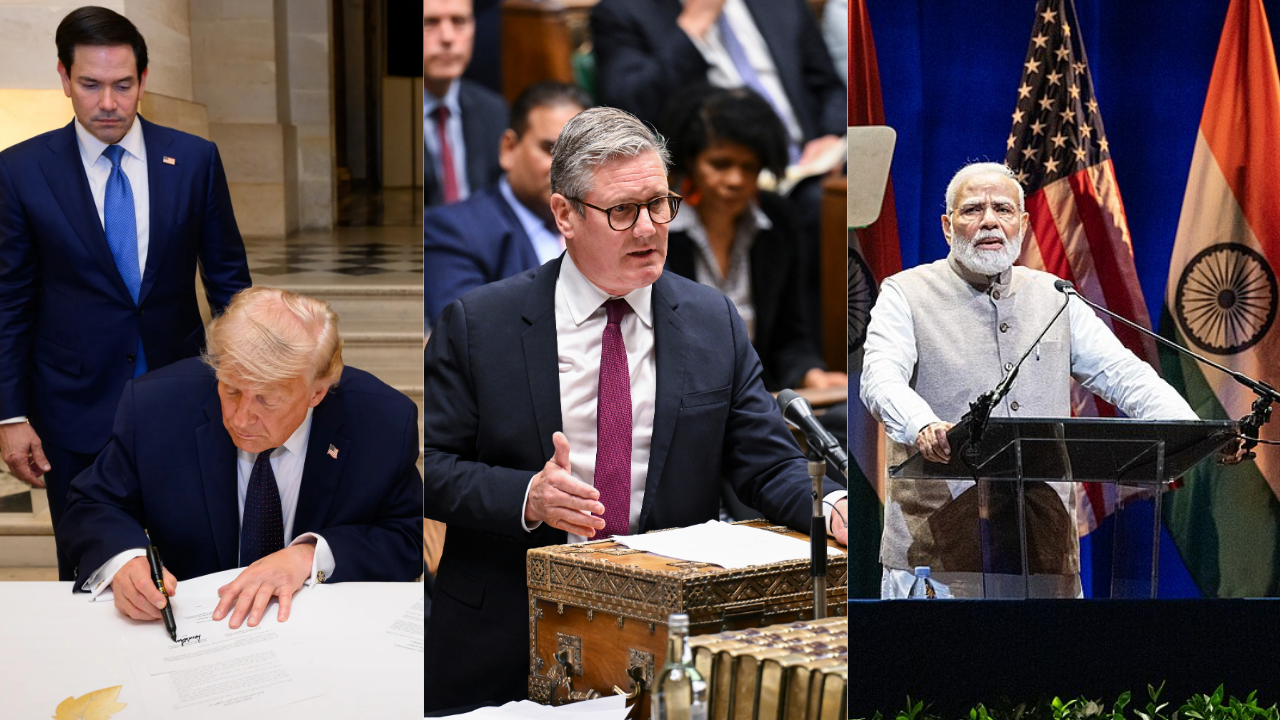
Image: Tasnim News Agency, CC BY 4.0, via Wikimedia Commons
Image: Myanmar Now News, CC BY 4.0, via Wikimedia Commons
Image: © European Union, 1998 – 2026, Attribution, via Wikimedia Commons
sneak peak
Rachel Rizzo: On this week's episode.
Dhruva Jaishankar: We have a lot of evidence to suggest that maybe a ceasefire is forthcoming and maybe we'll see that in the next few days on the other hand there's a lot of evidence that the war is not letting up at all.
Rachel Rizzo: She suffered a pretty serious setback with a referendum loss on judicial reform. Meloni has said is that this would sort of like "demafia" the judiciary and introduce an appointment by lottery system rather than election of their members.
Dhruva Jaishankar: Myanmar is important because it's really at that intersection, It borders China, it borders India, and it borders Southeast Asia. It's a member of ASEAN, the Association of Southeast Asian Nations. And so those are the three primary actors.
WELCOME TO AROUND THE WORLD
Dhruva Jaishankar: Hello, I'm Dhruva Jaishankar.
Rachel Rizzo: And I'm Rachel Rizzo. Welcome to the Around the World podcast. Your essential guide to understanding the forces shaping our world today. Every week, we cut through the noise to bring you clear, insightful analysis of the most important developments in geopolitics.
Dhruva Jaishankar: Whether it's security challenges in Europe, great power competition in Asia, domestic politics in the United States, or regional developments in Latin America or the Middle East, we make sure you're up to speed on what's happening and more importantly, why it matters.
Rachel Rizzo: Thanks for tuning in. And also be sure to like and subscribe to the Around the World podcast on Youtube, Spotify and Apple Podcasts. Onto the show.
A ceasefire in reach?
Rachel Rizzo: Hey, Druva.
Dhruva Jaishankar: Hi Rachel, good to see you.
Rachel Rizzo: Good to see you too, it's been a couple weeks.
Dhruva Jaishankar: Yeah, it's been a of weeks. A lot's been going on. Mostly, I think everyone's been preoccupied with the war in Iran, and that's certainly something we're going to discuss in the next few minutes. But also other things happening around the world. So I think we'll just touch on those as well. What's happening in Myanmar on the other side of India, and also in Europe as well, politics continues there. How does Iran, let’s start with Iran, how does Iran look from your vantage point?
Rachel Rizzo: Yeah, lots of stuff going on. Yeah. I mean, look, I feel like this war, from the get-go, it has been pretty incoherent and some might say, depending on where you sit or stand on this decision, also misguided, which means that the end result remains pretty convoluted and the messaging coming from the White House remains convoluted as well. There's mixed messaging in terms of whether or not negotiations are happening or whether they're not happening. There's discussions potentially about a 15-point plan that Iran says is maximalist and unacceptable. They've come back with a five-point plan. But amongst all of this, what continues to happen? The Strait of Hormuz remains effectively closed. Only 62 ships have traversed it in the month of March. Energy prices are continuing to skyrocket. There's instability in the market globally and other countries that are not directly involved in what's going on, Europe, India, certainly and beyond that are beginning to feel the effects of this ongoing instability. So it doesn't seem like it is ending anytime soon, but also the messaging again, as I said before, it is pretty mixed. What are you hearing your side of the aisle or your side of the ocean, I should say.
Dhruva Jaishankar: So again, there's a lot of confusion out there. think let's try and break it down as to what we know with reasonable certainty. So on Monday, we were recording this on a Thursday, it'll be coming out Friday. So a few days ago, three days ago, Donald Trump announced talks with Iran to bring it into the conflict before markets opened in the United States, not coincidentally. There was a lot of confusion around this announcement. Iran, as you said, initially denied that any talks had taken place, but the oil and stock markets responded very positively to this, right? And yet the Strait of Hormuz remained effectively closed. Now Iran is it may let non-hostile, whatever that means, pass through the right? So are talks underway or not? I think, again, a few things we know. The United States has been reaching out to intermediaries, mostly Turkey, Pakistan, and Egypt, to propose, amongst other things, this 15-point plan, which includes stipulations on sanctions relief, but also denuclearization and commitments that Iran might have to make. And Iran's military leaders, at least, have so far publicly resisted this, although they do seem to be back and forth with five-point plan that Iran seems to come up with. A few things, again, to note. One is Israel is clearly uncomfortable with all of this. They've been leaking to the press. So a lot of times the first time we're hearing about this is because the Israelis are putting it out there, seemingly because they are concerned. The other thing is the emergence of an interlocutor in Mohammed Baga Galibaf, who is the speaker of Iran's parliament may emerge as the lead interlocutor with the United States on the Iranian side. He was previously the mayor of Tehran. He has a military background. He was a pilot who fought in the Iraq-Iran War so he has credibility with the military establishment in Iran. But there's some speculation that he may be put up as a future leader. But there do seem to be differences within Iran. The military, particularly the IRGC, the Islamic Revolutionary Guard Corps, does not necessarily seem to be playing ball with this.
Rachel Rizzo: Yeah. But so are you saying that, are you suggesting rather, that there is enough instability in Iran where, you know, this sort of like uprising that has happened over the last few months and which we about on an episode, I think in January, I mean, could this go somewhere? Obviously, interim leaders or current leaders in Iran have said to parents, don't let your children, your kids go out in protest because we
shoot them. So it seems like they are squashing any sort of regime change discussions or possibilities of uprisings or democratic transitions in Iran.
Dhruva Jaishankar: Look, the honest answer is there's not a lot of information coming out of Iran, right?
Rachel Rizzo: Yeah.
Dhruva Jaishankar: Because there's been a media blackout, there's internet cutoffs, and sometimes just so there's not been, I mean, it's very hard and a lot of this is in the realm of speculation.
Rachel Rizzo: Mm-hmm.
Dhruva Jaishankar: In terms of, know, the initial political leadership was pretty decimated. And then figures that emerged like Ali Larijani was killed subsequently by an Israeli strike. He was sort of seen as one of the sort of old guard that had a lot of credibility at home.
Rachel Rizzo: Mm-hmm.
Dhruva Jaishankar: Today, just today, the Navy command killed by another strike.
Rachel Rizzo: Yep.
Dhruva Jaishankar:The president has survived. The foreign minister has survived. There is more about the new Khomeini's son has, but it has not been very visible. A lot of them are.
Rachel Rizzo: No, and some people say he might be injured or something.
Dhruva Jaishankar: There are rumors that he's in a coma, that he's been injured or somewhat injured. So the statements have come out, but he's not been very physically present. And again, some of it has to do with security. concerns, you know, Larijani appeared publicly two days before he was hit in the strike. So I think it's very unclear who the leadership is at this point of time. It may end up being a sort of rump leadership of the IRGC, which is more hardline, possibly. But again, someone, I think the feeling is Ghalibaf is somebody who might be willing to do a deal. He has the credibility, he's sort of seen technocratic, but has the military cred. So, you know, somebody who has engaged with Western leaders in the past. So again, there's still just way too much uncertainty about the regime in Iran, obviously they're trying to out a position themselves as still being strong and still being capable, but it's very hard to know.
Rachel Rizzo: Yeah, and so there's no sense amongst whatever stated Iranian leadership is currently in place that they're ready for a deal or looking for a deal because they are clearly fighting. They are, they've been caught on their back foot. They're not looking to kind of sit back and allow the Trump administration or other Western countries to be able to claim a win here. So it seems like there's still, it doesn't seem like it's gonna wind down anytime soon, unless you are seeing something different.
Dhruva Jaishankar: No, mean, see, the other way of looking at it is if they were to reach a ceasefire agreement now or soon after this, would actually, Iran would come out looking pretty good. And that's not necessarily the case a few weeks from now. So at this point, the narrative would be, I mean, Trump would, of course, sell this as a win. He, he decapitated
Rachel Rizzo: Sure
Dhruva Jaishankar: He, he decapitated
leadership. He, you know, managed to or degrade their missile program. That's how it'll be portrayed in the United States. But in Iran, it would be, well, we resisted, you know, everything was thrown at us and we
and we survived. Right.
Rachel Rizzo: Yep. Yeah, that's a good point.
Dhruva Jaishankar: And we cut off the Strait of Hormuz and the world, brought the world to its knees, right? So I think from their point of view, it is appealing to maybe reach a ceasefire soon.
Rachel Rizzo: Mm-hmm
Dhruva Jaishankar: I think there appear to be some divisions because there are mixed messages coming out of Iran. There are different interlocutors there. There's one channel, actually I want to talk about this quickly, which is through Pakistan.
Rachel Rizzo: Yeah, yeah.
Dhruva Jaishankar: Pakistan is pushing itself as an intermediary, was the one that seems to have sent the 15-point plan from the United States to Pakistan to Iran has proposed a meeting in Islamabad. Interestingly, the Iranians do seem to have been clear that they don't want to negotiate with Steve Witkoff and Jared Kushner. They want possibly bringing JD Vance into the picture as a negotiator, because that was who was negotiating with them before the war started in Oman, broken through Oman.
Rachel Rizzo: Mm-hmm, yeah.
Dhruva Jaishankar: So anyway, that's one way. But that doesn't seem to be the only line of communication Turkey has claimed again, for example. There is a G7 foreign ministers meeting taking place today in Paris, so I think we may have some clarity after that.
Rachel Rizzo: Yeah, and then other things to look out for, obviously. There's been a lot of discussions about US troop redeployment to the Middle East continuing. I think, two MEU's, Marine Expeditionary Units. That kind of begs the question about the specialty of these Marine units are amphibious landings. And so what could that potentially mean? And where could they possibly do be deployed. So I think in terms of the military preparedness side, that's something to look for.
Dhruva Jaishankar: There's actually, so yesterday there was a very contentious in the House, in the US Congress, where the members of Congress were, and the relevant committees were briefed about this. And some of the, Republican members stormed out quite about this because they're worried about some kind of ground invasion, whatever that means. Some of the speculators, all again in the realm of speculation, is around Karg Island, which is an island on the western end of the Persian Gulf, Iranian controlled, which is kind of crucial to their energy exports as well,
Rachel Rizzo: Mm-hmm.
Dhruva Jaishankar: Whether the US plans to seize that and maybe not even stop there. So that's where some of the speculation is. So there's no, there doesn't seem to be a let up in terms of US force posture. Israeli strikes have continued despite Trump's announcement. In fact, it seems to be accidental now, but there was a hit on an Iranian nuclear facility at Bushehr. And there's some concerns about that it could lead to some environmental damage and something that whatever you may think on the war, whatever side you're on, even the people opposed to Iran are concerned about the possible consequences of a nuclear disaster there. So again, it doesn't seem like, and this seems to be bit further hardening of the position of the GCC of the Gulf Arab states. So they've expelled Iranian diplomats. In the last few days they put out a statement just today the GCC which was quite striking it's quite critical of Iran so all of again we have a lot of evidence to suggest that maybe a ceasefire is forthcoming and maybe we'll see that in the next few days on the other hand there's a lot of evidence that the war is not letting up at all.
Rachel Rizzo: Mm-hmm. Yeah, and then one other thing before we move on and talk about what's happening in Myanmar. I think the European position is something worth talking about and definitely worth watching over the next week or so. Mark Rutte, who's the NATO secretary general, has said that he believes that European leaders will, quote, come together in some sort of way, especially in terms of helping to reopen the Strait of Hormuz. But of course, they're stuck between a few different difficult points here. You know, there's public opinion. There's their own continental security. There's the relationship with the United States where Trump renewed his threats on Greenland, calling the Europeans weak again, saying that they kind of attacking them for not being willing to be specifically involved. But they're also feeling the brunt of this. They're facing, you know, inflation and energy prices. And I think eventually what happens is the domestic cost of those things ends up being higher than some sort of direct involvement for certain European leaders. And so I think that's something that's worth watching, especially over the next couple of weeks, if energy prices continue to remain high and the energy market to remain squeezed.
Dhruva Jaishankar: Two quick questions for you on that specific thing. One is, Mark Ruta, the NATO secretary general, seems to have not one himself fans amongst other European leaders
Rachel Rizzo: No.
Dhruva Jaishankar: for sticking his neck out. just one quick thought. And secondly, Spain, of all countries, has been perhaps the most critical of the United States and the Trump administration on this issue. And the Prime Minister there has actually defended it. I saw he compared, he's like, the Vatican has criticized this war. You don't see anybody criticizing the Vatican. He's kind of stuck to his guns on that. Quick thoughts on how Spain has deferred from the Trump administration quite vocally and the Mark Ruta's reputation in Europe.
Rachel Rizzo: You know, this is part of the reason that Mark Ruto was chosen as NATO secretary general, right?
Dhruva Jaishankar: The Trump Handler.
Rachel Rizzo: Yeah, he was the Trump handler. When he was the prime minister of the Netherlands, he was seen as someone who knew how to deal with Trump, who knew how to speak with him, who knew how to sit at the table with him, kind of push the right buttons. But what that means when you're NATO secretary general is that you are trying to lead a consensus-based organization. And you're caught between countries that see this war as, as I said in my opening statement, misguided and incoherent, and they see it as not their war. They see it as an undeserved provocation from the United States. And they're asking themselves, wait a minute, we've been on the receiving end of tariffs, we've been on the receiving end of threats of our own security in terms of the potential to invade Greenland, you know? So why should we continue to support the United States when they have put us over and over again in untenable positions, both at home and abroad? And Spain, I think, really has been at the forefront of this when it comes to the war in Iran. And we've seen anger from the Trump administration, know, threatening tariffs on them as well. And so I think what we're seeing in Europe is an unwillingness at this point to kind of like fall to their knees and do what the Trump administration says that they should do. And as I said before, unfortunately, they are going to have to figure out what their role is here because whether they like it or not, they are on the receiving end or bearing the brunt of economic results of this campaign, including skyrocketing energy prices. So let's watch what happens. But, you know, I think the U.S. is seeing what happens when they continuously put allies into a corner and like berate them over the course of like a decade at this point.
something old, something new: Myanmar’s elections
Rachel Rizzo: So, but, you know, shifting from Iran, you've been following pretty closely what's happening in Myanmar. You've been following what's happening in Myanmar closer than I have. So tell us what is going on there and what you've been watching.
Dhruva Jaishankar: Yeah, I think part of the point of a podcast like this is, we often discuss what's urgent and what's in the news and immediate, but also sometimes also talking about what's important, even if it's not in the news as much as maybe should be. So, Myanmar is a really fascinating country. I visited a couple of times now almost a decade ago and a really amazing country. But you know, in February, 2021, the Tatmadaw, which is the Myanmar's military, took control of the country in a coup. You may have seen the images of this woman doing a workout video.
Rachel Rizzo: Yes. I was just going to say that.
Dhruva Jaishankar: Yeah, so that's what happened February 2021. And the immediate dispute was over the then military leader, Min Aung Hlaing and differences with the civilian elected government of Aung San Suu Kyi and her coalition, party, whose government had just won elections the previous year. And it was over his extension. That was the immediate issue. So the junta took over, and the military took over in a coup. Initially, they controlled about 40 % of the area of the country, about two thirds of the population. But a civil war has basically been raging on since then. The military actually some setbacks in 2023 particularly. Elections, very disputed elections took place earlier this year, which is I talk back to focusing on it. And the results, of course, were very contentious. Many said it's not necessarily a very free or fair election. But now Min Aung Hlaing, after basically being the military ruler, is retiring, possibly to shed his uniform, with the speculation being that he's going to make himself President. So he's not relinquishing the reins of power, but he's shedding his uniform.
Rachel Rizzo: So as we say in our opening every week, we don't just talk about what's happening geopolitically, but we also talk about why it matters. So what are the geopolitical implications of this? obviously, you have major players in the region, China, Southeast Asian nations, India. Where do all these puzzle pieces fall into place?
Dhruva Jaishankar: Yeah, so Myanmar is important because it's really at that intersection, right. It borders China, it borders India, and it borders Southeast Asia. It's a member of ASEAN, the Association of Southeast Asian Nations. And so those are the three actors. And the US has had a very dangerous role as sort of treated Myanmar like a pariah state for a long time. And then after 2015 in particular started even a little bit earlier than that, started opening up to it, had diplomatic relations, but that's not been reversed. So China's arguably the most important external actor, but it's played a very odd role in all of this. On the one hand, Myanmar's opening after 2011 especially was intended to diversify the country's dependence on China and the coup kind of reversed course. But China has sort of been playing all sides in some ways. They've been a mediator between some of the factions in the conflict, but they've also actually undermined negotiations at certain time. So in 2024, they actually put one of the rebel leaders under house arrest in Kunming in China to kind of block some of the negotiations. So there's little love lost even in the Myanmar military for Beijing, but it remains the most important actor. And they've made efforts now to try and reach out, the military, to India and Russia to kind of diversify their military dependence on China. ASEAN is perhaps the second actor of consequence and they were the lead negotiators, international negotiators with the new military junta. They had this presented in April 2021 five-point plan which really didn't go very well, you know, very far. Indonesia was really kind of the lead in on many of those negotiations but it's kind of this whole episode has added to questions about ASEAN's effectiveness as an organization and it's because it's taken its lowest common denominator approach. And finally India has had this tricky balancing act of continuing to engage the Myanmar military in the bureaucracy, but not politically legitimizing the coup that took place. And so it had a very belated political engagement. They invited the foreign minister to something a few years after the coup, was a bit of a, you know, at the political level, not a lot of contact at first. But then as as sort of oppositional forces sort of gained ground in 2023, especially 2034, then India also started reaching out to other parties as well. And New Delhi's priorities have been sort of managing this very long and contested border. It's not contested, but it's a very complicated border between India and Myanmar. There's some counterterrorism concerns, the counter narcotics concerns, a lot of illicit arms trade. And COVID actually was a big, you know, they had to engage the government to manage because it was a flow of people. And so those were some of the considerations. And so India and others, including the United States, somewhat belatedly provided, for example, humanitarian assistance after a pretty bad earthquake that took place in Myanmar last year. So this has been kind of the sort of game that is underway. The United States, meanwhile, has sort of lost a lot of leverage that it had started to accumulate by disengagement. And in some way, continues to stream Myanmar or Burma in official U.S. government as a pariah state.
Rachel Rizzo: So what would you say are two or three main lessons to draw from this or what are you watching next on this specific issue?
Dhruva Jaishankar: Yeah, I think if you look back over the past, again, it's been a very difficult six years for the country. But if you look back the past years, think a few lessons. One is sort of, you know, there's always this debate about balancing values and interests. And for a country like the United States, they can sometimes afford because they have the luxury of distance, they can afford to be sort of, you know, the coup is bad, the junta has done some terrible things. We are going to sanction everyone involved and sort of them off. But for countries in the region, India, the ASEAN countries, Thailand, especially, even Japan, they've had to engage with the military to different degrees. And so I think that that's one of those questions, which is it doesn't look the same, you know, the sort of values versus interests debate. A second is it's been notable how Aung San Suu Kyi who was, you know, a global champion of democracy, a former leader, a Nobel Peace Prize winner, and how she's sort of fallen off the radar in some ways. And partly it has to do with her tenure as the de facto are on the question of the Rohingya, which were sort of a minority group that were discriminated against. And she kind of embraced sort of the Burmese nationalism narrative. And so even though she's been imprisoned or she's been sentenced to a long imprisonment, there hasn't been a of galvanizing of global support for her, which you would expect.
Rachel Rizzo: No there hasn't.
Dhruva Jaishankar: Yeah, so when was the last time you heard about her in the context of human rights or democracy? So that's been quite interesting. And then lastly, think it's been interesting to see as there have been swings on the battlefield as different factions have gained ground or lost ground in the civil war, it has led to external parties engaging different people, right. So when the Tatmadaw looked weak, a lot of countries started engaging the opposition there. But as they've now kind of consolidated in certain areas, there's kind of a growing, people are quite reconciled to, in other countries to well, we have to work with them even though we're not happy with them. And that again carries lessons for other conflict areas, whether it's Ukraine, whether it's Iran, you know, in some ways success or failure on the battlefield translates into diplomatic success and failure as well.
Rachel Rizzo: Absolutely. Yeah, super interesting. We'll watch it closely.
meloni’s referendum defeat
Dhruva Jaishankar: Last issue, know, interesting things happening in European politics.
Rachel Rizzo: Always.
Dhruva Jaishankar: Yeah, we just had Danish elections. But another one, we had a referendum in Italy and Italy's Prime Minister, Giorgia Maloney, who's been extremely popular, she's been in power since 2022, and yet it appears that the referendum that she was pushing lost. What happened there?
Rachel Rizzo: Yeah, I mean, it's really interesting because I remember when Georgia Maloney was elected, there was a lot of unease about her rising to the rank of prime minister, creating a right-wing coalition. But she has been pretty popular at home. She has brought stability to Italian politics. Stability and Italian politics are not two
Dhruva Jaishankar: Don't go together naturally.
Rachel Rizzo: topics that you see together very often, you know, Italy has been pretty stable over the last three or four years. And I think on top of that, she has forged a pretty good relationship with the Trump administration and has sort of risen as a leader that is pro-NATO and pro-Ukraine support but also sort of falls in line with the Trump administration in terms of domestic priorities, which means that she's a good voice for Europe, a good conduit for speaking on behalf of Europe to the Trump administration. But what ended up happening this past week is she suffered a pretty serious setback with a referendum loss on judicial reform. So this was known as the Nordio reform, and it would have, I mean, it kind of gets into the weeds in terms of how the Italian constitutional system is set up, but it basically would have separated the career paths of judges and prosecutors and split the high council of the judiciary into two distinct bodies. And basically what Meloni has said is that this would sort of like "demafia" the judiciary and introduce an appointment by lottery system rather than election of their members. And so I think it's notable that she lost that because many reports are saying that this judicial reform was pretty deep in the weeds. And so people didn't vote against the actual reform. It was a way for them to voice displeasure with Meloni and her government, actually. Which sounds pretty familiar because it is what has happened in the US when it to the 2016 election of Donald Trump. know, a lot of people decided to vote for Trump because they didn't like Hillary Clinton. So I think it's interesting to kind of extrapolate what that might mean for Maloney, what that might mean for popularity in Italy, and basically what it might mean for the general elections next year. So that's something to watch closely as well.
Dhruva Jaishankar: It's really interesting because I think polls showed a few months ago even that the majority might vote to pass this referendum, vote yes on the referendum,
Rachel Rizzo: Yeah.
Dhruva Jaishankar which would lead to this judicial reform of Italy's high judicial council. But a few interesting things happened. think voter turnout was actually higher than expected.
Rachel Rizzo: Yeah. It was. It was like 60%. Yeah, it was pretty high. Yes.
Dhruva Jaishankar: I think it was like 50-55 percent. And amongst young voters especially, and young voters voted pretty decisively, over 60 voted against it, particularly in the south of Italy. Again, it's called into question, she was looking pretty secure leading up to next year's general election in 2027, and now I think that's called into question. So, because she's such a linchpin in European politics, as you said, she's right-wing, kind of in some ways pro-NATO, pro-Trump on many issues, so she's been this sort of a, and brought stability to Italian politics, and now that's been called into question. And so it'll be interesting see how this plays out. I'm very skeptical of this translating to other European countries but we have a Hungarian election coming up now where Viktor Orbán is kind of, know, his tenure is in question. So it'd be interesting to see if the broader ramifications of this in European politics.
Rachel Rizzo: Yeah, absolutely, And then I think, you know, what happened in Denmark this week where the Danish prime minister failed to secure a majority, it was her party's weakest election showing since I think 1903. So, yeah.
Dhruva Jaishankar: And despite the Greenland bump, Mette Fredrickson, who was a very impressive prime minister, but she had received a bump in popularity because of a rally around the flag effect as Greenland. And yet her party did much worse than expected. So let's see. Yeah.
Rachel Rizzo: Well, we can spend a whole episode on just European elections.
Dhruva Jaishankar:. Yeah, yeah. But again, the Iran war continues. I'm sure we'll continue talking about that. But there are other things happening around the world. I hope we can discuss this in future episodes as well.
Rachel Rizzo: Absolutely. And as always, be sure to like and subscribe to the Around the World podcast on Spotify, YouTube, and Apple podcasts. And we'll see you all next week.



.jpg)


.jpg )


.jpg)

