
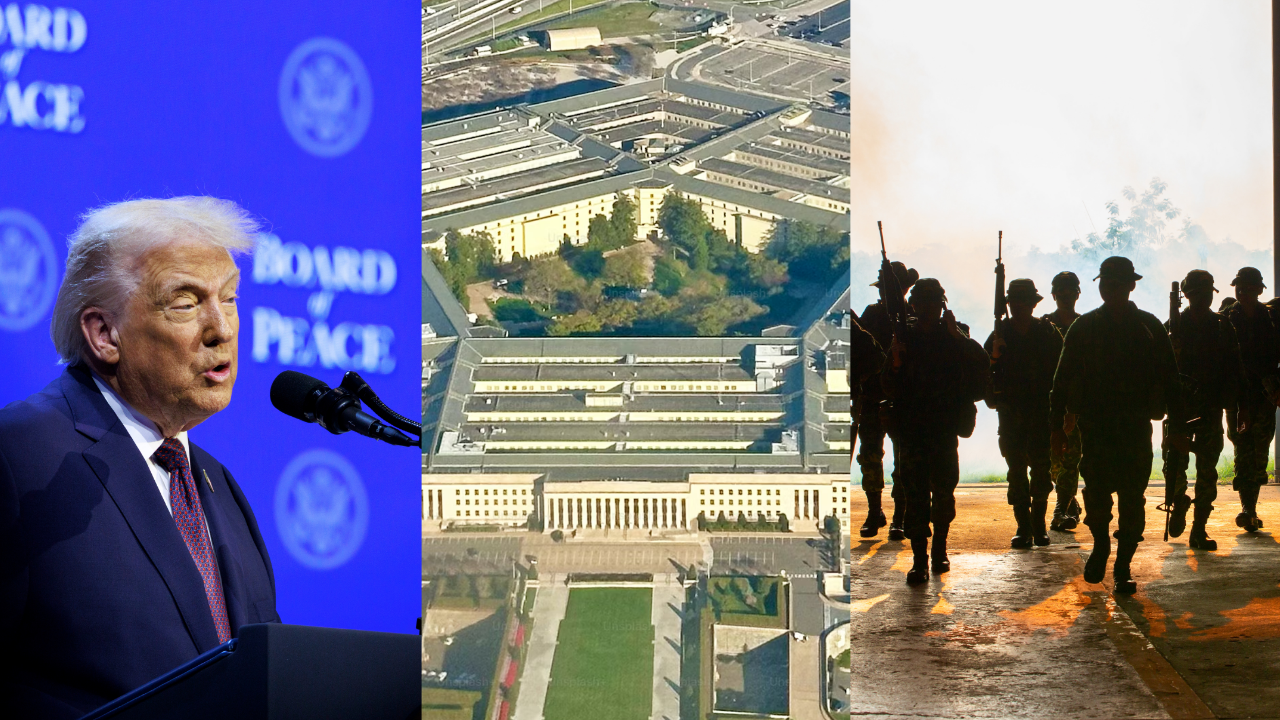
January 30, 2026 — In this week’s episode of Around the World, hosts Dhruva Jaishankar and Rachel Rizzo examine Trump’s Board of Peace, a multilateral initiative originally aimed at overseeing the Gaza ceasefire — and the questions around its membership, funding, and Trump’s ongoing role. They also assess the Department of War’s newly released National Defense Strategy and its priorities for U.S. security, as well as China’s recent detainment of top PLA officers.
Available on Spotify and Apple Podcasts.
Image: Board of Peace session with world leaders at the Official, on 22/1/2026 from 10:30 to 11:30 in the Congress Centre – Congress Hall (Zone C), Stakeholder Dialogue (special session/board of peace). CC BY-NC-SA 4.0. Courtesy of the World Economic Forum / Jason Alden, via Flickr.
Sneak peek
Dhruva Jaishankar: On this week's episode...
Rachel Rizzo: I think in order for a body like this, a plurilateral body like this, or a minilateral body like this to have meaning. The way that it's given meeting is by other organizations or other countries thinking that it is legitimate and having it be legitimized.
Dhruva: The National Defense Strategy, define in some ways the role and worldview of the US military, the US Defense Department, now called the Department of War, the most controversial parts as I see it and where there's been some pushback has related to China and it says: our goal is simple, to prevent anyone, including China, from being able to dominate us or our allies. I think more controversially, it seeks a stable or, quote, a decent peace with China. There was a big bombshell that dropped amongst the China watching community the last few days. And this was a surprise announcement that General Zhang Youxia, who is like the vice chairman of the Central Military Commission or and he's been detained and purged, right? And so was Liu Zhenni, who is the chief of staff to join staff departments. So these are two of the most senior military officers in China have been purged. Five out of the six military positions, the senior most of the CMC are now vacant and there's only one guy, one guy standing and who really controls the PLA now is sort of anyone's guess.
Welcome to Around the World
Dhruva Jaishankar: Hi, I'm Dhruva Jaishankar.
Rachel Rizzo: And I'm Rachel Rizzo. Welcome to the Around the World podcast. Your essential guide to understanding the forces shaping our world today. Every week, we cut through the noise to bring you clear, insightful analysis of the most important developments in geopolitics.
Dhruva Jaishankar: Whether it's security challenges across Europe, power dynamics in Asia, domestic updates from the United States, or regional updates in Latin America or the Middle East, we make sure you're up to speed on what's happening and more importantly, why it matters.
Rachel Rizzo: Thanks for tuning in. And also be sure to like and subscribe to the Around the World podcast on Youtube, Spotify and Apple Podcasts.
Rachel Rizzo: Hey, Dhruva, how's it going?
Dhruva Jaishankar: Hi, Rachel. Hi, how are you?
Rachel Rizzo: Good, good, good. Not as newsy of a week as every other week this year, but still busy. We had the big FTA with Europe and India that was signed. That was a big one. Republic Day here in New Delhi, that was exciting.
Dhruva Jaishankar: Did you get to see any of those things or be involved in any of the Europe meetings?
Rachel Rizzo: No, so I just watching it all be set up downtown was like super intimidating over the last week. It was just so much going on. And all of the traffic was crazy. So I stayed home. But I did watch the flyover from a distance. So that was pretty fun.
Dhruva Jaishankar: Great. And here we've had bad traffic as well in Washington because of the snow. So things are still shut down. Federal government was shut down for a few days and things are still quite messy.
Rachel Rizzo: Yeah, DC takes forever to clean any of the snow up. yeah, just good luck with that.
Dhruva Jaishankar: Yes. But we have had some developments over the past week, which are quite noteworthy.
Rachel Rizzo: Yep.
Replacing the UN?
Dhruva Jaishankar: You mentioned a few, but one thing that has picked up steam a little bit, it was announced a couple of weeks ago now, but we got more clarity during Davos, is Trump's Board Peace.
Rachel Rizzo: Yes.
Dhruva Jaishankar: Now, this originally seemed to be defined in the context of the Gaza War as sort of part of the peace process there. But it seemed then there was a report and seemed to be confirmed that it's going to be much more expensive. So what exactly is Trump's Board of Peace and what's that all about?
Rachel Rizzo: So I think the short answer is that we're not quite sure yet. You're right that Trump first proposed this idea, this concept of a Board of Peace back in September of 2025. This was part of the second phase of a 20 point plan to end the war between Israel and Hamas. And basically it was sort of designed ultimately to oversee the Gaza ceasefire and reconstruction following the Israel Hamas war. And then it was kind of formally established just last week in January 2026 on the sidelines of the World Economic Forum in Davos. But as you mentioned, the mandate has expanded. doesn't just, it doesn't even actually talk about Gaza and Hamas and Israel in sort of like the final charter. Its mandate has expanded to include just this general idea of promoting global stability and conflict resolution around the world.
Dhruva Jaishankar: So who exactly signed up for it so far?
Rachel Rizzo: So I think this is the big question. as of now, you have 19 of 62 invited countries that have signed this charter. So you have notable participants, including the UAE. You have Hungary, you have Pakistan, you have Argentina, like an interesting grouping here. But you also have major European allies like France, Germany, the UK, Italy, that have all thus far declined to join or remain non-committal. And I think there's also some controversy surrounding the executive board of this board of peace. Critics, I think, describe it as sort of a pay to play club, I'm putting that in quotations here,
Dhruva Jaishankar: They expect to pay a billion dollars to become part of the board, is that right?
Rachel Rizzo: That's right. like, instead of having a Gaza-focused mechanism, countries that contribute more than a billion dollars receive permanent membership. As I mentioned before, the Charter doesn't mention Gaza, despite the board's origins in the Gaza peace agreement. Trump has also suggested it might replace the UN. This raises some concerns. And then, Finally, just like the executive governing board here, it includes folks like Secretary of State Marco Rubio, Jared Kushner, Steve Witkoff, Tony Blair, World Bank President, Ajay Banga. So I think the framework is there for it to be something, but we're not sure exactly what that something is going to be quite yet. There's still major questions at play here. And it's something that I think will be closely watched in the coming months.
Dhruva Jaishankar: I think just some questions of of membership, obviously, leadership, what exactly enforcement, what kind of enforcement it will have, what would Trump's role be in it? mean, is this really the question about how much this is very personalized? Will Trump still have a role in a post-president environment? So I think all those questions are still being raised.
Rachel Rizzo: Absolutely, and I think that you ask all the right questions. I don't think there's a clear sense of what Trump's role is in it going forward. I mean, clearly now he's the head of it, the chairman, whatever you want to call it. But this question about membership, who's in, who's out, what the governing board looks like, what mandate does it actually have? I mean, I think in order for a body like this, a plurilateral body like this, or a minilateral body like this to have meaning, The way that it's given meeting is by other organizations or other countries thinking that it is legitimate and having it be legitimized. And so I think let's watch that closely and see if more countries sign on to it, if more decide not to sign on to it. Lots at play here. And then I think for the US, kind of switching gears a little bit, a few weeks ago now, I guess this would have been in December. We talked about the national security strategy that was released. Big deal, lots of drama around it given the way that the Western Hemisphere was prioritized over all other regions in the world, what it meant for Europe, what it meant for India, what it meant for the Indo-Pacific. What the Defense Department has released, I think it was just last week at this point, they love to drop these documents on Friday, was the new National Defense Strategy. So can you talk a little bit about that, maybe how it differs from the NSS, how the NSS informed the NDS, maybe how international folks that are this should be reading it.
NDS v. NSS
Dhruva Jaishankar: Yeah so the National Defense Strategy, NDS, is something produced by the Pentagon, meant to be informed by the National Security Strategy, and define in some ways the role and worldview of the US military, the US Defense Department, now called the Department of War, over the rest of this presidency. And we finally have the NDS, and I think it's not entirely surprising the main outcomes. And their four main, we'll get into the diagnosis in a second, but in some ways the prescriptions are basically four pillars. One, it has a very expansive definition of homeland security covering the Western hemisphere, missile defense, again, things we've been talking about. Very much in line with the Trump administration. Second, and this is the part which is, think, the most contentious is policy of deterring China through strength. And again, some of the devil in the details here. The third is allied and partner burden sharing again, not not particularly surprising It's something the Trump administration has stressed for a long time whether it's NATO allies or allies in the Indo-Pacific of the Middle East and fourth, it's supercharging the defense industrial base again something not entirely surprising. There a lot of legacy problems in the US military and I think overcoming some of those so the most controversial parts as I see it and where there's been some pushback has related to China and it says: our goal is simple, to prevent anyone, including from being able to dominate us or our allies. That's quite vague n some ways, what exactly that means, can be interpreted.
Rachel Rizzo: Yeah.
Dhruva Jaishankar: I think more controversially, it seeks a stable or, “a decent peace” with China. And this is very much the language of the current Undersecretary of War for Policy, Elbridge Colby. know, ElBridge is popular, know, and is somebody who's known to many of us. He's been around in Washington for long time. He is the main architect of the NDS. Incidentally, this was the role he played in the first Trump administration in 2017, he was a slightly more junior capacity where he was the lead drafter of that. But there's been a shift in the rhetoric since 2017. And in fact, he used some of the same language that he used in the speech that he gave in 2024 when the Trump administration was out of power, when the Republicans were out of power at the National Conservative Conference. And there he kind of used this term, decent piece and contrasted it with what he saw as hawkishness on the part of many in Washington who wanted to seek somehow a regime change or something in China, like a much more aggressive ideological conflict. I think there are a lot of open questions now. I think the biggest one is, a modus vivendi or a decent piece of balance of power, however you call it, between the United States and China something that can live with? Because any strategy it takes two. It's responding to. And I think skeptics will rightly also ask how much this is different from what Clinton and Bush and Obama pursued for 20 years with China. So I think there's also varying interpretation of what it means to dominate the United States or its allies, right? At what stage does the United States intervene if China is doing something with the Philippines or with Japan or with Korea? And then of course, there's a question of some mismatching the intentions with other actions, like for example, Trump applied 25 % tariffs on Korea.
Rachel Rizzo: Yeah
Dhruva Jaishankar: Just as Colby was visiting Seoul to deliver his first speech, kind of explaining the and where he called South Korea a model ally, right? So again, there's sometimes a little bit of a mismatch there. So those are all the questions raised by the NDS.
Rachel Rizzo: Yeah, I I think, that the other thing I would add is you often hear the phrase burden- sharing.
Dhruva Jaishankar: Mm-hmm.
Rachel Rizzo: In the context of the US allies in Europe. This is very much a phrase that Trump likes to use when referring to the Europeans. But interestingly enough, that phrase burden sharing, burden shifting is now being applied to US partners and allies in the Indo-Pacific as well.
Dhruva Jaishankar: Right.
Rachel Rizzo: So I think of having that phrase or that strategy just applied to Europe and Russia, it now very much applies to the Indo-Pacific as well, we should be watching closely at how that burden shifting applies in the region.
Dhruva Jaishankar: And it means something quite different in Indo Pacific context because one you don't have pooled resource sharing like you have a NATO, the US alliance structure is different.
Rachel Rizzo: Exactly.
Dhruva Jaishankar: Second, you have like partners such as India, Vietnam, Singapore, Indonesia that are sort of not bound by any kind of treaty obligations with the United States. And then I think third is that it's, it means something very different in peacetime and wartime. Right. So you have an active conflict in Ukraine. There are concerns about an active conflict in the Indo Pacific but we haven't had sort of a major breakout at this point of time. So I think it really means very, it's very different based on the context.
Purging the PLA
Rachel Rizzo: Absolutely. Okay, so staying in the Indo-Pacific region, but moving beyond the national defense strategy, you have been watching some military purges in China over the last little week, or the last little I guess I should say. Can you tell us a little bit what's happening there and what you have had your eye on in China on this particular issue?
Dhruva Jaishankar: Yeah, so this was kind of the, there was a big bombshell that dropped amongst the China community the last few days. And this was a surprise that General Zhang Yuxia, who is like the vice chairman of the Central Military Commission or CMC.
Rachel Rizzo: So big, big name, big personality. Okay.
Dhruva Jaishnkar: He's the senior most military officer in China, and he's been detained and purged, right?
Rachel Rizzo: Oh.
Dhruva Jaishnkar: And so was Liu Zhenli, who is the chief of staff to join staff departments. So these are two of the most senior military officers in China have been purged.
Rachel Rizzo: Wow.
Dhruva Jaishankar: The CMC is, I should explain, is one of the most important bodies in China, not just militarily. It's headed by Xi Jinping, the leader of China. And the vice chair is the senior most military officer. And it's also worth pointing out that the People's Liberation Army of China is kind of unlike a of national militaries because it's a political body. It's like the armed wing of the Chinese Communist. So these purges are a big deal. And it's not like comparable to, for example, Trump's removal of the chairman of Joint Chiefs of Staff. The charges against Zhang have been included the usual stuff that often accompanies these kinds of purges. Corruption, there's a whiff of espionage. There's a report in the Wall Street Journal that many have cast aspersions on that Zhang transferred nuclear secrets to the United States. Really doubts about the accuracy of this report, but it's equally possible that there were political factors at play, including questions of loyalty, personal loyalty to Xi Jinping or questions of competence. And Zhang is a particularly interesting figure because he's amongst the last serving Chinese military officers to have fought, to have had combat experience. He fought in the war against Vietnam in 1979. He was involved in action in 1984 as well. And he's also from an old Communist Party family. His father, his father and Xi Jinping's father served together during the Chinese Civil War. They're like old, old comrades. So a big deal.
Rachel Rizzo: So is this the first time that Xi Jinping has actively purged members of his inner circle or the military or is this something we've seen before? Why is it different if so?
Dhruva Jaishankar: So Xi has overseen the biggest political and military purges in since Mao Zedong. And it started soon after he took the reins of power in 2013. Zhou Yongkang, who was one of the senior most official of Hu Jintao regime, of the previous regime, was purged, expelled from the party, imprisoned for life. Someone at the time, I remember, compared this to Barack Obama throwing Dick Cheney prison, right? I mean, that was the kind of signifiance of it. But such episodes have become more regular both in the political sphere and in the military. And we spoke on an earlier episode with Neil Thomas, and he mentioned there's several vacancies at the senior levels of the CCP, as was evident at the party plenum.
Rachel Rizzo: Mm-hmm.
Dhruva Jaishankar: But on the military side, just recently the defense minister purged, most visibly the former foreign minister Qin Gang, who suddenly disappeared from public view and related to pretty credible espionage charges. So imagine like the US Secretary of State suddenly like disappearing without an explanation right?
Rachel Rizzo: Yeah.
Dhruva Jaishankar: Now are a ton of vacancies at the top of the PLA. So five out of the six military positions, senior, you know, the senior most of the CMC are now vacant and there's only one guy, standing, one guy standing and who really controls the PLA now is sort of anyone's guess.
Rachel Rizzo: So are there are these purges, are there broader implications for say Taiwan or, you know, China's ability to like build its own military or pursue active conflict? How would you read into that?
Dhruva Jaishankar: I think, again, I'm not the expert on this, but I've been reading a lot of commentary by some people who follow this very closely.
Rachel Rizzo: Mm-hmm.
Dhruva Jaishankar: it's pretty ambivalent, evidence that it can be read in two very different ways. On the one hand, the PLA purgers have removed commanders with the most experience in Taiwan-related contingencies. And the PLA rocket forces, which is in charge of missiles, long-range strike, They've witnessed a major shakeup. There's been a major corruption scandal associated with them as of the Eastern and Southern command. So one interpretation that Xi maybe has been dissatisfied with recent military exercises and planning for Taiwan, but an alternate explanation interpretation that Xi’s actually shaping a PLA much more in his own image, staffing of a younger commanders with less combat experience, as possible that the risk of miscalculation or just general risk aversion in the PLA decreases. And that increases the possibility of conflict for example, over Taiwan or another contingency.
Rachel Rizzo: Interesting.
Dhruva Jaishankar: So two, think, very conflicting and almost opposing ways of reading this.
Rachel Rizzo: So in terms of what are you gonna be watching next?
Dhruva Jaishankar: Let's see where this goes, who is appointed. Again what it means, you know, the tenor of the rhetoric coming out of China will be very interesting because some of this will be. So again, I think we can have people who follow this much more closely than I do on future episodes to discuss this.
Rachel Rizzo: Okay, sounds good. think we will definitely do that. As always, we'll be keeping an eye on all these developments and make sure we're keeping our listeners up to date on the latest happenings in geopolitics around the world. So be sure to tune in every Friday for the latest episodes.
Dhruva Jaishankar: As always, thank you for joining us on the Around the World podcast. We'll see you next week.
Rachel Rizzo: Thanks.