
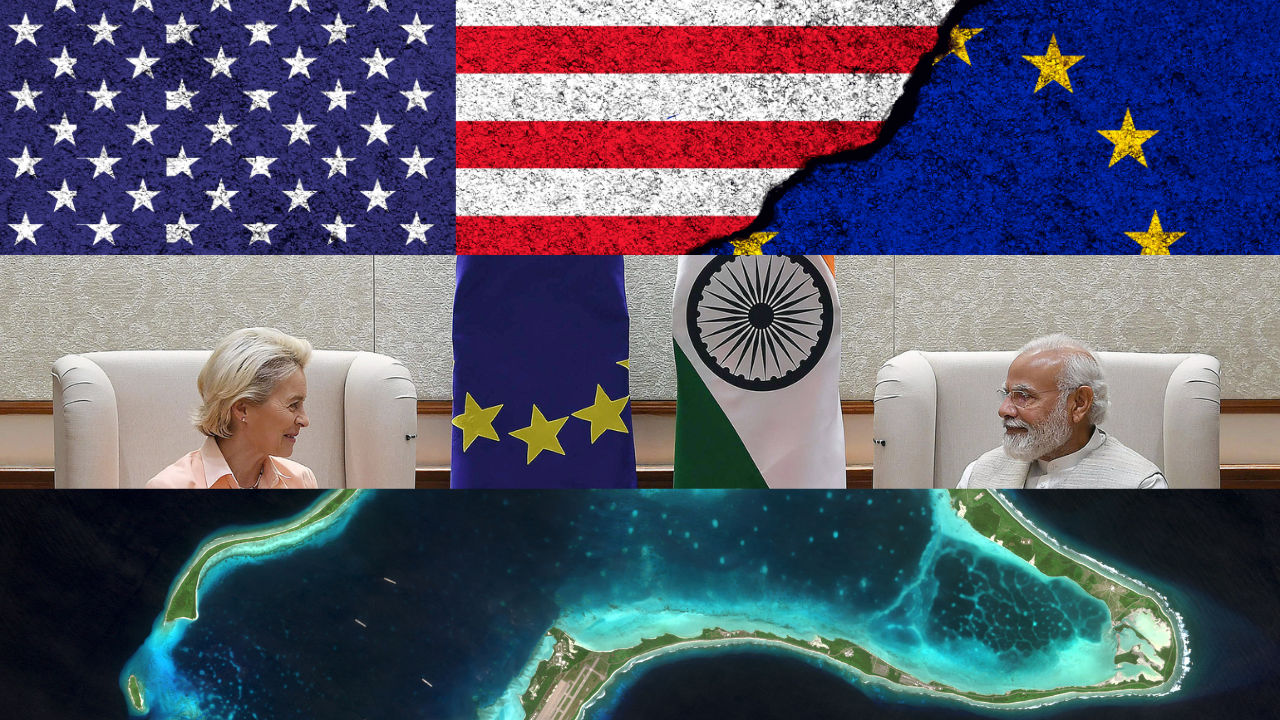
January 23, 2026 — In this week’s episode of Around the World, hosts Dhruva Jaishankar and Rachel Rizzo are joined by Garima Mohan, Senior Fellow at the German Marshall Fund, to discuss the growing momentum in EU-India relations ahead of an upcoming summit and potential trade agreement. Dhruva and Rachel also dig into the latest developments between Trump and Greenland, as well as the sudden resurrection of the U.K.–Mauritius Chagos Islands deal.
Available on Spotify and Apple Podcasts.
Image: FellowNeko, via Shutterstock.
Image: 111176. PM meeting the President of the European Commission, Ms. Ursula Von Der Leyen, in New Delhi on April 25, 2022. Courtesy of the Government of India Press Information Bureau, via pib.gov.in.
Image: Copernicus Sentinel-2 data 2021, ESA / CNES, via Wikimedia Commons.

SNEAK PEAK
Rachel Rizzo: On this week's episode.
Rachel Rizzo: I think you said two words there that perfectly encapsulate what is going on here. And those two words are and yet. The Europeans are increasing their defense spending and yet. They are coming to the table when Trump threatens tariffs and yet. They are sending troops and showing that they will better defend Greenland if that is what Trump is looking for and yet.
Garima Mohan: And next week is really momentous because we have EU Commission President von der Leyen as chief guest for India's Republic Day, followed by the EU-India summit on the 27th of January, where we are expecting no less than 113, 114 takeaways. The biggest of them are, of course, the long elusive free trade agreement, which I think we are very close to signing. An advanced security and defense partnership between the EU and India, of the sort the EU has with Japan, South Korea, Norway, so a really important list of partners.
Dhruva Jaishankar: This has been a sort of become a campaign issue for Nigel Farage. And reform UK, is sort of the right-wing opposition in the UK, which is gaining ground politically And they're seeking to turn this return of the Chagos Islands into an election issue in Britain. This is threatening to reopen a can of worms on a very tricky issue that many people had thought was resolved and has somehow survived changes in government in the UK, Mauritius and the United States.
Welcome to Around the World
Dhruva Jaishankar: Hi, I'm Dhruva Jaishankar.
Rachel Rizzo: And I'm Rachel Rizzo. Welcome to the Around the World podcast. Your essential guide to understanding the forces shaping our world today. Every week, we cut through the noise to bring you clear, insightful analysis of the most important developments in geopolitics.
Dhruva Jaishankar: Whether it's security challenges across Europe, power dynamics in Asia, domestic updates from the United States, or regional updates in Latin America or the Middle East, we make sure you're up to speed on what's happening and more importantly, why it matters.
Rachel Rizzo: Thanks for tuning in. And also be sure to like and subscribe to the Around the World podcast on both Youtube, Spotify and Apple Podcasts.
Dhruva Jaishankar: Hello, Rachel.
Rachel Rizzo: Hey Dhruva. How’s it going?
Dhruva Jaishankar: Good, good. Like every week, think every week this year, I've been thinking it's going to be a slow week and we can go into more depth on a particular issue,
Rachel Rizzo: No.
The Pursuit for Greenland Continues
Dhruva Jaishankar: But events seem to seem to take precedence over everything else. But this week, this past weekend, I can tell you on Saturday, felt like something, this January 17th, it felt like something fundamentally cracked in transatlantic relations. And Trump posted on Truth Social that on February 1st, eight European countries, which are all sending troops to Greenland, will be charged a 10% tariff that will become 25 % tariff on June 1st.
Rachel Rizzo: Yeah.
Dhruva Jaishankar: And I, to be honest, even I was taken aback by the response by many of my European friends and colleagues who, some of whom are, have been like real votaries and committed transatlantic partners have said, you know, Europe needs to find a way to work with Trump. But even from any of these European backers of the US alliance, there's been a really strong response. We've seen that in the last couple of days in Davos and Trump has him backed out. And he's actually today, the day of our recording, he's actually speaking in Davos. So Rachel, what's going on with Greenland and tariffs and the transatlantic relationship?
Rachel Rizzo: You know, it's always such a hard question to answer what's going on with Greenland because it changes by the day. But first I would say a couple things. Look, I mean, we've talked about this before. The Greenland idea isn't new, but it's a renewed interest in this administration. And people always say that we should take Trump seriously, but not literally. And when it comes to Greenland, I say take him literally because he is hell bent on finding a way to acquire this island and people and he's says it through the lens of the US needing it for national security reasons. The US is the only country that could defend Greenland. But there are also other issues at play here. The idea of whether critical minerals are accessible on the island at some point. aren't now. Whether the melting of ice in the Arctic means that shipping lanes will become accessible for longer stretches throughout the year and what that means for US access, but also access for Russia and China. So there's a lot here. But what I would say is that as we are doing this recording, we're doing this on Wednesday, we'll release it on Friday, he's giving his Davos speech now.
Dhruva Jaishankar: Mm-hmm.
Rachel Rizzo: It might have just ended. And we were wondering if he was going to talk about Greenland and he did. And he basically said, he had kind of hearkened it back to World War II and the United States defending Greenland, winning World II and kindly returning the island to the Danes. He also said, which I think everyone was hoping to hear, that he would not use force to acquire the island. Now, of course, he said we could and we would win. No one could defend it, but he won't do that. So in terms of what happens now, he wants direct and immediate negotiations with the Europeans. However, the Europeans are also holding a pretty firm line here. So what happens next I think is still really anyone's guess, but I think we're in for a pretty difficult time in the transonic relationship.
Dhruva Jaishankar: But a quick thing, what precipitated this, right? We had eight European countries, it's four Nordic countries minus Iceland, Germany, France, UK, and Netherlands, sending what was pretty small groups of small military units, I think the UK even sent just one officer to Greenland, right? That is what precipitated Trump's ire, right? Yeah.
Rachel Rizzo: Yeah. It was. And they sent those troops, as the secretary general of NATO said, sort of under the guise of looking at the region, doing sort of a situational recon, because Trump has talked so much about Russia and China in that region and the threats both of those countries pose to Greenland, sort of sending NATO troops there to look and see what actually is happening. But also, I think, what could end up happening there is short of acquiring Greenland, which Trump has really backed himself into a corner here saying that anything less than that is unacceptable. I think we could see some broader mill to mill cooperation through the lens of NATO in response to Trump saying that this is a national security threat. But I think there's also a question on how the EU decides to respond to Trump's threat of tariffs, as you mentioned, 10 % on these eight countries February 1st, potentially 25 % in June. Whether or not the EU will invoke this trade bazooka that could send this into a real escalatory spiral, I think those are the things that we're gonna be watching over the coming, maybe even days here, depending on when negotiations get started.
Dhruva Jaishankar: But I feel like there's almost like a real sense of betrayal on the part of many Europeans. There was a feeling that there, I think, a couple of things. One, they were doing something that Trump was criticizing them for not doing, which is reinforcing the security of Greenland. And instead of a positive response, they get slapped with tariffs that, at least in some of those countries, with the UK particularly, they felt that some of this had been settled already. And this, again, one of the few relationships that had been reasonably stable, you know, think there's a feeling that the Labour government in the UK had done everything to accommodate Trump. And yet there was, you know, there's been this response, right? So just explain a little bit, like, what is the response in Europe? Because we've heard some pretty extraordinary statements coming out of Mark Carney, the Canadian Prime Minister, the Belgian Prime Minister yesterday in Davos, you know, described like, you know, we're not slaves. But there really has been a very visceral response on the part of many Europeans to this development.
Rachel Rizzo: Mm-hmm. I think you said two words there that perfectly encapsulate what is going on here. And those two words are and yet. The Europeans are increasing their defense spending and yet. They are coming to the table when Trump threatens tariffs and yet. They are sending troops and showing that they will better defend Greenland if that is what Trump is looking for and yet. So I think it really shows that you know, this idea of multilateralism, this idea of allies and NATO especially as like a sense of mutual defense doesn't necessarily play with this administration. It's very much as the Canadian Prime Minister, Mark Carney said, an era of might makes right, an era of renewed great power rivalry. And while I do think that the president, the US president certainly sees Greenland as important, I do think there's an aspect of this that's just like he wants a big island
Dhruva Jaishankar: Mm-hmm.
Rachel Rizzo: And he wants to be able to say that this thing that the United States has tried to do for so long, know, Harry Truman secretly offered Denmark $100 million for it and they said no and that only became public years later. So I think for him being able to say that he's the one that got this done is a big aspect of this entire conversation. And I think we also have to keep that in mind that it goes deeper than just security, minerals, shipping. It gets to the heart of who Donald Trump is as a person and as a president.
A Long Time Coming for EU-India Relations.
Dhruva Jaishankar: Well, that's a great segue to the transatlantic rift that we're seeing in Davos and elsewhere is contributing to something that's really been in the works for some time, which is a closer EU-India partnership as Europe seeks to diversify its security and trade partners. And to discuss that, have Garima Mohan, who is senior fellow at the German Marshall Fund, to talk us through this, based in Brussels from India. Garima has been a friend of ours for many years and really is one of the best experts on India-Europe relations. Garima, thank you for joining us.
Garima Mohan: It's great to be here. Thank you for having me.
Dhruva Jaishankar: Yeah. So, Garima, you you heard we were talking about this sort of real shake up that we've seen in even the last few days in the transatlantic relationship. But a lot's been there's been a lot of traffic from Europe to India. We are going into Republic Day, January 26, which is, you know, India will have a parade. There's usually a head of state or government as a guest. We'll have European Commission, Ursula von der Leyen, European Commission President Ursula von der Leyen as the guest, the chief guest for that and reports now of a trade deal. So talk us through maybe what is to be expected over the next week or so in EU India engagement.
Garima Mohan: Yes, it has indeed been a very eventful month for EU-India ties. It started with the visit of German Chancellor Merz, his first official visit to a non-NATO ally, first visit in Asia to India, followed by we've also seen dignitaries from Spain and Poland. And next week is really momentous because we have EU Commission President von der Leyen as chief guest for India's Republic Day, followed by the EU-India summit on the 27th of January, where we are expecting no less than 113, 114 takeaways. We've been told in a pre-briefing. The biggest of them are, of course, the long elusive free trade agreement, which I think we are very close to signing. Piyush Goyal, Minister Goyal, has called it the mother of all trade deals. So really setting up very high expectations, hope they're able to sign it. An advanced security and defense partnership between the EU and India, of the sort the EU has with Japan, South Korea, Norway, so a really important list of partners. And then a bunch of other agreements around mobility of highly skilled professionals, startups, industry bodies, a defense industry forum. We'll also see an industry forum for the first time on the sidelines of the summit. So really a lot of momentum around issues of security, economic security and trade diversification, all three areas where as you noted earlier, Europe is feeling a lot of stress because of tensions with the US as is India.
Dhruva Jaishankar: So two quick questions from me, I'm sure Rachel has some as well. One, what step will this be in a trade agreement? Because we've just seen even the last day, the Mercosur agreement, which was at this stage about a year and a half ago, EU Mercosur, this is a group of South American countries, that is hitting some judicial roadblocks in Europe. There've been protests against it. So even if a trade agreement is signed between India and the EU, there's still some steps ahead. And what does that look like? How real is that?
Garima Mohan: Yes, so this is the beginning of the trade agreement journey for EU and India, but I would consider this as one of the most important steps. Politically agreeing that both sides have agreed to close all the chapters that were under consideration and now they will work on the text of the agreement which will be released later is what we've been told, but they will be signing a political agreement and as is the case, in the case of UK and India, the agreement text came out after a few weeks. Their last few final negotiations still to be done. What you're referring to with Mercosur, Mercosur is a different sort of deal because it has provisions on agriculture. One chapter that is excluded from the EU India FTA. Now agriculture, as we know, is a very sensitive issue and we've been seeing lots of protests from farmers, but also countries like France around that. With India, on the other hand, there seems to be an agreement across capitals that this is an agreement we need to sign. We want to tie India politically and geoeconomically closer to Europe. So there seems to be a very sort of positive assessment, positive momentum around this. And we do not expect a lot of opposition even from the EU Parliament, because even the EU Parliament, which till a few years ago was known as you know, a body that was very critical of India, I generally issuing, generally, yeah, political statements on domestic things and what's happening in India. I've seen the biggest tonal shift in the EU Parliament on India, where they've started talking about India as a very important partner, strategic partner for Europe. This is the time that we have to get India right. We cannot afford to miss the India bus, are quotes that I've heard from the European Parliament. So of course there can be roadblocks on both sides, but I do think the biggest one was agreeing to something and having something to sign and announce on the 27th of January.
Dhruva Jaishankar: Mm-hmm.
Rachel Rizzo: So for our listeners that don't nerd out on think tank papers the way that we might, Garima, you released a sort long reform piece today with the German Marshall Fund and the headline is A Long Time Coming. So everyone who's listening to this should go read it. But also I wanted to ask you that, like, has this relationship been such a long time coming? And is it driven, I think, by both sides recognition that while the US remains a key partner, it's also unpredictable. And so there's a new impetus behind the Europe-India relationship that perhaps wasn't there before, but is there now?
Garima Mohan: Exactly. That's exactly how I see it. And I would say in the timeline of where I would place things shifting between Europe and India. The first is around 2014, 2015, where we saw increasing outreach from India to Europe and Europe's sub regions. We have a paper on that as well at GMF. We've marked it. We've done some sort statistical mapping and we saw the number of high-level visits from India, envoys, diplomatic engagements with various parts of Europe, not just the big capitals increasing. And then the second important shift in the timeline was 2020, when Europe started feeling the squeeze from China. And that is the bigger element in explaining how and why Europe changed its mind on India in a way. It's really when Europe started feeling the squeeze from China, the conversation around the China shock started picking up and the impact it'll have on jobs and manufacturing and competitiveness of European industry, that there was this sort of awakening and a realization that people in Europe, countries in Europe need to diversify and economically diversify more than anything else. And Europe started speaking the same language that India has been speaking for a long time, diversification, which is central element to Indian foreign policy.
Dhruva Jaishankar: And strategic autonomy, we're hearing a lot of that in Davos as well from Europeans. It's just interesting them adopting a lot of Indian terminology for describing Google. I want to ask you about two acronyms that those of us who follow Europe-India relations throw around a lot. A lot of people don't fully understand. One is CBAM and what it is and how that can factor into potentially be a challenge to Europe and India. And the second is IMEC.
Garima Mohan: Hmm.
Rachel Rizzo: Yeah.
Dhruva Jaishankar: The India-Middle East-Europe corridor, which is something we heard lot about. Then developments in the Middle East, it seems to have taken a step back. But what is the interest in Europe, particularly in IMAC? So maybe if you could elaborate on those two issues.
Garima Mohan: Sure. Just to explain the difficult part, the challenge, let's go with the challenge first and then the opportunity in IMEC CBAM. Carbon border adjustment mechanism is a domestic sort of legislation ruling in Europe that will have an impact on industries and imports coming into Europe that have to apply to certain standards when it comes to environmental stuff and green standards where Europe is significantly advanced. CBAM is having a direct impact on the FTA negotiations and one thing that we still know is being negotiated is steel and the impact it will have on Indian steel industry and Europe is very keen on green steel and has different standards there. So I think that is something that needs to be worked out. But from what I've heard, many in Europe, particularly legislators and policymakers understand that European internal laws can actually have a detrimental effect on their external partnerships and relationships. And they do not want this to derail, particularly in the case of India. So hopefully they'll find the solution there. And second on IMEC, the India Middle East Economic Corridor. Back a few years ago, connectivity was the key word that we heard everywhere, at least in think tank conferences, and everybody was talking about, you know laying down roads and physical infrastructure and digital infrastructure connecting these regions. And IMEC is still seen to be what could be a flagship project for Europe and India. And particularly here in Brussels in the EU commission. There is a sense that IMEC is the great deliverable where you connect huge economies across India, Middle East, and Europe, and you create these new trade routes, but also digital routes that will unlock potential possibilities and increase trade traffic, but other sort of ways of growth connecting these three regions closer. It does seem a little bit like a pipe dream till the tensions in the Middle East are resolved. And also a lot of the funding and support around the IMAC idea originally came from the US. So we also need to see what that will look like. And of course there is opposition from countries like Turkey, which are also important partners for Europe. So I think we'll have to see, but for me, security defense partnership and some of the other things that are included in the EU India Summit are more tangible and sort of easily achievable deliverables that I'll be looking at.
Dhruva Jaishankar: Mm-hmm. And sure, yeah, sure. Yeah. Rachel, unless you have a final question for me, but want to give it to you, anything else from you?
Rachel Rizzo: No, mean, I think that, I mean, you really covered this pretty obviously fully. So I think you would say that if we walk away from the visit next week with at least an assigned trade deal, expanded security and defense partnership, that would be considered a successful visit.
Garima Mohan: Yes, and I think the third thing that is important and new in this is the involvement of private sector industry stakeholders.
Dhruva Jaishankar: Mm-hmm.
Garima Mohan: That was not done before and that really broadens the base of the partnership and more people are involved and there are more nodes that will keep the momentum going even when the leaders depart and they get busy in their own geographies. This is important and particularly migration from India, highly skilled folks and mobility on that. I think that's a real opportunity, given the pressures on the H1B visa, this is an opportunity for Europe and India to invest in. And building robust people-to-people ties keeps the relationship strong and going.
Dhruva Jaishankar: One final question for me. I mean, Garima, you really laid out nicely the EU, like Brussels and Delhi, like the connect that's taking place and all that. But we've also seen a pretty high frequency of bilateral visits to India from Europe just in the last few weeks. Last week, Rachel and I discussed German Chancellor Friedrich Merz's visit to India. I think Macron is also there this week or next week.
Rachel Rizzo: Yeah.
Garima Mohan: The AI Summit, yeah he’ll come in February.
Dhruva Jaishankar: We have Radosław Sikorski, the Polish foreign minister was there a few days ago, the Spanish foreign ministers in Delhi this week. why all of this, you know, while it's understandable that there's a lot of lead up to the EU India Summit, what explains all these bilateral visits that are taking place as well as flurry of bilateral visits in the run?
Garima Mohan: Yeah, I think there are two reasons for this. One is the immediate pressure a lot of these countries are facing from the US. There is a real sense in the capitals that in a world where alliances cannot be trusted, that they need to look for trusted partners and India is a boat they cannot afford to miss. So we have that sense in the German Chancellor Metz, for instance. The coalition agreement of his government mentioned the need to raise ambition of ties with India. France, of course, France and India is very important deep strategic partnership that has long roots, but also in countries like Spain, where the China element doesn't play that well. Pedro Sanchez has good ties with China. It's one of the few countries that does talk about investments from China and continuing an economic partnership. Even there, the consensus is that the India relationship is as important and needs to be cultivated and invested in, which I think is very interesting development across the board in Europe.
Dhruva Jaishankar: Well, thank you, Garima. Thank you for joining us and perhaps have you on later to discuss developments in a few months time.
Garima Mohan: I hope we can continue on the good way wave and that none of this is proven wrong next week. Thank you. Thank you for having me.
Return of the Chagos Islands
Rachel Rizzo: Okay, so with that, we've talked a lot about Davos this week. We've obviously talked about the EU visit to India. But that doesn't mean the rest of the world stops. There's other stuff going on. Dhruva, you've been paying close attention. It seems like there's something going on with the Chagos Islands. Care to enlighten us on what's going on there, please?
Dhruva Jaishankar: Yeah, so again, a going on, know, Gaza peace plan to Trump's new border piece. I think we can discuss this in future episodes. But one thing that kind of caught us stray in the Greenland business has been Trump in the context of Greenland sort of resurrected an issue that many thought had been settled last year, which was a deal between the United Kingdom and Mauritius for the return of the Chagos Islands, which are this archipelago in the middle of the Indian Ocean.
Rachel Rizzo: So give us some background on this because this is, it's not new to me, but it's definitely not something that I watch like daily or monthly or even yearly. So tell us what's going on.
Dhruva Jaishankar: Yeah yeah, no, it is important for India, and I'll get to why in a second. But in 1965, Mauritius, which was a British colony, gained independence from the UK. And the Chagos Islands, which were governed as initially part of the Seychelles, then later Mauritius by Britain, was kind of hived off. It was detached administratively and retained by Britain as the British Indian Ocean Territory, BIOT was the official name for it. And a base on that island was leased in the 1960s to the United States in Diego Garcia. So you'll sometimes see references to Diego Garcia.
Rachel Rizzo: Did hear about that. Yep.
Dhruva Jaishankar: So in the 60s and 70s, as part of this arrangement, there were about 2,000 Chagosian islanders native to this archipelago who were forcibly removed by the British. And Mauritius, over time, basically tried to build a legal and political case for the return of the Chagos island. And in doing so, particularly over the 2000s, received more and more support initially from the International Court of Justice and then overwhelming support at the United Nations for the sovereignty of these islands to Mauritius from the UK.
Rachel Rizzo: Okay, and so it seems like there some deal between the UK and Mauritius now.
Dhruva Jaishankar: Yeah, so in 2022, this was a conservative government, it was in power in the UK, the Tories, and they started negotiations towards the return of the Chagos Islands to Mauritius. It was concluded under a Labour government, they've been changing government in the UK in 2025. The sovereignty of the islands, basically by this deal, would be transferred to Mauritius. Britain would take on the islands on a 99-year lease. So we'd not have sovereign control, but we'd be leasing it. And the US military presence would be allowed to remain there. So this was the deal that was ironed out. And it was initially criticized by pretty much everybody in the opposition in the countries involved. So the deal was criticized by the political opposition in Mauritius for selling out. And then that party, which criticized, it came into power in 2024. it was the government of Navin Ramgulam, who was the opposition leader. But then he went ahead and finalized the agreement. And so there was a sovereignty transfer agreement settled in 2025. This was also tacitly welcomed by India, which is the security sponsor for Mauritius and which the Mauritian National Security Adviser is India and India helps to patrol the waters around Mauritius. It provides a lot of military assistance to that country. And so for India, it squares this dilemma of supporting Mauritius and decolonizing the decolonial agenda, while preserving a US military presence as a check against China and the Indian Ocean. And moreover, there are also plans, also early signs, that India is planning on using some, taking advantage of military facilities at Diego Garcia. Last October, US and Indian P8I, Maritime Aircraft, Maritime Reconnaissance Aircraft, jointly did a training there. And meanwhile, the Trump administration also came in in this period and conducted an interagency review last year in April. Trump gave it a sign off. And Marco Rubio publicly affirmed the United States support for this agreement in May of last year.
Rachel Rizzo: So that May of last year, we are talking about Greenland now, and this issue has now been resurrected. Is there a tie between those things? Like, what's happening with this?
Dhruva Jaishankar: Exactly. In Trump's mind, seems to be he, you know, so the treaty hasn't yet been ratified. Trump is now criticizing the UK for this agreement, which again, he signed off on last year. And he kind of links it to broad European weakness, including on Greenland. So he brought this up again on a Truth Social Post in the context of Greenland criticizing the UK. But I think there's a bit more than meets the eye here because in part, he's responding. This has been a sort of become a campaign issue for Nigel Farage.
Rachel Rizzo: Mm-hmm.
Dhruva Jaishankar: And Reform UK, is sort of the right-wing opposition in the UK, which is gaining ground politically and which is aligned quite closely to some of the Trump MAGA movement in the United States. And they're seeking to turn this return of the Chagos Islands into an election issue in Britain. But all of this is to say, this is threatening to reopen a can of worms on a very tricky issue that many people had thought was resolved and has somehow survived changes in government in the UK, Mauritius and the United States. So something to watch there, but it's playing out in some very weird ways for Indian Ocean security, for US alliances and posture, and for British and European right-wing politics as well.
Rachel Rizzo: Yeah, absolutely. Super interesting. thanks for giving us a rundown at something that we'll obviously be watching and update everyone. And again, we'll keep an eye on this, but also the EU visit to India, obviously the Greenland discussions and keep everyone up to date on the latest happenings. Be sure as always to tune in every Friday for the latest episodes and like and subscribe to the Around the World podcast on Apple podcasts, YouTube and Spotify.
Dhruva Jaishankar: Thanks for joining us.
Rachel Rizzo: Thanks.