
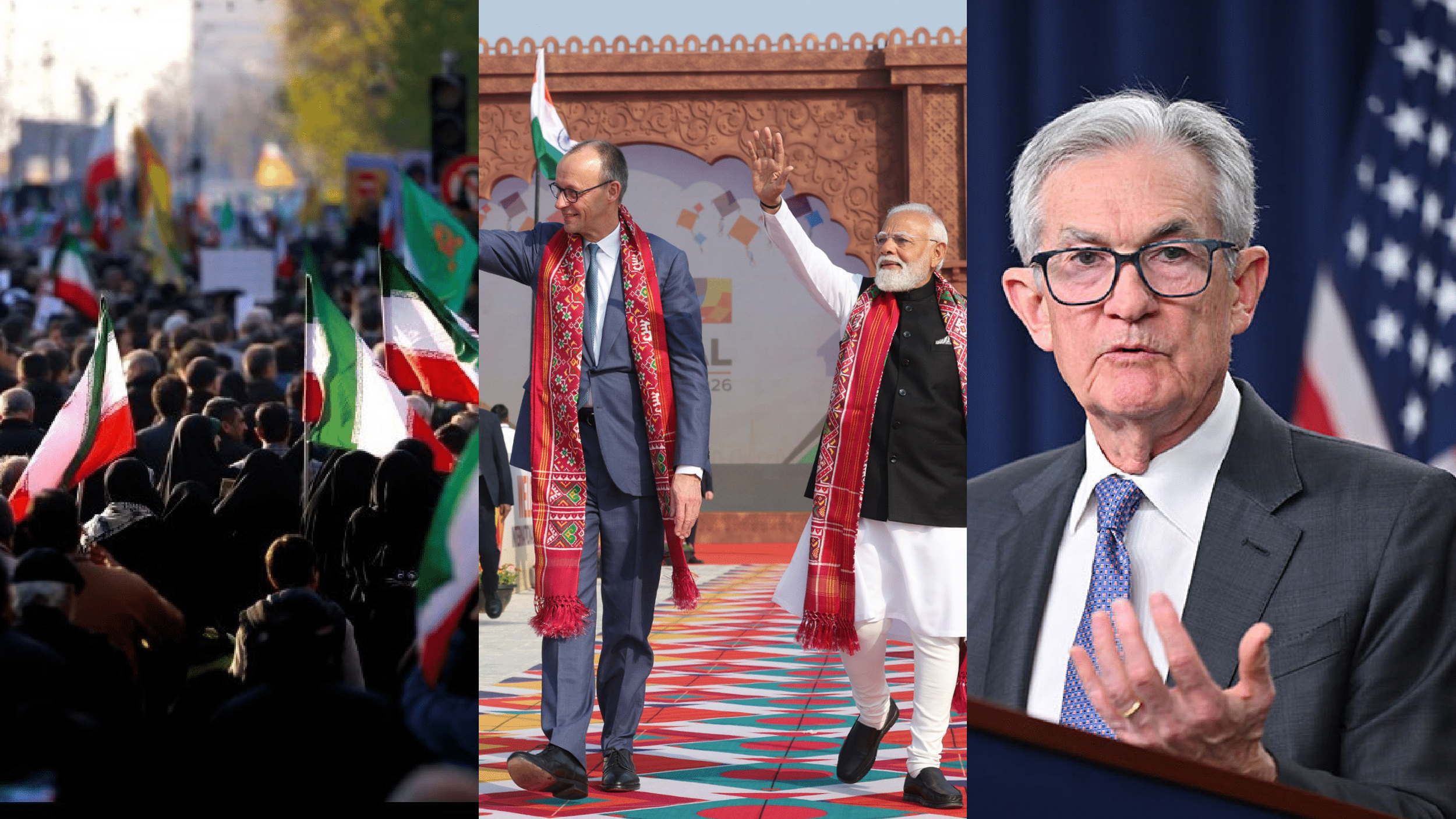
January 16, 2026 — In this week’s episode of Around the World, Dhruva Jaishankar and Rachel Rizzo dive into the resurgence of protests in Iran and what it means for the country’s economic and political future. They also unpack German Chancellor Friedrich Merz’s visit to India and the growing tensions between the Trump administration and the U.S. Federal Reserve.
Available on Spotify and Apple Podcasts.
Image: Tasnim News Agency, CC BY 4.0, via Wikimedia Commons
.jpg)
Image: 200886. PM and German Chancellor Friedrich Merz, participates in the International Kite Festival at the Sabarmati Riverfront at Ahmedabad, in Gujarat on January 12, 2026. Courtesy of the Government of India Press Information Bureau, via pib.gov.in.
Image: DSC_0454. Chair Powell answers reporters’ questions at the FOMC press conference on December 10, 2025. Courtesy of the Board of Governors of the Federal Reserve System, via Flickr.
Sneak Peak
Rachel Rizzo: On this week's episode...
Dhruva Jaishankar: So late last month in late December 2025, widespread protests erupted in Iran against the government of the Islamic Republic and have really spread and intensified since then. There are estimates in the last few days of at the very least several hundred up to maybe 2000 people having been killed in these protests, which is quite an astonishing number. US President Donald Trump has threatened 25 % tariffs against any country that does trade with Iran. And some of the protests have been specifically against Ali Khamenei, the 86-year-old Iranian supreme leader and the successor of Ayatollah Rouhallah Khomeini, who was the one who sparked the ⁓ Iranian revolution in 1979.
Rachel Rizzo: German Chancellor Friedrich Merz made his first official visit to India this week, January 14th. He was accompanied by 23 German CEOs. And for those who watch Germany closely, you'll know that this is a huge deal. The business community has always been this thermometer for policy discussions in many ways. It's a huge reason, that Germany hasn't distanced itself from China faster
Dhruva Jaishankar: The United States has been pretty careful about coordinating monetary policy with central banks, particularly of the G7 countries and the G20 economies. This year, we're likely to see a sort of divergence amongst the, particularly the developed economy. And this could play havoc with currency exchange rates around the world.
Welcome to Around the World
Dhruva Jaishankar: Hello, I'm Dhruva Jaishankar.
Rachel Rizzo: And I'm Rachel Rizzo. Welcome to the Around the World podcast. Your essential guide to understanding the forces shaping our world today. Every week, we cut through the noise to bring you clear, insightful analysis of the most important developments in geopolitics.
Dhruva Jaishankar: Whether it's security challenges across Europe, power dynamics in Asia, domestic updates from the United States, or regional updates in Latin America or the Middle East, we make sure you're up to speed on what's happening and more importantly, why it matters.
Rachel Rizzo: Thanks for tuning in. And also be sure to like and subscribe to the Around the World podcast on both Youtube, Spotify and Apple Podcasts.
Rachel Rizzo: Dhruva, how's it going?
Dhruva Jaishankar: Hi Rachel, how are you?
Rachel Rizzo: Pretty good, pretty good. Just got back from Bihar, was at the ORF Think Tank Forum at Nalanda University. So a fun few days of cultural and ideas exchanges.
Dhruva Jaishankar: Yeah, and a place that lot of visitors to India don't actually go to. it's ⁓ great that you managed to get there.
Rachel Rizzo: Yeah, it was a new state for me, new visit for me. So a lot to get through today, excited to be here.
Dhruva Jaishankar: Mm-hmm.
Rachel Rizzo: I think today we're gonna be talking about protests sweeping Iran. We had a major visit here in New Delhi from Chancellor Friedrich Merz of Germany. And there's also been a lot in the news about the ongoing I guess you could call it a conflict between the chairman of the Fed Jerome Powell and the president of the United States Donald Trump. So a lot to get through. I want to start with you and get right into it with the Iran protests. I mean, this has been one of the biggest things in the news. Can you tell us a little bit about what's going on and what you're watching here?
Protests Resurge in Iran
Dhruva Jaishankar: Yeah, so last week we hinted at this, I think a little bit because there were some reports of protests in the first week of January.
Rachel Rizzo: Yep.
Dhruva Jaishankar: They have picked up and intensified. So late last month in late December 2025, widespread protests erupted in Iran against the government of the Islamic Republic and have really spread and intensified since then. Now, information coming out of Iran is quite spotty in part due to widespread internet blackouts. But there are estimates in the last few days of at the very least several hundred up to maybe 2000 people having been killed in these protests, which is quite an astonishing number. US President Donald Trump has sought to take advantage of the protests. He's encouraged them quite publicly, threatened 25 % tariffs against any country that does trade with Iran and amongst the countries, China is the number one trading partner of Iran, Turkey, Iran, Germany are amongst others who do trade. Barring China is really…the trade with Iran's trade with the rest of world isn't actually that much because of years of sanctions. So far, there hasn't been that much clarity about enforcement of those tariffs, or even an executive order to that effect. But again, that's some of the ripple effects that we're seeing from these protests.
Rachel Rizzo: Yeah, absolutely. And there was, I think, a video of him today from the White House saying to the protesters, help is on the way. So that's something to watch closely. As you hinted at, mean, these protests have been going on for a while over last couple of months. But in general, these are not the first protests of this kind that Iran has seen, correct?
Dhruva Jaishankar: Right. in the 1980s, you know, in 1979, we had the Islamic, the Iranian revolution. In the 1980s, there was Iran-Iraq war, but large scale incarceration against any political dissidents in that period. But this is in some ways the third major protest in the last 15, 20 years against Islamic Republic. In 2009, after elections were disputed, this was the election of Mahmoud Ahmadinejad, who was considered a hardliner. You had what was called the Green Movement. And those disputed election results kind of sparked sort of younger Iranians to take to the streets and express dissatisfaction with the way the elections have been conducted. Those protests eventually died down. Then three years ago, a little over three years ago, there was the death of a woman named Mahsa Amini, who is a 23-year-old woman.
Rachel Rizzo: Yep.
Dhruva Jaishankar: She died in the hands of law enforcement. There are disputes about what exactly happened. But reportedly she was taken in for not properly wearing a hijab. And that led to widespread protests and anger, particularly at the Iranian morality police. The latest wave of protests appeared to have been in some ways a continuation of that, but also triggered by economic factors. And some of the protests have been specifically against Ali Khamenei, the 86-year-old Iranian supreme leader and the successor of Ayatollah Rouhallah Khomeini, who was the one who sparked the Iranian revolution in 1979.
Rachel Rizzo: Yeah, and with Mahsa Amini, I mean, that set off the woman life freedom movement, which was a major movement for not just women's rights, but rights in general in Iran.
Dhruva Jaishankar: Mm-hmm.
Rachel Rizzo: And so it seems like sort of that coming back in a much maybe even stronger way. ⁓ But there's always kind of this discussion or this like question mark about the restoration of the Shah. Can you talk a little bit about that? I don't follow Iran super closely, so I would love kind of your insights here.
Dhruva Jaishankar: I mean, neither do I. I mean, what's been interesting about this wave of protests is it seems to have been enough that people are actually talking about what comes next. And many of the dissident groups, particularly those outside Iran, are already seemingly, I mean, maybe it's a premature, but sort of jostling for position.
Rachel Rizzo: Mm-hmm.
Dhruva Jaishankar: And one of the things that has come up is sort of the possibility of the restoration of an Iranian monarchy. The heir to the Shah of Iran who was deposed in 1979 and died in 1980 is his eldest son Reza Pahlavi, who has been living in Potomac, Maryland outside Washington, DC for the past several decades.
Rachel Rizzo: Oh wow. Okay.
Dhruva Jaishankar: Now, it's unclear how much support he actually enjoys amongst the Iranian diaspora, let alone the people of Iran. Some surveys suggest actually not that much. the dynasty, the Pahlavi dynasty, was actually established only in the early 20th century. The founder having deposed the previous gudger dynasty that sort of was responsible for reunifying Iran in the late 18th century. So there's already been some questions, some criticism of his legitimacy, his standing, including by supporters of the MEK, which is a sort of leftist Iranian dissident group that is quite active outside of Iran. So, I mean, I would just say watch this space. It's unclear what the end game will be. They might be, these might definitely be the most violent protests in the Islamic Republic's history. The comeback time for the government is really on the back foot following the conflict with Israel. The economy is weak. There questions about succession to the aging Ayatollah Khamenei and those are swirling. So let's watch this space.
Rachel Rizzo: Yeah, absolutely. And a big question mark over what Donald Trump will do. So maybe something that will be in the news next week.
Merz Meets Modi
Dhruva Jaishankar: Mm hmm. Turning to you, we you you've been a long time follower of European politics, including Germany. You were just in Berlin a few weeks ago. ⁓ And now you're in India. And we had German Chancellor Friedrich Merz, not often seen as the most charismatic leader coming to on a trip to India, which seems to be quite significant. And I should add, comes on the heel of or in the in anticipation of a bunch of major European visits to India. We'll have Macron coming.
Rachel Rizzo: Yep
Dhruva Jaishankar: Many other European leaders making their way to India. Talk us through what that visit accomplished.
Rachel Rizzo: Yeah, absolutely. We do have Ursula von der Leyen, president of the European Commission, coming to India as the guest of honor for the Republic Day celebrations on the 26th, so something that we're going to be watching closely. Yeah, I mean, so like you said, German Chancellor Friedrich Merz made his first official visit to India this week, January 14th. So this was a meaningful trip for a few reasons. First, it's taking place with the backdrop of these ongoing threats to Greenland and the desire for Europe and European member states themselves to deepen their relationships with other partners in the midst of this uncertainty emanating from the United States. So he basically, what he's done is positioned New Delhi as a central partner in things like trade, technology, security. These were all notable. But I think perhaps even more notable is who came with him to this trip. He was accompanied by 23 German CEOs. And for those who watch Germany closely, you'll know that this is a huge deal. The business community has always been this thermometer for policy discussions in many ways, maybe even more so than in the United States. So it's a huge reason, for example, that Germany hasn't distanced itself from China faster because of what it means for the business community, what it means for exports and imports. And in turn for people's future political positioning. So Merits, among other things, backed a conclusion of the India-EU free trade agreement. We'll see if that's signed in the next few weeks. He announced a CEO forum, expanded defense industrial cooperation. So overall, a hugely meaningful and successful visit.
Dhruva Jaishankar: You hinted at this a little bit, again, I think in this climate, the security cooperation aspect of Germany-India relations and Europe-India relations stands out a little bit. What exactly happened on the security side?
Rachel Rizzo: Yeah, the free trade agreement between the EU and India gets a lot of the attention, obviously, as it should. But there's also discussions about a potential security and defense agreement between the EU and India. So that's something to watch closely. But under that backdrop or with that backdrop, Mertz and Modi talked about expanded military to military engagement through things like joint exercises, senior level exchanges, and perhaps most importantly, they endorsed a new roadmap for defense industrial cooperation focused on things like long-term technology partnerships, co-development of equipment in India, which is a huge thing for Modi with his made in India efforts. The biggest one I would say is this submarine deal that maybe you've heard about, maybe you haven't. For our listeners, New Delhi has been negotiating with Berlin to procure six diesel electric submarines from German Thyssenkrupp Marine Systems. These are going to be manufactured in Mumbai by an Indian company. So India has confirmed that these negotiations are ongoing, they're moving positively, but the deal hasn't quite been sealed yet. during this trip, you had senior government officials basically say that the discussions covering things like technical issues, finance, commercial aspects, they're all ongoing. moving in a positive direction, something to watch.
Dhruva Jaishankar: And finally, what were the CEOs interested in when they came to India?
Rachel Rizzo: Yeah, absolutely. mean, as I mentioned before, I don't need to go into it again. Like, I just want to drive home the point of how important it was to have these German CEOs here. First, it's important to note that India or Germany is India's largest trading partner within the European Union. More than 2000 German companies have pretty long standing presence in India. So this is already a major market for German companies. So they talked about future oriented sectors like innovation, aerospace, and defense as pretty key areas where cooperation can deepen even further. They want to combine things like German engineering precision with India's scale and talent. And they highlighted specifically that German machinery manufacturers and Indian equipment producers can expand the global equipment market. So overall, especially with the creation of a CEO forum, this is one of the things that came out of the visit. I think we really see a landscape where this relationship could flourish and strengthen even more in the coming year. Years, I guess.
Dhruva Jaishankar: Yeah, and I think it comes at a pretty pivotal time, I mean the German economy hasn't been doing great the last couple of years.
Rachel Rizzo: No, it hasn't.
Dhruva Jaishankar: There's been an over-dependence on Chinese, the export market, which is, you know, they understand this vulnerability increasingly, with the possible exception of the auto manufacturers. I know Merz has been to Bangalore, which is sort of a place where a lot of German companies are headquartered as well in India. again, interesting to see, you know, the space because there does seem to be that complementarity between the two economies at this particular point in time.
Rachel Rizzo: Yeah, and Merz is in a tough spot because, as you mentioned, the economy is not doing well. And they have sort of a perfect storm brewing in terms of debt, in terms of having to increase spending on things like infrastructure, defense spending. So they're kind of facing a difficult future at the moment. So important to build new relationships. Yeah.
Dhruva Jaishankar: Mm-hmm. Actually, and speaking of difficult political futures, I don't know if you followed, but the AfD, the right-wing German party, their head, Alice Weidel, kind of criticized Mertz's visit to India as sightseeing. Did you see that?
Rachel Rizzo: Yeah, of course. This is her favorite thing to do.
Dhruva Jaishankar: Yeah, and yeah, so, but what some people point out is she hasn't criticized similar visits to China, which has just been interesting. something to watch in German politics as well.
Trump v. Powell
Rachel Rizzo: Yeah, absolutely. And then finally, shifting it to the United States, can you tell us what's up between the chairman of the Fed, Jerome Powell, and President Trump?
Dhruva Jaishankar: Yeah, we're in some pretty extraordinary territory regarding the US Federal Reserve. And this may seem like a domestic issue in the United States, but this has pretty significant potential international implications. the US Federal Reserve is the United States equivalent of a central bank. Every major economy has a central bank, which guides monetary policy. And in the past week, the US Department of Justice, an arm of the executive branch, launched an investigation, a criminal investigation into the Fed and the chairman of the board of governors Jerome Powell for allegedly lying to Congress about the renovation, the $2.5 billion renovation of a Fed building. Now this has been criticized as implying this is politically motivated, including by Republican senators and stock markets also fell following the news.
Rachel Rizzo: Mm-hmm.
Dhruva Jaishankar: But Powell responded by issuing a pretty unprecedented two minute video statement calling the Department of Justice's threat of criminal indictment as a pretext to undermine the feds independence. Now the chair of the feds board of governors, Powell is appointed by the president to a four year term and is confirmed by the Senate. And Powell's term expires in May of this year. And he says that the president basically cannot remove him before then. So that's kind of where the standoff is at the moment.
Rachel Rizzo: Mm-hmm. So, what are you gonna be watching between now and May?
Dhruva Jaishankar: So I think the reason this is important is the Fed has a dual mandate to use monetary policy to keep inflation low and unemployment low.
Rachel Rizzo: Mm-hmm.
Dhruva Jaishankar: That's been always the tricky balance. And to do this, its independence from short-term political expediency has often been deemed necessary. It shouldn't be vulnerable to the whims of the short-term whims of elections and so forth. That's part of the underlying principle of central bank independence. But Trump has been quite publicly dissatisfied with Powell, whom I should, you know, it's interesting Trump appointed him to this role in his first term.
Rachel Rizzo: Yes, he did.
Dhruva Jaishankar: He was, he was then he was then renewed under Biden. And Trump essentially wants the Fed to lower interest rates, believing that this would be popular, would be popular with businesses, it would give a boost to the short term boost to the economy and he and his advisors seem to believe that employment figures in the United States are good enough that they can withstand a slight increase in unemployment that would come from this. Many members of the Fed, including Powell, seem to disagree with this assessment. They believe that US inflation is higher than they would like still. It hasn't come down as much as they had hoped for. That net hiring has stalled. Unemployment is looking not great. And so this is I think the crux of their disagreement with the Trump administration last year. There was an attempt to remove one of the Fed board members Lisa cook who was a Democratic appointed member over allegations of mortgage fraud. So it's a personal issue, but the Supreme Court blocked that attempt and so meanwhile Trump has been trying to populate the Fed board with some of his key advisors Stephen Myron who is until recently chairman of his Council of Economic Advisors was confirmed as a member of the Fed. And then there is some already speculation about who the next chairman of board might be. It may be Kevin Warsh, who is a former Fed governor, who's been speculated as a candidate to succeed. Another one of Trump's advisors is also sort of in the running. So I think that speculation has already come, but it's just sort of interesting that there has been this such a public spat between these two institutions at this time.
Rachel Rizzo: Yeah, it's super public and the Fed is supposed to be independent, as you mentioned. So the fact that this is playing out so publicly is sort of unprecedented territory in the US. But you mentioned in your opening remarks on this specific topic that this might seem like a domestic issue, but it's actually not just a domestic issue. This reverberates through the global economy in many ways. Can you tell us why and maybe why that matters, why people should be watching this?
Dhruva Jaishankar: Yeah, so the interest rates set by the Fed have implications for banks, including private banks in the United States, but also international implications. And especially since the global financial crisis of 2008, 2009, the United States has been pretty careful about coordinating monetary policy with central banks, particularly of the G7 countries and the G20 economies. This year, we're likely to see a sort of divergence amongst the, particularly the developed economy is with Canada, Japan, much of Europe actually increasing their interest rates, even as the United States and a few other UK and a few others actually lower their interest rates. And this could play havoc with currency exchange rates around the world.
Rachel Rizzo: Mm-hmm.
Dhruva Jaishankar: So potentially wide international implications, including for the US economy for global exchange rates, and just international monetary policy coordination writ large. One thing that's sort of interesting to see is in the last couple of days, I'm not sure if this is a pretty smart move, but a bunch of other international central bankers actually publicly backed Jerome Powell. And I'm not sure again, that helps his case domestically because he sort of feeds into this narrative that he's part of a globalist elite, right?
Rachel Rizzo: Mm-hmm.
Dhruva Jaishankar: So again, I understand the spirit behind it that sort of central bank independence, you know, stand together with one of your own, but I'm not sure that necessarily sends the right message to the White House.
Rachel Rizzo: Yeah, I'm not entirely sure, but certainly not the last that we're going to be hearing about this or talking about this. you said, Powell's chairmanship goes at least until May. We're not sure what's going to happen between now and then. But as always on our, on the Around the World podcast, we're going to be keeping an eye on all of these developments and making sure we're keeping all of you, our listeners up to date. So as I mentioned before, be sure to tune in every Friday for the latest episodes. We're on Spotify, YouTube, and Apple podcasts.
Dhruva Jaishankar: As always, thank you for joining us on the Around the World podcast and we'll see you next week.
Rachel Rizzo: See you, Dhruva.