
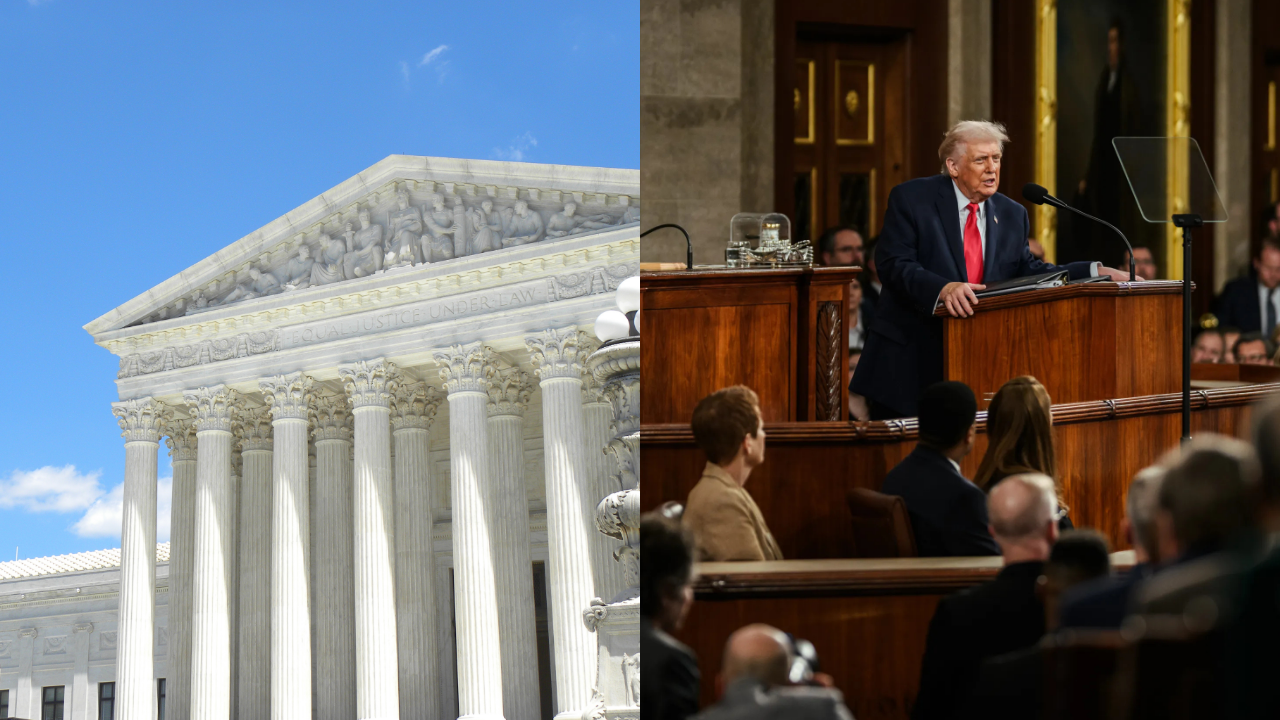
February 27, 2026 — In this week’s episode of Around the World, hosts Dhruva Jaishankar and Rachel Rizzo recap a landmark U.S. Supreme Court ruling that struck down President Trump’s use of emergency powers to impose global tariffs, exploring its implications for current trade deals and future negotiations. They then pivot to Trump’s State of the Union address, highlighting his claims of economic revival and conflict resolution abroad.
Available on Spotify and Apple Podcasts.
Image: Mathieu Landretti, CC BY-SA 4.0, via Wikimedia Commons
Image: The White House, Public Domain, via WhiteHouse.gov

Sneak Peek
Rachel Rizzo: On this week's episode.
Dhruva Jaishankar: The Supreme Court voted six to three to strike down President Donald Trump's use of International Emergency Economic Powers Act, IEEPA, and his use of IEEPA for tariffs. This really constrained his ability to apply tariffs. That being said, there is a sort of menu of options that Trump has on the table, at least five different ways that he can continue to impose tariffs, each with certain limitations. Most immediately, he imposed some tariffs under Section 122, which basically limits tariffs to 15, up to 15%, but only for 150 days, and it can be extended with congressional approval.
Rachel Rizzo: I mean it was like it was typical Trump, you know, he started the main section of the of the State of the Union basically saying our nation is back, it's bigger, it's better, it's richer, it's stronger than ever before. He talked about falling inflation. He claimed credit for what he refers to as a turnaround for the ages. it was pretty light on foreign policy, actually. It took a backseat. But what he did say was, as has become very custom for Trump, pretty self-congratulatory. He claimed credit for ending eight conflicts around the world.
Welcome to Around the World
Dhruva Jaishankar: Hi, I'm Dhruva Jaishankar.
Rachel Rizzo: And I'm Rachel Rizzo. Welcome to the Around the World podcast. Your essential guide to understanding the forces shaping our world today. Every week, we cut through the noise to bring you clear, insightful analysis of the most important developments in geopolitics.
Dhruva Jaishankar: Whether it's security challenges in Europe, great power competition in Asia, domestic politics from the United States, or regional updates in Latin America or the Middle East, we’ll discuss what's happening and more importantly, why it matters.
Rachel Rizzo: Thanks as always for tuning in. And be sure to like and subscribe to the Around the World podcast on Youtube, Spotify and Apple Podcasts. Onto the show.
SCOTUS Strikes Down Tariffs
Rachel Rizzo: Hey Dhruva.
Dhruva Jaishankar: Hi, how are you?
Rachel Rizzo: Good. You're in Australia?
Dhruva Jaishankar: I'm in Canberra. I've spent the last week here mostly in Sydney and also in Canberra. Very interesting. We were launching a report on maritime security in the Indo-Pacific, but also had very good meetings with think tanks and officials in Sydney and Canberra from the Australian, Japanese, Indian governments in Sydney, but also in the foreign defense ministries here in Australia. So it's been very productive. And it's also just nice to get a, it's my first time back in Australia in six years.
Rachel Rizzo: Nice.
Dhruva Jaishankar: And it's nice to kind of get a sense of how they see the world, whether it's relations with the United States or what's happening in the South or Southeast Asia. So it's always interesting to learn from perspectives here. So it's been a very educational, illuminating week for me.
Rachel Rizzo: Good, good. And then you're not going back to the U.S. after. You're coming straight here to Delhi.
Dhruva Jaishankar: Yeah, and we may record maybe a next episode in Delhi where we'll both be there for.
Rachel Rizzo: We've got, yeah, we've got the Raisina dialogue next weekend.
Dhruva Jaishankar: Yes, yeah, big annual conference at the Rise in a Dialogue. Planning is underway. I think, Rachel, you're very much involved in that. So next week should be a very exciting week in India.
Rachel Rizzo: Yeah, lots of India-focused stuff coming up, but it was a big week for US domestic politics and also the reverberations that they might have in terms of some of Trump's major cornerstone decisions of his presidency. And the biggest one that we want to talk about first is this Supreme Court decision to strike down Trump's tariffs.
Dhruva Jaishankar: Yes.
Rachel Rizzo: That kind of came as a surprise. Everyone had been waiting for this decision for a while. But tell us what you've been watching. Tell us what happened.
Dhruva Jaishankar: Yeah, so we, think a lot of us have been watching this from late last year. There actually had been an expectation that maybe the US Supreme Court would make a decision on tariffs in December. It got postponed a little bit, but we finally had a ruling. The Supreme Court voted six to three to strike down President Donald Trump's use of International Emergency Economic Powers Act, IEEPA, and his use of IEEPA for tariffs. This really has constrained his ability to apply tariffs using that legal authority. And essentially what the Supreme Court said, it was again more procedural than against anti-tariff, so we can get to that a little bit as to why. But essentially they said that no president has used this to confer tariff authority. And really, it was more on the legality of the process rather than a ruling against tariffs in general. And he could not, the president could not provide a sort of clear rationale for his ability to impose tariffs of unlimited amount, duration, and scope under these extraordinary powers. And it basically required congressional authorization. So that was the sum and substance of the ruling.
Rachel Rizzo: Got it, got it. And so I think the major question that I still don't quite have an answer to is what it actually means for the tariffs that have been imposed. mean, people are talking about reimbursements, but those are legal issues there. It's a huge pain. He's now increased the global tariff rate to 15 % in response to this. I mean he's obviously clearly upset about it, but what does it actually mean?
Dhruva Jaishankar: So I think that two important things to look at. One is the international dimension, and one is the domestic dimension of this ruling. So on the international dimension, I think the ruling essentially says 60 % of Trump's tariffs that he has imposed are invalidated, including most significantly against some of the tariffs against Canada, Mexico, China. That being said, there is a sort of menu of options that Trump has on the table, at least five different ways that he can continue to impose tariffs, each with certain limitations. Most immediately, he imposed some tariffs under Section 122, which basically limits tariffs to 15, up to 15%, but only for 150 days, and it can be extended with congressional approval. And this is what he did immediately. The rationale for Section 122 tariffs is that there's a challenge with international payments. Again, that's questionable, but that's what he has now used. In the meantime, what I think we can expect is that there will be investigations and an imposition of tariffs under several other potential rationales. Section 232 tariffs that relate to threats to national security determined by the Department of Commerce. Section 201, which is sort of injury to domestic industry.
Rachel Rizzo: 301 or 201?
Dhruva Jaishankar: There's 201 and 301.
Rachel Rizzo: Okay.
Dhruva Jaishankar: So 201 is by the International Trade Commission. Section 301 is discrimination against U.S. businesses or violation of U.S. rights under trade agreements, and that's determined by the U.S. Trade Representative.
Rachel Rizzo: Got it.
Dhruva Jaishankar: Then there's also, this is kind of another biggie, a potential one, is Section 338 which is discrimination against US commerce. that's kind of a, he could do that, but that would be much more wide ranging. So essentially he has a menu of at least five different authorizations that he could use. I think some people are jumping to the conclusion that this means the end of tariffs. think Peter Navarro had an article in the Financial Times, this is one of his trade advisors. And also some of the things Trump has said that he's not backing down from tariffs.
Rachel Rizzo: Yeah. Yeah.
Dhruva Jaishankar: This has simply complicated his legal authority to impose tariffs under IEPA. So that's the international dimension. The domestic dimension, think one thing that may pick up is the question of the tariffs that have been raised, and it's quite significant in terms of value. We're talking billions of dollars here. Do these need to be reimbursed to importers, to American importers? And I guess the question I have is, how much particularly small and medium enterprises in the United States, which have had to pay pretty hefty tariffs over the past year or so, how much they will demand sort of reimbursements? Will this potentially affect ⁓ Trump's popularity in the run up to the November midterm elections,
Rachel Rizzo: Yeah.
Dhruva Jaishankar: Then sort of the legal processes that take place. we're talking, I think I have the statistics somewhere. I mean, it is really like a very large number of transactions, millions of transactions have taken place. so how this process unfolds is really going to be complicated.
Rachel Rizzo: And it's going to be a, I mean, we're looking at like a long term process here. I mean, this is not something that's going to be wrapped up with a bow anytime soon. This is just the very beginning and we've got a long road ahead right.
Dhruva Jaishankar: Yeah, and so I think you've got this 150 days, either Congress will reauthorize some of that 15 % tariffs, or even if not, there will be a raft. And in some ways, the administration has been preparing for this since at least November or December last year, because in the oral arguments made in the Supreme Court, it was pretty clear that many of the Supreme Court justices, including the conservative justices, expressed quite a lot of skepticism about the legal authority that the US President had to impose these tariffs unilaterally. So I think they have been preparing the ground for at least two or three months to impose a raft of new tariffs under different authorities.
The Longest SOTU Address
Rachel Rizzo: Okay and then a few days after that decision, he then had to face three of the Supreme Court justices who made that decision in his State of the Union address. So that was fun.
Dhruva Jaishankar: Yeah, that happened. I was in a strange time zone, didn't follow the State of Union as much as you might have. So tell us a little bit about what happened in what I think is the longest State of Union address in history.
Rachel Rizzo: Yeah, it was like an hour 48 minutes I think off the top of my head if I remember right.
Dhruva Jaishankar: Mm-hmm.
Rachel Rizzo: But yeah, I also am in a strange time zone when it comes to watching US primetime TV So I was up at 7:30 in the morning here in Delhi watching it with my cup of coffee in the morning So that was pretty a nice way to start the morning, you know with like Trump yelling at everyone But I mean it was like it was typical Trump, you know, he started the main section of the of the State of the Union basically saying our nation is back, it's bigger, it's better, it's richer, it's stronger than ever before. He talked about falling inflation. He claimed credit for what he refers to as a turnaround for the ages. you know, this also, as I mentioned before, comes on the heels of the Supreme Court declaring his tariffs illegal and him rising or raising global tariffs in response to that. I thought that it was gonna, I mean, he would maybe start some sort of, not like direct yelling confrontation with the Supreme Court judges that were there, but certainly would like call them out in a pretty, in a pretty loud, garish sort of way. But he sort of avoided that. He, he, you know, greeted them when he walked in. Chief Justice Roberts, who's a, you know, right leaning Chief Justice on the Supreme Court, he's the one that wrote the opinion, actually. So that part of it wasn't as shocking as I thought it was going to be, but the rest of the speech obviously was sort of classic, classic Trump.
Dhruva Jaishankar: And what about foreign policy?
Rachel Rizzo: Yeah, so it was pretty light on foreign policy, actually. It took a backseat. But what he did say was, as has become very custom for Trump, pretty self-congratulatory. He claimed credit for ending eight conflicts around the world. This is a line that we have heard from him many times up until now. He rattled off that included the Israel-Gaza, what was it? No, Israel-Iran ceasefire. He talked about the India-Pakistan standoff earlier last year. I think he said that the Pakistani prime minister would have been killed if it wasn't for him, if I remember the line correctly. He said Gaza was just about there, which you know that's obviously one of the most debatable things that you can say in terms of foreign policy at the moment.
Dhruva Jaishankar: My pet favorite war that he's ended is the one between Egypt and Ethiopia, which is you know which aren’t neighboring countries, but that's one he takes credit for. Yeah.
Rachel Rizzo: Yeah he did talk, he mentioned this too. He talked about Armenia and Azerbaijan. And then he talked about the, you know, obvious military operation in January that captured Venezuelan president, former president, guess, Nicolas Maduro. He said Venezuela is our new friend and partner. Said that we're now on the receiving end of millions of barrels of Venezuelan oil. He said pretty little on the Ukraine war, despite the fact that the speech fell on the four-year anniversary of Russia's invasion. He just had kind of a brief line about working to end the killing and the slaughter. But I will say on Iran, he did strike a little bit more of an ominous tone. He warned that Iran would not be allowed to get a nuclear weapon. He left military action on the table. But I think as usual, there are people that are his champion when it comes to foreign policy. Critics, obviously, point out a very clear gap between these triumphant frames that he presents and the reality on the ground. So it's long on confidence and short on strategy, as some people might say.
Dhruva Jaishankar: And what was, I didn't see it, but what was the partisan flavor like? know, I mean, again, you have Democrats in the audience. It has, I think in recent years, the State of Union has taken on a more partisan tone, but what was it like?
Rachel Rizzo: Yeah, I mean, remember, I can't remember what year it was exactly, but there's that famous moment during Trump's State of the Union. was during his first, I almost said first semester, during his first administration where he finished the State of the Union and Nancy Pelosi stood behind him and just ripped up the speech.
Dhruva Jaishankar: Nancy, Nancy Pelosi, ripped it. Yeah, yeah, yeah.
Rachel Rizzo: So that didn't happen because he had Vice President Vance and Mike Johnson standing, sitting behind him. But he set up the speech to make it as partisan as possible. Ilhan Omar. the Congresswoman from Minnesota screamed that he had killed Americans. This was in a moment about immigration, about halfway. And obviously she's talking about the ICE agents and Alex Preti and the in Minneapolis who was killed, who was shot by an ICE agent. About halfway through the speech, he asked everyone in the, and this was a really interesting moment. He asked everyone in the chamber to quote, stand up and show your support for the idea that the first duty of the U.S. government is to protect American citizens rather than illegal aliens. And those are his words, illegal aliens are his words.
Dhruva Jaishankar: Mm-hmm.
Rachel Rizzo: And immediately Republicans jumped to their feet, they applaud, Democrats stay seated, and then Trump just wheeled on them and said, should be ashamed of yourselves for not standing up. So, I mean, it's, and he didn't stop there. He referred to the Democrats as crazy in a moment where JD Vance and Speaker Johnson stood up and applauded. So I mean, it's a moment that I think Republicans have said that they are going to use in terms of footage for the midterms that are coming up this November. So there's a lot there, but I think we have to, it wasn't as shocking as some of his former State of the Unions, I guess, because we've heard it before. We kind of know what his MO is at this point. I thought it was gonna be a little bit heavier on foreign policy, but we'll see how things go on that front. yeah, for anyone that watched it, it wasn't anything that was like super new.
Dhruva Jaishankar: Well, there's a lot else going on this week, partly as a result of the Supreme Court ruling. The US has delayed trade talks including with India that were scheduled to take place.
Rachel Rizzo: Mm-hmm.
Dhruva Jaishankar: There has you know, I think they're close to an interim agreement there, but it has also complicated the existing and negotiated trade agreements with Europe and with Japan and many others so I think that that's one space to watch. We've seen a burst of violence in Mexico related to cartel related violence.
Rachel Rizzo: Yep.
Dhruva Jaishankar: Drug leader known as El Mencho, cartel leader, was killed and that has sort of triggered some violence there. And I think another thing, I mean I'm certainly watching, a lot of people are, is the ratcheting up of tensions on Iran.
Rachel Rizzo: Yeah.
Dhruva Jaishankar: Again today in fact there's some talks going on to kind of hopefully avert sort of tensions there, but I think a lot of people are expecting possible military action against Iran. So.
Rachel Rizzo: Yeah, but not when Modi is in Israel, which is where he is now.
Dhruva Jaishankar: Yes, yeah, but I think he's returning today or tomorrow and at time of this recording he's actually hosting Canadian Prime Minister Mark Carney. So again, lot going on in the world. I think we'll discuss all of this next week and beyond. But it's interesting to see these tensions, know, the Supreme Court ruling, the State of the Union and other things in the United States and how it's being read all over the world.
Rachel Rizzo: Absolutely. Yeah, and I think maybe our next episode will come to you live from India, perhaps, when we are both finally in the same place. So of course, we'll see how that goes. And as I mentioned before, be sure to tune in every Friday for the latest episodes. We took a week off last week. Things were a little busy and hectic with travel schedules. But of course, as always, subscribe to the around the world podcast like the around the world podcast on Apple podcast YouTube and Spotify and we will see you all hopefully next week!
Dhruva Jaishankar: As always, thank you for joining us and see you next week.
Rachel Rizzo: Thanks, Dhruva.
Dhruva Jaishankar: Bye