
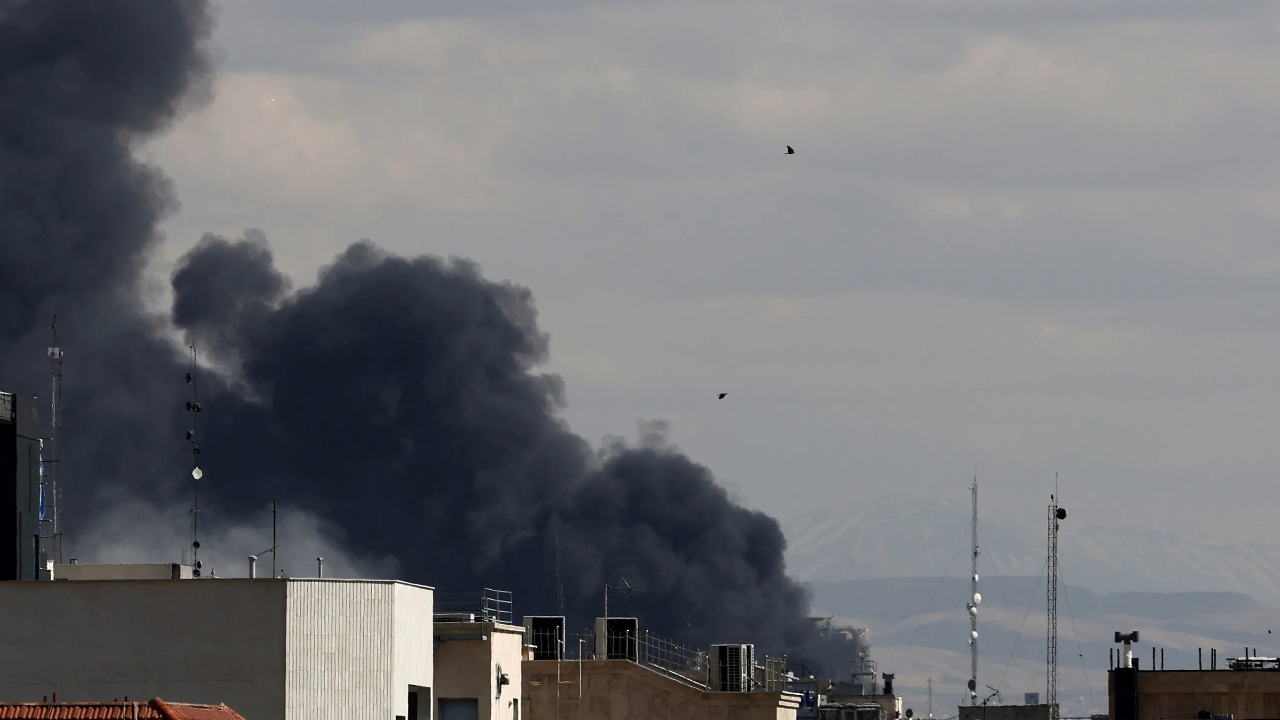
March 6, 2026 — In this week’s episode of Around the World, hosts Dhruva Jaishankar and Rachel Rizzo zero in on the escalating conflict in the Middle East, unpacking the U.S.-Israeli strikes that killed Supreme Leader Ayatollah Ali Khamenei and Iran’s retaliation against military bases and critical infrastructures in the Gulf. They explore Israel’s push for regime change, the impact on U.S. domestic politics, and how Europe and the Gulf Arab states are being drawn into the widening war.
Available on Spotify and Apple Podcasts.
Image: Avash Media, CC BY 4.0, via Wikimedia Commons

Sneak Peak
Rachel Rizzo: On this week's episode.
Dhruva Jaishankar: Looking this from Iran's point of view, they say, well, Israel's hardened its targets, US military bases have hardened their targets. If this is an existential conflict from their point of view, they're trying to go after all commercial activity in the Gulf. They've hit all six GCC countries, Gulf Cooperation Council countries. So they have gone after, very deliberately after this sort of economic infrastructure, energy infrastructure, hoping that this would compel the GCC countries to lean on the United States to bring a swift end to this conflict, perhaps short of regime change.
Rachel Rizzo: The real wild card here is how does US involvement develop over time? Hegseth has said that this campaign is just getting started, which really creates a question about what the casualties for the United States might look like. If Iran emerges from this battered but not broken, you get a sense that these actions were for naught. I wouldn't say it's a popular move, but just how unpopular it is, we'll have to see.
Welcome to around the world
Dhruva Jaishanker: Hello, I'm Dhruva Jaishankar.
Rachel Rizzo: And I'm Rachel Rizzo. Welcome to the Around the World podcast, your essential guide to understanding the forces shaping our world today. Every week, we cut through the noise to bring you clear, insightful analysis on some of the most important developments in geopolitics.
Dhruva Jaishanker: Whether it's security challenges in Europe, great power competition in Asia, domestic politics in the United States, or regional developments in Latin America or the Middle East. We'll discuss what's happening and more importantly, why it matters.
Rachel Rizzo: Thanks for tuning in. And as always, be sure to like and subscribe to the Around the World podcast on YouTube, Spotify, and Apple podcasts. On to the show.
A widening war
Rachel Rizzo: Hey, Dhruva.
Dhruva Jaishankar: Hi Rachel, you're in Delhi for the Raisina Dialogue, which is starting today.
Rachel Rizzo: Yeah, we're both in Delhi. We're finally recording. We're recording from the same city, but not from the same place.
Dhruva Jaishankar: The same building. And as we're speaking, the Raisina Dialogue, this is the Observer Research Foundation's big annual conference, is getting underway. I think, again, in the building we're in, Prime Minister Narendra Modi of India, President of Finland, Alex Stubb, are speaking, I think, right now. I'll get to see the video later, I think. I'll probably do that, avoid the crowds.
Rachel Rizzo: Yeah, it's pretty busy down there. We snuck away to do this recording because, you know, as everyone probably watching this and listening to this knows, it has been a pretty incredible week in terms of developments in geopolitics. And you know, for an event like the Raisina Dialogue, where you spend months sort of planning for it, the strikes in Iran and the ensuing conflict in the Middle East, which seems to be widening, doesn't seem to be stopping, is really sort of changing the nature of the conversations that we're having here. So we wanted to be sure to take some time and kind of inform our listeners, inform our viewers of what has been going on over the last five or six days, how that impacts the region, how that impacts Europe. And so, Dhruva, I wanted to start with you and, you know, most people listening have an idea that the U.S. and Israel struck Iran and there's been retaliation. But give us a sense of like the timing of that. What is happening now and what you're watching.
Dhruva Jaishankar: So we actually discussed this a few weeks ago. I think like three weeks ago on an episode where we discussed the, we discussed the US military buildup in Iran in the Persian Gulf or against Iran. And we talked about it being possibly imminent at the time.
Rachel Rizzo: Yep.
Dhruva Jaishankar: About two or three weeks elapsed. And then this past Saturday, February 28th, Israel initiated strikes against targets in Iran and Tehran and other parts of the country. These were initially sort of decapitation strikes so they really went after the leadership of Iran, killing the Supreme Leader Ali Khamenei, who has not only been like a long time Supreme Leader of Iran, but is also a religious figure of great consequence as well. In addition, several other Iranian leaders were killed, but I think the Israelis estimate that about 40 senior leaders, political, military, and clerical leaders were killed in those initial strikes, including the Defense Minister, the Chief of Staff of Iran's Armed Forces, and many others. So that kicked things off. The United States joined those strikes. President Trump authorized it. And we saw, we can get to like what happened next. But I think the one thing that differentiated this from the conflict last year, the summer of June of 2025, is that the Iranian response was very quick. They seem to have been better prepared.
Rachel Rizzo: Mm-hmm.
Dhruva Jaishankar: They launched drones, missiles, airstrikes against a pretty wide range of targets. And they were not relegated to US military bases and Israel, which were struck, but also the Gulf Arab states as well.
Rachel Rizzo: And so, I mean, you point to something really important, which is that this is, it doesn't just feel much different than last June. It is fundamentally different than last June. The aims are different.
Dhruva Jaishankar: Mm-hmm.
Rachel Rizzo: The breadth is different.
Dhruva Jaishankar: Yeah, yeah, so I mean, I think, let's look at this first from Israel's vantage point. In the post October 7, 2023 environment, Israel's threat perceptions have increased. The war in Gaza wasn't going exactly according to plan and they were worried about Hezbollah, which is the Iranian ally in Lebanon joining, so preemptively, well entering the conflict with Israel. Preemptively Israel struck Hezbollah, killed its leader Hassan Nasrallah in a very dramatic fashion, and also took out air defenses and missiles that were operated by Iranian proxies in Syria and Iraq. So by the end of 2024, essentially, Israel had a clear path, if you think of it from the point of view of air defense, to Iran. So I think that was step one. Step two was like last week's, I'm sorry, last year's 12-day war in June, where they really brought home their air superiority. In fact, they completely dominated the airspace in Iran, were able to strike IRGC, Islamic Revolutionary Guard Corps, leadership killing many of them. And then, of course, the U.S. followed up with strikes on Iran's nuclear facility. So I look at this as sort of the third round of, in three years, of this Israel-Iran war. And this one has a very explicit objective, as you suggested, of regime change in Iran.
Rachel Rizzo: Okay. And so the retaliation by Iran has not just been – it has widened beyond Israel. It has widened beyond Hezbollah, which is now involved in this conflict as well. But it's hit major financial, global, geopolitical centers – the UAE shutdown airports in the Gulf. This feels much bigger for the Iranians. Is it a last breath of existence for this regime? I mean, how are they thinking about their retaliation and what comes of this?
Dhruva Jaishankar: Mm-hmm. Right, Israel again sees this as kind of a real final attempt perhaps at regime change
Rachel Rizzo: Absolutely.
Dhruva Jaishankar: and believe that the window will close after. By the way, Israel is going into elections later this year, I by October. They think that by then, in any case, Iran will have built up a lot of, built up its arsenal again, and then perhaps even accelerated nuclear program. The United States is a bit more ambivalent about this, about what the end game is. And Trump himself is, I mean, reflected both in Trump himself and his advisors and they have slightly different views as to what the objective is here. The US entered into talks. Again, it's unclear, there's lot of speculation how sincere those talks were on the part of the United States. Was it really a last ditch attempt? Could a compromise have been reached? Rather infamously now, Oman's foreign minister has gone on to say
Rachel Rizzo: Yeah.
Dhruva Jaishankar: Iran basically accepted almost everything the United States wanted so the U.S. shouldn't have started this war, that's the implication. But then again, looking this from Iran's point of view, they say, well, Israel's hardened its targets, US military bases have hardened their targets. The only, mean, if this is an existential conflict from their point of view, they're trying to go after all commercial activity in the Gulf. They've hit all six GCC countries, Gulf Cooperation Council countries, Saudi Arabia, UAE, Qatar, Oman, Kuwait, Bahrain, gone after energy infrastructure, including refineries, ports. They’ve gone after military installations in Iraq and Jordan and even as far as Cyprus where there's a British base. They've hit a French base in the UAE and then shipping coming out of the Strait of Hormuz into the Indian Ocean into, you know, towards Oman. So they have gone after, very deliberately after this sort of economic infrastructure, energy infrastructure, hoping that this would compel the GCC countries to lean on the United States to bring a swift end to this conflict, perhaps short of regime change.
Rachel Rizzo: Yeah. It was really interesting this morning. We had Deputy Secretary of State here in, at Raisina, Chris Landau, and he brought up this conflict and said that Iran, since the fall of the Shah, has been in a state of, quote, this is what he said, death to America ever since, and that just couldn't fly anymore. And so I find it interesting to see what this administration thinks about regime change and what may come after because this idea that a pro-American, pro-Western democracy is somehow going to emerge out of this is just, it seems pretty close to impossible.
Dhruva Jaishankar: Well, we've heard that story several times before
Rachel Rizzo: Yeah
Dhruva Jaishankar: With at best, mixed results, right? But since you mentioned the U.S. Secretary of State, Deputy Secretary of State, who is speaking at Raisina, and this is a little plug for the event, I think we'll also be hearing from the Deputy Foreign Minister of Iran this week at the same event. I don't think there too many places around the world where you can hear from senior U.S. and Iranian officials. And I think the Israeli Foreign Minister will be participating virtually as well, doing a live interaction. So things to look forward to probably by the time this episode comes out but before this recording. I wanted to ask you about the US domestic political angle to this. A question I'm getting a lot is how is this going to play domestically in the US? Trump famously campaigned on a platform of saying he's not going to start any more wars. You know sort of a lot of people in the MAGA movement are against foreign intervention but again you see him basically help launch the largest in the Middle East in 30 years. What do you make of this?
Rachel Rizzo: Yeah. Well, the Deputy Sec State talked about that today and said, you know, Trump didn't, he was not elected with this idea that he was going to bomb Iran or go to war with Iran. But the way that the developments have played out in that region in these negotiations, it became clear that there was no other option. And so, you know, do with that what you will or believe it or not, but that's kind of the, I think, the mindset that this administration is approaching it with. Look, there's a couple things here. We have the midterm elections in November. And so I think it really, first of all, it's really risky timing because you have about six months or seven months for this to either wrap up or for it to balloon into something that requires a much heavier presence by the United States than was originally planned. And then it becomes a debate about the United States yet again being a instigator of and involved in another foreign war that was not congressionally authorized. So a clear majority of Americans just based on polls say that the administration has not clearly explained its goals. And I think that's true. Depending on who you speak to or who you hear from some people say it's a war. Other people say it's not a war. Some people say it's regime change. Other people say it's about the nuclear program. So I think the end goal here is, I don't know what a win looks like. Independent voters, I think it's about 58%, say the US should not have taken military action. 89 % of Democrats agree. Even a slice of the Republican Party opposes it too. And so I think the real wild card here is how does US involvement develop over time? 6 U.S. service members have already been killed in a drone strike in Kuwait. Historically, to put it crudely, body bags changed the political calculus pretty quickly. And Hegseth, Secretary of War, Hegseth has said that this campaign is just getting started, which really creates a question about what the casualties for the United States might look like. The shadow of Afghanistan and Iraq still looms large over the domestic voters in the United States at looms large over public opinion, especially if Iran emerges from this battered but not broken, you get a sense that these actions were for naught. And so the timing is one of them. I think deaths are another one. I think US involvement in general is another one. But it's certainly, I wouldn't say it's a popular move, but just how unpopular it is, we'll have to see.
Dhruva Jaishankar: What's your gut sense that let's this drags on for a few weeks and I'll get into why I think that might be the case after this.
Rachel Rizzo: Yeah, I think you're probably right.
Dhruva Jaishankar: Let's say it drags off for a few weeks, whatever the outcome is, maybe it's successful, maybe not from the US point of view. Does this help or hurt Trump in the midterms? What's your gut sense?
Rachel Rizzo: Well, I think it could end up helping him, if I'm being honest. If he is able to walk away from this and claim credit for a fallen Iranian regime that was anti-American, and we have yet to see what will take its place, I think that will take some time. If the US is able to walk away with limited casualties, if they are able to contain the war regionally and see it wrap up in the next few weeks rather than drag out closer to the midterms. I think that he will be able to point to this as a, you know, American power and the U.S. being able to, you know, stand by its position that the Iranians cannot have a nuclear weapon and moving forward with that policy position without dragging this out or without expanding this war. But again, I think it really depends. But I do think that if it's able to be contained, the Republicans will certainly use this as a campaign talking point. But even if it is contained, the Democrats will use it as well, saying it's just another example of presidential overreach and the sidelining of Congress. So I think that's where we are.
Dhruva Jaishankar: So bringing it back to the region a little bit. A few quick thoughts, and then I want to ask you about Europe in particular. So one other thing I think to watch, I mean, it’s just four points, think that maybe haven't, I mean, just scanning the news, I don't think have received as much attention in the US as in particular as maybe is warranted. One is the role of the Gulf Arab states is going to be really interesting to see in the next few days and weeks. They've been taking pretty, like a pummeling, you know, in terms of missile strikes again against civilian targets. They've been reacting defensively so far. And the question though is their exhausting law of the air defenses and so at what stage if at all do the UAE and possibly Saudi Arabia and possibly even Qatar kind of go on the offensive against Iran effectively joining the United States and Israel in this campaign. So that would be one interesting thing to watch. A second is the effect on the energy markets.
Rachel Rizzo: Yep.
Dhruva Jaishankar: And you're already seeing a little bit of jostling amongst major economies in trying to look for longer term solutions, which is suggesting that, again, planning is underway for this possibly last for weeks. so, again, a few days of shock in the oil markets, people could live with they would adjust, there's enough strategic reserve in most major economies for oil especially, but I think it's something to look for, which is why I think it may, again the planning is on for this lasting few weeks.
Rachel Rizzo: Yeah, I think that's right.
Dhruva Jaishankar: I think a third thing we just had in the last 24 hours news of a ship that was sunk, Iranian naval vessel. It was actually in India for pretty routine military exercise. In fact the military exercise, one of them, they participated with actually involved the United States as well. It was a U.S. destroyer there in the same exercise. It was on its way back to Iran. It was sunk in international waters by a U.S. submarine.
Rachel Rizzo: Was this the torpedo video?
Dhruva Jaishankar: I haven't seen the video of it.
Rachel Rizzo: It's nuts. Yeah.
Dhruva Jaishankar: Okay, so it was sunk by a US submarine off in international waters closest to Sri Lanka. Several, about 30 plus sailors have been rescued. It looks like many have been lost at sea. But again, how that plays out, and it's playing out a little bit politically in India, how that plays out in the wider region. It is wartime, it was international waters, it was against a warship. But I think the dynamics of that will be interesting to see just in terms of public relations and so the justification for this war. And then one more thing I think worth considering, we've been talking about regime change versus non-regime change. Like you know if Israel meets the objective of regime change, it has won the war. If doesn’t is it a loss? There are also kind of like in between solutions. We may end up with like a Venezuela type situation
Rachel Rizzo: Mm-hmm.
Dhruva Jaishankar: Where on paper the Islamic Republic of Iran but it has a sort of weakened leadership that knows that if it steps out of line, it'll be decapitated again by a combination of Israel and the United States, right? So a sort of Delcy Rodriguez type situation in Iran. So we have an interim leadership right now. The President of Iran survived the initial assault. He was actually wounded last year in June in one of the Israeli strikes but Masoud Pezeshkian, he survived. Ali Larijani is a really interesting figure to watch. He's kind of had every role in the, every key role, in the Iranian government for the past 20 years and then of course people may come from the clerical establishment as well. Actually Khamenei's son, his second survived and was widely tipped to be a possible heir as well. So let's see like what happens the Iranian domestic front as well. But want to ask you last, what is the scene in Europe? We've had attacks against, as I mentioned, French bases, British bases in Cyprus. An Italian contingent in Kuwait was also struck. So again, Europe is being dragged into this conflict. How do you think plays out there?
Rachel Rizzo: Yeah, I mean, first of all, it's another hit for the United States and Europe because it puts allies in an incredibly difficult position where they're left balancing their relationship with the United States, left being forced potentially to respond to a conflict that was not instigated by them and but they are now implicated in and involved in. They have to deal with their public opinion as well. But on top of that, just going beyond domestic stuff, I mean, just energy prices. I mean, seeing what that might mean for the European continent, most Europe imports, essentially all of its oil and a significant share of its LNG, meaning that if we look at a major surge in prices, it could be reminiscent of the 2021 to 2023 energy crisis. The European Central Bank is in a dilemma here because you have this oil shock that could potentially push this sticky inflation higher while at the same time the growth outlook weakens from U.S. tariffs at the same time. So that seems like it could be the worst of both worlds. There's also concerns about what it means for Europe's security, right? Not just when it comes to its imported fuel dependence, but that it distracts EU attention from this $90 billion Ukraine aid package and a potential refugee wave. I mean if we're really looking at the potential knock-on effects of this, I think if the conflict wraps up in a few weeks, the economic damage stays manageable. But if it really drags on with the Strait of Hormuz remaining closed, Qatar LNG offline, Europe faces a really difficult energy question and an inflation crunch heading into the summer storage season, so lots going on with the Europeans but again, I think we'll probably have another conversation about this next week, the week after, just based on how it plays out.
Dhruva Jaishankar: And its’s also been interesting to watch it from India. know, there are a few shared concerns as well. You know, the energy prices being one and India is very dependent on imports of fossil fuel energy from the Middle East. The almost nine million strong Indian community, the Indian diaspora in the Gulf, you know, and their security and safety, you know, it's kind of mind boggling, but there are almost as many Indians in the Middle East as the entire population of Israel.
Rachel Rizzo: Yeah, wow.
Dhruva Jaishankar: Right. And so their safety and security in the run up to state elections, where it's quite sensitive issue in India. And then also, India has a very large Shia population as well, probably the third or fourth after Iran and Iraq and possibly Pakistan. And so how that plays out domestically as well. So I think the multiple dimensions to what is a wide and complex conflict that will have really reshaped potentially the Middle East for decades to come. So really something to watch.
Rachel Rizzo: Absolutely. I think you're right. And will, again, we'll cover all of this probably again next week and have a chat about whatever happens in the coming days. But as always, as I mentioned in our opener, be sure to like and subscribe to the Around the World podcast. Wherever you get your podcasts, Apple, Spotify, YouTube, and thanks, Dhruva, and we'll see you next week.
Dhruva Jaishankar: Thanks Rachel, bye.
Rachel Rizzo: Bye.