
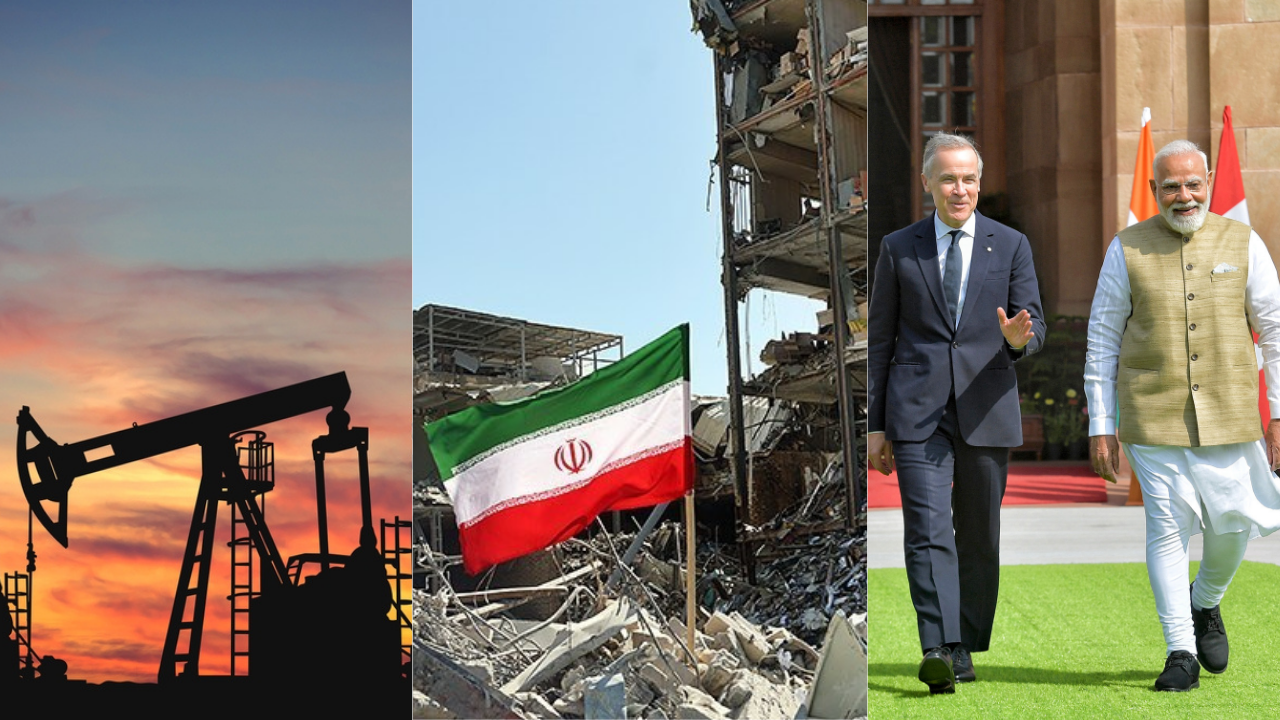
March 13, 2026 — In this week’s episode of Around the World, hosts Dhruva Jaishankar and Rachel Rizzo explore the recent disruptions in global energy markets following the Strait of Hormuz closure, examining its impact on oil prices and the steps countries have taken to mitigate the effects. They also continue the conversation on the Middle East conflict, delving into the debate over potential U.S. troop deployments to Iran despite opposition from both Democrats and Republicans. They wrap up the episode with a quick look at Canadian PM Mark Carney’s trips to India, Australia, and Japan, and what they signal about Canada’s efforts to reduce dependence on the United States.
Available on Spotify and Apple Podcasts.
Image: Andrew Ly / Shutterstock
Image: Tasnim News Agency / Hossein Zohrevand, CC BY 4.0, via Wikimedia Commons. Cropped from original.

Image: 205269. PM meets the Prime Minister of Canada, Mr. Mark Carney at Hyderabad House, in New Delhi on March 02, 2026. Courtesy of the Government of India Press Information Bureau, via pib.gov.in.
Sneak peak
Rachel Rizzo: On this week's episode.
Dhruva Jaishankar: So there's already a cooking gas shortage in India, in some of the smaller South Asian countries, in Africa, that we're already feeling. And secondly, jet fuel is another thing to watch out for, which is we're going to see a spike in airline prices because jet fuel is something that a lot of countries are dependent on the Middle East to export still.
Rachel Rizzo: Senator Blumenthal, who's a Democrat from Connecticut, walked out and said that he is under the impression that the administration is indeed on a path toward deploying American troops on the ground in Iran. This was a direct quote of his. And he said that he left briefing angrier than he had ever been at any briefing in his 15 years in the Senate and he left with more questions than answers. But I think that's what we have right now are more questions and answers.
Dhruva Jaishankar: And even on trade and economics, Canada is a major beneficiary of access to the United States market. And so, again, while we may see some diversification underway, it may not be as much, I think it's tempered by realism on the part of Canadian businesses as to how much they will.
WELCOME TO AROUND THE WORLD
Dhruva Jaishankar: Hello, I'm Dhruva Jaishankar.
Rachel Rizzo: And I'm Rachel Rizzo. Welcome to the Around the World podcast. Your essential guide to understanding the forces shaping our world today. Every week, we cut through the noise to bring you clear, insightful analysis of the most important developments in geopolitics.
Dhruva Jaishankar: Whether it's security challenges in Europe, great power competition in Asia, domestic politics in the United States, or regional developments in Latin America or the Middle East, we’ll discuss what's happening and more importantly, why it matters.
Rachel Rizzo: Thanks as always for tuning in. And be sure to like and subscribe to the Around the World podcast on Youtube, Spotify and Apple Podcasts. On to the show.
A sudden surge in oil pricing
Rachel Rizzo: Hey, hey, Dhruva.
Dhruva Jaishankar: Hi, good see you, Rachel. I'm back in Washington and you’re in Delhi?
Rachel Rizzo: Yeah, I can tell you've got the ORF America background. Here in Delhi, just wrapping up from the Raisina dialogue last weekend
Dhruva Jaishankar: Yes.
Rachel Rizzo: Where you of course were, you were here for it and we both recorded an episode from our various rooms in the same hotel so that was fun.
Dhruva Jaishankar: Yeah, and it was quite an eventful conference. This was held just a few days after the outbreak of war in the Middle East, but we had the Iranian Deputy Foreign Minister speaking, the US Deputy Secretary of State, the Israeli Foreign Minister participated virtually. And so the implications were on everyone's lips there, so kind of quite timely. But one thing that's happened, I think, in the last few days even has been extreme volatility in the global oil market and global energy markets.
Rachel Rizzo: Yep. Yeah, and that doesn't seem to be going anywhere. It seems to actually be getting worse.
Dhruva Jaishankar: Yes.
Rachel Rizzo: Especially now that the new Ayatollah just spoke and said that they were going to keep the Strait of Hormuz closed for now.
Dhruva Jaishankar: Yeah, so I mean I think this is really interesting to think through, right? You know, global energy consumption in some ways drives the economy. About a hundred million barrels per day of liquid fuel is used around the world. Mostly oil, you know, crude oil that's been processed, but also liquefied natural gas and other energy sources. And about 15 to 20 percent of all energy flows through this very narrow strait, the Straits of Hormuz. Between Iran on the one side and Oman and UAE on the other. And in some ways, the closure of the Strait of Hormuz has been like the nightmare scenario for people in the energy industry, right? Like this is something people have been contemplating what would happen with the global economy shut down. And yet that's precisely what has happened. Over 20 ships have been hit, I mean, container ships, commodity ships but also oil tankers have been hit in the ongoing conflict over the past 10 days or so and that has freaked out insurance companies
Rachel Rizzo: Mm-hmm.
Dhruva Jaishankar: Which are now charging a huge premium. Also the sailor security is also at risk and so we've had the effective shutdown of the Strait of Hormuz which is quite striking.
Rachel Rizzo: Did you see that article actually in The Economist, I think it was today or yesterday, basically talking about the very limited options that Trump has in terms of bringing down global oil prices and sort of balancing out the volatility? One of them was countries releasing some from their strategic reserves. There's obviously difficulties and challenges when it comes to that as well, though.
Dhruva Jaishankar: Yes. So initially, within the days of the outbreak, OPEC +, which is a cartel of oil exporters, including a few others like Russia, agreed to a very tepid—they had a scheduled meeting anyway—they agreed to a very small increase in production initially
Rachel Rizzo: Mm-hmm.
Dhruva Jaishankar: Which made people think that maybe people thought it was not going to be as bad. But what we've seen in last few days is the International Energy Agency, which is a group of mostly developed economies United States, Europe, Japan, South Korea, others, have collectively said that they're going to release 400 million barrels from their strategic reserves. And that is, in some ways, again, that's about four to five days of global energy consumption.
Rachel Rizzo: Oh so not much. Like, five days.
Dhruva Jaishankar: I mean, this is pretty significant, but again, if you add it up,
Rachel Rizzo: Yeah.
Dhruva Jaishankar: It doesn't appear to be that much. It'll be spread out over some time. So the idea is to give a bit more flexibility to the global energy market.
Rachel Rizzo: Okay.
Dhruva Jaishankar: But one thing I think has happened, which is I think, again, this was the nightmare scenario, but a few steps were taken by several countries over the past decade or so that has kind of offset some of the, again, the doomsday scenarios that have been predicted for this. One, I think the biggest one is that the US has increased its output significantly,
Rachel Rizzo: Mm-hmm.
Dhruva Jaishankar: Both oil and gas. A decade ago, a little over a decade ago, the US was the largest oil importer. It's now the largest producer in the world.
Rachel Rizzo: Mm-hmm.
Dhruva Jaishankar: It's also the largest liquefied natural gas LNG exporter in the world. So the US, to some degree, other Western Hemisphere economies, Canada, Brazil, Guyana, have all increased their output significantly over the past decade or so. And that has kind of offset some of the over-dependence on the Gulf. The second is that Saudi Arabia and UAE have built pipelines.
Rachel Rizzo: Okay.
Dhruva Jaishankar: So Saudi Arabia has a major pipeline going from east to west across Saudi Arabia, allowing them to actually use Red Sea ports to export oil. So it's again kind of circumvented the Strait of Hormuz. And the UAE has also built a west to east pipeline that runs parallel to the Strait of Hormuz. And so again, these two major pipelines have slightly offset some of the choke point that the Strait of Hormuz represents. A third development has been China building up reserves.
Rachel Rizzo: Okay.
Dhruva Jaishankar: China has invested massively in oil reserves over the past decade or so. And then lastly is the US has decided just in the last few days to kind of loosen some of the restrictions, sanctions, waivers on Russian oil exports as well. So all of this means that there's actually more flexibility, more resilience in the global energy markets than one might have expected a decade ago.
Rachel Rizzo: So is this like the doomsday scenario that everyone is saying that it is?
Dhruva Jaishankar: So yes and no. I think we are having the shock. I mean the reality is, the Strait of Hormuz is going to be functionally disrupted for perhaps weeks.
Rachel Rizzo: Yeah.
Dhruva Jaishankar: Again, people were worried about this. There is more flexibility in the global energy markets than before, as I mentioned, for all those reasons. So a combination of strategic reserves, storage in China, pipelines that build resilience in the Gulf, and greater exports out of the United States and the Western Hemisphere.
Rachel Rizzo: Mm-hmm.
Dhruva Jaishankar: But where I think the pinch is going to be felt is in areas which are more specialized.
Rachel Rizzo: Okay.
Dhruva Jaishankar: So for example, liquefied petroleum gas, which say in India, where you are,
Rachel Rizzo: Yep.
Dhruva Jaishankar: Is used a lot for cooking. So there's already like a cooking gas shortage in India, in some of the smaller South Asian countries, in Africa that we're already feeling. And secondly, jet fuel is another thing to watch out for, which is we're going to see a spike in airline prices
Rachel Rizzo: Great.
Dhruva Jaishankar: Because jet fuel is something that a lot of countries are dependent on the Middle East to export still.
“BOOTS ON THE GROUND”
Rachel Rizzo: Okay. So this isn't the only debate that we are having about the ongoing conflict in the Middle East. One of the big ones is this potential for, as we like to call it, boots on the ground. I'm putting this in quotes because it's become such a mainstay of discussions when it comes to U.S. involvement in really any conflict abroad. It's something we talked about when it came to the Nicolas Maduro raid earlier this year. We’ve, you know, talked about it through the lens of the conflict in the Middle East last year. So that's another one that's kind of heating up in the United States is where is the end game and does the end game include actual Americans on the ground in Iran somehow?
Dhruva Jaishankar: So what's striking is that Trump's campaigned on this issue.
Rachel Rizzo: Yeah.
Dhruva Jaishankar: That this would not, the end of forever wars, and even if there were gonna be strikes, and he had shown in his first term a propensity to use, for example, long distance airstrikes or targeted attacks, that it would not be, he would not go back to the era of Iraq, Afghanistan style, what critics call forever wars. So where do you see this going?
Rachel Rizzo: Yeah. Yeah, so basically where this, I mean, there's always a debate about this. Anytime you get involved in something overseas. And there's a debate about where we go with it and if American personnel are going to be necessary. So this particular one was essentially ignited by Secretary of State Marco Rubio, who is actually against this idea, who ended up telling Congress in a briefing that the US needs to physically secure Iran's nuclear material. He said people are going to have to go and get it. And that really freaked everyone out, not just amongst the Democrats, but Republicans too. Around that same time, there were these reports that started to surface that Trump had been in contact with Iranian Kurdish rebel groups in Iraq, which analysts and others and policymakers could interpret as potentially exploring proxy forces on the ground. At the same time, sources have told the media that Pete Hegseth is actively pushing for a ground troop deployment, while as Marco Rubio, as I mentioned before, is against the idea. So there's a split within the administration itself on this particular topic.
Dhruva Jaishankar: So it’s interesting to see where this goes. Again, one interesting point is that there have been US and Israeli strikes at border checkpoints between Iran and Iraq, which suggests, again, support for the infiltration of Kurdish rebels into Iran. And so when you talked about the proxy forces, that seems to be happening, at least.
Rachel Rizzo: Yeah.
Dhruva Jaishankar: But again, the politics around US boots on the ground in Iran will actually be, again, very interesting to see how that plays out between now and November.
Rachel Rizzo: It's going to be super interesting. There was a classified hearing hosted by the Senate Armed Services Committee where Senator Blumenthal, who's a Democrat from Connecticut, walked out and said that he is under the impression that the administration is indeed on a path toward deploying American troops.
Dhruva Jaishankar: Interesting.
Rachel Rizzo: On the ground in Iran. This was a direct quote of his. And he said that he left briefing angrier than he had ever been at any briefing in his 15 years in the Senate and he left with more questions and answers. But I think that's what we have right now are more questions and answers. The majority of voters in the US oppose sending US ground troops to Iran. Only 20 % support it. Even most Republicans support it, sorry not support it, oppose it as well. And at the end of the day, I mean, logistically it's going to be extremely difficult if you're talking about a ground operation, it's like airborne rangers securing entry points, special forces, you know, Navy SEALs carrying out these really sensitive tasks, trying to penetrate extremely hardened nuclear facilities, collecting intelligence, securing nuclear materials, and then getting out.
Dhruva Jaishankar: Hmm. Mm-Hmm.
Rachel Rizzo: I mean, I don't want to, I don't want to make a cartoonish comparison here, but I remember watching, I think we all watched Top Gun 2 a couple years ago, and it was all based on this Iran scenario.
Dhruva Jaishankar: Yes.
So I've been reading these things and I'm like, well, they were pretty close. But no, mean, I don't think Trump has ruled it out, but it would be, I think it would be, it would be pretty surprising at this point. But again, it's part of the debate. It's something we can't ignore and it's something to keep a close eye on for sure.
cAN CANADA DIVERSIFY?
Rachel Rizzo: Okay, and then moving on to a different region because we've been talking about Iran and the Middle East for a couple weeks now. Canadian Prime Minister Mark Carney was in Delhi. He's now in the Indo-Pacific. What are you watching there?
Dhruva Jaishankar: So again, in non-Iran news, Canada's Prime Minister Mark Carney, who made a speech in Davos a few months ago, which I think led to a lot of conversations about the Western unity. Essentially, he said that the US-led international order had been a bit of a fiction, that it was a useful fiction, but that time has come to an end and we need to move on. And it was a speech he wrote personally. You can criticize it. I think it's worth reading even if you disagree with it, but it kind of started a conversation on dependence on the United States and really on diversification. Can a country like Canada, which is so dependent on the U.S. for security and for its trade and economic well-being, actually successfully diversify? Carney went on a trip of where he visited India, Australia, Japan, not coincidentally for Quad partner countries of the United States, and in each case actually helped try to consolidate their relationship with a uranium supply
Rachel Rizzo: Mm-hmm. Yeah.
Dhruva Jaishankar: Deal in India, a meeting with the Prime Minister Albanese in Australia, and a new partnership that he was announced when he was in Japan. This kind of outreach reflects a kind keenness of Canada's leaders and businesses to reduce the dependence on the United States.
Rachel Rizzo: Yeah.
Dhruva Jaishankar: I think they're also appear to be tempered by a certain sense of realism that, you know, let's say on security, Canada remains extraordinarily dependent on the United States for missile defense,
Rachel Rizzo: Yep.
Dhruva Jaishankar: For foreign intelligence, and replacing that is going to be extremely costly.
Rachel Rizzo: Under spends on defense.
Dhruva Jaishankar: Yeah, and I think a lot of Canadian taxpayers or politicians understand the limits of that. And even on trade and economics, Canada is a major beneficiary of access to the United States market. So, again, while we may see some diversification underway, it may not be as much, or I think it's tempered by realism on the part of Canadian businesses as to how much they will continue to have to work with the US.
Rachel Rizzo: Yeah.
Dhruva Jaishankar: So something to watch, because it's part of, I think, a longer set of developments that is taking place. But it's interesting to see him going out so aggressively.
Rachel Rizzo: It is. Yeah, don't talk about Canada through that lens very often. And so it's a different moment for Canada, I think, for sure.
Dhruva Jaishankar: Yes, yes. And I think, you know, Carney's speech had been made by another leader who may not have had the same kind of resonance, but the fact that it was Canada of all countries that did that, I think was really what triggered a lot of, Trump himself started calling Carney, Governor Carney,
Rachel Rizzo: Yeah.
Dhruva Jaishankar: This is something he had previously only reserved for Justin Trudeau.
Rachel Rizzo: Uh-huh.
Dhruva Jaishankar: As a kind of to demean him. And in his meetings with Carney, he had been much more respectful until the speech. So let's see what happens now.
Rachel Rizzo: Yeah, absolutely. As always though, we are keeping an eye on all of these developments and more. We'll see what happens over the next five or six days when we record next week or the week after. But as always, thank you for joining us on the Around the World podcast. And as I mentioned before, always be sure to like and subscribe, listen to us on Spotify, Apple Podcasts, and YouTube as well. .
Dhruva Jaishankar: Mm-hmm. Thanks for joining us.
Rachel Rizzo: Thanks