
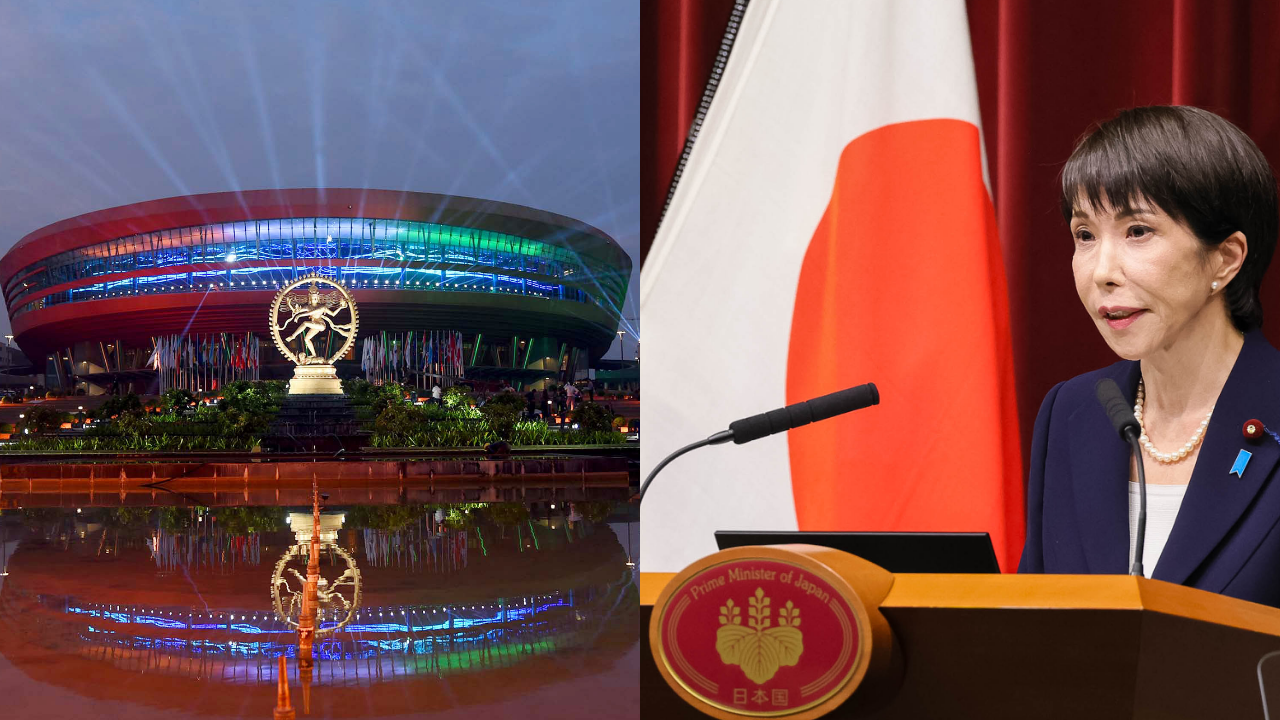
February 13, 2026 — In this week’s episode of Around the World, Amlan Mohanty, Technology and Society Fellow at Carnegie India, joins hosts Dhruva Jaishankar and Rachel Rizzo to discuss India’s upcoming AI Impact Summit, which will take place in New Delhi and feature global leaders and CEOs from companies like Nvidia, OpenAI, and Microsoft. They explore the Summit’s implications for global AI governance, India’s role as the first Global South host, and tensions around access, inclusion, and U.S.-China competition. Dhruva and Rachel then pivot to Japan, where they recap Prime Minister Sanae Takaichi's major victory for the Liberal Democratic Party during the recent snap election.
Available on Spotify and Apple Podcasts.
Image: Ministry of Culture (GODL-India), GODL-India, via Wikimedia Commons
Image: 内閣広報室|Cabinet Public Affairs Office, CC BY 4.0, via Wikimedia Commons


Dhruva Jaishankar: On this week's episode.
Amlan Mohanty: You know whether you have the US or China or India or the Middle East, I think everybody wants to see that AI is producing some significant social economic impact. But I think there are two areas where you are likely to see some tension. I think one is this question of access, right? Like US and China, for example, are competing with each other. And I think then that begs the question, what does that mean for access for the rest of the world? And the second area where potentially we could again see some disagreement is around this question of trust and safety. I think we've all seen that some parts of the world,are willing to take more of a free market, laissez-faire approach or deregulatory approach when it comes to trust and safety or AI governance. So what is, I think, the consensus around questions of trust and safety and questions of access is potentially where I think there could be some contentious discussion.
Dhruva Jaishankar: We discussed the new Japan's new prime minister, I think in October on an episode of the show, Sanae Takeuchi. She just had snap elections, general elections in Japan. Her party, the Liberal Democratic Party or LDP won just a sweeping landslide victory that was really quite stunning. And I think nobody would have expected this in October or September, October where she, you on a not even her first try, she had been elected leader of a battle party. She welcomed Donald Trump to Japan very soon after becoming prime minister. She's doubled down on relations with South Korea, which have always been a very sensitive subject in both countries. Then the other thing is there's a sort of a relatively new far right party called Sanseitō. And Sanseitō increased its vote share to about 7%. So again, something to watch there, but it has been quite a turnaround over the past three or four months in Japanese politics and again with some implications for Taiwan relations with China, Korea, the United States and beyond.
Welcome to Around the World
Dhruva Jaishankar: Hi, I'm Dhruva Jaishankar.
Rachel Rizzo: And I'm Rachel Rizzo. Welcome to the Around the World podcast. Your essential guide to understanding the forces shaping our world today. Every week, we cut through the noise to bring you clear, insightful analysis of the most important developments in geopolitics.
Dhruva Jaishankar: Whether it's security challenges across Europe, power dynamics in Asia, domestic updates from the United States, or regional updates in Latin America or the Middle East, we make sure you're up to speed on what's happening and more importantly, why it matters.
Rachel Rizzo: Thanks for tuning in. And also be sure to like and subscribe to the Around the World podcast on Youtube, Spotify and Apple Podcasts. Onto the show.
India's AI Impact Summit with Carnegie India's Amlan Mohanty
Dhruva Jaishankar: Hi, Rachel.
Rachel Rizzo: Hey, Dhruva, how's it going?
Dhruva Jaishankar: Good. I'm back in Washington after a quick trip to Europe. And how are you?
Rachel Rizzo: Good, good, good. You were in Budapest, right, for the Global Dialogue?
Dhruva Jaishankar: I was in Budapest yes, and very interesting politics there, something we'll discuss on a future episode. But this week we will focus on something that's happening in a few days, which is India will be hosting the AI Impact Summit, which brings together national leaders. We, I think, expect the leaders of France, Brazil, amongst other places, and the international CEOs, such as those of Nvidia, OpenAI, Microsoft, many more. And so they'll all be converging on Delhi in the next few days. And to discuss the summit and its implications, we're pleased to have Amlan Mohanty join us this week. Amlan's a lawyer by training. He's worked for Google and now is at Carnegie India think tank based in India and also works with Niti Ayog, which is the Indian government's in-house think tank. So Amlan, thank you for joining us this week.
Amlan Mohanty: Hey Dhruva. Hi, Rachel.
Rachel Rizzo: Hey, thanks so much for being with us today. Or I guess it's evening here in India. It's morning for Dhruva.
Amlan Mohanty: Thank you for having me. Of course.
Rachel Rizzo: So great to have you here. So we kind of wanted to start this out for people listening to the show. You some folks are like deeply steeped in the policy discussions around AI, the implications of AI. I am not one of those people. I focus on, you know, security and economics and those issues. So AI it’s something that, you know, that we all sort of have to touch on, but that is better understood by others sometimes. And so I wanted to, you know, maybe this is a question that's, you know, too easy, but we can start with an easy ballpark question. Can you explain for people that don't follow this stuff super closely, what exactly is the AI summit? Is it standalone? Is it part of a series? And how did India come to be hosting it?
Amlan Mohanty: Yeah, no, thanks, Rachel. There's no easy question. I think it's an important question to start off with. You can't, I think, escape AI in the newspapers or actually online or anywhere else these days. But it's worth thinking about why, like you said, India is hosting this summit. To answer your question, is a summit in the series of global AI summits that was first started at Bletchley Park by the government of the UK in 2023. Since then, it's been to Seoul and Paris and now in India and happens essentially every year. And so India was the co-chair of the summit last year along with France. And it was decided that India would host this year's summit. In terms of kind of what's unique about this summit, right? There are obviously lots of AI conferences that happen around the world. But this one's particularly, I think, important because it's actually hosted by the government itself. So in many ways, it's a multilateral platform that invites participation from governments around the world, but also features high level participation from companies, tech CEOs, AI startups, lots of international development organizations. And so they all come together in this forum once a year to talk about what's pressing and what's top of mind when it comes to AI. And so that's actually where we are at. And this is going to start on Monday on the 16th of February. And I will point out this is actually now the first global AI summit that's going to be hosted in the global South. And so I think that's also something to keep in mind.
Dhruva Jaishankar: So one subtle change that's happened, you mentioned it started in Bletchley Park, which is historically significant. was where a lot of the World War II code breaking took place, then to Seoul, Paris, and now here. But the name has changed a little bit over time, right? So the initial one was the AI Safety Summit. Then last year we saw the AI Action Summit in Paris. And this time they're calling it the AI Impact Summit. So what's the significance for that? And while you're at it, so what is India hoping to highlight beyond the name change as well?
Amlan Mohanty: Yeah, no, absolutely. You've hit the nail on the head. I think there's a lot that goes behind that nomenclature, right? I think the government of India was very, I think, intentional about calling it the Impact Summit. I think what they're really trying to signal is, in 2023, when the UK government hosted this inaugural Bletchley Park Summit, there was a lot of discussion about these large, potentially powerful models and applications like Chat GPT. They were concerned about what the risks of this could be, right? Like potentially malicious users around this or deep fakes or, you know, potential issues around bias and discrimination. So that was the focus then. And we've now since, you know, evolved to, you know, I think seeing some of the kind of potential of this technology. And we're, I think where we're at in 2026 is to say, look, there's all of this, you know, opportunity, look, all of these ideas, there's this optimism around this technology. But I think in 2026, we want to see that return of investment in a tangible way. And so I think that's what impact denotes. It's like, are we able to in 2026 really demonstrate what the social, economic, technological impact of this technology is on the lives of people? And I think this is something that's actually very personal to the Prime Minister Modi, who's been talking about really having AI touch people's lives and have a positive impact on their lives. So I think that's what this summit is being organized around. And I think that's why they picked the term impact summit. And I think you'll see a lot of the deliberations are going to be anchored around this idea of demonstrating impact, real social economic impact on the lives of people with AI.
Rachel Rizzo: Can I go back to something that you said in your opening answer that I wanted to get you to expand upon? You said, you know, it's worth noting that this AI Impact Summit hosted in India is the first one of its kind. You know, the first was in Bletchley Park, then Seoul, then Paris. This is the first that's hosted in the Global South. What is the significance of that in your mind?
Amlan Mohanty: I think it is actually really significant because it really, I think, informs the nature of the discussion and what I think the government leaders meeting in New Delhi next week are going to try and achieve and try and get out of this, right? Because it's the Global South, I think the nature of the conversation is a lot less about, you know, where is the technology at? Are we being able to, you know, develop this technology, accelerate this technology? So it's less about the technology itself and it's a lot more about people. And I think that's just a product of the fact that it is actually the global majority that we're talking about here, right? So people, for example, talk about what do you mean by the global South? Is it countries, you know, south of the equator? But I think, you know, you can use this synonym to say it's actually which represents the majority of the people of the world. And so, you know, this is a summit that's being organized around, you know, principles of human centricity, right? Like, again, as I mentioned, how does AI impact people's lives? And so I think, you know, that's one way to think about it. And the second, I think, is to think about where we are geopolitically right now. The rules of the global order are being rewritten. is rebalancing of powers. There's a lot of discussion around the importance of technology and trust in the context of multilateral bilateral relationships, and AI is central to that. So I think it's also worth thinking about where does the global South fit into this? And some people use the phrase middle powers. So I think you'll find that this summit is going to engage with questions around equity and access and inclusivity, which are, I think, very fundamental to how the Global South thinks about questions of access to technology and technology development.
Dhruva Jaishankar: I want to ask you a bit more on the application side in just a little bit. But first, mean, since you mentioned this of geopolitical context, we will have expect delegations to the summit from both the United States and China. And for many observers of AI, there seems to be at least on the R&D side in terms of developing AI models, kind of a two way race between the US and China to develop better, more comprehensive models. They're pouring tons of financial and human resources into this. So I think from the US we expect people, sort of a pretty senior delegation involving the White House, State Department, Commerce, and others, the scientific establishment. And then from China also, I think quite a senior delegation, sort of AI leaders from government. But what, where do you see, with this emphasis on the Global South, how do you see this affecting this kind of appears to be in some ways a two-horse race between the US and China to develop the most ambitious AI models.
Amlan Mohanty: Yeah, no, you're absolutely right. There is going to be a delegation from the US and China, but several other countries from the EU, from Latin America, from the African Union. So really, I think it speaks to India's convening power. And I think the relationships that Prime Minister Modi and his government have actually established over the last few years to ensure that this is a global summit, not just in name, but in substance. You actually have everybody that matters in AI at the table. So I think that's something to just note. And two, in terms of you know, kind of where we're at. Yes, it does seem like a two horse race when it comes to kind of AI technology development. But I said early on, I think, you know, this technology only really works and is only really transformative if it actually is diffused through the entire population. I think you'll see that message kind of hammered through the summit, which is, you know, whether or not, you know, it's the US or China that's actually leading this race. How do we ensure that AI is actually adopted and diffused across the rest of the world? And what are the mechanisms through which that happens? I think there'll be a big part of this summit that's going to be talking about access to this technology. What are the ways in which this can be accessed? So there's this entire discussion around Pax Silica that the US is leading, where this is about having like-minded countries at different levels of the supply chain have access to this technology. China has a similar kind of thinking around diffusing its technology through open source and open weight models and developing standards that allow for quick adoption of these technologies around the world. And you know, you see different parts of the world, including the African Union saying, you know, they're considering themselves to be scaling hubs, where you invest in this technology and you're able to develop this technology at a massive scale. India has its own kind of approach to DPI, which is again around openness and inclusivity and interoperability. So you actually see a lot of different, I think, ideas being presented at the summit. But I think fundamental and central to that is how can we leverage this powerful, potentially transformative technology and diffuse it through the entire world to ensure that there is actually human flourishing that's front and center of all of this.
Dhruva Jaishankar: So just a quick follow up and know Rachel has other question, but like you mentioned DPI, maybe just explain to people what DPI is for like non-Indian. I think in India, a lot of people know it intuitively. And maybe also what does the summit signal about India's broader approach to AI? What is India doing in the AI space? And maybe with some sort of what are some tangible outcomes that we've already seen India produce in the AI space?
Amlan Mohanty: Sure. Yeah. So DPI, the full form is digital public infrastructure. And it's actually more than a type of technology. It's a way of approaching technology design, which is to say, we'll create building blocks which are open by design, which are interoperable by design and are scalable by design. So these are some of these design elements around which you design technologies. And really the idea is people can build on top of this to be able to have impact at population scale. So let me give you an example, right? Aadhaar, which is a national ID project in India, is designed on these principles, right? It's, you know, interoperable, it's inclusive, it's open by design, and it's allowed the national ID system to scale to a billion plus people in a very short period of time. The UPI platform, the Unified Payments Interface is a P2P payments platform where people in India are able to make payment transactions between each other, independent of where your bank accounts or, you know, what applications you are using. So I can make a payment to Dhruva using a UPI app independent of you know where he is, what bank account he uses, what phone he's using, what operating system he's on, what app he's using. And this is, like I said, it's open, it's interoperable, it's inclusive, it's scalable. And so really, I think the Indian government is trying to think about how it can bring some of this thinking to this idea of having AI diffuse through the population to produce a real impact. And so you know I'm looking at the summit from the lens of what India might want to achieve. I think India will want to demonstrate some of this thinking. There is this national AI mission that was approved with a $1 billion plus initial budget that cuts across seven pillars, which includes things like data and computing power and talent and startup financing and trust and safety. So it will definitely want to bring that front and center. It will also want to, I think, demonstrate its own thinking around things like sovereign AI. So it is, for example, supporting and issuing, providing grants to local national champions to be able to build sovereign AI, which includes you know models. It's also funding local startups and MNCs to develop chips, semiconductors, and all of this will take time. But I think this is an opportune moment for the Indian government to say, and we heard IT Minister, Ashwini Vaishnaw at Davos talk about how India is investing across the AI stack. Dhruva, you mentioned applications and people kind of think about India being very forward and very successful at the application level, whether it's IT services or products. But actually, if you kind of listen to what I think Mr. Vaishnav was saying is India is investing long term across the AI stack, its chips, its data centers, its models, its applications, and this might take time. But that is the strategy for India. I'm sure it will be using this summit to showcase some of that work.
Rachel Rizzo: Are there any potential tensions that you're following or will be looking for potentially on display at next week's summit? mean, obviously different countries, I'm thinking of the US and China have potentially different futures in mind when it comes to the development and the use of AI. Maybe these clash even with the futures that major companies see as well. What are you going to be looking at in that specific route?
Amlan Mohanty: Yeah, no, that's a great question, Rachel. Look, I think there's some things everyone will agree on. And I think we're fortunate that on this idea of organizing principle of impact, I think everyone agrees that's where we're headed. I think it's taken some time, but whether you have the US or China or India or the Middle East, I think everybody wants to see that AI is producing some significant social economic impact. So I think that's why we agree. But I think there are two areas where you are likely to see some tension. I think one is this question of access, right? And fundamentally, I think, as Dhruva was saying earlier, because it's kind of this bipolar AI race we're working with, right? Like US and China, for example, are competing with each other. And I think then that begs the question, what does that mean for access for the rest of the world? Which of these two kind of future trajectories or visions for AI is the rest of the world potentially going to get?And two, between these two countries, how are they going to intermediate their relationship with the rest of the world in terms of access to this technology? So think access is going to be really a sticking point. And to really break that down with an example is if India is very keen to, I think, demonstrate and ask for a principle of inclusivity to drive future discussions around AI, which is, as Prime Minister Modi says, AI for all or AI for inclusive development. I would ask, is this something, for example, that the US government is going to get behind? Because from everything we've heard in the previous summit in Paris, one of the, I mean, for your listeners, that actually wasn't a consensus, in that leader statement. The US and the UK did not sign that leader statement. And one of the reasons potentially for that is there was a big emphasis even in that summit around inclusivity. And of course, that's a subjective term and you know, there might have been some tensions around questions around what that means. So I'll definitely be looking to see whether if the Indian government kind of advances some thinking around equitable access, around inclusivity, around questions of non-discrimination, whether it's something that they can build consensus around. And the second area where potentially we could again see some disagreement is around this question of trust and safety. And this is not new. I think we've all seen that some parts of the world, I think, are willing to take more of a free market, laissez-faire or deregulatory approach when it comes to trust and safety or AI governance. I think the US government is a good model of that. And so, while the Indian government has presented a model that's a lot more balanced and measured, which is try and promote innovation, support innovation, light touch, flexible approaches. They are aware and are willing to intervene through regulation to address specific risks. For example, the Indian government just issued regulations on deepfakes, I think two days ago. And that's actually quite at odds with some of the positions, like I said, that other governments are in. So what is, I think, the consensus around questions of trust and safety and questions of access is potentially where I think there could be some contentious discussion.
Dhruva Jaishankar: Well, thank you, Amlan. This has been very insightful and comprehensive. And I think this is obviously an issue that's not going to go away anytime soon. So I'm sure we'll have future discussions on this podcast and other places on AI. But good luck to you and your colleagues who have been working a lot over the past year plus too behind the scenes in terms of raising awareness and sort of fleshing out policies as well for next week's summit. And thanks for joining us.
Amlan Mohanty: Thanks, Dhrua. Thanks, Rachel. Really enjoyed this conversation. See you guys soon. Bye.
Takaichi Sweeps the Snap
Rachel Rizzo: Thanks for being with us. Bye. Okay, so we covered the AI Summit here in India, moving a little bit further to the east before we wrap up for the day. Elections in Japan. Dhruva, what do you have to say about, you've been watching this.
Dhruva Jaishankar: Yeah, yeah. I mean, we discussed the new Japan's new prime minister, I think in October on an episode of the show, Sanae Takeuchi. She just had snap elections, general elections in Japan. Her party, the Liberal Democratic Party or LDP won just a sweeping landslide victory that was really quite stunning. And I think nobody would have expected this in October or sometime October where she not even her first try, she had been elected leader of a battle party.
Rachel Rizzo: Mm-hmm.
Dhruva Jaishankar: Just looking back, her initial priority when she became prime minister in October was the economy. That was really bread and butter issues, people inflation, debt, things like that, that people focused on. But she also had to deal with a bunch of foreign policy issues immediately upon assuming the leadership. She welcomed Donald Trump to Japan very soon after becoming prime minister. She's doubled down on relations with South Korea, which have always been a very sensitive subject in both countries. So right now we have a sort of center left government in South Korea, a right wing government in Japan. This was traditionally a source of tension in the relationship. And the fact that the two of them, the two leaders actually did a drumming session together. I don’t know if you saw this, this went kind of, and she also had a meeting with China's leadership very early on in a bid to sort of engage them. Then what happened was in November last year, in remarks in parliament, she said that in a Taiwan crisis, that any kind of military conflict in Taiwan would constitute an existential crisis for Japan. And this led to, I mean, in some ways it was well known, this is something her predecessors had been dealing with, but this led to this really sharp response by Chinese diplomats in Japan. In fact, one of the consul generals, I think in Osaka, said something saying, when a snake sticks its head out, you have to cut its head off, which then he had to retract that.
Rachel Rizzo: Yeah.
Dhruva Jaishankar: And this led to basically a really nasty diplomatic spat between China and Japan. A Chinese fighter jet locked radar on a Japanese aircraft. Soon after that, China introduced new rare, January, new rare earth restrictions on Japan. Travel advisories were issued. But these events have only sort of added to Takeuchi's popularity and she ended up much higher than her own party.
Rachel Rizzo: Okay, so then why the snap elections?
Dhruva Jaishankar: So I think, again, the party had been sort of on the back foot. They'd been losing ground. I think the only saving grace for them was that there wasn't a unified opposition or a charismatic leader in the opposition that was able to take advantage of that situation. But the party was really, really unpopular and her predecessors were. I think she just took advantage of the fact that her personal popularity spiked after all of this, called snap elections, and this gamble appears to have paid off quite well for her. The LDP, her party, has increased its vote share by 10 % over the previous election. They want a complete majority. And at the same time, China has done a kind of quiet climb down. They sort of quietly authorized a continuation of some rare earth exports to shipments to Japan. And this victory will also strengthen her hand in dealing with Trump. Trump loves the winner. He sent a relatively warm congratulatory message to her. But a couple of things to observe about the elections. One is actually voter turnout was still really low. It increased just a little bit, but just over 50 percent.
Rachel Rizzo: Oh that is low, yeah.
Dhruva Jaishankar: So that still suggests that like in Europe, a pretty widespread dissatisfaction with electoral politics. And then the other thing is there's a sort of a relatively new far right party called Sanseitō. They have sort of modeled loosely on a sort of Japan, on a sort of American Manga movement or like the AfD in Germany and things like that, anti-immigration. And Sanseitō increased its vote share to about 7%. So again, something to watch there, but it has been quite a turnaround over the past three or four months in Japanese politics and again with some implications for Taiwan relations with China, Korea, the United States and beyond.
Rachel Rizzo: Absolutely, all stuff to watch.
Dhruva Jaishankar: Great. Thanks again for joining us this week on Around the World for what's been happening in geopolitics. Be sure to tune in every Friday for the latest episodes.
Rachel Rizzo: And as always, thanks for joining us. And as I said at the beginning, be sure to like and subscribe to the Around the World podcast. are on YouTube, we're on Spotify, and we are also on Apple podcasts. We'll see everyone next week.