
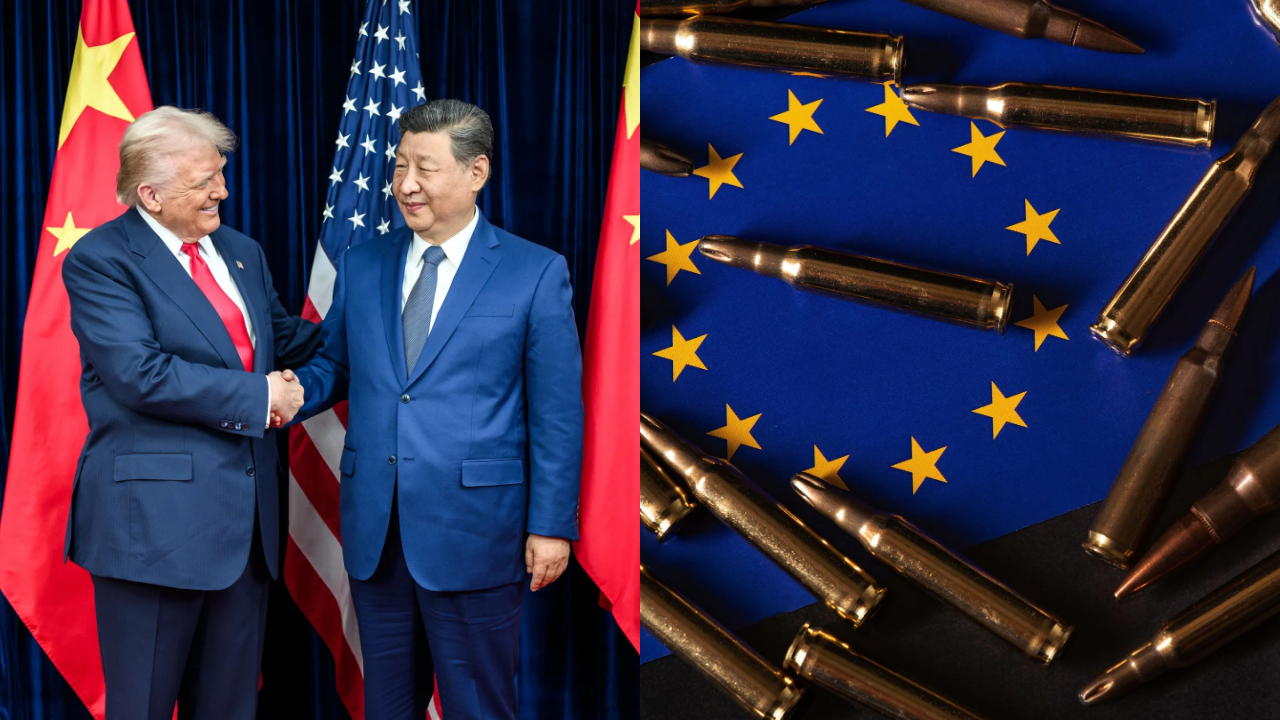
May 15, 2026 — In this week’s episode of Around the World, hosts Dhruva Jaishankar and Rachel Rizzo unpack the high-stakes summit between U.S. President Donald Trump and Chinese President Xi Jinping, outlining what each side is hoping to secure amid rising tensions over tariffs, critical minerals, Taiwan, and the conflict in Iran. The episode then turns to Europe’s mounting security dilemmas, from the future of NATO to the growing push for a more self-sufficient European defense strategy.
Available on Spotify and Apple Podcasts.
Image: The White House, Public Domain, via WhiteHouse.gov
Image: MantasVD, via Shutterstock.com
sneak peak
Dhruva Jaishankar: On this week's episode.
Rachel Rizzo: President Donald Trump, wants China to pressure Iran, to reopen the Strait of Hormuz. He really wants to clinch a deal on rare earths minerals used for the growing semiconductor industry and other things. And he really wants the Chinese to purchase US agricultural products that it had boycotted during the trade war.
Dhruva Jaishankar: I think we're going to start seeing the gradual Europeanization of NATO without anyone risking trying to sort of, they don't even want to publicly talk about a NATO minus the United States because that may become a self-fulfilling prophecy. So slowly developing autonomous capabilities and some areas will move faster than others, we will start just seeing the Europeanization of NATO rather than the dissolution of NATO.
Rachel Rizzo: In New Delhi, we have the meeting of BRICS foreign ministers here today. You have this list of countries that I think numbers 11 now and it comprises more than half the world's population. You have these countries that are growing in terms of GDP, and they're really wanting to remake the global system in a way where the rules aren't necessarily all written in Washington. And then you have Trump going to Beijing not from a position of strength either.
WELCOME TO AROUND THE WORLD
Dhruva Jaishankar: Hello, I'm Dhruva Jaishankar.
Rachel Rizzo: And I'm Rachel Rizzo. Welcome to the Around the World podcast. Your essential guide to understanding the forces shaping our world today. Here at Around the World, we cut through the noise to bring you clear, insightful analysis of the most important developments in geopolitics.
Dhruva Jaishankar: Whether it's security challenges in Europe, great power competition in Asia, domestic updates in the United States, or regional developments in Latin America or the Middle East, we make sure you're up to speed on what's happening and more importantly, why it matters.
Rachel Rizzo: Thanks as always for tuning in. And be sure to like and subscribe to the Around the World podcast on Youtube, Spotify and Apple Podcasts.
All eyes on beijing
Rachel Rizzo: Hey, Dhruva.
Dhruva Jaishankar: Hi Rachel, how are you?
Rachel Rizzo: Good good, it's been a while, hasn't it?
Dhruva Jaishankar: It's been three weeks since our last recording and a lot has happened around the world.
Rachel Rizzo: It’s been three three weeks?
Dhruva Jaishankar: Yeah, it’s been three weeks, yeah. But a lot happening, of course, continuing talks in Iran, something we may or may not get to, but not a lot of clarity there. We've had some political crises in a few places, including the United Kingdom, where Prime Minister Keir Starmer is facing resignations in his cabinet. It's kind of a real House of Cards type situation. But today, I think we can, something that's happening, that's ongoing right now is US President Trump's visit to China to meet with China's paramount leader Xi Jinping. How are things looking from New Delhi, where you are?
Rachel Rizzo: Yeah, I mean so this has been a highly anticipated visit. We've been talking about it for a few months now. And I think that, you know, President Donald Trump, this is his first visit to China since 2017, and he's showing up with a long list of needs. He wants China to pressure Iran, one of its closest partners, to reopen the Strait of Hormuz. He really wants to clinch a deal on rare earths minerals used for the growing semiconductor industry and other things. And he really wants the Chinese to purchase US agricultural products that it had boycotted during the trade war. And I think the thing about this meeting is that Xi, Xi Jinping, he knows every item on this list very well, and he's likely ready to play hardball. For example, when Xi threatened to restrict the exports of the rare earth minerals that underpin American semiconductors, EVs, fighter jets. They really got the United States to blink. And I think that the problem here with Trump coming to China with these asks is this fundamental scenario where Xi's guiding principle when dealing with Washington is that A, the East is rising and the West is declining, and that time and momentum are both on China's side. So it's going to be really interesting to see how both of those positions come to play in this meeting that is certainly very consequential.
Dhruva Jaishankar: Yeah, you know, it's interesting, the China policy under Trump's second term and remember his first term was one that really hardened U.S.-China policy. It sort of accelerated in some the competition. The 2017 national security strategy highlighted the Indo-Pacific as the first priority. There was a very nasty, you know, was spats over COVID and China's handling of the COVID pandemic in his first term over. There was a shutting down of a consulate. I mean, it was a, we've seen a bit of a shift in tone. And it started with Trump's inauguration, in fact, where he said he wants his legacy to be that of a peacemaker. He wants to end his second tenure as having reached some kind of grand bargain with China. And announcing that has already in some ways undermined, it's not like from a position of strength. It started off with, I want to do a deal with you. And then we've seen things flow from that with consequences for everybody else. That alone has made a lot of people in Washington, including in his own party, Republican Party, and his own administration, quite uncomfortable. That is, it's unclear how much of this is Trump reaching out to Xi and how much of this is really indicative of U.S. policy. And these views are not necessarily shared by members of the bureaucracy, Republicans in Congress, some businesses, and the military. So ne thing to watch out for, I think couple other factors have just shaped the tone of this conversation, but then we can get into a bit more detail about what they might be discussing, the content. One is, I think the tariff war last year led to this awkward truce. We spoke about it on the podcast in Korea when they met, and the fundamental, the basis of that agreement was China would continue to export rare earth permanent magnets to the United States. was a feeling the US was really dependent on that. And the US would continue to export certain amounts of high-end GPU semiconductors required for its AI development. And that was the kind of fundamental basis of that truce. Second is that Xi wants a return visit by the end of this year. So he's not going to give everything upfront now because he wants a
Rachel Rizzo: Yeah.
Dhruva Jaishankar: return visit to the United States by the end of 2026. And so again, there's indications that that may not resolve everything. Third, the Iran war has come in between, you know, this meeting happened a couple of months ago, I think the US would have had a much stronger hand. But now Trump is going a little bit more, you know, it has less leverage in some ways. So all of this is contributing to this perception, however real, that in some ways Trump wanted this meeting more than Xi did, and Xi's taking advantage of it. But getting to some of the substances, maybe talk a little bit about the trade and economic aspects of what they might be discussing.
Rachel Rizzo: Yeah, so there's a couple aspects here, trade and the economy, then sort of flowing from that, you have specifically rare earths and tech. So I think for China, they really want to buy some time to consolidate their technological and industrial positions. And for the US, I think they probably want to secure more symbolic wins rather than, you know, work towards any meaningful structural reforms to China's economic model. So I think if the US can push Beijing to, for example, buy Boeing aircraft or buy American soybeans for stability, they want to announce a bilateral board of trade and a board of investment. These have kind of already been sketched out in previous working level talks. And I think this is what happens for anyone that follows this high level symmetry very closely. A lot of the final outcomes are agreed upon ahead of time at the working level so that you can make sure that when you have the leaders meet at the highest level, they're able to sign a piece of paper and both sides can walk away with something and both sides can walk away with a win. Otherwise, you know, it could be seen as a failure. So you really want to make sure to cement those ahead of time. I think, you know, flowing from that, you have this issue of rare earths and tech, which I think is probably the most structurally consequential. China controls, and we've talked about this on the podcast, about 90% of global rare earth refining. So these are materials that we need for semiconductors, EVs, military equipment. And Beijing is expected to push for fewer US tech restrictions while Washington really wants China to resume shipments of rare earths and critical minerals after export controls really disrupted parts of the American automotive and aerospace sector. So kind of going back to what you were talking about in the tariff war last year, it hit both sides. So I think that the US is walking into this and there's sort of an uncomfortable reality, which is there's this rapid expenditure of advanced weapons systems in the US that have been used in the Middle East and Ukraine, which have compounded these deep vulnerabilities in supply chains that are tied to rare earth elements and magnets that China controls. And those inputs, as I mentioned, are dominated by China. So it's kind of a tough scenario, I think, for Washington walking into this. As you mentioned, Xi probably wants this meeting or knows that he can get more out of this meeting than perhaps the United States can.
Dhruva Jaishankar: Mm-hmm. And it also is this long-standing dilemma about short-term expedience. You need these critical supply chains versus a long-term de-risking. And how do you, over time, lessen that dependency? And the US is confronting that with China, but others are as well. Switching to geopolitics, how much do you think Iran will loom over? The Iran war and the straight-forward situation will loom over the Trump-Xi talks.
Rachel Rizzo: Mm-hmm. Yeah, so there, I mean, there's the geopolitical aspect to both to this as well, where you have Iran and you also have Iran and you also have Taiwan. So Iran in the Strait of Hormuz, I think for Trump, he really wants Xi to push Iran to reopen the strait. They want Beijing to use its over Tehran. China remains the largest buyer of Iranian oil. It purchases more than 80 % of Iran's shipped crude exports. But there's some complications here. Iran's closure of the Strait of Hormuz and Washington's competing blockade of Iranian ports have left Chinese ships stranded and in turn it has severely affected China's crude oil imports, half of which are shipped from the Middle East. So I think both sides have an interest in a resolution, but Beijing doesn't want to be seen as doing Washington's bidding for them. And so I think this is going to be sort of a delicate dance here. And then of course. And I'll come to you for this as well, because it's the elephant in the room, Taiwan. Xi said that in his opening remarks that Taiwan is, quote, the most important issue in US-China relations, and that if it's not handled well, it would push the relationship to a dangerous place. So I guess, you know, from your standpoint, what are you watching in terms of where both sides are going on on Taiwan? And how do you think this conversation is going to play out.
Dhruva Jaishankar: I mean, I think there's a lot of nervousness around that. Not so much, again, there is what will Trump himself say privately. You I think one of the you mentioned something earlier, you said, you know, most of these summits, and this is what I think a lot of us have grown accustomed to, you have a lot of the outcomes negotiated well in advance, you know, maybe until the final minute you have, but usually when a leader gets on a plane to go on a big trip somewhere, a big visit somewhere.
Rachel Rizzo: Yeah.
Dhruva Jaishankar: 95% of things are already ironed out. The challenges, as we've seen with Trump, and look at his summit in Alaska with Putin, that's not always the case. Or Vice President JD Vance's trip to Pakistan to negotiate with Iran. It's unclear whether a lot of the groundwork has been laid. And so I think a big uncertainty, and officials not just in Taiwan, but in Japan and others are sort of nervous about this, is what will be brokered behind closed doors by Trump himself? And will any indication be given? And there's an immediate issue over arms sales to, US arms sales to Taiwan that have been postponed because of this meeting. One thing China tries to do is always schedule these meetings to ensure that there's not an arms sale before. And that basically helps to postpone US arms sales to Taiwan. It's a game that they know they play, but that makes Taipei quite nervous. But even Japan and Japanese officials are sort nervous about what the outcome might be of that. Even if a signal is sent, even if unintentionally, on how much the US might be able and willing to defend Taiwan in the case of some sort of forceful reunification by the PRC. So anyway, that's, think, the subject of a great deal of uncertainty we’ll see what comes out of this. But more importantly than what comes out formally, I think, will be what signal does Xi himself read in the talks with Trump.
Rachel Rizzo: You know what I think is interesting too, and this isn't related specifically to the Trump and Xi meeting, but here in New Delhi, we have the meeting of BRICS foreign ministers here today. So you have Lavrov here, you have South Africa, you have Indonesia, you have this list of countries that I think numbers 11 now and it comprises more than half the world's population. And in both of these scenarios, Washington, in the BRICS scenario, Washington is absent. You have these countries that are growing in terms of GDP, and they're really wanting to remake the global system in a way where the rules aren't necessarily all written in Washington. And then you have Trump going to Beijing not from a position of strength either. So it's just interesting to see where the US is sitting on the world stage at the moment from two different poles, from two different meetings. And I don't know what that means going forward, but I think that there's been some leverage there that has been lost maybe for flying a little bit too close to the sun in some aspects.
Dhruva Jaishankar: And yet at the same time, Chinese Foreign Minister Wang Yi has decided to stay in Beijing for the Trump meeting and is skipping the BRICS summit. It tells you a question of China's priorities as well. Secondly, I think there's an inherent challenge within BRICS, which is there isn't really consensus on what kind of international order they do want to build. And you have countries like India, Brazil, some degree Indonesia, they're trying to position BRICS more as a non-Western body, and then you have China and Russia that want it to become a much more anti-explicitly anti-Western bloc and a much more cohesive bloc. And that tension is there. it's been there for a while. It's only exacerbated as new members have come on board. And then the third, this year particularly, there's a particular tension because Iran is a member of BRICS, as is the UAE, and they are effectively in conflict with each other at this point of time. And so in fact, I think a few months ago had we talked about the BRICS summit, which is going to take place in India this year, we would have said the main issue was resolving some of the dilemmas around Russia, China, India. But actually looks like the more immediate one will be between Iran and some of the other actors, notably the UAE to a lesser degree Egypt. Last year, in fact, the BRICS foreign minister summit did not even produce a joint statement on a very different matter. There were differences within the African countries between Egypt, Ethiopia, South Africa. So I think, again, on the one hand, you could say that there's that, but yet these other trends seem to indicate that despite the US losing some leverage, it still remains important as far as China's It still remains, Xi Jinping has said already, I think today, that it's the most important bilateral relationship, and Beijing understands that. And secondly, that the alternatives are still struggling to become very cohesive.
Rachel Rizzo: Yeah, lots to watch. then, so for you, you've been spending a bunch of time in Europe lately.
Dhruva Jaishankar: Yeah, been a lot, I just came back a few hours ago from Italy. I'm in the US now. But I've been taking part in a lot of very detailed conversations on European security with planners and policymakers from across Europe. And it's very interesting trends. It's a really interesting time to be looking at Europe's evolving security architecture. And again, it's quite complicated in some ways. I think the essence of it is that Europe faces a major security dilemma. And this will be reflected in July in about two months' time. There will be a summit in Ankara in Turkey where all the NATO leaders, 32 NATO leaders, including Donald Trump, presumably will attend. And this will be a real test, and not the last one by any means, of this transatlantic alliance, this 77-year-old alliance, NATO alliance, that now consists of 32 members.
Rachel Rizzo: And so, I mean, every time that there's a NATO summit where Trump is going to show up, everyone gets nervous about what's going to happen. So in the conversations that you've been having over the last few weeks, are people nervous about the summit in Ankara? How are they preparing for it? Do they feel united? What's the vibe, I guess?
Dhruva Jaishankar: So again, I think there's a dilemma, right? There's a great of almost visceral anger and a sense of betrayal on the part of European policymakers, including policymakers who are the most traditionally the most committed to the United States and we would be seen as the most pro-American voices in the European security establishment. They are very, you know, there's a real sense of personal, almost personal betrayal on their part of the United States. And it's a combination of things. It's the tariffs last year. I think Greenland was a real tipping point. I mean, there was real concerns about the US forcefully taking over at some point last year we talked about this. The non-coordinated Ukraine talks with Russia over Ukraine, that the US is kind of freelancing and not keeping Europe in the loop on things has been at times seemingly willing to give up too much. That's how they see it. And then now the Iran war. So this, you know, where some countries more than others have basically said we were not kept in the loop, we were not going to cooperate in this. And they're questioning both the legality of it, but more also the means by which it's being conducted and negotiated. So the combination of these things is really led to a deep, deep distrust of the United States. And yet few things remain, Europe's threat perception is still very high, although varied. And again, this is part of the problem that for countries in northern and eastern Europe, Russia remains an imminent challenge for them, security challenge. Yet for an Italy or Spain or Portugal, Russia is a distant, you know, a more distant challenge. It can be negotiated with. They're worried about the consequences, the immediate consequences. They're more worried about Mediterranean security, resource security, migration, illicit smuggling, things like that. China has surprisingly emerged as a new factor in European security calculus, both as an enabler of, as many Europeans see it, of the war in Ukraine and its backing of Russia, including through economic and supply chains. China's growing role in the Arctic, particularly the Russian Arctic, is being watched very carefully, and also a little bit in the Atlantic as well, where they're playing a role. So this idea that China was a sort of savior at least on the security side and increasingly on the economic side that's not really changed. That has changed a lot. It's no longer seen as some sort of alternative to the United States and Russia seen as a very close ally of Russia's.
Rachel Rizzo: Mm-hmm. Yeah, I mean, it's interesting because, you know, I've always been a little bit skeptical and critical of NATO wading too much into the China conversation or the Indo-Pacific theater. I mean I understand that you can't ignore China and I understand that you have to pay attention to its relationship with Russia. You have to pay attention to the way it funds and provides money and equipment for, you know, would-be adversaries. And you also understand that NATO needs a, something to shape its priorities. After 9-11, you had NATO and the United States and the global war on terror, the ISAF mission in Afghanistan, and NATO seemed very unified at that point. And then once you sort of lose a boogeyman, it becomes harder to maintain that unity. So then it was Russia and it's still and I wonder where China's going to fall into this.
Dhruva Jaishankar: I don't think, you know, there was actually a terminology that was quite carefully negotiated amongst, because they had to get consensus amongst all the members about how to frame China as a I think the term they used was decisive enabler in Ukraine, but also in the NATO strategy that emerged a few years ago, think it three or four years ago, there was a mention of China as a sort of strategic competitor. I forget the exact terminology that they used, but it was one of those things that was very hotly negotiated. I think the difference is this idea that NATO is going to be some sort of global force, which was what was in vogue a little bit after Afghanistan. That's out of the question today. The real question is European security and the role of Europe, the European member states in European security. The challenge, is that China is now increasingly encroaching upon that through a member. So in the Arctic, in the Atlantic, by its close partnership with Russia, including a defense industrial partnership that is emerging, but also I think in certain hybrid contexts as well. And we're seeing again, whether it's in cyber in the cyber space, whether it's in sort of non-conventional means, there are concerns, great concerns that are there. But it's obviously not going to be NATO's raison d'etre. I mean, that's really clearly Russia at this point of time. But again, there's this real dilemma that Europe is facing at this point of time. One is on the one hand, it has some It's the defense spending is really going up high, that's real, particularly by Germany. In a few years, German defense spending will be more than France and the United Kingdom's combined. Europe is also like, as we've seen, even with Ukraine, but also Poland, the Baltics, Czech Republic, they're really investing a lot in certain defense industries, particularly drones. So that's again real, they're becoming exporters of these systems. Europe collectively has industry leaders on artillery, tanks, diesel, electric, submarines, aircraft. So it has a sort of, I think one thing that is very real and is happening quite quickly is a real industrial rearmament in Europe that is definitely underway. The questions, though, are a few there, and this is why there's still a big gap. There's a leadership gap. So, very deliberately, there is no security leader in Europe. It's kind of diffused. Plans and command are in NATO, in which the US is still very deeply embedded.
Rachel Rizzo: And we lead, we have the Supreme Allied Commander of Europe, is in an American military position.
Dhruva Jaishankar: Exactly, is an American, right? Yeah, but recruitment and spending is really up to individual member states, right? They have own military policies. And then defense industrial capabilities, the EU is getting more more involved. They have a 150 billion dollar, a billion euro program called SAFE, Security Action for Europe. And that's a lending program to boost defense industrial production. They've just created a new European Commissioner for Defense and Space. So you have in some ways very disparate leadership. The second is that there's a technological gap. There’s certain gaps that Europe will struggle to fill if the United States is not in the picture. This includes surveillance, and reconnaissance, targeting for long-range strikes, space-based capabilities, air defense and missile defense functions, and probably most importantly, the nuclear umbrella. And that's something that they're going to struggle with. Weirdly, France is seen as something of a problem in a common European defense strategy, despite what French President Emmanuel Macron says publicly about the need for a cohesive strategic autonomy by Europe. that's basically European defense, I'm sorry, French defense industry is often in direct competition with the rest of Europe and the of Europe is towards these kind of pan-European coalitions for space, for defense, for nuclear, and France is doing its own thing. And so I think there's a bit of frustration, which is the talk of the French leadership doesn't quite match what they're doing in public. And finally, I'd say a big gap is a social one, which I think nobody is really talking about, is Europe remains a very pacifist society, maybe not quite on par with Japan. But most young Europeans do not want to join the military, there’s real opposition to perhaps reintroducing the draft in certain countries or some kind of conscription. This remains a very pacifist society and getting over that, again, with some exceptions, Finland is to some degree an exception. Getting over that will be quite challenging, which will have domestic political implications as well. So the upshot is, I mean, think where I'm sort of coming down on this is like, I think we're going to start seeing the gradual Europeanization of NATO without anyone risking trying to sort of, they don't even want to publicly talk about a NATO minus the United States because that may become a self-fulfilling prophecy. So slowly developing autonomous capabilities and some areas will move faster than others, we will start just seeing the Europeanization of NATO rather than the dissolution of NATO.
Rachel Rizzo: And not to like toot my own horn, two years ago, my colleague and I from, I think it's called the Europe's War Institute, his name's Michael Benhamou, he's French, we wrote a piece called, I think the title ended up being, It's Time to Europeanize NATO. And it was this argument, like, Europe needs to fend for itself. No matter who comes after Donald Trump, the machinery is starting to roll a certain way. And no matter who comes after him, it's not going to be a return to things as it once was. The paradigm has shifted permanently. And NATO needs to Europeanize itself. And some people, you look at the Cato Institute and the folks over at Stimson that are more of the like realist lens and you know they're kind of like cheering for that position but then you had folks that you even I worked with at the time who hated this piece and hate this argument because they think it's a so you're creating a self-fulfilling prophecy rather than creating a NATO that will be much stronger at the end of the day so I've always been on this you know Europeanize NATO wagon and I'm excited to see more and more people join me on here because I think the right way forward ultimately.
Dhruva Jaishankar: Well, it's a way of threading this needle, right? is, I mean, think the reason I think it's happening is that the alternatives are just not really feasible this idea that overnight there'll be a European army is not feasible for a variety of reasons, nor is this idea that the US can be dependent upon in perpetuity for defending Europe. So I think that this is the natural outgrowth of that. But anyway, interesting times, very serious conversations on the way. think some things, again, are moving faster than a lot of people expected. Other things are moving in a very gradual pace for a variety of political, social, and economic reasons.
Rachel Rizzo: Yeah, absolutely.
Dhruva Jaishankar: So again, interesting times for Europe as it reemerges as a geopolitical actor rather than a geopolitical theatre.
Rachel Rizzo: Yeah, we'll keep an eye on the summit. I think it's in July, so in couple months from now.
Dhruva Jaishankar: Yeah, early July.
Rachel Rizzo: As always, we're still tracking the negotiations in Iran. Also Ukraine, which doesn't get a lot of coverage these days, but those are still happening. We'll keep an eye on these. Make sure we're keeping everyone up to date. And be sure to tune in for our latest episodes every couple of weeks. Depending on how wild the news cycle is, sometimes we do every week, sometimes we do every two weeks.
Dhruva Jaishankar: As always, thank you for joining us on the Around the World podcast and tune in and we'll see you again.
Rachel Rizzo: Thanks.