
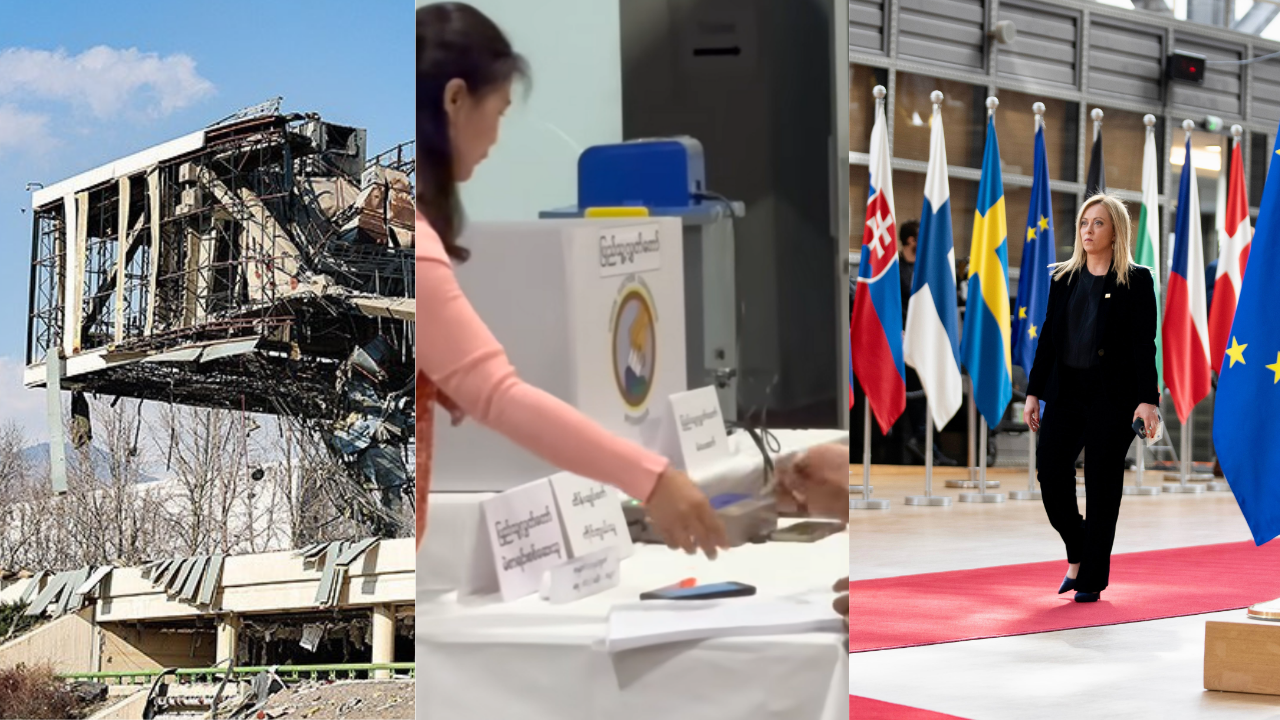
October 24, 2025— Hosts Dhruva Jaishankar and Rachel Rizzo delve into the ongoing Russia-Ukraine conflict, highlighting Ukrainian President Volodymyr Zelenskyy's recent visit to D.C. and Putin-Trump talks. They also cover the recent election of Japan's first female Prime Minister Sanae Takaichi, and U.S.-Australia relations with focuses on rare earth agreements and the AUKUS pact.
Available on Spotify and Apple Podcasts
Transcript
Sneak Peek
Rachel Rizzo: I think this created a situation where Putin really blinked and got on the phone with Trump and there was some discussion about the two sides potentially meeting in Budapest, but that meeting has been scrapped for now.
Dhruva Jaishankar: So you've had now the past few years a series of short-lived prime ministers, each of whom who has been quite unpopular. But the opposition parties are even more so and don't have enough the numbers to actually form a credible opposition.
Rachel Rizzo: Keeping it in the Indo-Pacific, but moving it south a little bit, we had a major visit this week with Australian Prime Minister Anthony Albanese. So were you watching that? How did that go? What was the point of this visit? I didn't even know he was in town. I don't think a lot of people did.
Welcome to Around The World
Dhruva Jaishankar: Hi, I'm Dhruva Jaishankar.
Rachel Rizzo: And I'm Rachel Rizzo. Welcome to the Around the World podcast. Your essential guide to understanding the forces shaping our world today. Every week, we cut through the noise to bring you clear, insightful analysis of the most important developments in geopolitics.
Dhruva Jaishankar: Whether it's security challenges across Europe, shifting power dynamics in Asia, domestic updates from the United States, or regional updates from Latin America or the Middle East, we make sure you're up to speed on what's happening and more importantly, why it matters.
Rachel Rizzo: Thanks for tuning in.
Dhruva Jaishankar: It's been an interesting week as usual. We've had a burglary in the Louvre, which is something out of Ocean's Eleven. Iceland recorded its first mosquitoes, a sign of global warming. RIP D'Angelo,
Rachel Rizzo: Super newsy stuff. Lots of lots going on.
Zelensky Comes to Town
Dhruva Jaishankar: Yes, yes, yes, so a lot of important things, but let's bring it to something that's on a lot of people's minds is a war still going on in Ukraine. Ukrainian President Zelensky was in Washington, D.C. he met with President Trump. How did that go?
Rachel Rizzo: So there's a couple things here. First, the meeting was not as a much of a public disaster as the meeting between Zelensky and Trump in November. Remember that one took place in the Oval Office. It was super public. It devolved really quickly. This one was behind closed doors and reports indicate that it got just as contentious, especially because Zelensky is hoping to get more support from the United States on the ongoing war. And again, this meeting devolved into like map throwing and some arguments between both negotiating sides and Zelensky walked away with nothing yet again. So not great, but not as bad as the meeting went back in February. So at least that's a positive development. Pretty low bar, unfortunately, yeah.
Dhruva Jaishankar: That's a very low bar.
Rachel Rizzo: Pretty low bar unfortunately, yeah.
Dhruva Jaishankar: What do you think is animating Trump's... What are the major points of disagreement here?
Rachel Rizzo: OK, so there are a few things here. The first is that you talk to a lot of people who focus on Europe, who focus on Ukraine, and they'll say that Trump is always flip-flopping on his position with Ukraine. And I actually don't think that's true. The one consistent thing about Trump is that I don't think he really cares whether or not Ukraine specifically wins this war. What he cares about is that his team is able to get a win for his administration. Now this meeting with Zelensky came on the heels of a couple things. The first was, as we talked about last week, this ceasefire between Hamas and Israel, which is tenuous at best. But it also came on the heels of a two hour phone conversation with Putin. Now a couple weeks ago, there were discussions being floated about potentially having the United States send long range Tomahawk missiles to the Ukrainians and letting them use them. And I think this created a situation where Putin really blinked and got on the phone with Trump and there was some discussion about the two sides potentially meeting in Budapest, but that meeting has been scrapped for now. So there's just a lot of, this is a quick moving conflict. It's still going on. Russia continues to bombard Ukraine and it still shows an unseriousness or an unwillingness to really come to the table.
Dhruva Jaishankar: Yeah, so they spoke, Putin and Trump spoke about a potential meeting in Budapest. It was announced Trump kind of announced it. There's some significance to Budapest being a European Union country, Hungary being a European Union country, a NATO member. But Viktor Orban, the leader of Hungary, has been more sympathetic than most European and EU and NATO countries and NATO leaders to Russia, right? So there was a self-significance of where they met. But why did that meeting get scrapped then?
Rachel Rizzo: So it seems as though the meeting got scrapped because there were not really going to be any deliverables in this meeting because there is still too much daylight between Ukraine and Russia in terms of what both sides are looking to get out of a potential ceasefire negotiation and where the two sides actually are. So I think Donald Trump and his team wanted to avoid an Alaska 2.0. Now, Alaska was, course, where Putin and Trump met a couple of months ago. And it was this, you know, he literally rolled out the red carpet for Putin thinking that they were going to walk away with some sort of negotiation or some sort of settlement and instead walked away with nothing. And I think you can blame that on a few things. The first is just, as I said before, Putin doesn't want to negotiate. This war gets to the heart of like Russian identity for him and his legacy and the legacy of like Russian imperialism. The second is that I think Steve Witkoff and his negotiating team kind of oversold to Trump what the Russians were willing to come to the table with in August. And so instead ahead of this potential meeting, Trump and his team sent Marco Rubio to talk to Lavrov, and I think out of that meeting it became very clear that there really is nowhere to go as of now. So what happens now? The US sanctioned two major Russian oil companies today, Luke Oil and Rosneft. So that's good. It still isn't sending Tomahawk missiles, although I don't think that's totally off the table. There's a big question about whether Europe will be able to use these frozen Russian assets that they're holding in a Belgian bank to provide loans to Ukraine for its recovery. So lots of big questions and stuff that we will cover in, I'm sure, the coming weeks and months because unfortunately I don't think this war is going anywhere anytime soon.
Dhruva Jaishankar: And those sanctions that were rolled out are going to have effects on the global oil markets. In fact, it's something being watched in India as well because there will be some potential spillover effects for global oil prices and for India as well.
Rachel Rizzo: Yeah, and I think there's been obviously frustration in India because as we remember, when this full-scale invasion happened in 2022, there was a push by the West to have India purchase Russian oil to keep global oil markets stable as other entities like the EU weaned themselves off of Russian oil. So it puts India in a difficult spot. But again, I'm sure that there will be plenty to talk about on this front for the time to come.
Japan Elects a New PM
Rachel Rizzo: And then I wanted to turn to you to look even further east than Ukraine and Russia, kind of focusing on the Indo-Pacific a little bit this week.
Dhruva Jaishankar: Yep.
Rachel Rizzo: And there's two major developments. The first is that there is a new Japanese prime minister. Tell us about her.
Dhruva Jaishankar: Mm-hmm. Yep. Yeah, so the Japan elected this week its first female prime minister, Sanae Takaichi. This is actually her third bid for a leadership position for leadership of her party, the LDP, and consequently the prime ministership. This made her the first female and a lot of the commentary is focused on a few things. One, her being the first female. Two, her being very conservative and three, some of the personal quirks in her personality. But just a little bit of background on this. So the Liberal Democratic Party, the LDP, has pretty much had a lock on politics in Japan for the past 70 years or so. And what ended up happening while it consistently formed the government, it was basically a series of factions within the LDP that kind of jostled for power. And they had a sort of informal system of rotating the leadership amongst these factions. And so if you had enough of the factions aligned on something, they would help appoint the new leader. This kind of got disrupted. There were a couple of sort of interregnums in between short periods when non-LDP coalitions formed but they were short lived. Then over the past two decades, two figures kind of came to dominate Japanese politics. First Junichiro Koizumi who was prime minister for quite a while, very popular, and then Shinzo Abe, who really sort of dominated Japanese politics. And the sort of faction system kind of broke down a little bit. Now, with Abe's assassination, he was assassinated shortly after he stepped down as prime minister. There were number of scandals that the LDP was involved in, including one involving the universal church and funding around this, which made the LDP really unpopular. And so you've had now the past few years a series of short-lived prime ministers, each of whom who has been quite unpopular. But the opposition parties are even more so, and don't have enough the numbers to actually form a credible opposition. I would just put Takaichi in as part of a series of likely short-lived prime ministers in this very unusual political terrain where the LDP is deeply unpopular and yet the opposition is too weak to actually provide a credible alternative.
Rachel Rizzo: Is it sort of like in the US where in 2016 we had Hillary Clinton running against Donald Trump and a lot of people voted for Donald Trump not because they liked him but because they really didn't like Hillary Clinton and there weren't any other options? Could you kind of compare it to that a little bit or is it just a different political system?
Dhruva Jaishankar: You know, I think it's a parliamentary system, so it's very difficult. I think the US politics won't offer an easy analogy where you have, again, a dominant incumbent party that is so unpopular and yet, again, no credible, serious opposition that's likely to form a true alternative for the long run. So I'm not sure there's a good US analogy to it, but I'm sure you can find something in British or some other politics. Actually, maybe British politics today offers something of a parallel.
Rachel Rizzo: Well, yeah. It could and so I also kind of road tested this comparison earlier with one of my friends who works on Asia and works on Japan and it seems like maybe you could sort of compare this new prime minister. She's sort of like maybe a Japanese Meloni where Meloni is like right wing and some might say far right. She is like very traditional in her values but is also kind of liberal internationalist in her approach. Like she's supported Ukraine, supports NATO and the EU. So, you know, there's this comparison that people draw between like what a prime minister does at home and how right-wing they might be and how that translates to what kind of policies they stand for on the world stage. So I wonder if that's maybe something to watch for.
Dhruva Jaishankar: So we'll see about that. I mean, at least Meloni is quite popular now at home in the sense that she's got enough of a mandate now that she's going to be a figure and she's not in a precarious position. We still have to see about Takaichi now. A couple of things on that front, though. One is she'll have an early opportunity to meet Trump. Trump is going to Japan as part of his Asian swing. He's going to Seoul. He'll likely meet Xi Jinping there, amongst others, for the APEC summit. So he is doing an early visit to Japan. And so an early test of the new prime minister will be this visit on the diplomatic side. There will be security and trade issues on the agenda when they meet. And so she will be tested quite early and her ultimately her management of the economy and this of tricky diplomacy will be this early test. Another thing to watch out for just on the domestic side, her biggest challenger is Shinjirō Koizumi who is the son of Junichiro Koizumi, who I mentioned earlier, who was very popular prime minister. And he is sort of like the first, might be the first millennial leader of Japan. He's kind of been groomed for this. He's made two or three bids now for the leadership position and fallen just short, but he's taking over the portfolio of defense minister.
Rachel Rizzo: Oh interesting.
Dhruva Jaishankar: And that's a sort of really interesting you know, particularly at this time where there's this emphasis on defense spending, moving him to a serious portfolio. And he was again, the most likely credible challenger to Takaichi. That's a space to watch.
Rachel Rizzo: And then of course, another issue to watch is Japan-Korea relations.
Dhruva Jaishankar: Yeah, so that'll be another test of Takaichi. So interesting thing has happened. Korea recently elected a new president, Lee Jae-Myung. He's a really interesting character. He came from a very humble background, union leader. He's with the Democratic Party of Korea. And this has historically been a faction that has been more skeptical of the US alliance, but also more skeptical of relations with Japan. And these issues, these historical issues between Japan and Korea have often bubbled up to the surface under this dispensation. In theory, a sort of center-left leader in Korea, a right wing leader in Japan might be the kind of combination that would lead to a resurfacing of some of these issues that many had thought had been put to bed. again, there's something the Biden administration did a lot. They held a trilateral summit in Camp David- US, Japan, Korea. And that was really an attempt of putting to bed a lot of the historical distrust between Japan and Korea. So one of the things to look forward to now you have new governments in the United States, Japan, Korea. Different parties in all these places, not in Japan, but different parties in the other two.
Rachel Rizzo: Mm-hmm.
Dhruva Jaishankar: How much can this hold? The early signs are actually quite positive for the Japan-Korea relationship. One of the first places the new Korean President Lee visited was Japan. He then came to the United States, had a relatively good meeting with President Trump. One thing, however, while they may be able to manage those historical differences, other factors have now come into play. Tariffs, of course, being one, but also the arrest of these Korean workers at a factory in the United States, which is still dominating headlines in Korea.
Rachel Rizzo: Oh yeah.
Dhruva Jaishankar: Anyway, all of this means that we're in a very interesting place to watch as Trump goes to Japan first and then goes on to Korea.
A Bit More South of the Indo-Pacific
Rachel Rizzo: Yeah, and obviously with this administration, the Indo-Pacific and the states within it are both a geographical focus, but also a bilateral focus for them as well. you know, keeping it in the Indo-Pacific, but moving it south a little bit, we had a major visit this week with Australian Prime Minister Anthony Albanese. So were you watching that? How did that go? What was the point of this visit? I didn't even know he was in town. I don't think a lot of people did.
Dhruva Jaishankar: I did because I actually got stuck behind his motorcade at one point.
Rachel Rizzo: Okay, fair.
Dhruva Jaishankar: So I was late to something because I saw this Australian motorcade go by. So I did actually know he was in town. It also got overshadowed by another thing, which is Trump went after Australia's ambassador to the United States, former Prime Minister Kevin Rudd. And we had a slightly Zelensky-like moment in the White House where he said, I know you said bad things about me. And it led to a little bit of tension that's been all over the Australian press. But the two important reasons, one is there's a feeling in Australia that the United States under Trump in the second term is really not paying enough attention to them. There's a little bit of so they're hoping to get some of that back. But two things to look out for. One, there was an agreement on rare earths, which is one thing that really animates this White House. They care for some reasonable, you know, well, good reason in some ways because of the China concerns. They care about rare earths. So they’ve reached an agreement. Australia has more active rare earth exploration projects than any other country. So a lot of potential.
Rachel Rizzo: Mm-hmm.
Dhruva Jaishankar: So they've agreed to a smallish, significant but still small capital infusion to invest, but more importantly, a sort of price management mechanism to counter Chinese dumping because essentially what China has been doing is flooding the market at certain times to undercut and essentially make it financially not viable to invest in rare earths. So that's one of the things that there is now some coordination mechanism for managing prices for rare earths. And the other significant thing about this visit was Trump essentially seemed to greenlight AUKUS. And this is an agreement, a US-Australia-UK agreement that was signed under the Biden administration. It has survived changes in government in both Australia and the UK. And it's a somewhat controversial project, mostly for the expense, to do two things. One, help Australia acquire nuclear-powered submarines. This is called Pillar 1 of AUKUS.
Rachel Rizzo: Yep.
Dhruva Jaishankar: And this would give their submarines reach into the Northern Pacific in a way that they can't currently achieve that. And the second aspect is to collaborate in certain critical technologies and that's already starting to reap some dividends. So that's essentially the green light on AUKUS, which the Trump administration had been reviewing and this rare earth agreements were two of the highlights of this visit.
Rachel Rizzo: Ok, and I think probably at some point it would be worth it for us to do a deep dive on AUKUS because this was such a huge part of the Biden administration. I remember when this was announced a few years ago, how upset the French were.
Dhruva Jaishankar: Yes.
Rachel Rizzo: They were so upset, actually, that the French ambassador to the US canceled a major party at his house, which is like everyone looks forward to this and everyone was so upset about it. And so, I think for our listeners and people who tune in who don't know the background on AUKUS, we'll do a deep dive in that sometime soon. obviously lots of stuff to keep watching here. We also have a major high level EU summit happening in Brussels next Tuesday. So we'll be watching that really closely and can give you some updates next Friday on what comes out of that meeting. Our listeners will keep you up to date on the latest happenings on this in geopolitics. Be sure to tune in every Friday, especially next Friday for the latest episodes.
Dhruva Jaishankar: As always, thank you for joining us on the Around the World podcast and we'll see you next week.