

Background Paper No. 39
BY Anit Mukherjee and caroline arkalji
I. CONTEXT: THE DECLINE OF AID
Global development assistance is undergoing a radical transformation. Over the past two years, the United States, Europe, and other traditional donors have significantly scaled back their aid and concessional financing commitments to developing and low-income countries. Official development assistance (ODA) declined by nearly a quarter in 2025 and is projected to fall further by nearly 6 percent in 2026, reaching around $153 billion in 2026. This constitutes a reduction of nearly $50 billion from 2023 levels, with direct consequences for financing for poverty alleviation, health, education, social protection and climate resilience in developing countries.
This decline is occurring as debt servicing obligations are rising across low- and middle-income countries. In 2024, their collective external debt reached $8.9 trillion, equivalent to 23.4 percent of their combined gross domestic product (GDP), including $1.2 trillion owed by the 78 most vulnerable countries eligible for World Bank’s International Development Association (IDA) finance. While a significant share of this borrowing was supposed to support development priorities, servicing obligations now constrain new spending: 21 of 89 low and middle income countries spend more than 20 percent of government revenue on interest payments alone. Globally, around 3.3 billion people live in countries where interest payments exceed public spending on education and health combined, resulting in a shrinking fiscal space for long-term development.
The rationale for development cooperation is also changing. In traditional donor countries, aid is increasingly viewed through the lens of national security and geopolitical competition, shifting from what was once framed as global solidarity into a more transactional instrument of foreign policy. As external assistance becomes more limited and less predictable, countries from the Global South are being forced to reevaluate their approach to external assistance. This vulnerability is particularly evident in the health sector, which has been disproportionately affected as the United States, which accounted for approximately 42 percent of global health ODA in 2023, has slashed support.
This shift is changing the nature of development cooperation. Low-income countries have a wider choice of sources of development finance at a time when concessional aid is becoming scarce. The changing composition of sovereign creditors illustrates these trends, as within the countries eligible for the IMF's Poverty Reduction and Growth Trust (PRGT), the share of traditional Paris Club creditors in total disbursements have declined from 39 percent in 1996 to 12 percent in 2020, while the share of non-Paris creditors, including China, rose from 8 to over 20 percent in the same period. While the shift away from multilateral engagement may create new options for some borrowers, this geoeconomic fragmentation is likely to involve significant economic costs in the aggregate, making it difficult to coordinate financing in critical areas such as climate change mitigation and pandemic preparedness.
The focus has shifted to a new framework where developing countries have greater agency to negotiate the terms to access development finance and investment to support long-term development objectives. The reshaping of trade flows and supply chains due to tariffs and export controls, the need for diversification of energy sources, the rising demand for critical minerals, and strategic competition between the United States and China for influence over market access, maritime routes, and logistics corridors create space for some countries of the Global South to become key players in the emerging global development paradigm.
In this scenario, how can recipient countries of loans and concessional finance increase their bargaining power to secure finance and investment for sustainable development? The most common assets that developing countries have leveraged include access to their markets, their natural resource endowments, and their geographic locations, with the most adept states often combining these attributes to leverage supply chain disruptions and geopolitical competition. Notable examples include Cambodia, Guyana, the Democratic Republic of Congo (DRC), Mozambique, and Palau which have been among the larger recipients of external financing in the developing world (as a percentage of GDP). The experiences of these and other countries can be used to derive useful lessons, including the need for stronger domestic institutions to ensure long-term productivity, the benefits of prudent fiscal and sovereign wealth management, and the compounding effects of collective bargaining through multilateral or regional groupings.
II. FROM AID EFFECTIVENESS TO STRATEGIC BARGAINING
The existing literature on aid effectiveness highlights the asymmetry in bargaining power between traditional donors and recipients, with the balance strongly in favor of the former. Limited bargaining power has constrained the capacity of countries of the Global South to negotiate the terms of engagement with bilateral and multilateral donors. Even when development assistance is based on global consensus such as the Millenium Development Goals (MDGs) and Sustainable Development Goals (SDGs), allocation is often determined by donor priority rather than country needs. Moreover, countries with stronger governance and implementation capacity often capture a larger share of development assistance, gaining greater access to external resources than countries that have not demonstrated comparable results.
While the decline of traditional development assistance presents significant challenges, it also highlights a deeper question that has received growing attention in the literature: why are some developing countries more successful than others in attracting external resources and shaping development partnerships? Answering this question requires examining the evidence on the allocation of aid, the motivations of external actors, and the sources of bargaining power available to recipient countries.
The consensus in the traditional development literature recognizes recipient need, often represented as low GDP per capita, as a main moral and economic justification for aid, as extremely poor and heavily concentrated countries face more investment constraints. Experts argue that aid is essential for filling financial gaps in sectors like health, education, and infrastructure to break poverty traps. However, an extensive body of research highlights that donor strategic interests frequently displace the recipient's needs. Studies show that bilateral aid is often used as a tool for geopolitical diplomacy, with donors rewarding political affinity or allocating aid to secure export markets or promote commercial interest in recipient countries.
The debate on the effectiveness of aid involves two opposing frameworks. Jeffrey Sachs, among others, argues that large scale, coordinated public investments can break localized poverty traps and catalyze sustainable development. The likes of William Easterly counters that traditional top-down development and foreign aid often fails because it relies on grand blueprints, whereas homegrown, trial-and-error experimentation yields far better results. A more balanced approach in the debate is the Policy-Conditional Growth hypothesis, which was popularized by Craig Burnside and David Dollar. This suggests aid has a positive effect on growth only in countries with "good" fiscal, monetary and trade policies, while it remains ineffective in poor policy environments. Critical scholars highlight that when governments become overly dependent on external aid, incentives to strengthen domestic tax systems and public financial management can diminish, potentially weakening accountability to citizens and slowing institutional development. In addition, the bargaining process inherent in aid delivery is often asymmetrical. Donors leverage financial assistance to impose conditionalities that align with external priorities rather than national development goals, therefore constraining the policy autonomy of the Global South.
As traditional donors scale back their commitments, economic development literature is increasingly focused on transitional finance and the evolution from donor-recipient relations to new forms of development partnerships. The new framework emphasizes the strategic assets of emerging economies, such as growing consumer markets and critical minerals, as leverage in a more competitive geopolitical landscape. Recent studies suggest that for the Global South to successfully navigate the retreat of traditional donors, it must move toward locally-led development and domestic resource mobilization. This transition requires a fundamental rethink of development cooperation, moving away from aid toward bargaining models that prioritize long-term institutional learning and productivity of the recipient nations. Strategic assets alone do not generate development outcomes: countries require the capacity to influence the terms under which external resources are mobilized. Strategic assets may create opportunities, but their developmental value will ultimately depend on a country's ability to negotiate favorable arrangements, retain value domestically, and align external engagement with national priorities.
III. U.S.-CHINA COMPETITION
Development finance in the Global South is being reshaped by strategic competition between the United States and China, including over strategic assets in the developing world. Launched in 2013, China's Belt and Road Initiative (BRI) financed infrastructure projects through commercial lending to build railroads, ports, and oil and gas pipelines across Asia, Africa and Latin America. From 2021, the focus of BRI has shifted to digital infrastructure, urban transit, and renewable energy projects expanding the set of options for countries in Asia, Africa, and Latin America to finance infrastructure investment beyond traditional donors and multilateral development finance institutions (DFIs). At the same time, the United States continued to provide project finance in many of the same countries receiving BRI investments. Through the Development Finance Corporation (DFC) and the EXIM Bank, the United States provided around $76 billion between 2013-2021 in five key infrastructure sectors: transportation, industry, mining, construction, and energy.
Figures 1 and 2 map this competition by comparing the regional distribution of U.S. and Chinese development finance commitments across two periods that mark distinct phases in its evolution. The first, from 2010 until 2016, covers the outcomes of the 2008 global financial crises, when traditional donors augmented development assistance to support recovery in developing countries, and China expanded its overseas lending, resulting in
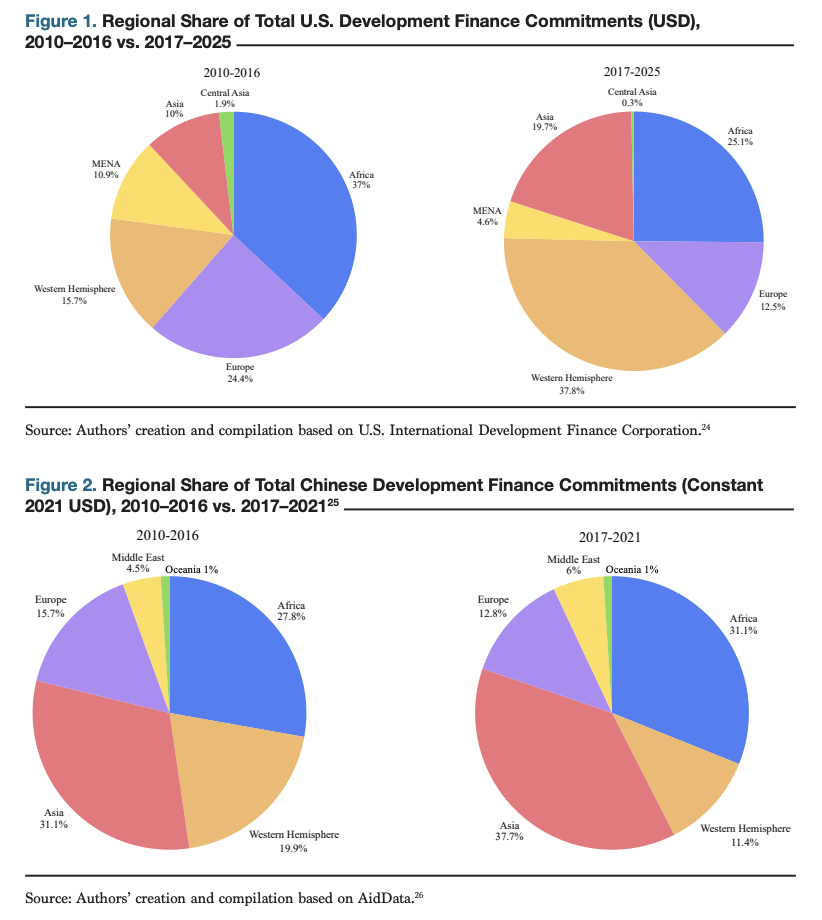
the launch of the BRI in 2013. The break in 2016 corresponds to the election and first term of U.S. President Donald Trump which brought an explicitly strategic and transactional use of U.S. development finance, reflected in the BUIILD Act of 2018, which created the DFC as a direct alternative to Chinese state-backed lending. Comparison of active projects shows that a larger share of DFC's projects was in BRI-focused countries in Latin America and Asia from 2017 onwards compared to the period from 2010-16, while the share of projects in Africa reduced significantly. China's geographic distribution remained relatively stable, with an increase in the share of BRI investments in Africa and Asia in 2017-21 compared to the earlier period.
Underlining this broadly stable distribution, however, Chinese development finance committed to Europe and the Western Hemisphere fell sharply between the two periods. Growing scrutiny of Chinese investment in the European Union, debt distress among the early BRI borrowers, and a slowing domestic economy led Beijing to concentrate state-backed lending on core BRI corridors in Asia and Africa, while relying increasingly on commercial and private channels elsewhere. The United States moved in a different direction in the Western Hemisphere. Strategic competition with China and the nearshoring of supply chains raised the share of U.S. development finance to Latin America and the Caribbean, where several countries had joined the BRI between 2017 and 2019. Much of this U.S. finance has flowed through the DFC, which has targeted sectors of geoeconomic weight, including critical minerals, ports, energy, and telecommunications. Its Western Hemisphere portfolio reached almost $11 billion between 2018 and 2024, spanning projects as varied as an Ecuadorian port expansion and Brazilian cobalt-nickel mine.
IV. THREE SOURCES OF LEVERAGE
The strategic assets that are emerging as sources of leverage for the developing world — and as objects of competition by the United States, China, and others — involve structural, economic, geographic, or demographic factors. They include natural sources such as critical minerals, strategic locations, and large domestic markets. These attributes give countries potential bargaining capacity. Utilizing these assets provides leverage. The leverage flows from policies and strategies such as export restrictions and coalition building through which countries can convert those assets into bargaining power. Bargaining power is the outcome — in the form of the political and economic gains achieved.
There are at least three kinds of strategic assets that are commonly used by individual developing countries as leverage. First, the size of a country's market. Countries with larger market size can retain more value locally through refining, logistics, insurance, infrastructure financing, and domestic capital formation, while global powers reposition around trade corridors, energy security, and strategic minerals. Regional integration through trade blocs such as the Association of Southeast Asian Nations (ASEAN), Mercosur, and the African Continental Free Trade Area (AFCFTA) create economic zones that facilitate supply chain integration for smaller economies of the region. ASEAN alone represents a combined economy exceeding $3 trillion, while AFCFTA, if fully implemented, could facilitate the flow of goods, services and investment across a market of more than 1.3 billion people. Second, countries endowed with natural resources, especially energy and critical minerals, can use them as strategic assets. The recent crisis in the Middle East underscored the need to diversify away from traditional energy suppliers thereby benefitting exporters in Africa and South America. Critical minerals needed for the clean energy transition, semiconductors, advanced manufacturing and defense equipment provides scope for the Global South to use them as strategic assets to leverage through tariffs, export controls and incentives for domestic manufacturing and processing. Third, countries with access to key shipping lanes, logistics hubs, and connectivity corridors occupy a favorable geographical position to attract finance and investment. This is not new. For centuries, countries have benefitted from their strategic position on trade routes.
These sources also rarely operate in isolation. In practice, countries often strengthen their bargaining position by combining multiple sources of leverage at once. Countries with large markets and resource endowments can build supply chains for both leveraging their dominance over a critical input (for example, Indonesia's mineral export restrictions). Resource endowments become valuable source of leverage when connected to logistics corridors, processing capacity, and collective producer coordination (for example, the Lobito Corridor between Angola, the DRC, and Zambia). Strategic location provides a natural advantage to countries especially when combined with markets, opening the possibility of creating geoeconomic hubs for manufacturing and exports.
However, leverage does not automatically translate into development outcomes. It depends on whether countries can deploy them through credible strategies, capable institutions, and coordinated policies. For example, export restrictions on unprocessed minerals are unlikely to catalyze domestic processing industries without parallel investments in energy infrastructure, logistics, and technical capacity. Cross-border logistical corridors linking resource extraction with processing and export require coordination between governments, donors, and private sector. But taken together, these trends point to a fundamental shift in the rationale of development cooperation. In a fragmented global economy, developing countries have an opportunity to move from passive recipients of aid to active negotiators of investment, using domestic markets, supply chain positioning, regional integration, and geopolitical flexibility to align external finance with national development priorities.
V. FIVE CASE STUDIES
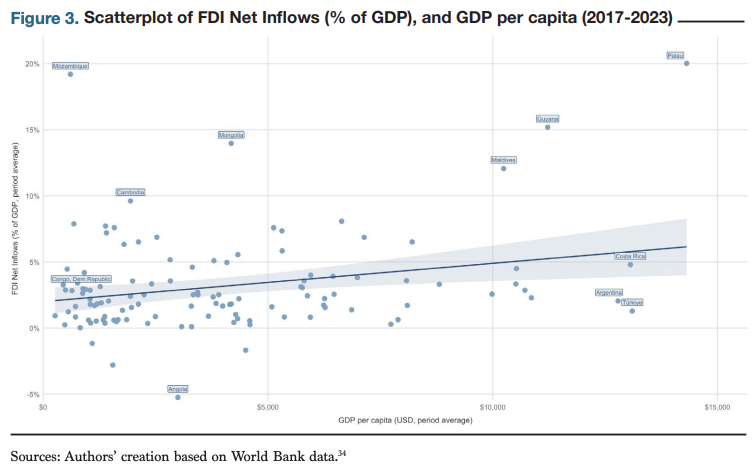
Net inflows of foreign direct investment (FDI) remain relatively consistent as a percentage of GDP among developing economies (see Figure 3). However, there are notable outliers, such as Mozambique, Cambodia, Mongolia, the Maldives, and Guyana, that appear to have attracted outsized net FDI inflows. This can be explained in part by the presence of rich natural resources in Mozambique, Mongolia, and Guyana, the strategic location of the Maldives, and Cambodia's integration into global manufacturing supply chains. A closer examination of the characteristics that these developing countries have used to attract inbound financing is illustrative. Cambodia has leveraged supply chain relocation, Mozambique its natural gas resources and geographical location, and Guyana its crude oil windfall. In addition, the experience of the critical mineral-rich Democratic Republic of Congo (DRC) and Palau's leveraging of geopolitical competition are worth examining.
We choose DRC considering its importance in the critical mineral supply chain as the producer of 70 percent of global cobalt output and in the context of geopolitical competition as a focal point of competing U.S. and Chinese infrastructure and resource investments. We examine Palau as a case of leverage resulting from its location in the South Pacific as global and regional powers seek to preserve their geopolitical influence, comparable to the Maldives in the Indian Ocean.
Cambodia
Despite Cambodia's limited domestic market, it successfully positioned itself as a manufacturing hub for firms selling into larger external markets. Its goods exports to the United States rose from approximately $2.8 billion in 2016 to $15.3 billion in 2025, while foreign direct investment reached roughly $5.2 billion in 2025, with Chinese investors accounting for 73 percent of total inflows and manufacturing investment increasing by 50 percent year on year. Supply chain relocation gave Cambodia an economic role and global trade relevance larger than its own domestic consumer market. After the United States announced a 49 percent reciprocal tariff on Cambodian goods in April 2025, Cambodia reduced tariffs on selected U.S. imports, created an inter-ministerial negotiating task force, and was able to secure a reduction of the U.S. rate to 19 percent, which was soon formalized through a reciprocal trade agreement.
The development gains are relevant but incomplete. Between 2010 and 2024, Cambodia's real income per capita almost doubled, from $1,155 to $2,085, while FDI inflows averaged 9.5 percent of GDP, nearly twice as large as the rate recorded by Vietnam. More than half of these inflows went to the manufacturing sector, contributing to job creation. Garments, footwear, and travel goods now employ about one million workers, most of them women, and account for close to half of national exports. Over the same period, China's share of Cambodia's external debt declined from nearly half of total external debt to less than one-third, while real ODA per capita increased from $650 million to $1.58 billion between 2010 and 2024. This suggests that foreign investment grew alongside, rather than replaced, concessional development finance, allowing Cambodia to draw on both investment and aid. Yet Cambodia's leverage remains vulnerable. The country imports around 80 to 85 percent of the manufacturing sector's inputs, limiting domestic value added and making exporters more vulnerable to stricter rules of origin. The country's experience shows that supply-chain position creates leverage only when domestic reforms convert temporary market access and foreign investment into lasting productive capacity.
Guyana
Guyana has emerged as a key supplier of crude oil as countries seek to diversify their energy sources following the crisis in the Middle East. From the start of production in 2019, Guyana is currently the fourth largest non-OPEC oil producer with an output of around 900,000 barrels per day. Over the past decade, the country has attracted an average of 20 percent of FDI as a percentage of GDP per year on average between 2019-2023. In 2022, Guyana's growth rate was 62.5 percent on the back of inflow of oil revenues from increased production levels. Anticipating this windfall, Guyana established the Natural Resource Fund (NRF) in 2019 to manage petroleum revenues for long-term development and energy transition. Oil revenues are deposited in an account held at the Federal Reserve Bank of New York, managed by the Central Bank of Guyana. In 2024, the NRF received total deposits of $3.1 billion, with the government withdrawing $1.5 billion bringing the total corpus at $2.6 billion at end of the year. Spending is governed by a legislated withdrawal rule tying the annual ceiling to the prior year's deposits, with funds released only after parliamentary approval and directed toward national development priorities, including infrastructure including the new Demerara River bridge, school construction, and healthcare. Guyana's approach is similar to other countries such as Chile and Mongolia which created wealth funds as a mechanism to channel resource rents for long-term social and infrastructure investment.
The Democratic Republic of Congo
In the intensifying race to secure critical minerals, the Democratic Republic of Congo (DRC) has emerged as a strategic player, primarily due to its position as the source of nearly 70 percent of global cobalt supplies vital for the clean energy transition. However, transporting its minerals from inland mines to ports has been a challenge. To strengthen transport infrastructure for copper and cobalt exports from mines to the port on the Atlantic coast, a consortium of donors led by the United States and the European Union (EU) signed a memorandum of understanding with Angola, DRC, and Zambia to develop the Lobito Corridor project backed by a $553 million loan from the United States DFC in December 2025, subsuming a BRI project started in 2015.
This was followed by the signing of a strategic partnership agreement between the United States and DRC setting up a Strategic Asset Reserve (SAR) of critical minerals, gold assets and unlicensed exploration areas. Taken together, the Lobito Corridor and the SAR extends beyond extraction infrastructure to control over the broader logistical networks ensuring the reliability of supply of critical minerals in a strategically important region. However, through a $1.4 billion investment and a 30-year concession to manage the Tanzania-Zambia Railway (TAZARA), China is expanding influence over critical transport corridors connecting Zambia copper belt to global shipping routes. China's strategy extends beyond extraction infrastructure to control over the broader logistical networks that determine the cost, timing, and reliability of mineral exports. This makes it harder for African nations to decouple their investment in the mining and critical minerals sector from China and fully exploit the potential leverage over their natural endowments.
Mozambique
Mozambique's emergence as a strategic player in energy supplies reflects an alignment of geography and energy security. Unlike suppliers in the Persian Gulf, Mozambique's offshore liquefied natural gas (LNG) infrastructure provides direct access to the Indian Ocean, bypassing strategic chokepoints such as the Strait of Hormuz and reducing transit vulnerabilities for Asian markets. The country possesses some of the largest natural gas reserves in Africa, with an estimated 3,766 billion cubic meters of recoverable resources concentrated in the offshore Rovuma Basin. As global powers move to diversify energy supplies away from politically volatile regions, Mozambique is emerging as a potentially significant LNG supplier. According to projections from the International Energy Agency, Mozambique's LNG production is expected to increase tenfold by 2030, making it the fourth largest source of natural gas after the United States, Qatar, and Canada.
Mozambique received $6.9 billion in loans and credit guarantees between 2013 to 2021 from the DFC including the approval of $4.7 billion by the United States EXIM Bank to restart TotalEnergy's Mozambique LNG project. At the same time, China provided approximately $9.5 billion between 2000-2022 in official development finance to the country, much of it concentrated in extractive industries, transport infrastructure, and LNG-related projects. These investments underscore Mozambique's leverage due to the growing strategic importance attached to alternative LNG supply chains and its locational advantage on the eastern seaboard of the African continent. Mozambique’s direct access to the Indian Ocean allows it to export LNG bypassing strategic chokepoints and connect to large and growing energy markets, especially in Asia.
Palau
In the South Pacific, countries such as Palau show how smaller states with limited domestic markets and natural resources can leverage their strategic geography around growing strategic competition in the Indo-Pacific region. In Palau, the United States, Australia, and Japan jointly financed a $30 million undersea fiber optic cable project, known as PalauCable2, aimed at strengthening digital connectivity, improving the resilience of the country’s telecommunications infrastructure, and reducing dependence on China. At the same time, China has attempted to expand its influence through economic coercion and incentives. China’s tourists once accounted for more than 50 percent of arrivals before tourism flows were restricted to pressure Palau over its recognition of Taiwan. The Chinese government reportedly offered Palau $20 million annually to establish a call center in exchange for severing ties with Taiwan, but the Palau government refused to do so. Across the broader Pacific Islands region, Australia committed $20.6 billion between 2008 and 2022, compared to $10.6 billion from China and $4.4 billion from the United States.
VI. CONCLUSION
These case studies suggest some of the ways in which developing countries are employing their bargaining power to source inbound capital amid the sharp decline in development assistance. Successful states are leveraging some combination of their markets, supply chains, geographical locations, natural resources, or geopolitical competition to source inbound capital. Yet their experiences also reveal potential shortcomings. In many cases, domestic reforms and stronger institutions will be needed to convert temporary inflows into lasting productive capacity. Wealth funds can help channel natural resource revenues into long-term social investments or infrastructure. Finally, regional or multilateral collectivism over natural resources or in terms of geopolitical or trade blocs strengthens the bargaining power of developing countries, particularly smaller nations in the Global South.
ACKNOWLEDGMENTS
The authors would like to thank Dhruva Jaishankar, Alan Gelb, Shantayanan Devarajan, and Jeffrey D. Bean for their review, comments, and suggestions of an earlier draft of this paper, and Pietro Zecca for his assistance with data collection, analysis and visualization.This background paper reflects the personal research, analysis, and views of the authors and does not necessarily reflect positions or policies of either of the institutions, its affiliates, or partners.
Cover image courtesy istockphoto user metamorworks.
Note: Citations and references can be found in the PDF version of this paper available here.