
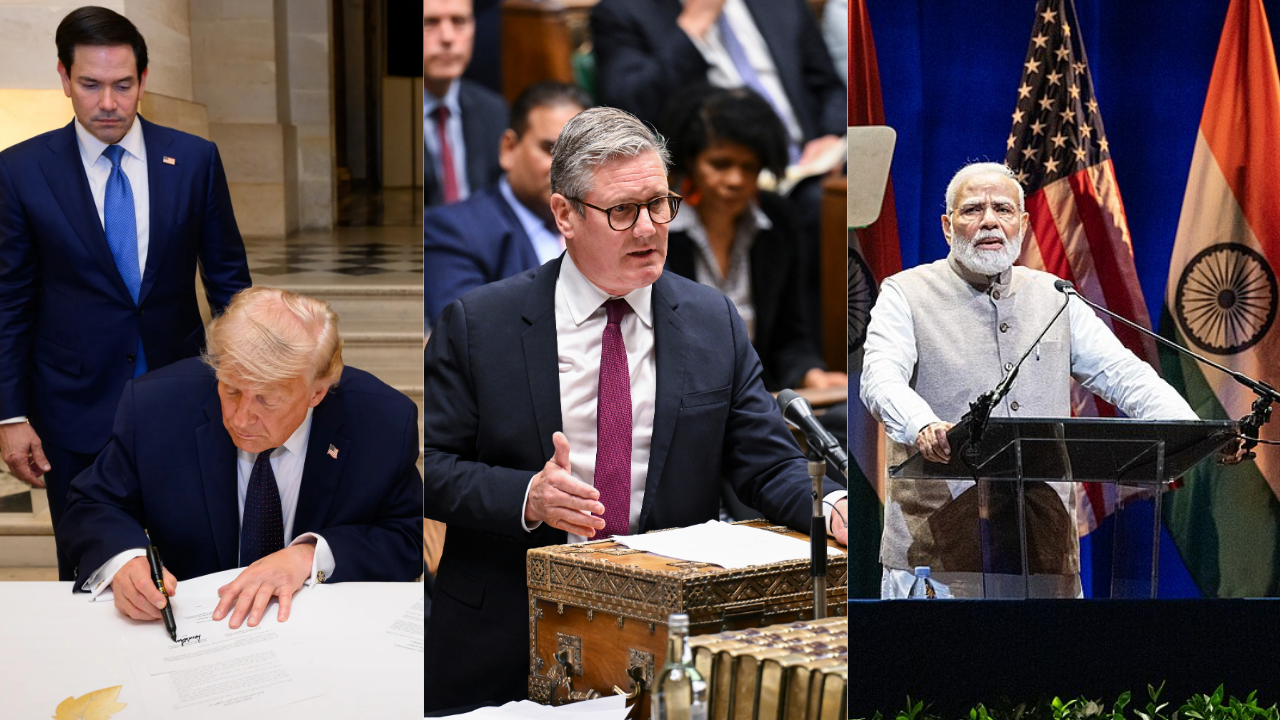
June 26, 2026 — In this week’s episode of Around the World, hosts Dhruva Jaishankar and Rachel Rizzo unpack the recent Memorandum of Understanding between the Trump administration and Iran, examining what it signals for U.S.-Iran negotiations, regional dynamics, and the future of the U.S.-Israel relationship. They also discuss the political upheaval in the United Kingdom following PM Keir Starmer’s resignation, exploring the economic, political, and structural forces behind Britain’s latest leadership crisis. Finally, drawing on their participation in last week’s India-U.S. Forum in New Delhi, they reflect on the state of the U.S.-India partnership and its areas of growing cooperation as well as the challenges that continue to shape the bilateral relationship.
Available on Spotify and Apple Podcasts.
Image: The White House, Public Domain, via WhiteHouse.gov
Image: Sir Keir Starmer MP (Holborn & St Pancras), © House of Commons, via Flickr
Image: U.S. Department of State, Public domain, via Wikimedia Commons

sneak peak
Rachel Rizzo: On this week's episode
Rachel Rizzo: What I think is actually really interesting is just the absolute breakdown we've seen in the U.S.-Israel relationship, largely because they will not stop bombing Hezbollah and Lebanon. Now obviously, Hezbollah is an Iranian proxy and when they launch missiles into northern Israel, this is at Iran's behest. If Iran said not to do that, they probably wouldn't. So you have Iran sort of testing the limits of the Israel relationship as well to sort of pull Netanyahu into a position where, he responds and then it the whole thing breaks down.
Dhruva Jaishankar: Prime Minister Modi and President Trump met in person for the first time in 16 months they met in France and that meeting seems to have gone quite cordially. After a year or so of somewhat turbulent relations. And it seems like both sides signaled to each other, that they want better relations with each other. And that was understood. Now, whether you get there or not is a is a is a different matter.
Rachel Rizzo: The consequences of the UK leaving the EU were always going to be felt. It was just a question of what party was going to be in office when it finally happened. Starmer won after, years of conservative rule. It was a wide margin. But I think that the actual depth of public enthusiasm behind that election was pretty shallow. I think it really digs into why these landslide victories in the UK system, which is this first past the post system, sometimes they don't translate into political capital.
welcome to around the world
Dhruva Jaishankar: Hello, I'm Dhruva Jaishankar.
Rachel Rizzo: And I'm Rachel Rizzo. Welcome to the Around the World Podcast, your essential guide to understanding the forces shaping our world today. Here, we cut through the noise to bring you clear, insightful analysis on the most important developments in geopolitics.
Dhruva Jaishankar: Whether it's security challenges in Europe, great power competition in Asia, domestic politics in the United States, or regional developments in Latin America or the Middle East, we'll discuss what's happening and more importantly, why it matters.
Rachel Rizzo: Thanks as always for tuning in. Be sure to like and subscribe to the Around the World Podcast on YouTube, Spotify, and Apple Podcasts.
Will the MoU Hold?
Rachel Rizzo: Hey Dhruva.
Dhruva Jaishankar: Hi Rachel. you know one of the fun things about recording this podcast around the world is we've also recorded it in different places around the world
Rachel Rizzo: We are around the world.
Dhruva Jaishankar: In India yeah, India, U.S. I've been I've done some episodes from Brussels, from Australia, but you are where in the world?
Rachel Rizzo: I am in Dubrovnik right now. I just got in. I'm here for the Dubrovnik Forum, hosted in, as the name would suggest, Dubrovnik, by the Croatian MFA. So, another couple of days of interesting conversations on geopolitics and yeah, it is the fun part about doing this because we get to do we get to host it from everywhere. And you're you're you're in DC but we were we were together in Delhi a couple of weeks ago. Yeah. my gosh, it was. I don't know where the time goes. Yeah, yeah, yeah. It was last week.
Dhruva Jaishankar: I'm in Washington, yeah. In Delhi, just a couple of days ago. Yeah yeah it was it was a few days ago, yeah, yeah, yeah.
Rachel Rizzo: Yeah. my gosh, it was. I don't know where the time goes. Yeah, yeah, yeah. It was last week
Dhruva Jaishankar: but you were but you're in Croatia and Dub Dubrovnik is, I've not been, but it's one of I from what I've heard one of the most beautiful cities in Europe,
Rachel Rizzo: It's crazy beautiful.
Dhruva Jaishankar: and now I think everyone knows it from Game of Thrones, right? Because I think that's the cap it it's it it it stands in for the capital city and and Game of Thrones.
Rachel Rizzo: Yeah. Yeah, absolutely.
Dhruva Jaishankar: Anyway, great. Yeah. But again saw a lot going on the last couple of weeks since we recorded our last episode.
Rachel Rizzo: Yep.
Dhruva Jaishankar: A big one is the United States and Iran seem to have announced an MOU. A little bit of irony here because I remember the first Trump administration, Trump railed against the term MOU and how they're nonbinding
Rachel Rizzo: Yes.
Dhruva Jaishankar: in Southern real estate contracts and but in any case the U.S. and Iran have an MOU and now we have talks taking place between the United States and Iran, brokered by Pakistan and Qatar in Switzerland, right? So, maybe start what do you think, you know, w what what went down with the actual MOU and where are we at the moment?
Rachel Rizzo: I mean, it's really interesting because if you look at where the relationship is with Iran and the position from which the United States is negotiating, you know, you've still got the Iranian regime in in place. You have its ballistic missile forces that are still intact, even though they've been obviously diminished. And same with the nuclear program. I mean, this is very much part of the discussion and so You know, it's interesting to kind of think through what the ultimate goals were of the United States when this whole thing kicked off and whether or not we're negotiating from a position of strength, which I don't think we are, and and sort of what happens from here. But I'd be interested to see kind of what how you're thinking about it and and what you're watching.
Dhruva Jaishankar: I mean it it it appears as if the still you know the terms of the MOU were laid out, and were quite vague on some points, several points. It seemed to give a lot more latitude than many Americans, including Iran Hawks in the United States expected on the nuclear side and in terms of proxies, that's Iranian proxies in Yemen and Lebanon. ⁓
Rachel Rizzo: Yeah. Mm-hmm. Yeah.
Dhruva Jaishankar: It did not include Israel in the discussions, which you know, given that Israel along with the United States had essentially initiated this round of the conflict
Rachel Rizzo: Yeah.
Dhruva Jaishankar: this has come as something of a setback to to Israeli Prime Minister Netanyahu in the run up to elections there. There's some feeling that some of the Gulf Arab states barring Saudi Arabia and Qatar are a little cut out of this process as well. So I think more again, like if this sounds like a broken record. We've had several discussions like this over the past few months, but it seems like there's still more questions than answers, that the negotiating positions for the United States and Iran still seem very far apart. But there has been a certain amount of criticism within the United States about giving up too much. and and I I think you know, given that Trump and many Republicans have been very critical of the JCPOA, this was the Iran nuclear deal that the Obama administration had negotiated a while ago, the current terms seem much more favorable speaking for Iran on
Rachel Rizzo: Yeah. Absolutely.
Dhruva Jaishankar: At least on the nuclear program. So how how how are you looking at how does it playing out, particularly with regard to Israel and the U.S. Israel relationship?
Rachel Rizzo: So, this is what I think is actually really interesting is just the absolute breakdown we've seen in the U.S.-Israel relationship, you know, largely because they will not stop bombing Hezbollah and Lebanon. Now obviously Hezbollah is an Iranian proxy and when they launch you know missiles into northern Israel, this is at Iran's behest. If Iran said not to do that, they probably wouldn't. So you have Iran sort of testing the limits of the Israel relationship as well to sort of pull Netanyahu into a position where, you know, he responds and then it the whole thing breaks down. But what I think is interesting as well is that, you know, you've had Vice President JD Vance recently speak out against Israel and say, you know, they can't bomb their way. Said something on I think on Ross Daltitz podcast, you know, they can't bomb their way to peace, or they can't, you know, bomb everyone as you know their main foreign policy strategy, something along those lines. But and then you had high-level cabinet officials in Israel like Ben-Gvir and Smotrich come out and basically, you know, call J.D. Vance an anti-Semite, call Jared Kushner, Steve Whitkop anti-Semites. I mean it's real breakdown. And so I think that, you know, obviously you have Netanyahu with the elections in October, and I think it is really going to be interesting to watch how much he responds to Trump here. Because if he if he is seen as sort of a puppet of Trump, then that doesn't play well with the domestic audience, obviously, especially his supporters. So I think the interesting questions here are, you know, can Iran keep Hezbollah in check? Can the U.S. restrain Israel? And those are questions that I don't know we have answers to quite yet.
Dhruva Jaishankar: You know, th this entire situation, I mean, unless something changes, which it could and we've had some pretty radical changes in every direction in the past few months. But at at this point of time it looks like we're in this very unsettled twilight zone, which is somewhat reminiscent to the United States and Iraq between 1991, the end of the first Gulf War, and 2003, the invasion of Iraq, right? Where you had this sort of you had like a no-fly zone imposed, you didn't have active conflict, but every once in a while you had, you know, missile strikes and air and aircraft shot down. You know, like there there was this sort of awkward sort of between outcry because it's no one's interest at this point in time to have that full-fledged conflict, and yet we're so far away from any kind of resolution that this this sort of awkward whatever you might want to call it, remains for the time being. But again it is interesting. I mean the the the U.S.-Israel tensions. I mean so Ben-Gvir and Smotrich are are are both allies of Prohibition Netanyahu. They're from different parties, far right, what I considered far right of Israeli parties. They're part of his coalition and and again it'll be interesting to see again whether these developments also play in their favor in the in the elections, right? Because when when the the margins are so small it's most likely gonna be a coalition government of some kind after the elections this fall in Israel. But it you could have this very strange thing, strange situation where even if Netanyahu personally suffers and his party suffers, you could actually it could all of this could actually strengthen the far in Israel as well.
Rachel Rizzo: Yeah, absolutely. So I mean this isn't going anywhere and speaking of yeah, no, what were you gonna say?
Dhruva Jaishankar: Yeah. And no and no and and and just like you know, irony is if you said even a few months ago that, you know, the the Trump administration would be in these sort of very vocal public disagreements with Netanyahu and something we're not gonna get into today too much, but Maloney, Premier Maloney in Italy.
Rachel Rizzo: Oh yeah.
Dhruva Jaishankar: Those I mean who would have thought a few months ago that the you know that those personal relationships would be so frayed at this point of time but it tells you again the the era we're living in
From Landslide to Exit: Starmer Steps Down
Rachel Rizzo: Yeah. yeah. It, we are living in an era of, and and speaking you know, parliamentary politics, we've had quite a landslide, upset, earthquake, however you wanna call it, in the UK this past week with Keir Starmer announcing his resignation. So that's another big one we kinda we wanna we wanna talk about today. You know, we don't discuss countries here that are stable. We only talk we only talk about when things are super messy. And I think super messy is a way that you could describe UK politics at the moment.
Dhruva Jaishankar: Right. I mean so what's I think unusual about this is I think it's less than a little less than two years ago, Kier Starmer and his Labour Party just won a sweeping majority, over four hundred seats of six fifty in the House of Commons.
Rachel Rizzo: Mm-hmm.
And, you know, you had this big pump mandate. He initially was quite popular. What happened? How is he how is he resigning without an electoral defeat in less than two years? What what what went wrong for him?
Rachel Rizzo: It's wild, but first I want to I wanna someone I think that we both know, Matthias Mattis, who is a professor at Johns Hopkins, also at ECFR. He wrote a fantastic article in Foreign Affairs about this very thing. I think it came out yesterday and he kind of talks about like it's really good and and I like it because it talks about how this like Brexit hangover is finally coming home to roost. And it was. He basically says, you know, the the consequences of the UK leaving the EU were always going to be felt. It was just a question of what party was going to be in office when it finally happened. But this is really interesting. I mean, you you said that Starmer won after, you know, years of conservative rule. It was a wide margin. But I think that the actual depth of public enthusiasm behind that election was pretty shallow. You know, it I think it really digs into why these landslide victories in the UK system, which is this first past the post system, they don't really translate or sometimes they don't translate into political capital. And there's this gap sometimes between seats won and and the Labor Party won a commanding number of seats in the House of Commons, four hundred and eleven out of six hundred and fifty. But I I think that you have to look at a broader picture about why this didn't translate into political success and why he ended up falling so hard so quickly.
Dhruva Jaishankar: So I mean i the one thing you do have this sort of tradition, recent tradition, at least in the United Kingdom, of intra party coups in some ways, right? You know, you've had you've had in even in the Conservatives you had a pretty quick revolving door of prime ministers and you know people within the cabinet event essentially sort of shunting them aside and taking taking over. And you see this in Australia, you see this in Italy and you know, I think famously associated with Italian politics. You don't see it as much in places like India or Israel, other parliamentary or Japan, other parliamentary systems as much. But all being said, what what actually brought down Keir Starmer, what what was the dissatisfaction within the Labour Party with him?
Rachel Rizzo: Well, there's a few that I think combine together to create a perfect storm. There was obviously, there's a scandal involved, as there always is. He appointed Peter Mandelson as ambassador to the U.S. in late 2024. And then surprise it emerged that Peter Mandelson had a personal friendship with the late Jeffrey Epstein, Epstein. And Starmer fired him, obviously, once these private messages between the two surfaced, but then he had to publicly deny lying to Parliament about how exactly Mandelson was even vetted in the first place, and I think this was really difficult because one of the issues that Starmer built his entire 2024 campaign on was around, quote, cleaning up politics. And this was not clean, this was very, very messy.
Dhruva Jaishankar: And yeah, so just a a little aside, but you know, for those of us who maybe remember the nineteen nineties, Peter Mandelson at that time was seen as like a future prime minister. He was a cabinet minister, he was very close to Tony Blair and that that wave of labor in the late 1990s, and then he was the EU trade commissioner, so a very powerful position in the European Union as well. And so to see his kind of fall in is is is really quite quite something,
Rachel Rizzo: .It really I mean, yeah, it was it a stunning political fall, I think, is is how you could describe it.
Dhruva Jaishankar: Mm-hmm. Yeah. And then, other factors?
Rachel Rizzo: And yeah, so and then you have the economic side here. And I sort of mentioned this in the opening a little bit, and again I would tell people to go read Matias' article on this 'cause it's just really good. Starmer inherited an economy that was still absorbing the lingering drag of Brexit. Then on top of that, it got hit by this fresh oil price shock when Israel and the United States launched their war on Iran in late February, which we've you know discussed a lot on this podcast. This drove up borrowing costs, it drove up mortgage rates on top of this already very painful cost of living squeeze. And so he was sort of boxed in by his own promises between not raising taxes or spooking bond markets with more borrowing. He just had no more room to or or no room to maneuver really. And so what that meant was that these flagship policies that he ran on, one of them was this major net zero investment push, another one was this digital ID rollout, these ended up being watered down or scrapped entirely. And what happens then is just confidence begins to erode even amongst his allies about not just his strategic vision but also his own judgment. So you sort of had this perfect storm start to brew, and then of course what you have is, on the side of this, Nigel Farage's Reform UK party waiting in the wings and posting historic gains in May during local and regional elections.
Dhruva Jaishankar: But then, I mean finally the the coup de grâce came from within his own party, right? So there were you had some resignations, what what went on there and and maybe talk a little bit about who is now looks likely to succeed him as Prime Minister. You have Andy Burnham who until a week ago wasn't even a member of parliament.
Rachel Rizzo: Nope.
Dhruva Jaishankar: Very popular yeah, he just he won a by election, now he's in parliament and now he may very well become prime minister. So talk a little bit about like how what finally ended up within the party, what changed and and what you know, what what do things look like from here on out and for British politics?
Rachel Rizzo: Yeah, so these local and regional election where the Reform UK party posted historic gains, this basically started the clock. and then you had this domino effect where you had Health Secretary West Streeting resigning and really publicly torching Starmer's record of indecision. He also floated even his own leadership ambitions. Then you had Defense Secretary John Healy quit over military funding disputes, followed very quickly by an armed forces minister, but then I think the final nail in the coffin was when Starmer's chief rival, as you mentioned, Andy Burnham, his outgoing Greater Manchester mayor, won a special election back into Parliament. Hours later, Streeting, the former health secretary, then through his support behind Burnham instead of running himself, which cleared a path for Burnham to take the leadership without contestation. So now what happens is, you know, Starmer stays on as caretaker PM. You have leadership nominations that will open in early July and close before Parliament's July 16th summer recess. And the contest is expected to be resolved before September. So the question now is, you know, this is gonna be is it the seventh Prime Minister in six years?
Dhruva Jaishankar: Yeah, something like that, yeah. Seventh, yeah. Mm-hmm.
Rachel Rizzo: or sixth prime minister? it's crazy. So when Andy Burnham effectively takes, inherits this mess from Keir Starmer, does he have any better shot at breaking Britain's cycle of toppled prime ministers? I don't know. I don't think anyone knows yet, but it's gonna be interesting to watch.
Dhruva Jaishankar: Yeah, great. Interesting to see where this goes.
Rachel Rizzo: Absolutely. Yeah. I mean, for those of us who have been following UK politics, which I think most people who listen to this podcast probably do a little bit, you will always remember Liz Truss's her prime ministership lasting shorter than a head of lettuce. Remember that? That was all that was the whole the whole internet thing.
Dhruva Jaishankar: Yes. Yes, yes, yes. Right, yes, so so Al although a weird bit of trivia, she's the only Prime Minister after Churchill to whose prime ministership lasted two monarchs in the UK. So it was during that sh during that short period you had two yes, yeah. So so, uh-huh.
Rachel Rizzo: Oh, yes. That is Yes, you're right. That's, that's a really good like pub quiz question. Another pub quiz question that someone should ask, maybe not now but in the future, like it would be who was Prime Minister of the UK when Queen Elizabeth passed away? And the answer would be Liz Truss because and no one would get it right 'cause no one will remember that.
Dhruva Jaishankar: Yeah, yes, yes, yes. Anyway, moving on, we you know
Rachel Rizzo: Yeah.
U.S.-India Gets Back on Track
Dhruva Jaishankar: We both happened to be in Delhi and in India last week. we were both at something called the India-U.S. Forum. It is sort of a smallish conference organized by the Anantas Center in India. It's i it's it's off the record. But essentially we had senior U.S. and Indian officials, this time a lot more Indian officials than U.S. officials, but a few of those, corporate leader business leaders from both countries. Think tank heads and experts, and you know, other people, but but largely people who are knowledgeable and invested in the U.S.-India relationship, something we've discussed on this podcast before. But I just want to, you know, thought we'd it'd be interesting to get your sense of like what were your some of your impressions. I had I have my thoughts, but maybe start with you. What what were some of your impressions from the two days of discussion we had there? And just to you know reinforce it was all under Chatham House rule, which means like we can talk about what was discussed but not who said what. .
Rachel Rizzo: Yeah. Yeah, I mean I got a sense that the U.S. is really committed to the U.S.-India relationship. I got a sense that it plays a central role in how the current administration sees its relationships not just in the Indo-Pacific, but globally as well. I think India plays a really important role for the Trump administration and whether or not that has has resulted in policies that benefit the U.S.-India relationship, I think is another is another conversation and I think you'll you'll probably get into that. But it also seems like there are a lot of areas, a lot of topics that the two sides are focused on building together. I mean defense tech was was a big one, you know another one I think is obviously going to be getting this interim trade deal across the finish line which everyone seems very bullish on. And so I thought that was really good news. So I'd be interested in your thoughts on this as well.
Dhruva Jaishankar: Yeah, so I'll get into some of the problems and challenges a little later, but one, overall the tone was much more positive than I think I had certainly had expected,
Rachel Rizzo: Yeah.
Dhruva Jaishankar: and maybe, significantly at odds with some of the public discourse of the US India relationship, you know, which tends to be much more critical and cynical. So generally much more constructive and positive than I certainly I had expected, you saw a pretty wide range of areas where the U.S. and India are cooperating. I mean sometimes not even the U.S. government, but U.S. entities, you know, from education, civil nuclear cooperation, and traditional energy sources, AI and tech, emerging technologies, defense production. I mean you you sort of name like the big issue and there is some kind of U.S.-India collaboration underway. And I think a lot of people who were there who like work on one aspect of it were quite surprised by the breadth and range of it. Three, I think the the our our meeting came just a few days after Prime Minister Modi and President Trump met in person for the first time in 16 months they met in France and that meeting seems to have gone quite cordially after a year or so of somewhat turbulent relations. And it seems like both sides signaled to each other, as you mentioned, that they want better relations with each other. And that was understood. Now, whether you get there or not is a is a is a different matter. On the trade side, just after we met, so just in the last three days, in fact, you had U.S. trade representative Jameson Greer out in India. It I we I didn't get a sense beforehand that he was there to finalize the deal, but I think iron out some of the the the the lingering issues. I think the big uncertainty right now is less in the U.S-India space, it is more U.S. tariff policy at this point of time. And that's being, you know, you have at least three different categories of tariffs that the Trump administration is exploring against multiple trade partners, not just India, all of which are in different layers of legal uncertainty. And until that is resolved to some degree, it's hard to see India agreeing to to fixed tariff rates because it doesn't want to lock itself in understandably to a disadvantageous position vis-a-vis other trade partners of the United States. And so I think and and the status quo, at least now unless other things come on come online, which is possible, the status quo doesn't really isn't too disadvantageous to India, barring a few sectors like the auto industry and stuff like that. So a 10% base tariff is something a lot of Indian exporters can live with. So so again there isn't that urgency on the Indian side. I think the the the lack of resolution, legal resolution on the U.S. side is the biggest hindrance to the trade deal. Briefly just on the challenges I felt, I think three quick things. One, there is still a lack of trust related to a sort of more hostile political opinion in India of the United States. And it's a cumulative effect of different U.S. policies and statements that President Trump has made in public and things like that, the killing of Indian sailors in in strikes recently, all of that has added up to and to to to lingering to a lower public opinion of the United States in India. This ORF poll of young Indians ORF survey, I think last year it was 82% had a positive view of the United States, and this year it's like 55% percent or something like that.
Rachel Rizzo: Sounds like Europe also. Yeah. Yeah. Yeah.
Dhruva Jaishankar: So yeah, yeah, but it's still probably higher than Europe, but but but but the the trend line isn't isn't positive. And that's constraining the Indian government's ability to do stuff. So one. Two, there in some ways discussions on differences around Pakistan were a little sidelined. I think there needs to be a you know, sometimes Americans are like, you know, what exactly is India's issue? Why should why is it wrong for us to engage with Pakistan? In, for India views it very differently and India sees it as supporting sort of, supporting the conditions for for terrorism against India. And it's it's it's a it's a much more much more deeply felt. The third issue which I think did didn't get a lot of attention but but and should probably is there are increasingly differences between the United States and India on the immediate region around India's neighborhood, at the very least a lack of alignment. In Sri Lanka, the Maldives, Nepal, Bangladesh where in some cases, you know, even a few years ago the two sides were talking a lot about developments in the region and that seems to have broken down a little bit and could lead to frictions down the line. So I would say those are the negative sides as I felt. But overall the tone was much more positive and constructive than I had expected.
Rachel Rizzo: Yeah, absolutely. I felt like you know, I compare this to Europe a lot on this podcast, but I do think that there gets to a point where, it's not beneficial to talk about how trust has has broken down, how bad the relationship is. You get to a point where people want to be forward looking and they want to work layers down where you have private companies and corporations that are still working on those close personal ties and moving the relationship forward, even if at a high government level things might be stalled. And I think this is another good example of seeing that happen where you can complain about it and you can be frustrated and you can talk about all the hindrances to the deepening of the relationship, but at the end of the day, people want it to move forward. And so I agree with you. I feel like we saw a lot of a lot of that as well. Which is I think good news.
Dhruva Jaishankar: Great. Well, again a lot a lot to talk about. Again, things keep on moving. I mean in again the U.S.-Italy spat was something I think nobody could have anticipated a little while ago. but again you've been now in l just in the last week in India, in Africa, in Europe. There's we have a World Cup going on here in the United States, which is also a lot of fun and very interesting and the geopolitics of that may be something to discuss in a future episode. But a lot to talk about and thanks again for joining us for this discussion, Rachel.
Rachel Rizzo: Yep. Yeah. Mm-hmm. Yeah. And as always, be sure to follow and like the Around the World podcast on YouTube, Spotify, and Apple Podcasts. And we'll see everyone next time.