
Future of Global Development Cooperation
Global development cooperation is in a state of turmoil. Donor countries are rapidly pulling back on their commitments, the multilateral system is unable to change its way of doing business, and the private sector is unwilling to invest in the face of heightened geopolitical risk and uncertainty. This is happening at a time when the developing world is facing profound demographic and technological transformation, urgent need to ensure food, health and energy security, and to invest in resilience in the face of a changing climate.
While the old order is rapidly crumbling, a new one is yet to emerge. This provides an opportunity for the Global South — the erstwhile recipients of development finance — to create a new architecture of development cooperation. By setting priorities, adopting pragmatic policies and forging effective partnerships, the Global South can assert its geopolitical leverage through a combination of strategic location, growing markets, and access to critical resources, both natural and human.
Over the next two years, ORF America is undertaking a project on the Future of Global Development Cooperation to advance a Global South-led framework for the coming decades. The project will convene a high-level Global South Working Group of experts from Latin America and the Caribbean, Sub-Saharan Africa, South and Southeast Asia, and the Pacific Island states to put forward practical ideas and recommendations for policymakers and practitioners as they address their development needs and priorities. The Working Group will provide guidance on how to maximize geopolitical leverage to attract investment, improve domestic resource mobilization and deployment to offset decline in donor funding, and operationalize South–South cooperation frameworks for knowledge sharing, technical assistance, and financing for development.
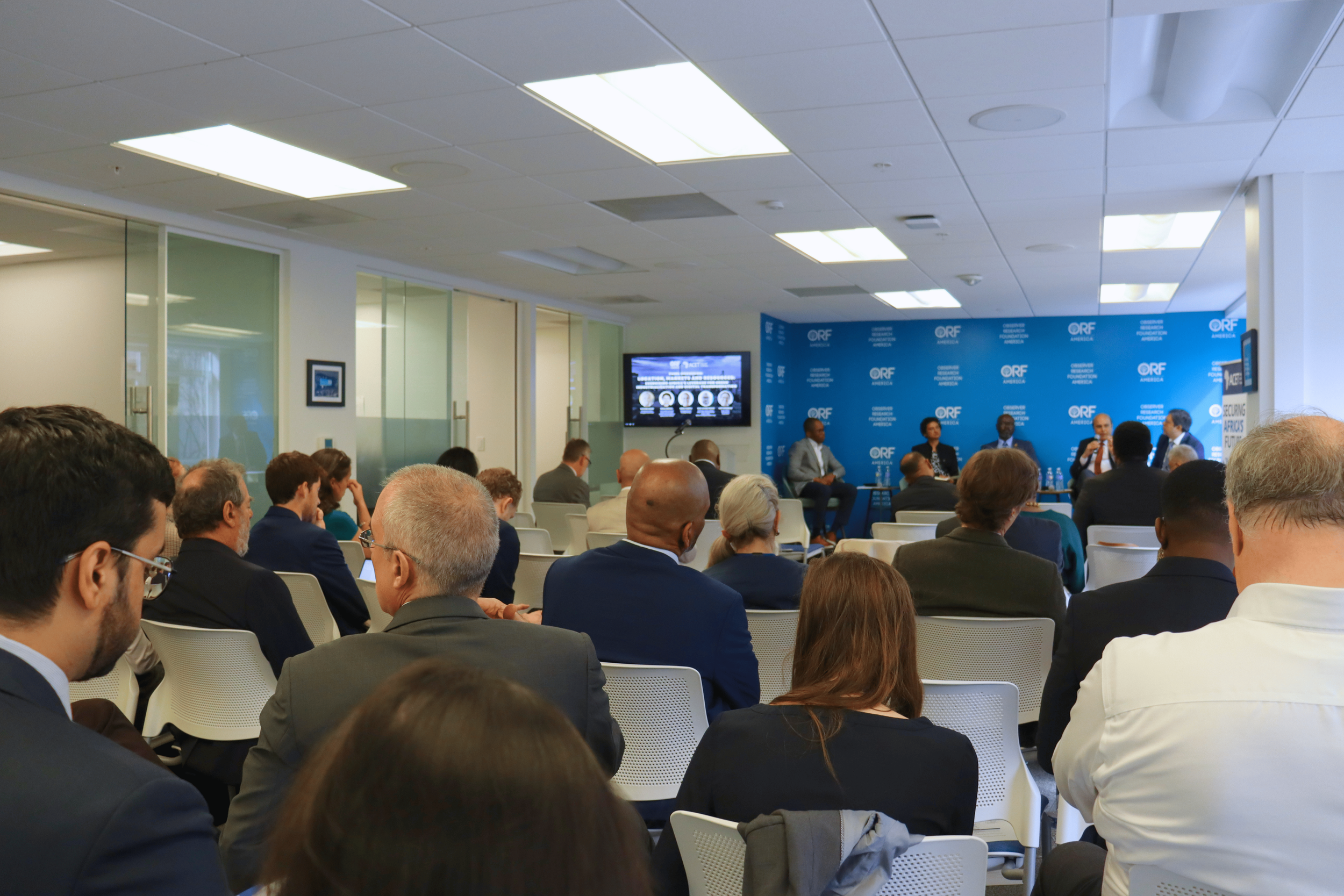
Global South Working Group
Abla Abdel Latif, Executive Director and Director of Research, Egyptian Center for Economic Studies
Dr. Abla Abdel Latif chairs Egypt's Presidential Advisory Council for Economic Development and serves as Executive Director and Director of Research at the Egyptian Center for Economic Studies (ECES). Formerly a long-time professor of economics at American University of Cairo (AUC), she advised Egypt's Minister of Industry, served on Central Bank and National Bank boards, and joined the 2013 constitution-drafting Committee of Fifty. She is also a cofounder and Board Member of BASEERA (the Egyptian Center for Public Opinion Research), and “El Nidaa” Foundation for job creation for women and youth in Upper Egypt. Read more here.
Ana Beatriz Vasconcellos,
Deputy Secretary for Digital Transformation, Government of Brazil
Ana Beatriz Vasconcellos is Deputy Secretary for Digital Transformation at the Presidential Secretariat of the Government of Brazil. An economist and public policy expert, she focuses on public sector innovation, digital transformation, and strengthening state capacity through digital public infrastructure (DPI). Previously, she led research on state capacity in the digital era as a Policy Fellow at the Institute for Innovation and Public Purpose, University of London. Read more here.
Diana Alarcón, Executive Director for Mexico, World Bank
Diana Alarcón is the Alternate Executive Director of the World Bank Group representing the constituencies of Costa Rica, El Salvador, Guatemala, Honduras, Mexico, Nicaragua, and Spain. Ms. Alarcon is an economist with a distinguished career in international affairs, economic development and policy analysis. She served as Chief Advisor and International Affairs Coordinator to then-Mexico City Mayor and current President Claudia Sheinbaum from 2018 to 2023. Previously, she worked for a decade at the United Nations Department of Economic and Social Affairs in New York where she played a key role in shaping analytical contributions to the intergovernmental processes for the 2030 Agenda for Sustainable Development. She has also held senior positions at the Inter-American Development Bank, UNDP and ILO. Read more here.
Elizabeth Sidiropoulos,
Chief Executive,
South Africa Institute of International Affairs
Elizabeth Sidiropoulos is the Chief Executive of the South African Institute of International Affairs, a role she has held since 2005. Her work focuses on South Africa's foreign policy, South–South cooperation, and the role of emerging powers in Africa. She is editor-in-chief of the South African Journal of International Affairs, co-chair of the Think 20 during South Africa’s G20 presidency, a frequent media commentator and author on diplomacy and development cooperation. Read more here.
Mari Elka Pangestu, Presidential Special Envoy for International Trade and Multilateral Cooperation,
Republic of Indonesia
Mari Pangestu is the Special Envoy of the President for International Trade and Multilateral Cooperation of the Republic of Indonesia and Vice Chairwoman of the National Economic Council. She previously served as Special Envoy for Climate Finance. A former World Bank Managing Director (2020–2023), she was also Indonesia’s Minister of Trade (2004–2011) and Minister of Tourism and Creative Economy (2011–2014). Currently, she is a Professor of International Economics at the University of Indonesia, a Board Member of the Centre for Strategic and International Studies (CSIS), Jakarta and a Distinguished Visiting Fellow at the Peterson Institute for International Economics, Washington DC. Read more here.
Pepukaye Bardouille, Director,
Bridgetown Initiative
Pepukaye Bardouille is an Advisor on Climate Resilience in the Prime Minister's Office of Barbados, leading the Bridgetown Initiative. She founded and led Dominica's Climate Resilience Execution Agency (CREAD) from 2018–2020, managing US$350 million in post–Hurricane Maria reconstruction funds. Previously at IFC, she led projects to scale off-grid and mini-grid electrification and resilience across Africa and Small Island Developing States. Read more here.
Pinaki Chakraborty, Visiting Distinguished Professor, NIPFP
Pinaki Chakraborty is a public finance economist and Visiting Distinguished Professor at the National Institute of Public Finance and Policy (NIPFP), New Delhi. He previously served as Director of NIPFP and Economic Advisor to India’s Fourteenth Finance Commission. He has also held senior roles with UNICEF, including Chief of Social Policy and Chief of Field Office (Kerala and Tamil Nadu). He is currently a Visiting Scholar at the Southern Center for Inequality Studies at the University of Witwatersrand, Johannesburg, South Africa. Read more here.
Rodrigo Salvado, Global Head,
Strategic Financing Partnerships, HSBC
Rodrigo Salvado is Global Head of Strategic Financing Partnerships at HSBC. He previously served as Director General of the Operational Partnership Department at the Asian Infrastructure Investment Bank and as Deputy Director for International Development Finance at the Bill & Melinda Gates Foundation. Earlier, he held roles at the African Development Bank, Harvard’s Center for International Development, and the Central American Bank for Economic Integration in Honduras.
Read more here.
Sachin Chaturvedi, Vice Chancellor, Nalanda University
Sachin Chaturvedi is Vice Chancellor of Nalanda University and a leading voice on development economics and South–South cooperation. Before joining Nalanda University, Dr.Chaturvedi was the Director-General at the Research and Information System for Developing Countries (RIS), New Delhi for over a decade. He has worked extensively on issues of development economics, including development finance, SDGs, South–South cooperation and global trade, investment and innovation linkages, with a special focus on the WTO. He currently serves as an Independent Director on the Board of the Reserve Bank of India. Read more here.
Shantayanan Devarajan,
Professor of Practice, Georgetown University
Shantayanan Devarajan is Professor of the Practice at Georgetown University’s School of Foreign Service. He was part of the senior leadership at the World Bank Group for over two decades, where he served as Senior Director for Development Economics and Acting Chief Economist, and as the Chief Economist for the Middle East and North Africa Region. He directed the World Development Report 2004, Making Services Work for Poor People. Read more here.
Toiata Apelu-Uili, Pacific Nationally Determined Contribution (NDC) Technical Officer, Secretariat of the Pacific Regional Environment Programme (SPREP)
Toiata Apelu-Uili is the Pacific Nationally Determined Contribution (NDC) Technical Officer at the Secretariat of the Pacific Regional Environment Programme (SPREP). She brings over 18 years of experience in government, including senior leadership roles within the Ministry of Natural Resources and Environment of Samoa, where she served as Assistant Chief Executive Officer of the Climate Change Division and Deputy Chief Executive Officer for Renewable Energy. Trained in environmental and social geography, she has contributed extensively to regional climate and energy policy and has represented Pacific Island States in high-level UNFCCC negotiations on climate change and biodiversity, supporting climate action priorities across Small Island Developing States. Read more here.
William Gyude Moore, Senior Fellow,
Energy for Growth Hub
W. Gyude Moore is a Distinguished Fellow at the Energy for Growth Hub and a lecturer at the University of Chicago’s Harris School. He previously served as Liberia’s Minister of Public Works (2014–2018) and as Deputy Chief of Staff to President Ellen Johnson Sirleaf, leading the President’s Delivery Unit that delivered over $1B in infrastructure and social programs. He supported Liberia’s Ebola response and recovery, and a leading scholar on Africa’s development financing. Read more here.
