
By: Sarah Salah
In his recent address at the World Economic Forum in Davos, U.S. President Donald Trump once again revived his long-standing interest in acquiring Greenland as a U.S. territory. Much of this renewed geopolitical enthusiasm rests on an assumption that Greenland represents a stable, accessible frontier ready for industrial extraction. But the island is undergoing profound geological transformation that makes large-scale infrastructure development not just difficult, but structurally precarious.
There is no question that Greenland holds substantial mineral wealth. The island hosts roughly 1.5 million tons of proven rare earth reserves alongside significant deposits of gold, graphite, zinc, nickel, cobalt, copper, and titanium. Many of these materials are central to clean energy systems, electric vehicles, wind turbines, battery technologies, advanced electronics, and defense applications. What distinguishes Greenland’s deposits is not abundance alone, but their geological complexity. Unlike most global rare earth deposits found in carbonate or phosphate formations, Greenland’s minerals are largely embedded in silicate rock. This makes extraction far more technically challenging and requires the development of specialized, potentially expensive processing techniques that are still largely unproven at scale. In short, Greenland’s mineral wealth is geologically real, but economically and technologically far more complicated than headline narratives suggest.
Beyond mineral composition, Greenland’s physical landscape is rapidly changing in ways that fundamentally undermine long-term industrial planning. Roughly 80% of the island is covered by a massive ice sheet spanning about 1.7 million square kilometers. Rising global temperatures are accelerating ice loss at alarming rates. In some areas, ice thickness reaches up to three kilometers, and as this immense weight melts away, it is triggering a phenomenon known as isostatic rebound — the upward springing of the Earth’s crust as gravitational pressure disappears. Scientists observe that this uplift is occurring immediately and elastically in regions of rapid ice loss, with parts of Greenland’s crust rising by as much as 12 millimeters per year. At the same time, Greenland’s melting ice is contributing significantly to global sea-level rise, accounting for up to 20% of future global increases.
Paradoxically, while global oceans rise, Greenland’s local coastlines are expected to experience falling sea levels. As the ice sheet shrinks, it loses the gravitational pull that currently draws ocean water toward the island. Recent studies estimate that local sea levels around the island could drop by approximately one to three meters by the end of the century. This creates a striking contradiction for infrastructure development as heavy industrial activity would require deep-water ports and Greenland’s coastlines are becoming progressively shallower. Compounding this instability, retreating glaciers and thawing permafrost are removing the natural buttresses that once supported steep mountain walls. The result is increasing geological instability, with massive landslides cascading into narrow fjords, generating destructive tsunami-like waves and eventually creating conditions that render large-scale construction and extraction increasingly hazardous.
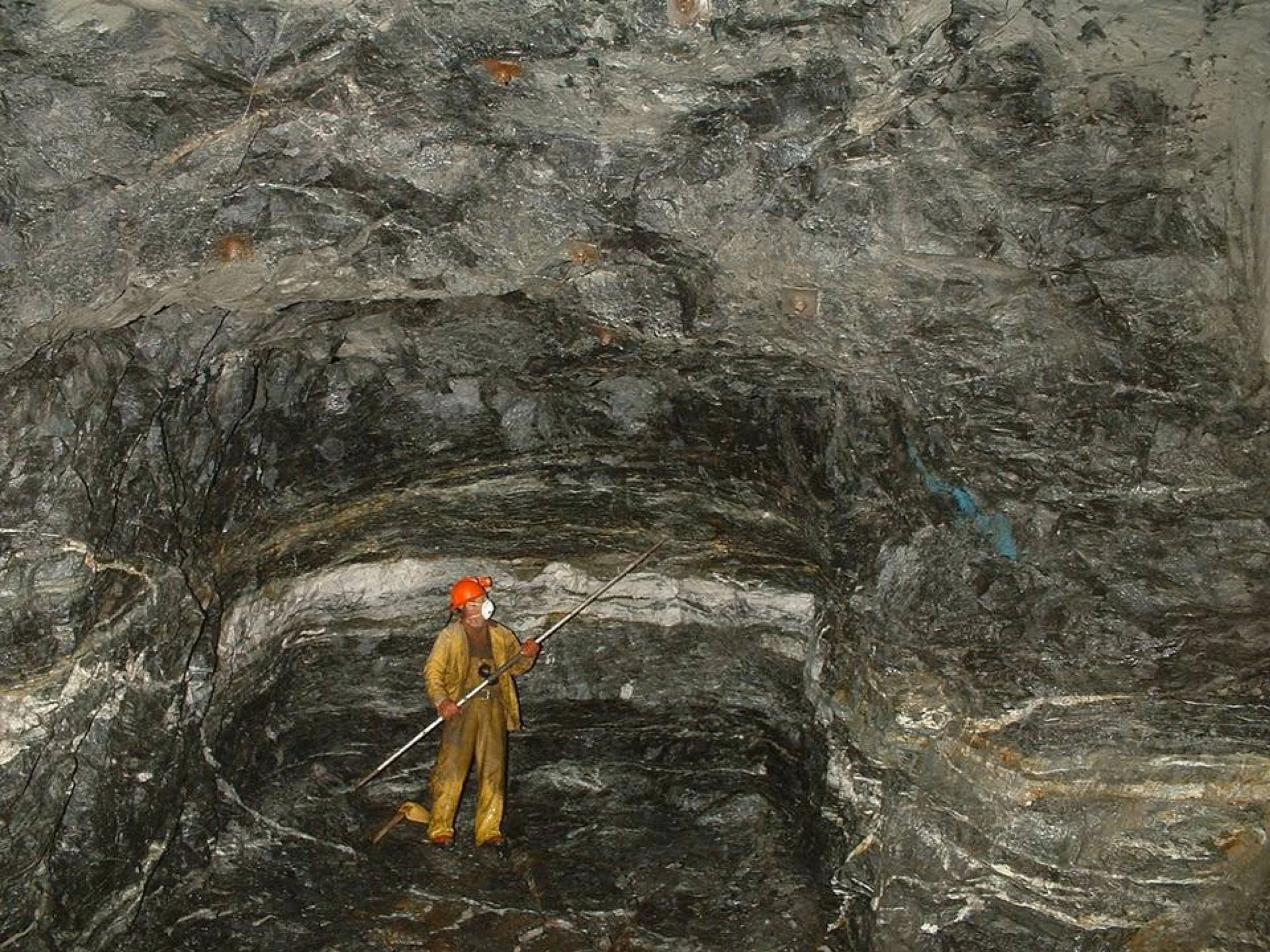
These physical transformations translate directly into formidable logistical and economic barriers. Most mining exploration sites in Greenland are located along the coast, making port infrastructure essential for transporting heavy equipment and extracted materials. Yet declining sea levels threaten the long-term viability of deep-water ports built today, potentially rendering them too shallow within decades. The island’s broader infrastructure is equally constrained. Greenland possesses just 93 miles of roads, only 56 of which are paved, and none connect towns or cities to one another. Roads exist primarily within individual settlements rather than forming an integrated transport network. The island’s only fully operational year-round mine, the White Mountain anorthosite project, illustrates these challenges vividly. It has no road connections and is accessible only by ship or helicopter, highlighting the extraordinary logistical effort required even for a single operation.
Time and costs further complicate any large-scale industrial ambitions. Greenland’s Minister of Natural Resources has noted that mining projects typically take around 16 years to progress from initial concept to full operation. This timeline is shaped by permitting processes, financing hurdles, construction challenges, and harsh environmental conditions. Over such extended periods, the very geological conditions infrastructure is designed for are likely to change significantly. Financial analysts also estimate that Arctic mining operations can cost three to five times more than comparable projects in temperate regions, driven by extreme weather, limited infrastructure, and high transport costs. Together, these factors severely undermine the economic feasibility of rapid resource development.
Greenland’s future cannot be approached through a traditional lens of territorial expansion or resource capture. Any serious policy discussion about Greenland must move beyond mineral maps and geopolitical ambition to confront the volatile physical realities of the Arctic environment itself. Strategic policy regarding the North Atlantic must reckon with these hard geological and environmental realities before embarking on geopolitical adventures. Ultimately, geopolitical aspiration, no matter how urgent or symbolic it might seem, cannot override geological reality.
Sarah Salah is a Spring 2026 Intern for the Energy & Climate program at ORF America.