
By: Anit Mukherjee
On February 18, President Luis Ignacio Lula da Silva of Brazil will arrive on a four-day state visit to India accompanied by nearly half of his cabinet ministers and over 150 business leaders. This visit, representing the largest economy in Latin America, culminates several years of high-level engagement between New Delhi and Brasilia, following recent visits by Brazil’s Vice President Geraldo Alckmin, Foreign Minister Mauro Vieira, and President Lula’s top foreign policy advisor, Celso Amorim.
Last year, India’s Prime Minister Narendra Modi conducted a visit to Brazil after the BRICS Summit in Rio de Janeiro. Lula’s state visit provides an opportunity to maintain the momentum. Significant India-Brazil cooperation in the global sphere — as in BRICS, the G20, and the United Nations — has not yet translated into a strong economic relationship between the two countries. Trade between India and Brazil stands at only $12.5 billion in 2024, less than 10% of Brazil’s trade with China. In spite of a Bilateral Investment Treaty signed in 2020, two-way investment stands at less than $1 billion until 2024.
Given Brazil’s status as an agricultural, mining, and industrial powerhouse, there is significant potential to expand trade and investment in the coming years. India can become an important market for Brazil’s agricultural products, critical minerals, and the aviation sector, while Brazil offers Indian firms access to both its large domestic market and a gateway for other Mercosur countries with which India has an existing preferential trade agreement in force from 2009. Lula’s visit might be an opportune time to transform the India-Mercosur PTA into a broader free trade agreement with Brazil’s support, deepening India’s trade and economic ties with Latin America. By becoming a member of the Inter-American Development Bank (IDB) in the future, India will also be able to support multilateral finance and investment as a partner in the region.
Things are moving on the right direction. Indian companies such as Bajaj and Mahindra have invested in motorcycle and tractor manufacturing facilities respectively and are set to expand their capacity eyeing a larger share of the domestic market. Brazil’s aircraft manufacturer Embraer announced a partnership with India’s Adani Group to explore opportunities to manufacture regional transport aircrafts in India. This follows similar agreement with Mahindra to manufacture C-390 Medium Transport Aircraft expanding cooperation in the defense sector. And the opening of the India office of Brazil’s Trade and Investment Promotion Agency (ApexBrasil) during Lula’s visit will facilitate the business-to-business ties that are set to advance significantly in the future.
Another area of alignment is technology. Lula’s presence at the AI Impact Summit in New Delhi will underscore the importance of harnessing the potential of transformative technologies such as artificial intelligence (AI). With AI increasingly becoming a tool for economic and social transformation, Brazil-India technology cooperation will play a critical role in shaping the global discourse on AI and to ensure that the benefits are distributed fairly and equitably.
Brazil and India share similar views on the role of technology to spur innovation, create jobs, transform governance, and make public services better and more efficient. Within a decade, Brazil’s Pix and India’s Unified Payments Interface (UPI) have become the largest instant digital payment networks in the world processing nearly one billion transactions per day. Built on a digital public infrastructure (DPI) approach, they provide a template for countries of the Global South to build low cost and scalable digital systems that are attuned to the needs of their citizens.
More importantly, Lula’s state visit to India will underscore the important role of Brazil and India as leaders of the Global South helping countries navigate geopolitical uncertainty, rebalanced global trade and supply chains, rapid diffusion of transformational technologies, and accelerating impact of a changing climate. During his first year in office, Lula was instrumental in the creation of the India-Brazil-South Africa (IBSA) Initiative in 2003, providing a vision of cooperation among three largest democracies of Asia, Africa, and Latin America. Two decades later, the three countries held consecutive presidencies of the G20 re-anchoring the group’s priorities to those of the Global South. Our review of the G20 IBSA presidencies shows how cooperation and coordination between India and Brazil was instrumental in the setting up of global alliances to advance energy transition and food security during a time of waning multilateralism, rising inequality, and stalled progress on global goals. With the United States hosting the G20 this year, a strong relationship between the two countries will be critical to consolidate the achievements and keep the priorities of the Global South on the agenda.
Anit Mukherjee is a Senior Fellow for the Global Economics & Development program at ORF America.
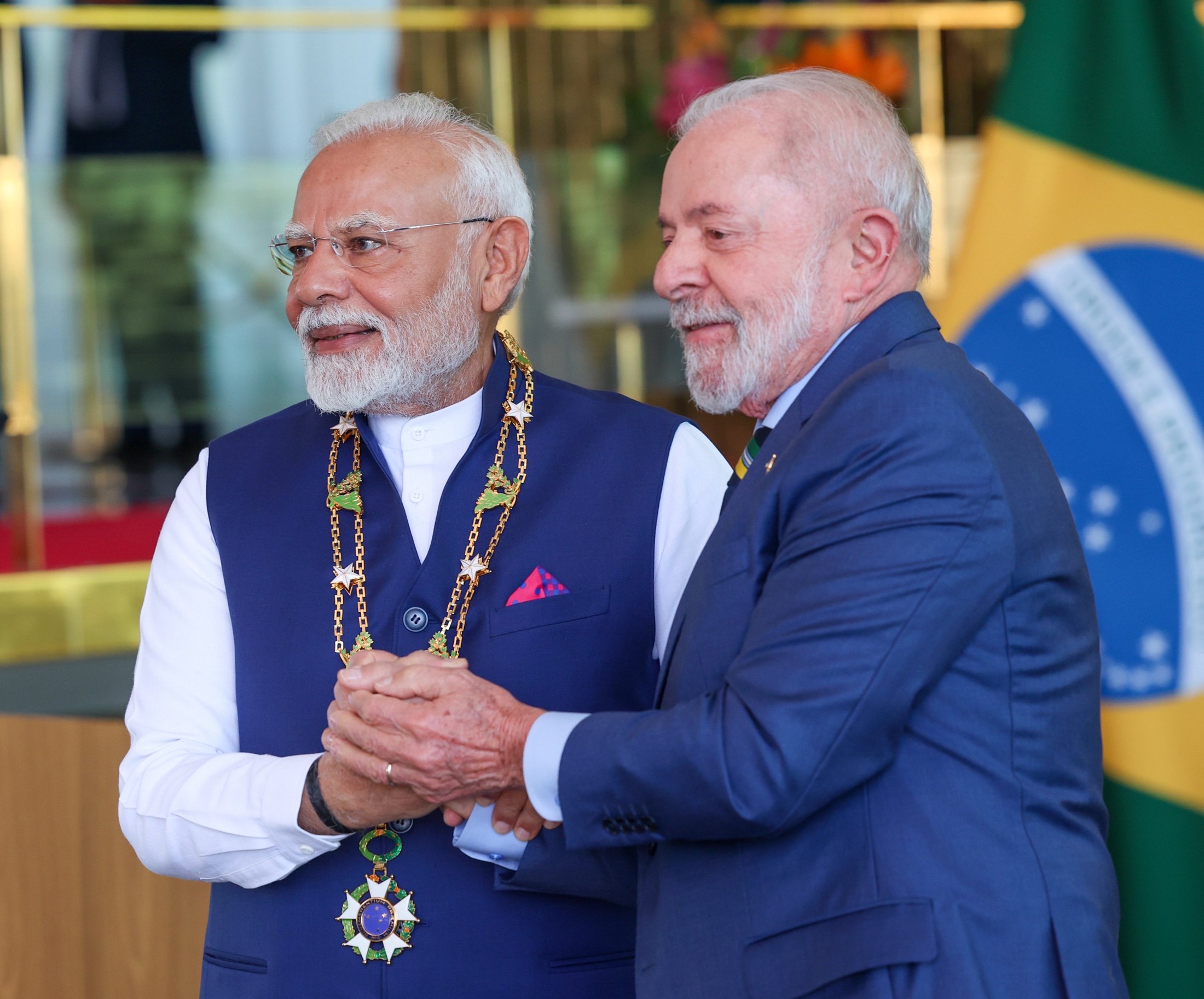
Image: 187042. PM receiving the Brazil’s highest honour - ‘The Grand Collar of the National Order of the Southern Cross’ by the President of Brazil, Mr. Luiz Inácio Lula da Silva at Brasília, in Brazil on July 08, 2025. Courtesy of the Government of India Press Information Bureau, via pib.gov.in.