
By: Anit Mukherjee
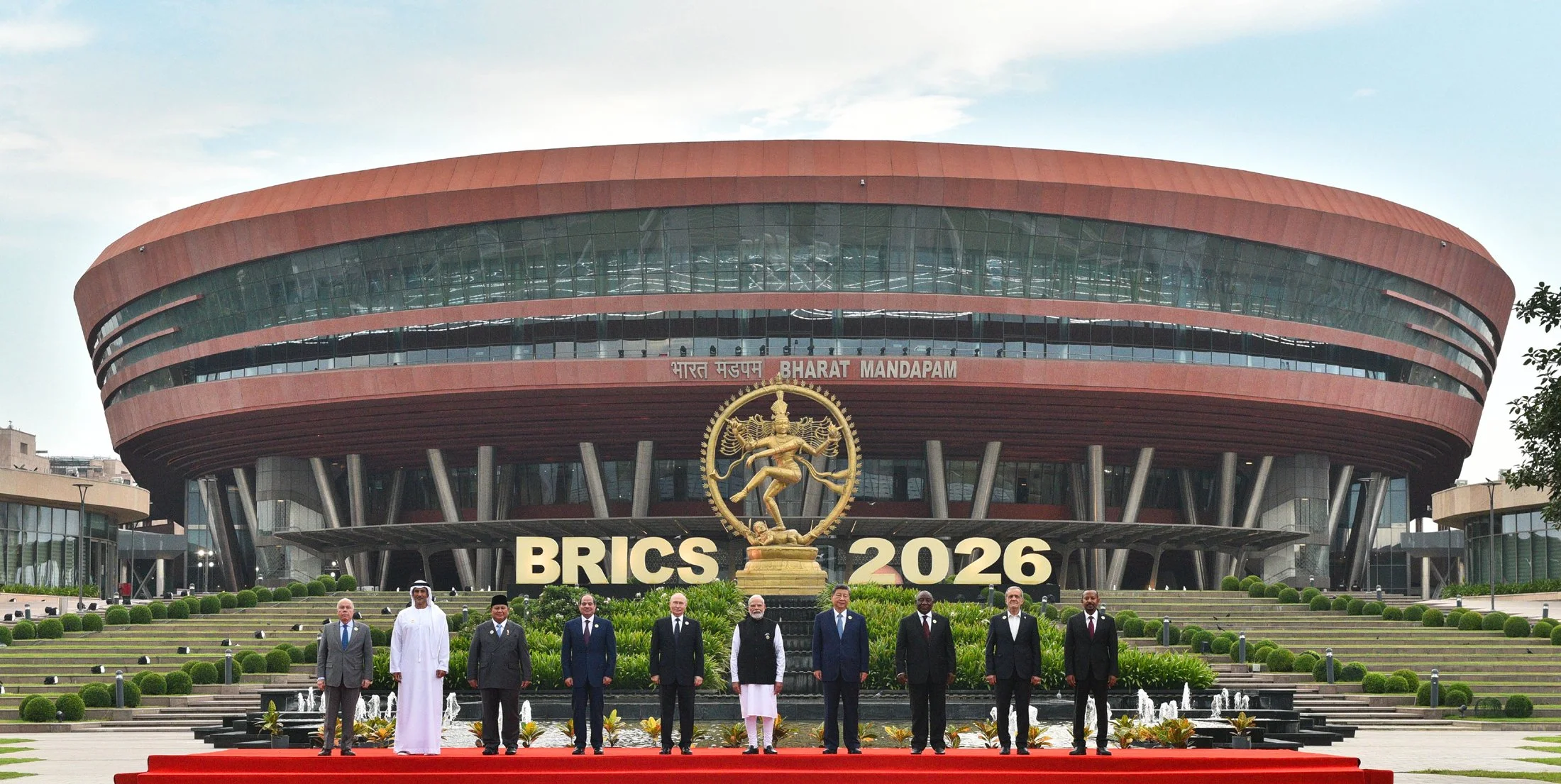
The recently concluded BRICS Summit in New Delhi received international attention, mostly for the meeting between Iran’s President and the Crown Prince of Abu Dhabi amid the continuing Iran War, and for Chinese leader Xi Jinping’s first visit to India since border clashes between the two countries. But the New Delhi Declaration that resulted from the summit also had implications for international trade, cross-border payments, and international financial institutions.
Founded in 2006 as a grouping of four countries — Brazil, Russia, India, and China — and later expanded with South Africa joining in 2010, the BRICS’ eleven current members constitutes half of the global population and nearly 40% of its GDP. The institution’s discussions have often focused on food, health, and energy security; digital transformation; and global governance.
The BRICS countries account for nearly a quarter of global trade and their statement therefore reflected their sensitivity to the imposition of unilateral tariffs. But intra-BRICS trade is relatively modest, accounting for less than 20% of South-South trade flows. Diversification remains a key challenge: with the exception of China and India, commodities and natural resources make up about 60% of intra-BRICS exports for the other eight members. Moving to a more balanced trade regime will require long-term investment and technology transfers to support modern manufacturing and integration into global supply chains, as mentioned in the New Delhi Declaration.
The Declaration also highlighted the importance of the related issue of cross-border payments. With most countries their own instant payment systems, efforts have been made to develop a BRICS-wide network that is decentralized to effect settlements in local currencies. Instead of a common ‘BRICS currency’, this arrangement seeks to make the different national payment systems interoperable to reduce the cost of cross-border transactions. The BRICS have also explored using central bank digital currencies (CBDCs) to settle cross-border trade payments as per a proposal by the Reserve Bank of India. In the end, the implementation will depend on the resolution of technical challenges, especially the currency swap agreements that underpin trade in local currency among the BRICS countries. But an alternative mechanism for cross-border payments is on the table, with more countries willing to entertain the idea than before.
A final point of note is that the summit endorsed a greater role for the BRICS New Development Bank (NDB) in development finance. Established in 2015 with the five founding members as equal shareholders, the objective of NDB was to invest in infrastructure and sustainable development primarily in BRICS countries. Since 2021, five countries (Algeria, Bangladesh, Egypt, the UAE, and Uzbekistan) have formally joined the NDB, and five more are in line to join in the near future. With nearly $100 billion in investible resources and over $40 billion in projects, the NDB’s mandate is expanding to include not only BRICS members but emerging market and developing countries (EMDCs) more broadly. With most of its lending undertaken in local currency, it remains an attractive proposition for EMDCs that are constrained by debt repayments, stagnant exports, and slowdown in remittances. The New Delhi Declaration supported an expansion in NDB membership that will enable it to play a larger role in the development lending to countries of the Global South while calling for the long overdue reform of existing multilateral financial systems.
In the 20 years since BRICS was formed as a loose agglomeration of developing countries, the New Delhi Summit demonstrated that its value lay in providing a space for some overlapping approaches to economic management and development. The challenge is one of coordination, reconciling national priorities with the wider objectives of balanced trade, efficient cross-border payments, and effective development finance.
Anit Mukherjee is a Senior Fellow for the Global Economics & Development program at ORF America.
Image: 216378. PM in a group photograph with BRICS leaders on the sidelines of the 18th BRICS Summit at Bharat Mandapam, in New Delhi on September 12, 2026, via pib.gov.in.