
US Engagement

Season 2 Episode 7 : U.S. Tariffs after Supreme Court Ruling, Trump’s State of the Union

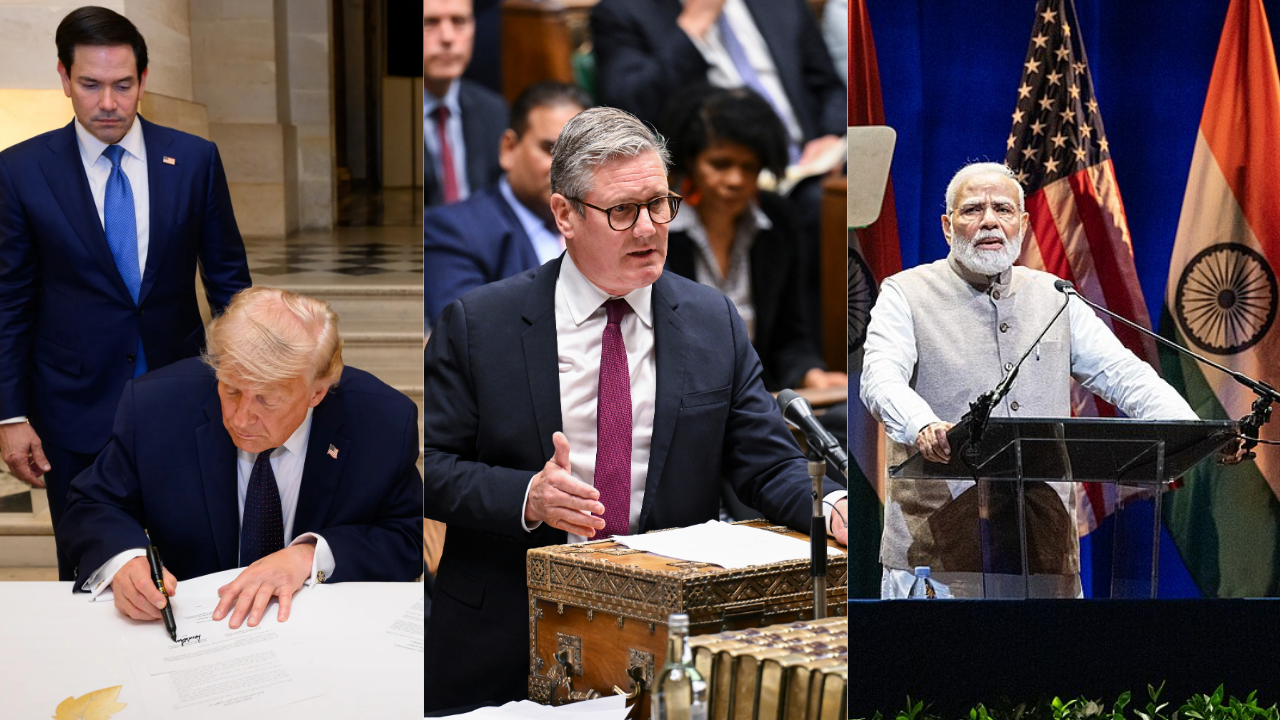
February 27, 2026 — In this week’s episode of Around the World, hosts Dhruva Jaishankar and Rachel Rizzo recap a landmark U.S. Supreme Court ruling that struck down President Trump’s use of emergency powers to impose global tariffs, exploring its implications for current trade deals and future negotiations. They then pivot to Trump’s State of the Union address, highlighting his claims of economic revival and conflict resolution abroad.

Available on Spotify and Apple Podcasts.

Image: Mathieu Landretti, CC BY-SA 4.0, via Wikimedia Commons
Image: The White House, Public Domain, via WhiteHouse.gov

Sneak Peek

Rachel Rizzo: On this week's episode.

Dhruva Jaishankar: The Supreme Court voted six to three to strike down President Donald Trump's use of International Emergency Economic Powers Act, IEEPA, and his use of IEEPA for tariffs. This really constrained his ability to apply tariffs. That being said, there is a sort of menu of options that Trump has on the table, at least five different ways that he can continue to impose tariffs, each with certain limitations. Most immediately, he imposed some tariffs under Section 122, which basically limits tariffs to 15, up to 15%, but only for 150 days, and it can be extended with congressional approval.

Rachel Rizzo: I mean it was like it was typical Trump, you know, he started the main section of the of the State of the Union basically saying our nation is back, it's bigger, it's better, it's richer, it's stronger than ever before. He talked about falling inflation. He claimed credit for what he refers to as a turnaround for the ages. it was pretty light on foreign policy, actually. It took a backseat. But what he did say was, as has become very custom for Trump, pretty self-congratulatory. He claimed credit for ending eight conflicts around the world.

Welcome to Around the World

Dhruva Jaishankar: Hi, I'm Dhruva Jaishankar.

Rachel Rizzo: And I'm Rachel Rizzo. Welcome to the Around the World podcast. Your essential guide to understanding the forces shaping our world today. Every week, we cut through the noise to bring you clear, insightful analysis of the most important developments in geopolitics.

Dhruva Jaishankar: Whether it's security challenges in Europe, great power competition in Asia, domestic politics from the United States, or regional updates in Latin America or the Middle East, we’ll discuss what's happening and more importantly, why it matters.

Rachel Rizzo: Thanks as always for tuning in. And be sure to like and subscribe to the Around the World podcast on Youtube, Spotify and Apple Podcasts. Onto the show.

SCOTUS Strikes Down Tariffs

Rachel Rizzo: Hey Dhruva.

Dhruva Jaishankar: Hi, how are you?

Rachel Rizzo: Good. You're in Australia?

Dhruva Jaishankar: I'm in Canberra. I've spent the last week here mostly in Sydney and also in Canberra. Very interesting. We were launching a report on maritime security in the Indo-Pacific, but also had very good meetings with think tanks and officials in Sydney and Canberra from the Australian, Japanese, Indian governments in Sydney, but also in the foreign defense ministries here in Australia. So it's been very productive. And it's also just nice to get a, it's my first time back in Australia in six years.

Rachel Rizzo: Nice.

Dhruva Jaishankar: And it's nice to kind of get a sense of how they see the world, whether it's relations with the United States or what's happening in the South or Southeast Asia. So it's always interesting to learn from perspectives here. So it's been a very educational, illuminating week for me.

Rachel Rizzo: Good, good. And then you're not going back to the U.S. after. You're coming straight here to Delhi.

Dhruva Jaishankar: Yeah, and we may record maybe a next episode in Delhi where we'll both be there for.

Rachel Rizzo: We've got, yeah, we've got the Raisina dialogue next weekend.

Dhruva Jaishankar: Yes, yeah, big annual conference at the Rise in a Dialogue. Planning is underway. I think, Rachel, you're very much involved in that. So next week should be a very exciting week in India.

Rachel Rizzo: Yeah, lots of India-focused stuff coming up, but it was a big week for US domestic politics and also the reverberations that they might have in terms of some of Trump's major cornerstone decisions of his presidency. And the biggest one that we want to talk about first is this Supreme Court decision to strike down Trump's tariffs.

Dhruva Jaishankar: Yes.

Rachel Rizzo: That kind of came as a surprise. Everyone had been waiting for this decision for a while. But tell us what you've been watching. Tell us what happened.

Dhruva Jaishankar: Yeah, so we, think a lot of us have been watching this from late last year. There actually had been an expectation that maybe the US Supreme Court would make a decision on tariffs in December. It got postponed a little bit, but we finally had a ruling. The Supreme Court voted six to three to strike down President Donald Trump's use of International Emergency Economic Powers Act, IEEPA, and his use of IEEPA for tariffs. This really has constrained his ability to apply tariffs using that legal authority. And essentially what the Supreme Court said, it was again more procedural than against anti-tariff, so we can get to that a little bit as to why. But essentially they said that no president has used this to confer tariff authority. And really, it was more on the legality of the process rather than a ruling against tariffs in general. And he could not, the president could not provide a sort of clear rationale for his ability to impose tariffs of unlimited amount, duration, and scope under these extraordinary powers. And it basically required congressional authorization. So that was the sum and substance of the ruling.

Rachel Rizzo: Got it, got it. And so I think the major question that I still don't quite have an answer to is what it actually means for the tariffs that have been imposed. mean, people are talking about reimbursements, but those are legal issues there. It's a huge pain. He's now increased the global tariff rate to 15 % in response to this. I mean he's obviously clearly upset about it, but what does it actually mean?

Dhruva Jaishankar: So I think that two important things to look at. One is the international dimension, and one is the domestic dimension of this ruling. So on the international dimension, I think the ruling essentially says 60 % of Trump's tariffs that he has imposed are invalidated, including most significantly against some of the tariffs against Canada, Mexico, China. That being said, there is a sort of menu of options that Trump has on the table, at least five different ways that he can continue to impose tariffs, each with certain limitations. Most immediately, he imposed some tariffs under Section 122, which basically limits tariffs to 15, up to 15%, but only for 150 days, and it can be extended with congressional approval. And this is what he did immediately. The rationale for Section 122 tariffs is that there's a challenge with international payments. Again, that's questionable, but that's what he has now used. In the meantime, what I think we can expect is that there will be investigations and an imposition of tariffs under several other potential rationales. Section 232 tariffs that relate to threats to national security determined by the Department of Commerce. Section 201, which is sort of injury to domestic industry.

Rachel Rizzo: 301 or 201?

Dhruva Jaishankar: There's 201 and 301.

Rachel Rizzo: Okay.

Dhruva Jaishankar: So 201 is by the International Trade Commission. Section 301 is discrimination against U.S. businesses or violation of U.S. rights under trade agreements, and that's determined by the U.S. Trade Representative.

Rachel Rizzo: Got it.

Dhruva Jaishankar: Then there's also, this is kind of another biggie, a potential one, is Section 338 which is discrimination against US commerce. that's kind of a, he could do that, but that would be much more wide ranging. So essentially he has a menu of at least five different authorizations that he could use. I think some people are jumping to the conclusion that this means the end of tariffs. think Peter Navarro had an article in the Financial Times, this is one of his trade advisors. And also some of the things Trump has said that he's not backing down from tariffs.

Rachel Rizzo: Yeah. Yeah.

Dhruva Jaishankar: This has simply complicated his legal authority to impose tariffs under IEPA. So that's the international dimension. The domestic dimension, think one thing that may pick up is the question of the tariffs that have been raised, and it's quite significant in terms of value. We're talking billions of dollars here. Do these need to be reimbursed to importers, to American importers? And I guess the question I have is, how much particularly small and medium enterprises in the United States, which have had to pay pretty hefty tariffs over the past year or so, how much they will demand sort of reimbursements? Will this potentially affect ⁓ Trump's popularity in the run up to the November midterm elections,

Rachel Rizzo: Yeah.

Dhruva Jaishankar: Then sort of the legal processes that take place. we're talking, I think I have the statistics somewhere. I mean, it is really like a very large number of transactions, millions of transactions have taken place. so how this process unfolds is really going to be complicated.

Rachel Rizzo: And it's going to be a, I mean, we're looking at like a long term process here. I mean, this is not something that's going to be wrapped up with a bow anytime soon. This is just the very beginning and we've got a long road ahead right.

Dhruva Jaishankar: Yeah, and so I think you've got this 150 days, either Congress will reauthorize some of that 15 % tariffs, or even if not, there will be a raft. And in some ways, the administration has been preparing for this since at least November or December last year, because in the oral arguments made in the Supreme Court, it was pretty clear that many of the Supreme Court justices, including the conservative justices, expressed quite a lot of skepticism about the legal authority that the US President had to impose these tariffs unilaterally. So I think they have been preparing the ground for at least two or three months to impose a raft of new tariffs under different authorities.

The Longest SOTU Address

Rachel Rizzo: Okay and then a few days after that decision, he then had to face three of the Supreme Court justices who made that decision in his State of the Union address. So that was fun.

Dhruva Jaishankar: Yeah, that happened. I was in a strange time zone, didn't follow the State of Union as much as you might have. So tell us a little bit about what happened in what I think is the longest State of Union address in history.

Rachel Rizzo: Yeah, it was like an hour 48 minutes I think off the top of my head if I remember right.

Dhruva Jaishankar: Mm-hmm.

Rachel Rizzo: But yeah, I also am in a strange time zone when it comes to watching US primetime TV So I was up at 7:30 in the morning here in Delhi watching it with my cup of coffee in the morning So that was pretty a nice way to start the morning, you know with like Trump yelling at everyone But I mean it was like it was typical Trump, you know, he started the main section of the of the State of the Union basically saying our nation is back, it's bigger, it's better, it's richer, it's stronger than ever before. He talked about falling inflation. He claimed credit for what he refers to as a turnaround for the ages. you know, this also, as I mentioned before, comes on the heels of the Supreme Court declaring his tariffs illegal and him rising or raising global tariffs in response to that. I thought that it was gonna, I mean, he would maybe start some sort of, not like direct yelling confrontation with the Supreme Court judges that were there, but certainly would like call them out in a pretty, in a pretty loud, garish sort of way. But he sort of avoided that. He, he, you know, greeted them when he walked in. Chief Justice Roberts, who's a, you know, right leaning Chief Justice on the Supreme Court, he's the one that wrote the opinion, actually. So that part of it wasn't as shocking as I thought it was going to be, but the rest of the speech obviously was sort of classic, classic Trump.

Dhruva Jaishankar: And what about foreign policy?

Rachel Rizzo: Yeah, so it was pretty light on foreign policy, actually. It took a backseat. But what he did say was, as has become very custom for Trump, pretty self-congratulatory. He claimed credit for ending eight conflicts around the world. This is a line that we have heard from him many times up until now. He rattled off that included the Israel-Gaza, what was it? No, Israel-Iran ceasefire. He talked about the India-Pakistan standoff earlier last year. I think he said that the Pakistani prime minister would have been killed if it wasn't for him, if I remember the line correctly. He said Gaza was just about there, which you know that's obviously one of the most debatable things that you can say in terms of foreign policy at the moment.

Dhruva Jaishankar: My pet favorite war that he's ended is the one between Egypt and Ethiopia, which is you know which aren’t neighboring countries, but that's one he takes credit for. Yeah.

Rachel Rizzo: Yeah he did talk, he mentioned this too. He talked about Armenia and Azerbaijan. And then he talked about the, you know, obvious military operation in January that captured Venezuelan president, former president, guess, Nicolas Maduro. He said Venezuela is our new friend and partner. Said that we're now on the receiving end of millions of barrels of Venezuelan oil. He said pretty little on the Ukraine war, despite the fact that the speech fell on the four-year anniversary of Russia's invasion. He just had kind of a brief line about working to end the killing and the slaughter. But I will say on Iran, he did strike a little bit more of an ominous tone. He warned that Iran would not be allowed to get a nuclear weapon. He left military action on the table. But I think as usual, there are people that are his champion when it comes to foreign policy. Critics, obviously, point out a very clear gap between these triumphant frames that he presents and the reality on the ground. So it's long on confidence and short on strategy, as some people might say.

Dhruva Jaishankar: And what was, I didn't see it, but what was the partisan flavor like? know, I mean, again, you have Democrats in the audience. It has, I think in recent years, the State of Union has taken on a more partisan tone, but what was it like?

Rachel Rizzo: Yeah, I mean, remember, I can't remember what year it was exactly, but there's that famous moment during Trump's State of the Union. was during his first, I almost said first semester, during his first administration where he finished the State of the Union and Nancy Pelosi stood behind him and just ripped up the speech.

Dhruva Jaishankar: Nancy, Nancy Pelosi, ripped it. Yeah, yeah, yeah.

Rachel Rizzo: So that didn't happen because he had Vice President Vance and Mike Johnson standing, sitting behind him. But he set up the speech to make it as partisan as possible. Ilhan Omar. the Congresswoman from Minnesota screamed that he had killed Americans. This was in a moment about immigration, about halfway. And obviously she's talking about the ICE agents and Alex Preti and the in Minneapolis who was killed, who was shot by an ICE agent. About halfway through the speech, he asked everyone in the, and this was a really interesting moment. He asked everyone in the chamber to quote, stand up and show your support for the idea that the first duty of the U.S. government is to protect American citizens rather than illegal aliens. And those are his words, illegal aliens are his words.

Dhruva Jaishankar: Mm-hmm.

Rachel Rizzo: And immediately Republicans jumped to their feet, they applaud, Democrats stay seated, and then Trump just wheeled on them and said, should be ashamed of yourselves for not standing up. So, I mean, it's, and he didn't stop there. He referred to the Democrats as crazy in a moment where JD Vance and Speaker Johnson stood up and applauded. So I mean, it's a moment that I think Republicans have said that they are going to use in terms of footage for the midterms that are coming up this November. So there's a lot there, but I think we have to, it wasn't as shocking as some of his former State of the Unions, I guess, because we've heard it before. We kind of know what his MO is at this point. I thought it was gonna be a little bit heavier on foreign policy, but we'll see how things go on that front. yeah, for anyone that watched it, it wasn't anything that was like super new.

Dhruva Jaishankar: Well, there's a lot else going on this week, partly as a result of the Supreme Court ruling. The US has delayed trade talks including with India that were scheduled to take place.

Rachel Rizzo: Mm-hmm.

Dhruva Jaishankar: There has you know, I think they're close to an interim agreement there, but it has also complicated the existing and negotiated trade agreements with Europe and with Japan and many others so I think that that's one space to watch. We've seen a burst of violence in Mexico related to cartel related violence.

Rachel Rizzo: Yep.

Dhruva Jaishankar: Drug leader known as El Mencho, cartel leader, was killed and that has sort of triggered some violence there. And I think another thing, I mean I'm certainly watching, a lot of people are, is the ratcheting up of tensions on Iran.

Rachel Rizzo: Yeah.

Dhruva Jaishankar: Again today in fact there's some talks going on to kind of hopefully avert sort of tensions there, but I think a lot of people are expecting possible military action against Iran. So.

Rachel Rizzo: Yeah, but not when Modi is in Israel, which is where he is now.

Dhruva Jaishankar: Yes, yeah, but I think he's returning today or tomorrow and at time of this recording he's actually hosting Canadian Prime Minister Mark Carney. So again, lot going on in the world. I think we'll discuss all of this next week and beyond. But it's interesting to see these tensions, know, the Supreme Court ruling, the State of the Union and other things in the United States and how it's being read all over the world.

Rachel Rizzo: Absolutely. Yeah, and I think maybe our next episode will come to you live from India, perhaps, when we are both finally in the same place. So of course, we'll see how that goes. And as I mentioned before, be sure to tune in every Friday for the latest episodes. We took a week off last week. Things were a little busy and hectic with travel schedules. But of course, as always, subscribe to the around the world podcast like the around the world podcast on Apple podcast YouTube and Spotify and we will see you all hopefully next week!

Dhruva Jaishankar: As always, thank you for joining us and see you next week.

Rachel Rizzo: Thanks, Dhruva.

Dhruva Jaishankar: Bye

Season 2 Episode 1 : Venezuela Operations, Greenland Tensions, and Recognition of Somaliland

January 9, 2026 — To kick off Season 2 of Around the World, hosts Dhruva Jaishankar and Rachel Rizzo recap what went down in Venezuela and the U.S. military’s capture of Nicolás Maduro and his wife. They also discuss the revived tensions between the United States and Greenland, and touch on Israel’s recent recognition of Somaliland as an independent state. 

Available on Spotify and Apple Podcasts.

Image: SWinxy, CC BY 4.0, via Wikimedia Commons

Image: www.horndiplomat, Public domain, via Wikimedia Commons

SNEAK PEAK

Dhruva Jaishankar: On this week's episode of Around the World.

Dhruva Jaishankar: So there were strikes against Venezuelan facilities, both military bases, port communications, antennas and such. This then led to a pretty targeted special forces operations with law enforcement officials, because again, Maduro is being tried. They went in straight and managed to get him in the middle of the night, and his wife, and extract them. it was a pretty daring military operation. It really showcases some of the unique capabilities of US military. There are not too many other military forces around the world that they're capable of doing such an operation. So seemingly effortlessly,

Rachel Rizzo: Greenland is an autonomous territory, but it is a part of Denmark. It's the largest island in the world. It is strategically located in the Arctic. Because of climate change, northern shipping routes, the seasons that those shipping routes can be used are becoming longer and China and Russia are working together to sort of consolidate control over those potential shipping routes. And so I think Trump wants to make sure that the United States is not only a player in this region, but is the dominant player in this region.

Dhruva Jaishankar: There has been some activism for some time, both by the people, by the de facto government of Somaliland, but also certain others to recognize it as an independent country. the United Arab Emirates has been amongst the most vocal in pushing for such recognition, not publicly, but certainly lobbying quite heavily to do that. For Israel, I think there is an added benefit. it's seeking greater recognition from different places. It's been attacked by Houthis in Yemen, who are just across the Red Sea from Somaliland. And so Israel obviously has an added incentive.

Welcome to Around the World

Dhruva Jaishankar: Hi, I'm Dhruva Jaishankar.

Rachel Rizzo: And I'm Rachel Rizzo. Welcome to the Around the World podcast. Your essential guide to understanding the forces shaping our world today. Every week, we cut through the noise to bring you clear, insightful analysis of the most important developments in geopolitics.

Dhruva Jaishankar: Whether it's security challenges across Europe, power dynamics in Asia, domestic updates from the United States, or regional updates in Latin America or the Middle East, we make sure you're up to speed on what's happening and more importantly, why it matters.

Rachel Rizzo: Thanks for tuning in. And also be sure to like and subscribe to the Around the World podcast on both Youtube, Spotify and Apple Podcasts.

Rachel Rizzo: Hey Dhruva and happy 2026. How was your break?

Dhruva Jaishankar: Happy New Year to you too. Good. I was in New Mexico and enjoying being out West and now back in Washington, DC. And how are you?

Rachel Rizzo: Things are good. Just was in Utah with family, now back in New Delhi, and it has been a newsy six days, hasn't it?

Dhruva Jaishankar: Yes, absolutely. So we're starting season two of Around the World with what promises to be a very exciting year. Just a few things, I think, to watch out for. I mean, we're going to get into what happened in the last week and the last few days. But I think in the next few months and the rest of year, we'll be looking out for a possible Donald Trump visit to China in April.

Rachel Rizzo: Mm-hmm.

Dhruva Jaishankar: We'll have the FIFA World Cup here in the US in the summer, the 250th anniversary of the United States. Trump also plans to host the G20 leaders in Miami this fall. And we'll have perhaps one of the most consequential midterm elections in the United States in long time.

Rachel Rizzo: Absolutely.

Dhruva Jaishankar: And all of that will have international repercussions as well. And also, again, I think we'll be tracking some big uncertainties. I'm sure you've been following, of course, the Ukraine ceasefire talks.

Rachel Rizzo: Yep, it's a big one.

Dhruva Jaishankar: Which seem to be two steps forward, two steps back.

Rachel Rizzo: Always.

New Year, New Venezuela

Dhruva Jaishankar: And then we'll see also whether the US-China trade ceasefire holds until April and then again until the rest of the year. So a lot of things to watch out for. And then of course, these big uncertainties. And the first one we'll get into, I think, is Venezuela.

New Year, New Venezuela

Rachel Rizzo: And that is the big news topic of the last couple of days. I woke up here, I think I was going to bed here maybe on Sunday and started getting texts from people about the United States, the Trump administration specifically nabbing Nicolas Maduro, former, I guess now leader of Venezuela. So can you just give us a quick overview? What just happened in Venezuela and what's happening now?

Dhruva Jaishankar: So we had actually discussed Venezuela, I think on the third episode of the show, I think back in about October or so, and there was already a US military buildup underway in the Caribbean, the deployment of an aircraft carrier group to the region. But what we saw happen in the early hours of early in the new year was two and a half hour operation by US special forces led by the Army's Delta Force that went to Caracas following bombing, so a bombing campaign, targeted bombing campaign, nabbed Venezuelan President Nicolas Maduro and his wife, brought them back to New York where they're facing now charges related to drug related charges in a US court. And so it's in some ways quite a pretty bold operation that came, you know, I can't think of a recent precedent like this against a head of state or government.

Rachel Rizzo: No, absolutely. And like you said, we did discuss this. I think it was on episode three, as you mentioned. So this wasn't completely unanticipated. But can you explain a little bit about the buildup and maybe a little bit more about some of the military actions that were taken, not just leading up to this, but actually in the operation?

Dhruva Jaishankar: So there were strikes against Venezuelan facilities, both military bases, port communications, antennas and such. It appears as if more than 30 Cuban soldiers who were there, Cuba had a good relationship with Venezuela, were killed in the operation.

Rachel Rizzo: Interesting.

Dhruva Jaishankar: The US says no American soldiers were killed. This then led to a pretty targeted special forces operations with and they were coordinating with law enforcement officials, because again, Maduro, being tried. It was a self-targeted operation where they went in straight and managed to get him in the middle of the night, him and his wife, and extract them. So brought them back to a US Navy ship and then from after that flew him back to New York to face charges. So it was a pretty daring military operation.

Rachel Rizzo: Yeah.

Dhruva Jaishankar: In some ways, think, much like the US bombing campaign against Iran's nuclear facilities last year. It really showcases some of the unique capabilities of US military. There are not too many other military forces around the world that they're capable of doing such an operation. So seemingly effortlessly, it was a high risk operation, but still the fact that it went off operationally quite successfully for the US is quite significant.

Rachel Rizzo: Yeah, I think you're right. And just setting the geopolitics aside, setting the decision aside, arguably it was a very successful military operation. What do you think this, what kind of signal would you say that this sends across the region now?

Dhruva Jaishankar: So Maduro and the government in Venezuela wasn't exactly popular in other parts of Venezuela. I partly the mismanagement of the economy had led to a big refugee outflow. And so in some ways it's being welcomed by Venezuelans abroad, including in the United States, who are quite a powerful political constituency. Also some in Latin America. I mean, for example, the Argentinian president Javier Mele, who is very aligned with the Trump administration, has been very enthusiastic. But at the same time, it's going to generate a lot of worries in other countries, particularly Cuba, with which the US has the most antagonistic relationship. But it's also been followed by some threatening rhetoric against Colombia and even Mexico. And so again, many others will be worried about the precedent it would set.

Rachel Rizzo: Can you also talk a little bit about maybe what this means about Trump's willingness to use force or what it says about his administration's approach, not just to foreign policy, but his approach to getting other states to potentially bend to his will? And maybe what signal does it send to states like Russia and China?

Dhruva Jaishankar: So, you know, one, I'd say two aspects to that. One is that a lot of people have characterized the Trump administration's worldview as isolationist. And I've been at least personally a little skeptical of that term because that suggests a real withdrawal from the world.

Rachel Rizzo: I agree, yeah. Yeah.

Dhruva Jaishankar: And instead, even in his first term, you saw his willingness to use force quite and quite daring, some would argue reckless, but certainly bold ways to use force to achieve certain decisive outcomes. And I'm thinking back to the assassination of Soleimani, Qasem Soleimani in Iraq, the Iranian al-Quds force leader six years ago, his use of like a really large weaponry against ⁓ ISIS and ISIL in Afghanistan in the first term. And then again, the bombing of Iran, Iran nuclear facilities and this, right? So there's been a track record of using force quite to achieve specific outcomes. And I think that, again, the isolationist characterization sometimes tends to gloss over that leading to people under underestimating the ability of the United States to use force under Trump. But it also, I think reinforces this view that might is right in this world in this day and age, know, so much for rules and norms.

Rachel Rizzo: Mm-hmm.

Dhruva Jaishankar: And if you're in Beijing or Moscow, I think it sends very mixed signals. It's been interesting to see some of the commentary emerging out of China and Russia in the last couple of days. On the one hand, it's a reinforces this view of spheres of influence. And at the same time, there's this grudging admiration of US capabilities. If you see the way Russia struggled in Ukraine, attempting something similar, change of government, a change of leadership there, again, shows the contrast in US capabilities.

Rachel Rizzo: Yeah, I think that's right. I think too that there's a lot of comparisons being made or lots of questions being asked about where or how Russia and China might be looking at this and how that might affect their own geopolitical decisions when it comes to, say, a Chinese decision to move against Taiwan, US decisions against Venezuela or Trump's decisions in the Western Hemisphere wouldn't magically decrease the costs that China would incur both militarily, politically, economically for a move on Taiwan. So whether they can look at it and say, well, the United States doesn't abide by international law, so we shouldn't either, but it doesn't change, I think, the calculus that much, I would say.

Dhruva Jaishankar: I think that seems to be the, there's been a lot of commentary on that exact issue over the last 48 hours.

Rachel Rizzo: Yeah.

Dhruva Jaishankar: And I think most of people who are sort of close followers of China and cross-strait relations believe that, it doesn't really change that much.

Rachel Rizzo: Mm-hmm.

Dhruva Jaishankar: If China wants to do something on Taiwan, they're going to do it anyway. There have been years of planning that has gone into this. For the most part, they don't believe the US is particularly law abiding anyway. They think there's a hypocritical double standards. So I think the general consensus is it doesn't make that much of a difference. Although I think some people are trying to use that argument to criticize the Trump administration's legality and appropriateness of the Trump action in Venezuela.

Rachel Rizzo: Yeah, that seems right. I think too that the big questions people are asking now, not just when it comes to Russia and China, but when it comes to the willingness of Trump potentially to use force elsewhere. And the Europeans are clearly on edge about this, given the comments that he's made about Greenland, for example. So I think this does bring in the question about whether or not Trump would be willing to assert that same kind of dominance over other countries that he deems not necessarily problematic in the same way as Venezuela, but as countries that are not bending to his will in a way that he would want them to.

Buying Greeland?

Dhruva Jaishankar: Yes. So actually I was going to pivot to you. fact, what, you know, the Greenland issue came up very early in the Trump term, Trump's second term, in his shortly after his inauguration. seemed to have died down for a little while, but is now back. Talk us through what does this mean for Greenland? Why is it back, back in focus?

Rachel Rizzo: Yeah, so I mean, the idea that Trump has wanted to purchase Greenland is not a new one. He first floated it back in 2019 during his first presidency. The idea then became sort of resurgent early last year in 2025 when he said again that the United States, quote, needs Greenland for national security reasons and then sent Vice President Vance on a visit there with the second lady. They received a very chilly reception from the locals, no pun intended. But then, like you said, the issue sort of died down last year. And even for me, as a person that was actually kind of watching this pretty closely, I sort of thought that that was going to be it. But with Trump, there's always a surprise around the corner. And when he was talking to reporters after the action in Greenland, he said yet again that the United States needs Greenland for national security. And he has thus far and continues to refuse to rule out the use of military force to acquire it for the United States. And so you've had comments from European leaders, from the Greenland prime minister, from the Danish prime minister. As most people know, Greenland is an autonomous territory, but it is a part of Denmark. And so a lot of issues, I think, are at play here. But the Danes, the Greenlanders, the Europeans are clearly concerned.

Dhruva Jaishankar: Yeah, and I saw one Katie Miller, who's the wife of Stephen Miller, who's the deputy national security advisors, tweet or put out on social media a map of Greenland with an American flag over it that triggered a response. And then there was a statement, think yesterday, was Tuesday of this week, which was it was a bunch of European leaders, Macron, Sanchez. was most of the top leaders sort of having unified position on Greenland and that any kind of it's up for Greenlanders to decide their future and Denmark and that this would threaten the need essentially implying this would threaten NATO as an alliance, right?

Rachel Rizzo: Absolutely.

Dhruva Jaishankar: But quick question. Why does Trump want Greenland?

Rachel Rizzo: So I think this is a really good question. mean, it's the largest island in the world. It's, I think, three times the size of Texas, if I'm not mistaken. It is strategically located in the Arctic. And there are a few things at play here. There are strategic issues at play. The US has ballistic missiles based in Greenland. We have space-based assets in Greenland. We have military personnel there as well. Because of climate change, for example, northern shipping routes, the seasons that those shipping routes can be used are becoming longer and China and Russia are working together to sort of consolidate control over those potential shipping routes. And so I think Trump wants to make sure that the United States is not only a player in this region, but is the dominant player in this region. It's also home to a lot of natural resources, albeit hidden under at some places, it's two miles worth of ice. So we're looking at things like critical minerals, lithium, cobalt, nickel. And so as this green transition continues and China continues to have most control over these critical minerals, Donald Trump wants to make sure that the United States sort of rests control of those critical mineral productions from China. And so this is where Greenland could really come into play here, although we are looking at years down the line and hundreds and hundreds of billions of dollars of effort here. This is not a quick fix or something that would happen overnight. So lots of issues that play both economic, political, military, strategic.

Dhruva Jaishankar: And what I mean, look, we can never rule anything out, but what would you say is like the probability or possibility of any kind of US military action against Greenland? Again, this is a NATO part of a NATO ally, right? So.

Rachel Rizzo: Yeah, it is. And which means it's protected by NATO's Article 5, which states that an attack against one is an attack against all. What it doesn't say is what happens when one NATO ally attacks another, especially when that ally is the United States. We've had issues like that in the past with Greece and Turkey back in the day.

Dhruva Jaishankar: Greece and Turkey, yeah.

Rachel Rizzo: Yeah. But I think this would be, I mean, this you never say impossible, but it would be unprecedented. And like I said about China earlier, what happened in Venezuela wouldn't in turn decrease the costs that the United States would incur for some sort of military action against Greenland. And I think the Europeans, as they have stated many times, would be very serious about defending it, although a different conversation would be how and what sort of assets would they actually be able to use here. But I think when you look at the statements that the White House has made, you have to contrast them to some of the statements that say Secretary of State Marco Rubio has made in the last day or so to a closed door session of Congress. said that the United States is interested in quote, buying Greenland, not invading it. And so I think that the likelihood of military action against it is still low. But I do think that the likelihood of economic pressure against it is very high. I think it's clear that the United States doesn't need to own Greenland in order to strategically benefit from it. The Greenlanders don't want to be part of the United States, poll after poll says this. And also earlier last year, polls also said that this was not a popular idea in the United States as well. Also remember that Trump ran on a campaign of peace and you know, what happened in Venezuela, Iran, you can argue about that, but imagine really getting bogged down in some sort of military conflict over Greenland. What would that look like? That would put him on par with the very Washington elites that he continuously lambast. So I think it's unlikely, but I do think that this is not the end of this conversation. It's just the beginning and there's a lot to watch.

Dhruva Jaishankar: Yeah.

Recognizing Somaliland

Rachel Rizzo: I mean, just like moving from Venezuela and Greenland to an issue that is pretty niche, but you happen to be paying attention to this. Can you tell us what's going on with Somaliland?

Dhruva Jaishankar: Yeah, I think, you know, it's nice to use this podcast to sometimes shed light on things that are not like in the news, or in the US news and sort of top level.

Rachel Rizzo: Totally.

Dhruva Jaishankar: This past week or so, Israel became the first country to recognize Somaliland. And I will just explain a little bit like why and why, because it may seem random.

Rachel Rizzo: Okay, please.

Dhruva Jaishankar: Israel's foreign minister actually made a visit there. This is in the Horn of Africa, the kind of northeastern or easternmost tip of Africa. And for background, Somaliland has been a sort of de facto independent state for much of the past couple of decades. It has a separate colonial history from the rest of Somalia. If you look on a map, you'll see it as part of Somalia, but it was a British protectorate rather than an Italian one. And it has the strategic location on the Gulf of Aden just at the mouth of the Red Sea. It's had peaceful transitions of power. So it's self-governing, but it's been pretty economically backward and disadvantaged over time. There's not been a lot of investment there. And there are some reports now of mineral resource wealth, which has excited naturally that seems to be something everyone is chasing that's excited some interest in the region and and some renewed interest. But most of all, it's that strategic location right at the Gulf of Aden at the mouth of the Red Sea. And there's a port in Berbera in particular, which is of considerable interest.

Rachel Rizzo: So you mentioned right at the top of your comments that Israel recognized Somaliland. Why now?

Dhruva Jaishankar: Yeah, so there has been some activism for some time, both by the people, by the de facto government of Somaliland, but also certain others to recognize it as an independent country. And most recently, the United Arab Emirates has been amongst the most vocal in pushing for such recognition, not publicly, but certainly lobbying quite heavily to do that. This would be welcomed by some, including landlocked Ethiopia which wants to have access to the sea.

Rachel Rizzo: Mm-hmm.

Dhruva Jaishankar: It's a large country and a landlocked country in Africa. But for Israel, I think there is an added benefit. The Abraham Accords, it's seeking greater recognition from different places. It's been attacked by Houthis who are across in Yemen, who are just across the Red Sea from Somaliland. And so Israel obviously has an added incentive. At the same time, there's been resistance to recognition, particularly from the African Union, which has a sort of informal understanding amongst its members that it won't recognize breakaway regions, as many countries in Africa are worried about the precedent it would set.

Rachel Rizzo: Hmm. Yeah.

Dhruva Jaishankar: And for example, Ethiopia itself has been dealing with the issue of breakaway regions in Tigray. And there others, I think, who are opposed to it. Saudi Arabia is actually opposed to recognizing Somaliland. Somalia naturally is, because they claim it's still part of Somalia. Djibouti is opposed because Djibouti kind of has a monopoly right now on a major strategic port in the region. It hosts Chinese, American, Japanese, French bases. And so I think there's now been this renewed push by the UAE and Israel to recognize it and also to get others, the United States, the United Kingdom, India, amongst others, to recognize Somaliland as an independent country. But again, all of that has been complicated by other equities, the US, for example needs cooperation from some of the leaders in Mogadishu and Somalia's capital for counter-terrorism purposes and anti-piracy operations.

Rachel Rizzo: So something to keep our eye on and watch closely. It's interesting that you mentioned the precedent of recognizing breakaway regions. have, for those of us that watch Europe pretty closely, we have the same issue with Kosovo.

Dhruva Jaishankar: Yeah.

A country like Spain won't recognize Kosovo or independence because of the precedent that could, exactly. So you have those issues that are always there and it's gonna be interesting to see sort of how that plays out going forward.

Dhruva Jaishankar: Well, an eventful first week of the year in 2026 and a lot more to watch out for. have been protests in Iran, elections in Myanmar. Just today, there's been this issue of an oil tanker by the United States and reportedly a Russian submarine was dispatched to protect it. we're seeing, so again, a going on, lot for us to talk about in future episodes. But thank you to listeners for joining us this week.

Rachel Rizzo: Yep. And as always, as Dhruva said, thanks for joining us on the Around the World podcast and be sure to like and subscribe to our podcast on YouTube, on Spotify and listen to us on Apple Podcasts as well. We'll see you next week