
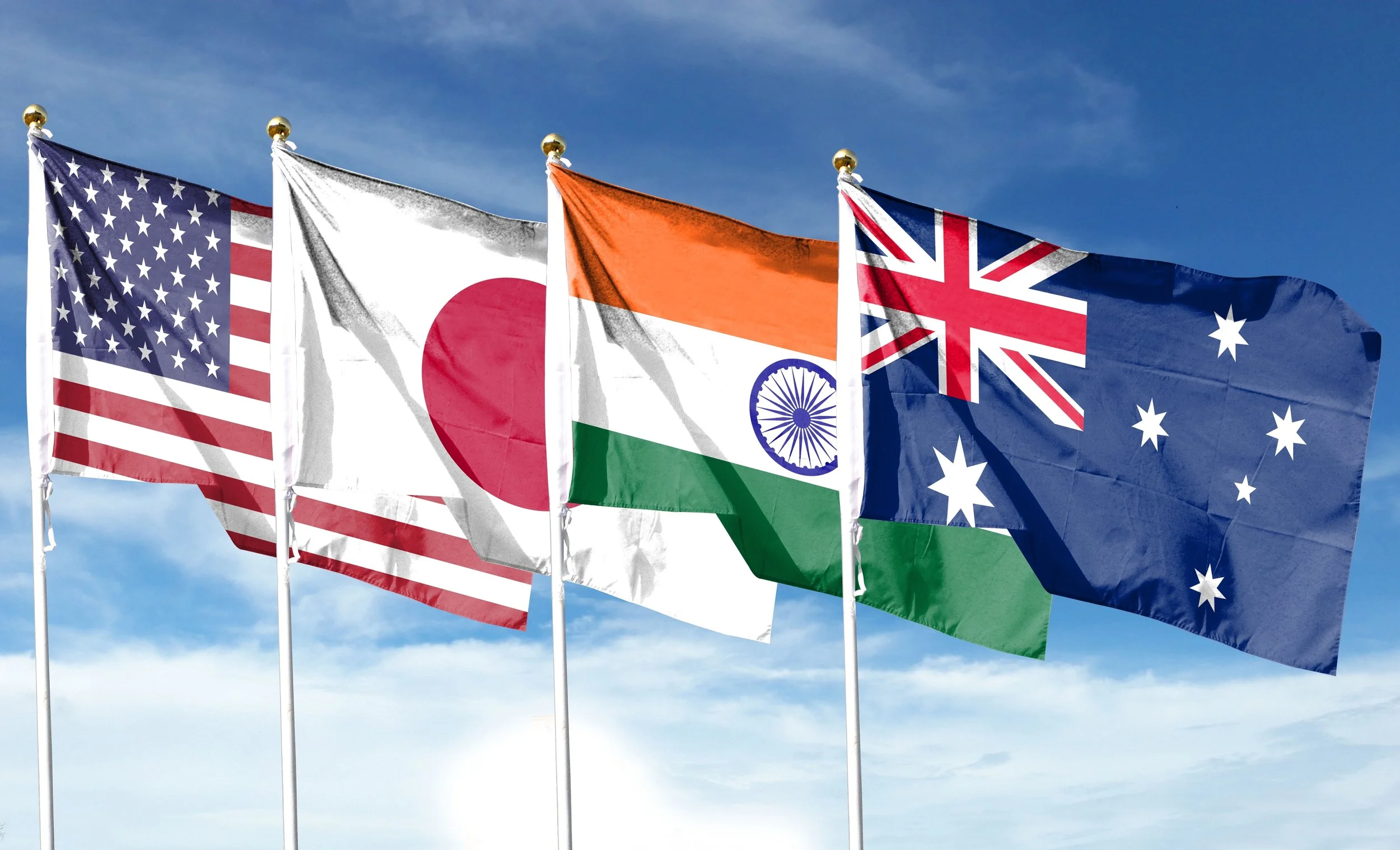
The Quad — a grouping of Australia, India, Japan, and the United States — met for the third time at the foreign ministers’ level since Donald Trump’s reelection as U.S. president. The grouping has not held a leaders-level summit since September 2024, in large part due to prior differences between India and the United States over tariffs and Trump’s engagement with Pakistan’s military leadership. U.S. frictions with Japan and Australia over defense spending and nuclear submarine technology have not helped, nor has Trump’s more conciliatory approach to the People’s Republic of China reflected in his visit to Beijing this month.
Yet a group that for many years was criticized for being long on high-level meetings and short on substance has quietly been continuing to work more intensively on a narrower set of issues, from critical minerals and humanitarian assistance to maritime security and undersea cables. The most recent meeting of foreign ministers resulted in at least four new outcomes and highlighted steady progress in a number of other areas. Just as significantly, their May 26 joint statement was more direct about the role of the grouping in increasing regional resilience and maintaining a balance of power in the Indo-Pacific.
Strategic Consultations. A major value of the Quad is the opportunity for leaders from the four countries to consult one another on regional and global strategic developments. The joint statement reflected issues that mattered to each of the four countries including “dangerous and coercive actions” in the South China Sea, concern over North Korea’s malicious activities and conflict in Myanmar, freedom of navigation in the Strait of Hormuz, terrorism at Pahalgam in India and Bondi Beach in Australia, and transnational crime. In the weeks and days leading up to the meeting, as well as the meeting itself, a wide range of issues of mutual concern were discussed among the four parties, with several major points of agreement despite divergent politics and priorities.
Energy, Critical Minerals, Ports, and Undersea Cables. Amid the Iran war and resulting energy crisis, the Quad appears to have focused this time around on economic security issues: particularly energy security and critical mineral supply chains. A newly announced Quad Initiative on Indo-Pacific Energy Security is intended to stabilize energy markets and build resilience in energy supply chains. After India hosted a Quad ‘Ports of the Future’ meeting last October, the four countries have agreed to deploy their resources in Fiji in the South Pacific, a strategically important country where all four countries boast complementary capabilities. The four countries also agreed to a Quad Critical Minerals Initiative framework, with a heavy emphasis on recovery and recycling. Additionally, they have advanced undersea cable standards cooperation over the past year.
Maritime Security. While the talking point of the Quad not being a security grouping remains a common one among commentators — mostly for it not being a defense ministry-led initiative — maritime security has long been a major pillar of its activities. In addition to India operationalizing the Indian Ocean element of the Indo-Pacific Maritime Domain Awareness (IP-MDA) initiative — an effort to provide commercial satellite data to smaller countries in the region — the four countries announced the Indo-Pacific Maritime Surveillance Collaboration (IPMSC) to share real-time information and conduct regular tabletop exercises. India also pledged to host the next Quad at Sea Ship Observer Mission after a previous edition held last year between Palau and Guam. These complement efforts such as by the United States, Japan, Australia, and the Philippines (the so-called “Squad”) with its specific focus on operations in the South China Sea.
Humanitarian Assistance and Disaster Relief (HADR). With HADR having been the original basis for Quad cooperation, the four countries have increased standard operating procedures during humanitarian disasters. This includes the Indo-Pacific Logistics Network (IPLN), a facility for employing each other’s military logistics platforms. The Quad has coordinated on HADR during recent disasters in Papua New Guinea and Myanmar, and continues to run tabletop exercises and field exercises, including out of Guam in the South Pacific.
Critical and Emerging Technologies. If there was one area which appears comparatively underwhelming on the Quad’s agenda, it is in critical and emerging technologies. The four countries have very different means and priorities, with the United States approaching the issue in more internationally competitive terms and a radical deregulatory approach at odds with many others in the international community. For their parts, India has focused more on technology deployment, Japan on its own industrial and technological advantages, and Australia in certain niche technologies, such as quantum. On the diplomatic side, bilateral cooperation efforts — as between India and Australia — have often taken precedence. Among the Quad, Pax Silica — a U.S.-led effort at coordination on the full stack of artificial intelligence, of which all four Quad countries are members — appears to have subsumed minilateral cooperation in this domain.
Overall, the latest Quad joint statement reflects continued and focused cooperation on a narrower set of issues than in the past. Meetings among Quad leaders may continue on the sidelines of summits like the G20 and UN General Assembly (at which all four countries participate) and possibly at the G7, to which India and Australia are often invited. Yet the latest joint statement highlights how economic security is receiving priority at this juncture, critical and emerging technologies are being somewhat marginalized by unilateral and bilateral efforts, and efforts of maritime security continue to progress in a more workmanlike manner. The Quad’s focus on regional public goods continues to make way for a more explicit set of regional and national security objectives.
Dhruva Jaishankar is Executive Director at ORF America.