
By: Caroline Arkalji and Anasua Basu Ray Chaudhury
The following excerpt is from Chapter 1 — Framing an Effective Policy Response to South–South Migration of ORF Global Quarterly: Societies in Transformation.
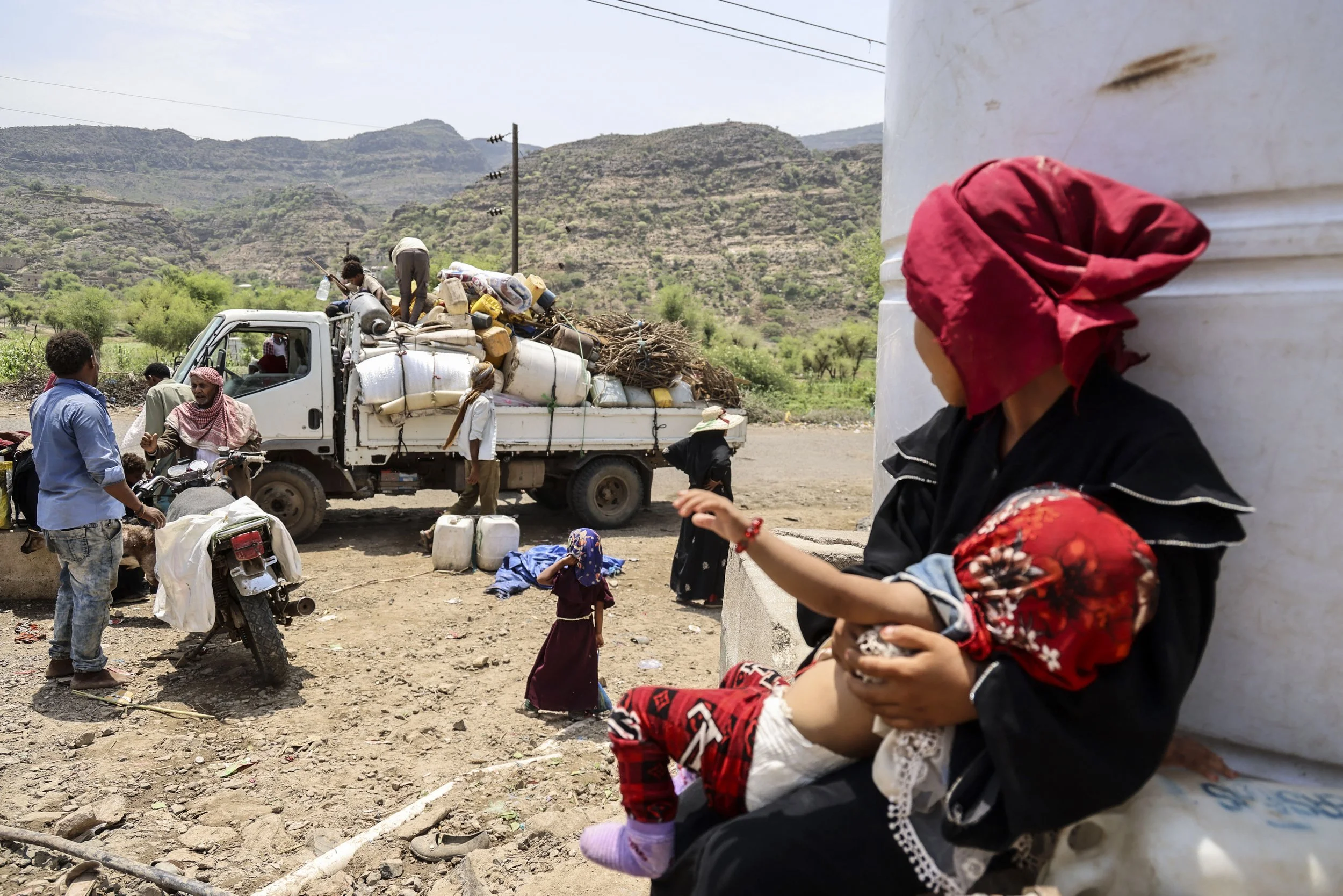
In 2025, when more than 62.2 million incidents of internal displacements were recorded, conflict and violence accounted for more displacements (32.3 million) than disasters (29.9 million), for the first time in history. These drivers, however, overlap: 42 countries experienced displacement associated with both conflict and disasters, highlighting the growing intersection of climate hazards, insecurity, and human migration.
By the end of 2025, the number of people recorded as internally displaced was pegged at 82.2 million. The World Bank projects that without adequate climate and development action, up to 216 million people could become internal climate migrants by 2050, including 86 million in Sub-Saharan Africa and 40 million in South Asia. These figures suggest that most future climate-related migration will occur across national borders in the Global South, underscoring the need for stronger domestic and international displacement planning and preparedness.
This article uses a number of important terminologies in its analysis:
Climate migration: Movement influenced by climate pressures such as water scarcity, declining agricultural productivity, sea-level rise, and flooding, often alongside socioeconomic vulnerabilities.
Environmental migrant: A descriptive rather than a distinct legal category under international law.
Climate refugee: Although widely used in public discourse, ‘climate refugee’ is not formally recognised under the 1951 Refugee Convention, which defines a refugee as a person outside their country who, owing to a well-founded fear of persecution on specified grounds, is unable or unwilling to seek that country’s protection.
Asylum seeker: A person seeking international protection whose claim for refugee status has not yet been determined.
Internally displaced persons (IDPs): Those who flee conflict, violence, or disasters, but remain within their country.
Cross-border South-South migration (SSM): Movement from one Global South country to another, either voluntarily or forcibly.
These overlapping pressures of climate and conflict are also reshaping the geography of migration through the rise of SSM. While policy debates have traditionally focused on South– North flows, migration between developing countries already constituted approximately 37 percent of international migration in 2020, compared to 35 percent for South–North migration. Countries of the Global South host at least 40 percent of international migrants and more than 85 percent of refugees and asylum seekers. Mobility within the Global South thus covers voluntary labour migration and forced displacement, increasingly shaped by the interaction of climate hazards, conflict, and economic insecurity.
In this context, this essay examines the drivers, human-security consequences, regional patterns, and governance gaps shaping climate and conflict-induced SSM. It argues for a protection-oriented approach that addresses the vulnerabilities and lived realities of displaced populations, particularly livelihood loss, gendered risks, and gaps in existing protection systems.
Climate hazards and armed conflicts are changing migration patterns and mobility dynamics across the Global South. Learn more about what it would take to protect people on the move in ORF Global Quarterly: Societies in Transformation.