
By: Pradeep Nair
India’s private space ecosystem has blossomed over the past few years. Pawan Goenka, chairman of the Indian National Space Promotion and Authorization Centre (IN-SPACe), India’s space regulator, says the country now has around 450 space start-ups, building launch vehicles, satellites, and space situational awareness tools. Yet several founders of successful Indian space start-ups began inside India’s public laboratories and institutes, having been founded by former government scientists or incubated at government universities. Even now, tapping into India's space economy requires working with the government at multiple levels.
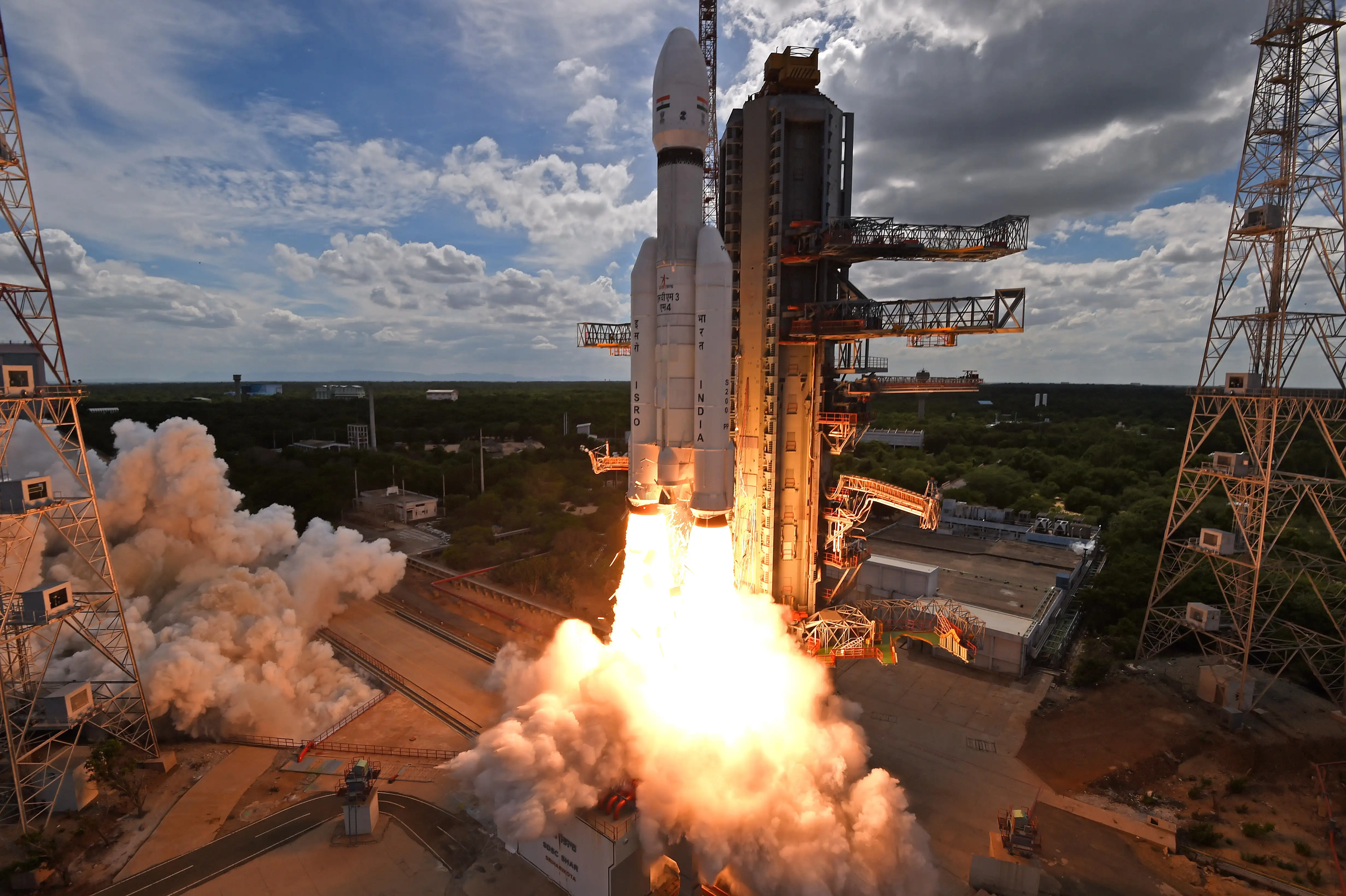
For decades, the Indian Space Research Organisation (ISRO) was India’s entire space sector. ISRO traces its origins to a national space research committee set up in 1962 and was established in 1969, with Vikram Sarabhai regarded as the founding father of India’s space program. Beginning with the SLV-3, which first flew successfully in 1980, ISRO went on to build the Polar Satellite Launch Vehicle (PSLV) and the Geosynchronous Satellite Launch Vehicle (GSLV). In 2017, a single PSLV flight put 104 satellites, 96 of them American, into orbit, then a record for one launch. ISRO’s Mars Orbiter Mission, or Mangalyaan, reached Mars orbit on its first attempt in 2014, and its Chandrayaan-3 made India the first country to land near the Moon’s southern polar region in 2023. These achievements laid the groundwork for India’s private space companies, which still draw on ISRO’s technology, test facilities, and talent.
In 2020, India’s Cabinet approved reforms to boost private participation across the entire range of space activities and created IN-SPACe as a single-window regulator and promoter. The Indian Space Policy 2023 then let private firms and other non-government entities undertake end-to-end space activities under IN-SPACe authorization, while refocusing ISRO on research and development and handing mature systems to industry. ISRO’s commercial arm, has signed 118 technology transfer agreements covering 83 ISRO technologies. A 2024 change to foreign investment rules allows up to 74% automatic foreign investment in satellites, 49% in launch vehicles and spaceports, and 100% in satellite components.
IN-SPACe’s chairman has set a goal of a space economy worth about $44 billion by 2033, part of a government aim of raising India’s share of the global space economy from about 2% to about 8%. While the Indian state is now deliberately making room for private firms, the boom in India’s space sector also shows how closely the state and private sector are tied together. The Indian government is at the same time a regulator, source of technology, customer, and investor.
That closeness is not an accident. Space is among the most government-entangled commercial sectors, and three features explain why. First, the technology is dual-use, so the same capabilities that serve commercial customers also serve defense and national security. This makes governments both the regulator and the buyer. Second, capital costs are high, and returns are slow, which makes public money and public demand unusually important early on. Third, launch sites, ranges, and test facilities have historically been built by states. Private firms often depend on infrastructure they did not build.
This has practical consequences at every stage of a start-up’s life. To begin, private companies need authorization from IN-SPACe before they can operate. Another implication concerns human talent: ISRO’s decades of training and its technology transfers feed the start-ups. Once a space start-up is established, sustainable demand is crucial because one launch cannot by itself make a sustainable launch business. Investment often comes from governments. In India, the central government and states such as Tamil Nadu now finance the sector directly. IN-SPACe has established a venture capital fund and a technology adoption fund. Export markets are also government-dependent: agencies such as the U.S. National Aeronautics and Space Administration (NASA) and the European Space Agency play a strong role in enabling access to global customers. A founder succeeds by lining up support in all of these roles, not just by finding a single backer.
The state’s roles matter in both directions. A U.S. company entering India has to engage multiple entities: IN-SPACe authorizes, ISRO supplies technology and launch facilities, NewSpace India Limited (NSIL) sells launches, and the government invests. An Indian company entering the United States faces a similar map of agencies and anchor customers. Pixxel won a NASA contract in 2024, Bellatrix has announced a propulsion manufacturing unit in Delaware, and Digantara has set up a facility in Colorado to serve U.S. defense customers. In the other direction, Voyager signed an MoU with ISRO and IN-SPACe in 2023 and ISRO’s launchers are open to U.S. customers seeking another option.
For all that activity, these are early days. India and the United States each have a strong space sector and a close relationship. But because space technology is dual-use, both have reason to build something deeper. The channels already exist: in August 2026, the U.S.-India Civil Space Joint Working Group met in Bengaluru to advance civil and commercial space cooperation under the two governments’ TRUST initiative, and the U.S. Office of Space Commerce has asked U.S. companies and other stakeholders about barriers to U.S.-India space commerce, including export controls. For U.S. policymakers, the task is to make those channels work for companies. That means clear rules on what can be shared and clear routes to government customers such as NASA. How clearly both governments lay out that path will help decide whether this early momentum becomes a lasting partnership.
Pradeep Nair is an independent advisor to several space companies with over 25 years of experience in management consulting, strategy & operations, and the social sector.
Image: Chandrayaan-3 via ISRO Chandrayaan 3 Image Gallery