
By: Ninad Kashyap
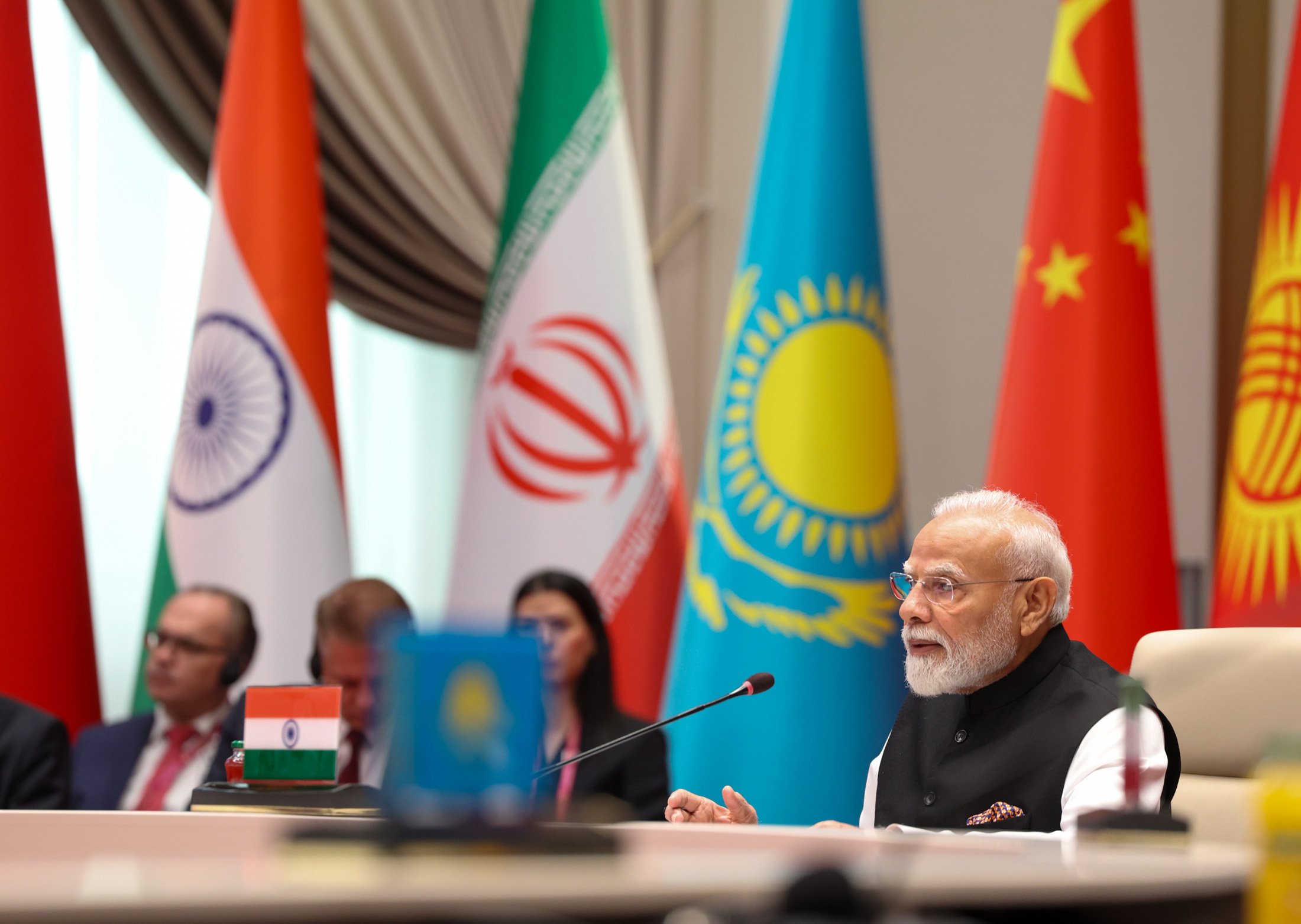
The Central Asian republics, nestled between Russia and China, have quietly emerged as an area of sustained engagement for both India and the United States. That engagement accelerated this year with Indian Prime Minister Narendra Modi’s visit to Tashkent in Uzbekistan and Bishkek in Kyrgyzstan from August 29 to September 1. On that trip, India elevated ties with Uzbekistan to a Comprehensive Strategic Partnership and announced that it will host the second India-Central Asia Summit in 2027. New Delhi has been working to institutionalize its relationship with Kazakhstan, Kyrgyzstan, Tajikistan, Turkmenistan, and Uzbekistan, both through the Shanghai Cooperation Organization, to which all but Turkmenistan belong, and separately through an India-Central Asia Dialogue of foreign ministers since 2019 and a leaders’ summit launched in January 2022. The most recent ministerial dialogue, held in New Delhi in June 2025, widened cooperation on connectivity, critical minerals, and financial linkages.
In practical terms, India’s engagement with Central Asia has been primarily development-focused: Indian Technical and Economic Cooperation (ITEC) training, digital public infrastructure, pharmaceuticals, and Indian university branches such as Amity University in Tashkent. New Delhi has also supported physical projects such as the eight-lane Dushanbe-Chortut highway and the India-Tajikistan Friendship Hospital. In August, Mumbai’s Lilavati Hospital announced a super-specialty outpatient clinic in Kazakhstan, its first facility outside India. Yet the commercial foundation remains thin. The binding constraint is geography. India has no overland route to the region, which is why its trade with Central Asia was under $2 billion in 2025 against China’s $106 billion. Attempts after 2012 to improve connectivity via Iran and Russia, including by investing in Chabahar port in Iran and the International North-South Transport Corridor (INSTC), have faced political and economic difficulties.
Meanwhile, on October 19, U.S. Secretary of State Marco Rubio met all five Central Asian foreign ministers in Samarkand under the C5+1 format. His visit coincided with a package of 54 U.S.-Uzbek agreements worth about $12 billion. Launched in Samarkand in 2015, the C5+1 platform is now the primary vehicle for U.S. engagement with the Central Asian republics. Its 10th anniversary leaders’ summit at the White House in November 2025 produced a statement of intent on economic cooperation and more than $130 billion in reported commercial commitments. That agenda is anchored by the C5+1 Critical Minerals Dialogue and the B5+1 business track. The emphasis is for now narrowly commercial — minerals, supply chains, the Trans-Caspian corridor — with leverage often applied through sanctions and trade conditions.
The U.S. and Indian approaches to the region converge in some important ways. India has imported Kazakh uranium for its civil nuclear program since 2009 and is among the largest suppliers of pharmaceuticals to the region. Its ITEC training program and its export of digital public infrastructure build administrative capacity that reinforces governance. On critical minerals, the India-Central Asia Rare Earth Forum, which first met in New Delhi in September 2024, and an India-Kazakhstan titanium-slag joint venture agreed in November 2024 parallel the C5+1 Critical Minerals Dialogue and advance the shared goal of diversifying supply chains.
There are also real limits, and they are more about capability than intent. India’s main gateway to the region runs through Iran, and that gateway has closed for practical purposes. The U.S. sanctions waiver for Chabahar expired on April 26, 2026. Earlier, the Indian-appointed directors of India Ports Global Limited, which runs the terminal, had resigned. New Delhi has since reportedly weighed transferring its operating stake to an Iranian entity. In any case, the Iran war that began in February 2026 has made the route unusable.
Overall, the U.S. and Indian approaches to Central Asia are more complementary than competitive: the United States can supply capital, technology, and security, while India supplies development, proximity, and a non-Western alternative. Concretely, there are tangible outcomes that the two countries can work towards in the region. First, they could align approaches in the C5+1 Critical Minerals Dialogue and the India-Central Asia Rare Earth Forum, whose second meeting is overdue, including through coordinating data-sharing, exploration, and investment. Second, they can work jointly on banking and financial connectivity to give Central Asian banks a clear sanctions-compliance pathway for settling trade with both countries. Finally, they could coordinate on digital partnerships to pair Indian delivery with American financing. Uzbekistan’s offer to host the inaugural India-Central Asia Digital Partnership Forum offers a near-term opportunity. Both Washington and New Delhi give Central Asia more options at a time when the Eurasian heartland is becoming ever more contested.
Ninad Kashyap is a research engineer at the CUNY Building Performance Lab in New York, working on public-sector energy efficiency.