
By: Jeffrey D. Bean
In Jacob Helberg’s 2021 book, The Wires of War, he outlines how modern geopolitical and technological competition operates both at the “front-end,” with respect to information and disinformation on the internet regarding narratives, and on the “back-end,” encompassing in all aspects of technology development and innovation. While Helberg warns of competition on the “front-end” with U.S. adversaries like Russia and Iran, he argues it is the all-consuming nature of the stakes of technology competition with the People’s Republic of China on the back-end over advanced compute, AI, and the tools and supply chains powering them that will shape the future geopolitical order. Now, as U.S. Under Secretary of State for Economic Affairs, Helberg has translated his words into the initiation of a multilateral policy platform to address the supply chain challenges in the decisive competition for technology leadership he laid out.
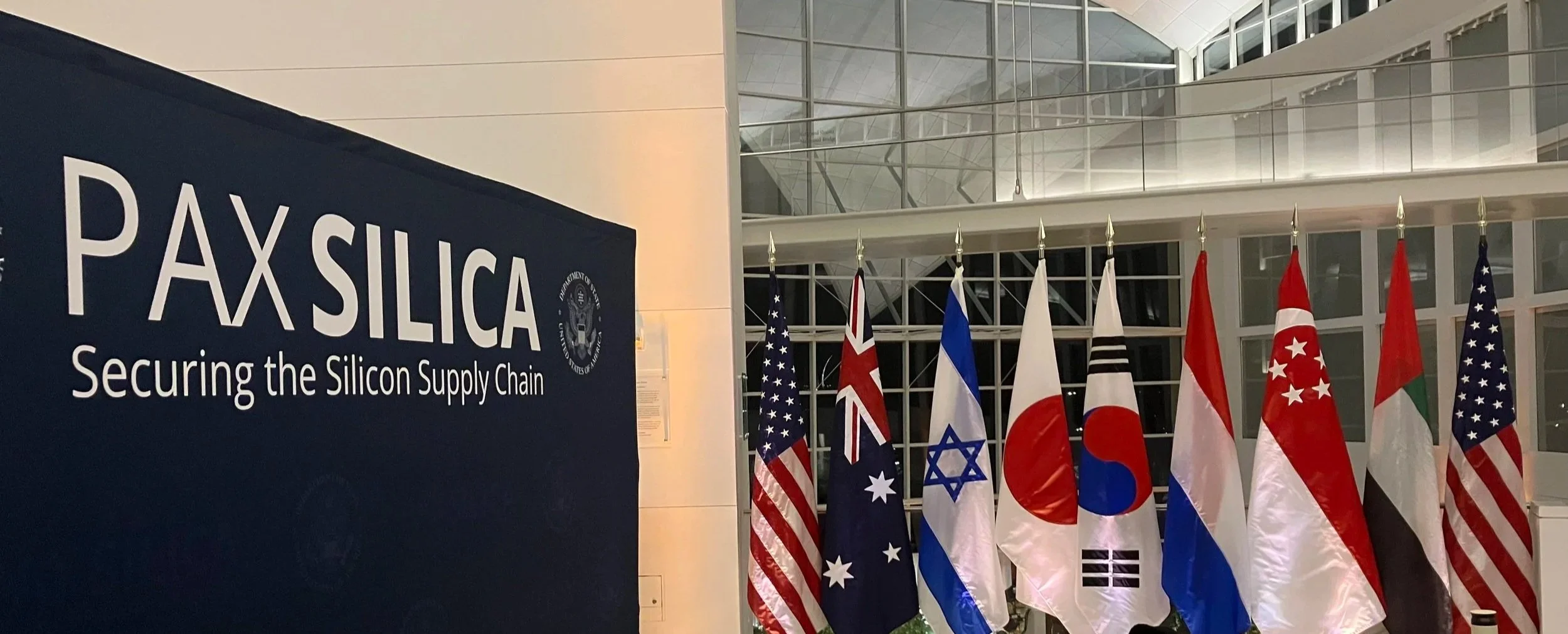
The Trump administration’s announcement of its new Pax Silica initiative to facilitate partnership and collaboration among critical and emerging technology supply chains is a strong sign that the administration is grappling with these pivotal challenges to mitigate coercive dependencies. At the signing ceremony on December 12, in addition to the United States, the seven states included were Australia, Israel, Japan, South Korea, the Netherlands, the United Kingdom, and Singapore, with the UAE also participating but not signing. Pax Silica’s goals include creating “secure, prosperous, and innovation driven silicon supply chain,” and to “reduce coercive dependencies, protect the materials and capabilities foundational to artificial intelligence, and ensure aligned nations can develop and deploy transformative technologies at scale.” These all appear to be sound goals and much needed given the scope and scale of the challenge confronting the United States and its allies and partners.
Yet there are already a few concerning signs for this initiative. First, the chosen partners feel a bit haphazard, with worrying omissions, such as Canada, Taiwan, and the EU (all listed as “guests”), and India. Second, the overall policy approach to this challenge feels uneven at best, particularly given the announcement earlier in the week that the U.S. government will allow NVIDIA to sell advanced H200 GPUs to China. That step does not align with the stakes outlined at the Pax Silica summit. Third, privately, experts and officials indicate that the background process for the summit was extremely rushed. Notably, the announcement lacked concrete announcements to showcase the policy direction, such as private sector projects or specific policy incentives, or collaborative mechanisms to achieve the intended aims. Finally, the level of confidence of partners that the United States will stay the course is understandably low.
That said, the broader contours of the Pax Silica initiative are very much needed and can be successful, if the administration is able to achieve the following:
I. Stabilize tariff schedules and restore predictability to global markets. This seems obvious, but unlikely. If Pax Silica is to be given time to become fleshed out, President Donald Trump will need to adjust course and sign bilateral trade agreements that are on the table with countries like India, and reduce the excessive or unpredictable tariff levies on key partners in North America, the European Union, and East Asia. Without a predictable trade environment, Pax Silica is in a tough place. The nature of investments in areas like semiconductor manufacturing, critical mineral extraction or processing, or undersea cables are, conservatively, often five-to-ten-year investments. The current Trump administration ends in three. Firms and partner governments are unlikely to make or support sustained investments unless they can reduce the risks to their revenue streams or import-export profiles, respectively.
II. Build and integrate the work of existing supply chain initiatives. In February 2025, the Trump-Modi meeting joint statement not only introduced new initiatives to succeed the bilateral initiative for Critical and Emerging Technologies (iCET), but also mentioned deeper cooperation under the Biden-era Mineral Security Partnership (MSP). The MSP is a 14 country + EU initiative which addresses a key need for U.S. resiliency given China’s dominance of the critical minerals supply chain, and new willingness to squeeze on chokepoints. Other ongoing initiatives need to be incorporated into a broader strategy for Pax Silica, including the Quad’s critical mineral security efforts, defense technology partnerships like AUKUS Pillar II, the CHIPS Act programs including State’s International Technology Security and Innovation (ITSI) funding, NATO efforts, and future bilaterals with Ukraine. Engagement with multistakeholder experts, think-tanks, academics, and technical experts can help aid the cause to find creative policy solutions.
III. Create clear incentives for partner countries, including outlay and commitments by the United States, rather than just one-way supplication. Want a firm in Canada or Australia to finish building and begin operating an extraction or processing facility with local government support to provide key inputs like gallium to Pax Silica members? Signing a guaranteed off-taker agreement for the U.S. Department of Defense for 20 years could help seal the deal. Desire that firms from countries like Singapore, South Korea, Taiwan, and Japan continue to invest in the United States for semiconductor manufacturing? Doing so will require stabilizing immigration and talent flows to allow predictability for law-abiding residents whose expertise the United States desperately needs to ensure it retains technological advantages in chips, AI, and renewable energy. Mechanisms to incorporate new members will also be necessary for the agreement to have an impact.
The success of Pax Silica as a tangible platform for the United States and U.S. allies and partners to secure supply chains and retain or regain advantages in technology will be a massive diplomatic and commercial undertaking. Sustained political will seems uncertain. But if the Trump administration and Undersecretary Helberg can include the elements above, a genuine, durable legacy that secures advanced technology supply chains and outputs is feasible.
Jeffrey D. Bean is a Program Manager for the Technology Policy program and Editor at ORF America.