

Special Report No. 11
By Piyush Verma, Medha Prasanna, and Sarah Salah

By Piyush Verma
Energy for Billions: India’s Turnaround and the World’s Future explores the energy choices that can help realize the ambition of Viksit Bharat — a developed India — and the lessons other economies might draw from India’s achievements and unfinished work.
By Piyush Verma
The grid is more than a machine for moving electrons. It is a shared system of costs, responsibilities and reliability. As AI campuses bring their own power, the question is not whether they are on or off the grid, but what they owe it when they still depend on it.
Background Paper No. 40
By Udaibir Das and Pietro Zecca
Edited Volume
By Soumya Awasthi, Ishita Deshmukh, Sameer Patil, Kavya Wadhwa, Purushraj Patnaik, Pranoy Jainendran, Sameer Patil, Rahul Rawat, Debjyoti Chakravorty, Basu Chandola, and Tanusha Tyagi
Editor: Dhruva Jaishankar
By Udaibir Das
Policy-makers cannot prevent every shock, but they can influence how prepared the economy is to deal with them, by reducing exposures, protecting essential functions and preserving policy room. Asia built its first generation of financial defenses after a crisis. It should build the second before the next.
Special Report No. 7
By Piyush Verma, Medha Prasanna, Caroline Arkalji, Erlijn Van Genuchten, and Siddharth Sharma
By Medha Prasanna
Without intentional strategies to strengthen energy infrastructure, the Global South will remain largely a consumer of AI technologies.
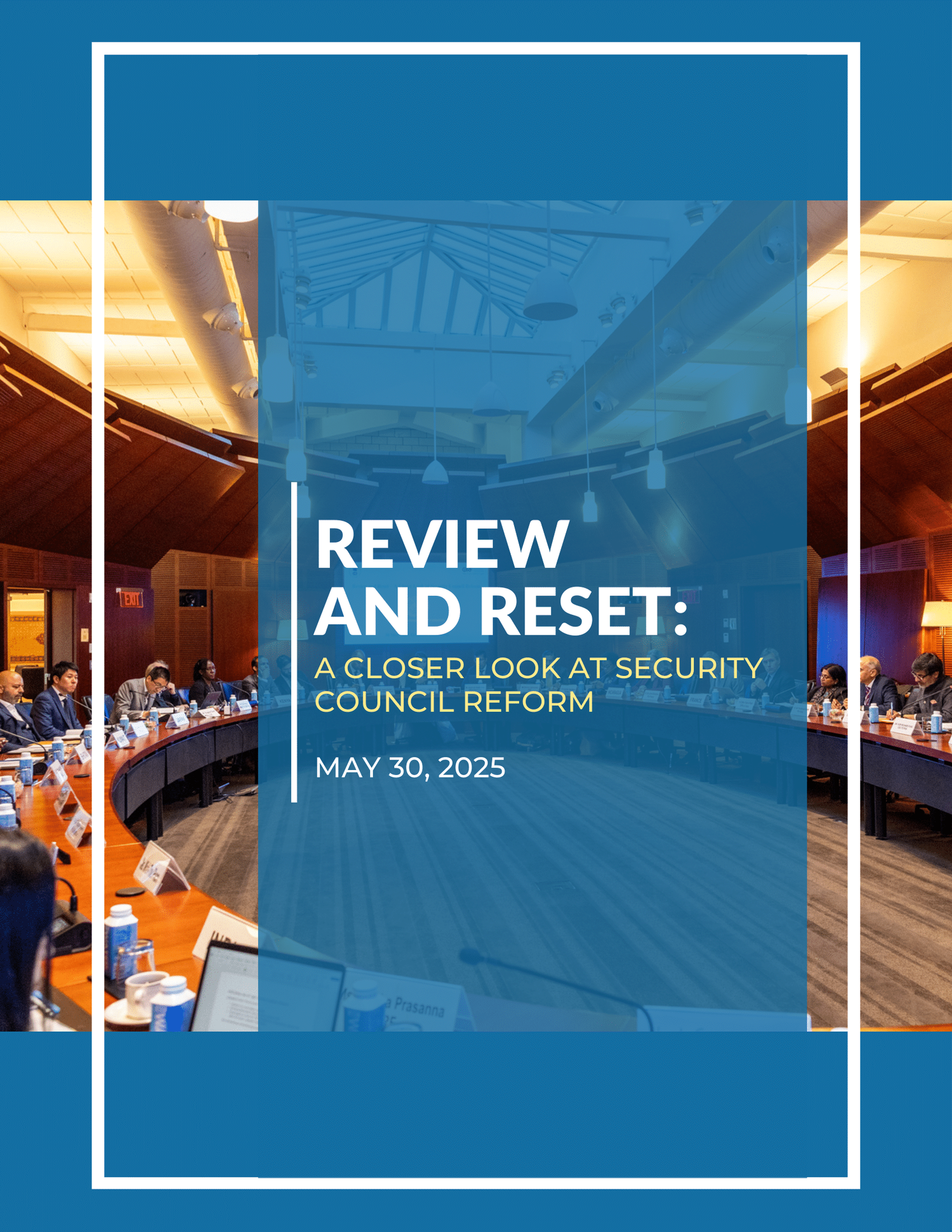
Participants and organizers noted that despite a few recent efforts, the situation concerning the United Nations Security Council (UNSC) has been static, with recent efforts at reform disappointing. While the Pact for the Future was a landmark meant to address historical injustice, it was, in some sense, a missed opportunity. UN@80 is an opportunity for greater flexibility, focus, and ambition.
Multilateralism is still necessary in a changing world but it must reflect the shift in global power. The UNSC reflects the immediate post-World War II order of 1945. Asia, with 60% of the world’s population, has only one permanent member: China. The third-, fourth-, and fifth-largest economies in the world (Germany, India, and Japan) are not permanently represented. Africa, home to 25% of UN members, has zero permanent UNSC members despite Africa being the subject of about 60% of UNSC resolutions. UN member states are increasingly turning to alternative multilateral and regional bodies, such as the G20, G7, BRICS-plus, the Quad, and the African Union, to address multilateral challenges. Growing violence around the world underscores the need for change, including the role of the UNSC and the politics around the veto. Opening the conversation to a wider public is absolutely necessary and the UNSC must be made more accountable.
Participants, including from permanent members (P5) of UNSC, noted that the invasion of Kuwait was a wake up call for UNSC reform. The 1990s also saw limitations in preventing genocide. In practice, the UNSC had already become more of a humanitarian organization, mitigating but not dampening conflict, with a particular focus on civil wars, non-proliferation, and counterterrorism. The UNSC now meets more frequently than ever but passes fewer resolutions. The body has been found wanting in crises such as Syria, Ukraine, and Gaza, and has fallen short in Sudan, Ethiopia, Myanmar, and Haiti. Moreover, the UNSC is unable to contend with transnational security challenges, such as pandemics and climate change, and the breakneck speed of technological advancements. Meanwhile, functions such as peacekeeping and humanitarian delivery are increasingly privatized, as in the Sahel and Gaza. There are also widespread concerns about the overuse of the veto by three of the five permanent members of the UNSC.
The reform process is characterized by several entrenched coalitions: the P-5 current permanent members, the G4 permanent member aspirants (Brazil, India, Japan, and Germany), the L.69 developing economies that want to dilute the veto further, an elusive common Africa group position, and the Uniting for Consensus coalition that is resistant to reform. Among the P5, France is most open to UNSC reform and aligned to the G4 position of about 27 total members and two permanent African members.
The UK is also open to permanent seats for the G4 and Africa, but both have stressed the need for more clarity from the Africa group. Discussions should move to the Intergovernmental Negotiations, but some participants prefer using other venues. Participants raised questions about how to raise the political price of the use of the veto. Some participants recommended the responsible use of the veto, making the veto costly, and enforcing article 27.3 of the UN Charter to prevent future deadlocks. Article 27.3 states an obligatory abstention by UNSC members on disputes to which they are a party but this has not been enforced in practice.
The second session discussed the perspectives of the L.69 group, representing several developing countries in the Global South, which has advocated for more radical UNSC reform proposals that might further dilute the power of permanent members. Members of the L.69 discussed the major implications of UNSC decision-making in the Global South and their unwillingness to accept the system as it is today. Some affirmed that both the permanent and non-permanent categories should be expanded to include two Africa, two Asia, and one Latin America permanent seats on the council.
Some members noted that there is a divergence on the subject of veto power and the total number of seats to be added to the council. The more conservative members warned that expansion could entrench existing hierarchies.
Looking beyond reform, the members also discussed the tools at the disposal of the UNSC to maintain international peace and security and the cost of bad decision making. Members explored accountability of a reformed UNSC and how those in positions of power should reflect on and internalize the consequences. Members agreed that reform needs to be comprehensive and address the various dysfunctionalities, as well as that all members of the UNSC must contribute to keeping international peace and security. Overall, there was some commonality between the G4 and L.69 positions, and India — as a member of both groups — can facilitate that process to create a common negotiating position.
The third session explored the G4’s proposals for UNSC reform. The G4 is a progressive advocacy group seeking real and expedited reform, comprising Brazil, Germany, India, and Japan. This group has offered a model involving their own inclusion as permanent members, along with two African representatives, the expansion of the non-permanent category, and a 15-year review clause. Participants expressed dissatisfaction with the reform process, including alack of text and timelines, and the need for complete consensus beforeatext can be presented. There was also opposition to faith-based representation at the UNSC. The G4 expressed flexibility on many issues, barring reform of the permanent category, which members consider non-negotiable.
Members of this group noted that the shared values of global governance of the G4 go beyond the purpose of UNSC reform negotiations. The G4 expressed its intent to take its place on the council seriously and make meaningful contributions to the UN system by 2030. This would be the only way for the UNSC to make itself more relevant and legitimate. Participants also highlighted the need to make the process less opaque, and advocated for a more open, transparent, and inclusive approach to UN reforms. A consolidated model later this year is possible but will be difficult.
In the final session, members of Africa Group reaffirmed the need for no less than two permanent seats and at least five nonpermanent seats on the Security Council. The lack of consensus about a formula for determining African representation has delayed the move toward text-based negotiations, with some advocating going slower to ensure a stronger consensus. There is hope that a model might be finalized following discussions in Sierra Leone and Zambia. Participants also raised other contributions that Africa could provide, including as a resource and for legitimacy.
Unlike members of the G4, this group emphasized the need for patience in reform to ensure effective representation and functioning of a reformed council. Some members noted that text-based negotiations could be a move backwards without consensus on reform.
This special report explores the opportunities of a U.S.-India Strategic Energy and Industrial Partnership.
Special Report
By Aditya Ramji
This volume of short working papers is a product of ORF America’s U.S.-India Emerging Climate Leaders as they attempt to develop ideas around climate collaboration and communication for the United States and India.
Special Report
By Abigail Doerr, Amol Kapoor, Bhagyashri Kulkarni, Dhruva Jaishankar, Jonika Rathi, Karan Sinha, Lindsay Maizland, Medha Prasanna, Meenakshi Venkatraman, Miaoru Guan, Mridu Jhangiani, Pankaj Mahalle, Patrick Soltis, Paul Gordon, Perrin Krisko, Sabareesh Suresh, Tanya Kak, Vandita Sariya, Vanshica Kant, and Vedant Patil
Editors: Caroline Arkalji, Jeffrey D. Bean, and Medha Prasanna
Ongoing armed conflicts in Europe and the Middle East and a fractured trade relationship between the world’s two largest economies, the United States and China, mean the energy transition cannot take economic integration and its accompanying benefits for granted.
Special Report
By Raj Sawhney, Shayak Sengupta, and Gregory Wischer
Editor: Shayak Sengupta
By Shayak Sengupta, Medha Prasanna and Peter Jarka-Sellers
The Agenda 2030 Partnership builds on nearly two decades of cooperation between the US and India on energy and climate issues.
The focus of this issue of the U.S.-India Energy Monitor is hydrogen in the United States and India.
Special Report
By Shayak Sengupta, Medha Prasanna, and Peter Jarka-Sellers
Observer Research Foundation America, 1100 17th St. NW, Suite 501, Washington DC 20036 USA