
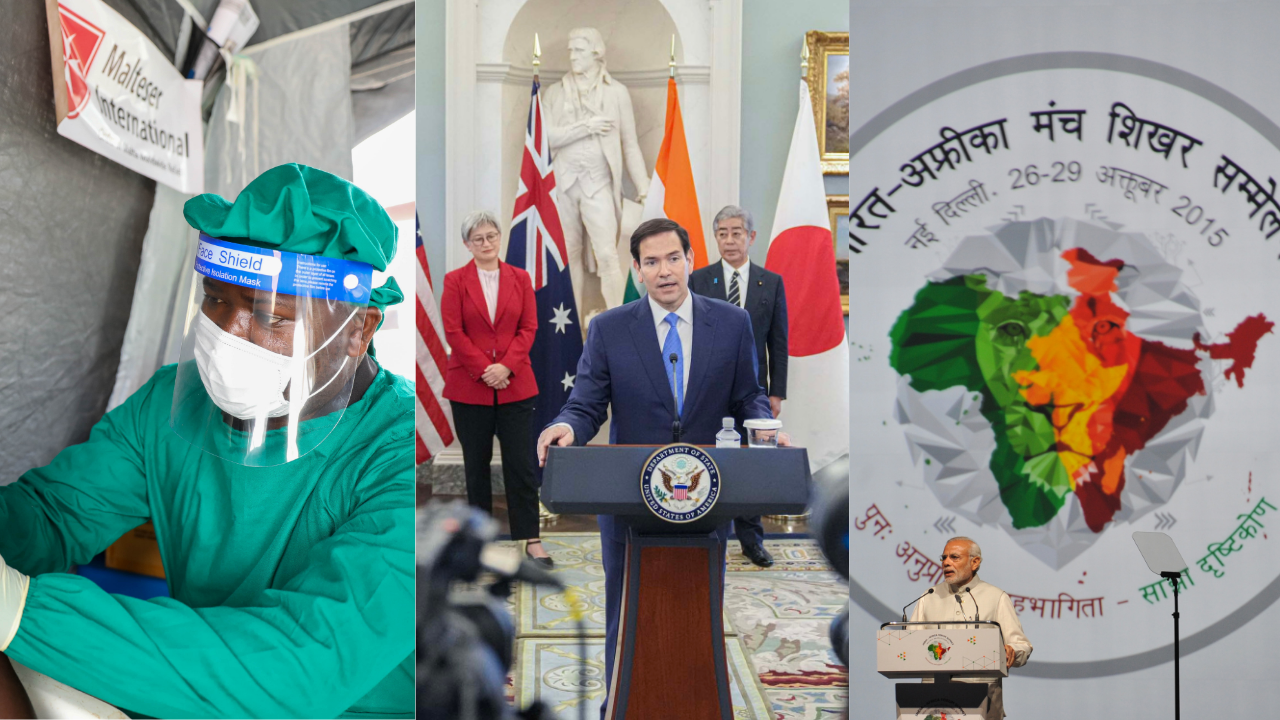
Explaining India

Season 2 Episode 14 : Ebola Outbreak, Rubio at Quad and NATO, India-Africa Ties

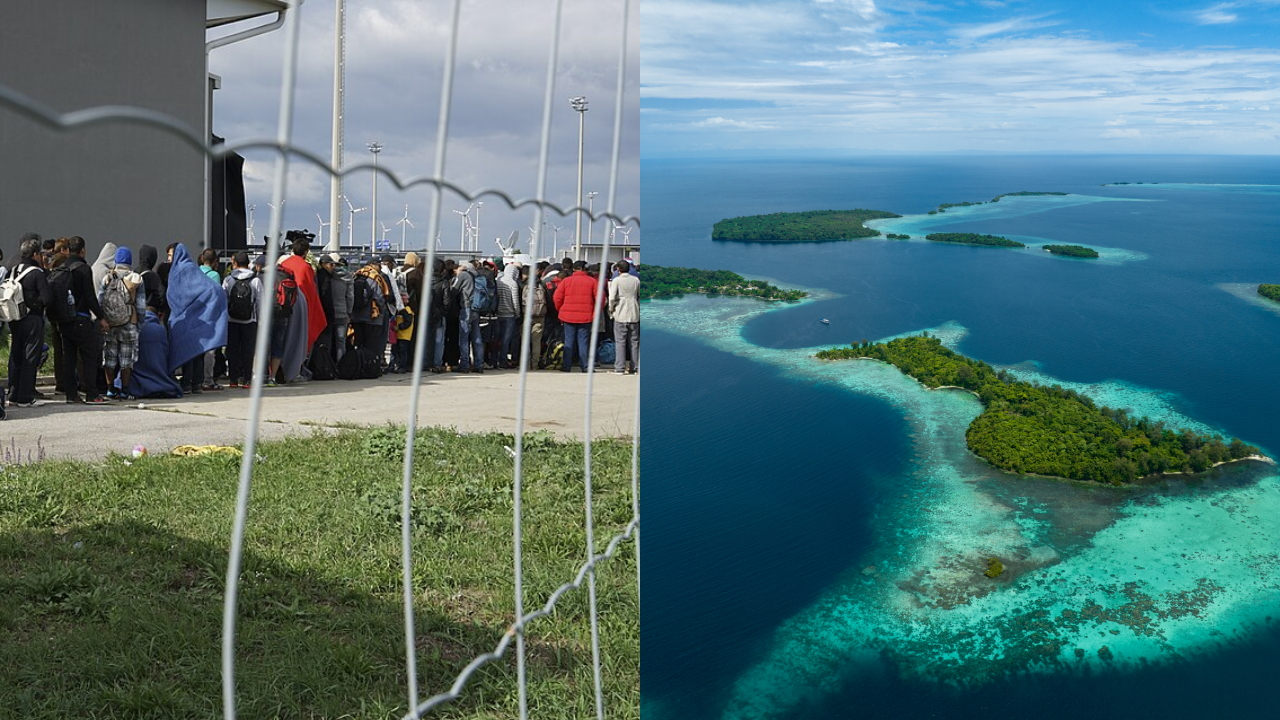
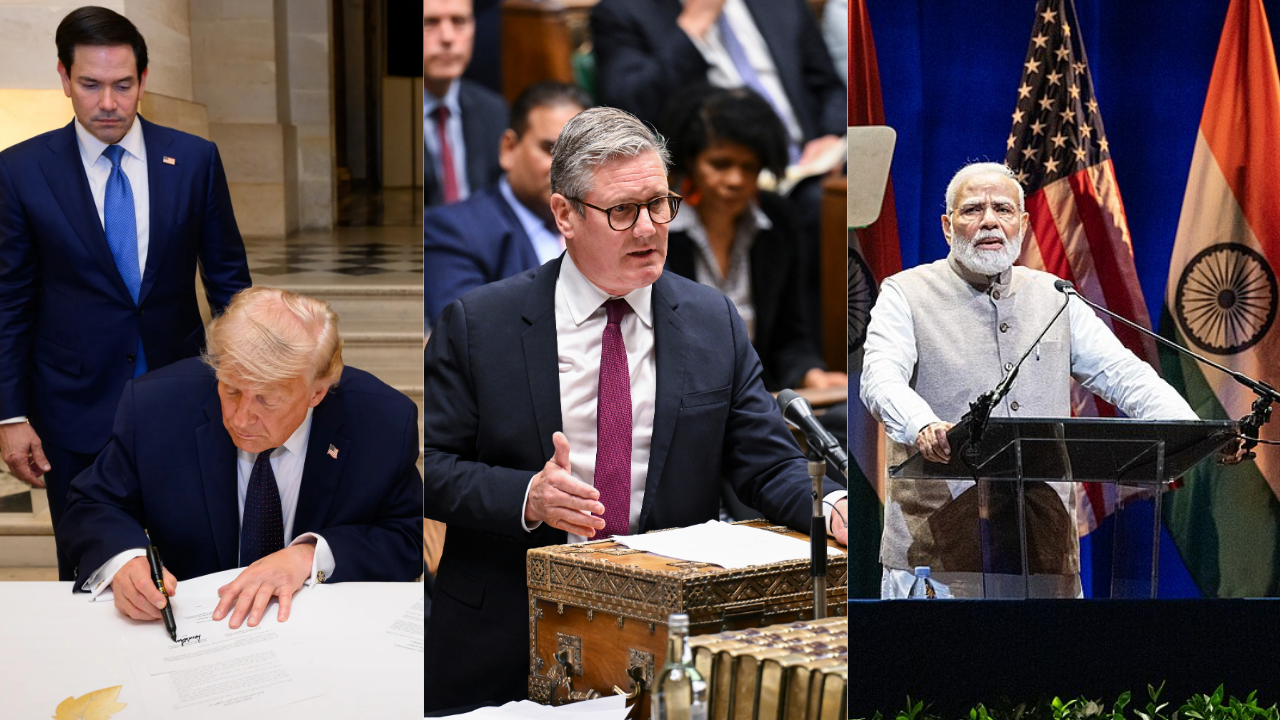
May 29, 2026 — In this week’s episode of Around the World, Veda Vaidyanathan, Fellow in Foreign Policy and Security Studies at the Centre for Social and Economic Progress, joins hosts Dhruva Jaishankar and Rachel Rizzo to break down the latest Ebola outbreak in the Democratic Republic of the Congo and Uganda — highlighting its implications for health governance and evolving India-Africa ties, as well as the recent cancellation of the fourth India-Africa Forum Summit. The hosts also recap U.S. Secretary of State Marco Rubio’s trips to Europe and India, assessing the outcomes of the NATO Foreign Ministers meeting and key developments in U.S.-India relations.

Available on Spotify and Apple Podcasts.

Image: © European Union, 2026, CC BY 4.0, via Wikimedia Commons

Image: Prime Minister addressing the Inaugural Session of India Africa Forum Summit 2015 in New Delhi (Oct 29, 2015) via MEAphotogallery on Flickr

Image: U.S. Embassy Australia via Instagram (@usembassyau)

Sneak peak

Rachel Rizzo: On this week's episode.

Veda Vaidyanathan: This outbreak is important because this is not the first time Congo is battling this. It's also happening at a time when, you know, Western funding cuts have happened in the region. The U.S. has pulled out of the WHO, USAID has shut down, clinics have shut down, healthcare workers have disappeared. There's also a conflict happening. There's also effects of climate change. So it's a multitude of factors which makes this, it's not just a pandemic. It's actually a scenario which India has to not just look at the health outcomes, but also the geopolitics around it.

Dhruva Jaishankar: The workman-like aspects of the U.S.-India relationship and the Quad relationship have continued, what has otherwise been a politically turbulent year despite tariffs, despite the adverse politics. But I think what is missing and what is going to take some time to repair, if it happens at all, is the sort political trust and the optics of the relationship.

Rachel Rizzo: When Rubio went to this NATO foreign ministers meeting, it wasn't a really easy room. It never is with NATO these days. He's already faced the difficult task of reassuring allies who are still anxious about the U.S. presidents' unpredictability. As we've talked about it before, I think that they have gotten used to these kinds of conversations, gotten used to the unpredictability of the U.S. It doesn't make it any easier, but it does make Europe a little bit less reactive.

welcome to around the world

Dhruva Jaishankar: Hello, I'm Dhruva Jaishankar.

Rachel Rizzo: And I'm Rachel Rizzo. Welcome to the Around the World podcast, your essential guide to understanding the forces shaping our world today. Here, we cut through the noise to bring you clear, insightful analysis of the most important developments in geopolitics.

Dhruva Jaishankar: Whether it's security challenges in Europe, great power competition in Asia, domestic politics in the United States, or regional developments in Latin America or the Middle East, we'll discuss what's happening and more importantly, why it matters.

Rachel Rizzo: Thanks for tuning in and be sure to like and subscribe to the Around the World podcast on YouTube, Spotify and Apple podcasts.

Navigating Tensions and Reigniting Ties

Dhruva Jaishankar: Hi, Rachel. How are you?

Rachel Rizzo: Hey, Dhruva, how's it going?

Dhruva Jaishankar: Good, good. We have a lot to talk about. The last couple of weeks, things are happening in Iran. We've had all sorts of developments. We'll be talking a little bit later about the Ebola outbreak in Africa and some of the implications of that with a guest. But we just had, you’re in Delhi, and we just had U.S. Secretary State Marco Rubio make his first visit as Secretary of State to India. How was it?

Rachel Rizzo: So this was part of a larger trip for the U.S. Secretary of State where he stopped by Sweden for a NATO foreign ministers meeting and then came here to India where he went to Kolkata, went to New Delhi obviously for high level meetings, Agra and Jaipur as well. He was also welcomed by a major event here in New Delhi, a 250th U.S. anniversary event that included a surprise performance by A.R. Raman. It included a performance from the village people and it included a phone call by President Trump to the U.S. ambassador here in Delhi, Sergio Gore, talking about the strength of the U.S.-India relationship. So Marco Rubio has certainly had a busy couple of weeks behind him and just flew back to the United States after the Quad meeting on Tuesday.

Dhruva Jaishankar: So let's start quickly with the NATO summit. We've spoken in previous episode about the Ankara summit that's coming up in July and its implications. But what was that all about, the meeting in Sweden?

Rachel Rizzo: So, NATO has these foreign ministers meetings occasionally just to kind of level set and make sure everyone's on the same page to talk about developments affecting the alliance. This specific foreign ministers meeting focused on issues related to defense spending as always, talked about defense industrial production and really tried to lay the groundwork for the upcoming NATO summit in Ankara in July. Now, you know, these NATO summits that take place, they come out with declarations, with communiques, and all of those are very carefully orchestrated ahead of time. So meetings like this make sure that allies are on the same page so that we don't get any major surprises at the leader level summits when they do happen. When Rubio went to this NATO foreign ministers meeting, it wasn't a really easy room. It never is with NATO these days. He's already faced the difficult task of reassuring allies who are still anxious about the U.S. presidents' unpredictability. And then just hours before the meeting, Donald Trump announced that he would be sending an additional 5,000 troops to Poland. This is after he announced that Poland would not be getting an expected deployment that it had been planning on as part of a rotational deployment. And it also followed an announcement that they would be removing 5,000 troops from Germany as well. So it was sort of a yo-yo of a trip for Rubio, but I think he left with NATO allies feeling okay. As we've talked about it before, I think that they have gotten used to these kinds of conversations, gotten used to the unpredictability of the U.S. It doesn't make it any easier, but it does make Europe a little bit less reactive.

Dhruva Jaishankar: And the reassurance tour seemed to have continued on to India, so maybe talk a little bit about the bilateral exchanges and just like the other stuff that happened you think from Rubio’s visit.

Rachel Rizzo: Yeah, so I mean, this was a really important meeting for Marco Rubio. I mean, the U.S.-India partnership has really long been hailed as one of the world's defining geopolitical alignments. Even Marco Rubio himself has referred to it as a defining relationship with the 21st century. And looking at the U.S. and India, these are two massive economies with a shared unease about China's rise. They're both democratic economies, major growing economies. And I think on paper, I think that should mean that all of the ingredients are really in place for a flourishing relationship. And indeed, New Delhi really welcomed Trump's second term with gusto. But as we have seen over the last year, almost immediately after Trump was reelected, that relationship started going south for various reasons we can talk about. And so I think Marco Rubio's trip to India was really meant to reassure the Indian leadership about the importance and the centrality of India to U.S. foreign policy and to try to right the ship a little bit after a very tough year.

Dhruva Jaishankar: But, you know, we can get into bit more of the substance of what was discussed, including the Quad that is India also hosted along with Secretary Rubio. The Foreign Ministers of Australia and Japan as well for a four-country meeting for the first time since July of last year. But what's your read on just like the mood? Tt seemed to be just going off of social media and even the traditional media, cable news and stuff in India, that the reception Ruby received wasn't, probably warmer than maybe some other U.S. leaders would have received, but certainly not as enthusiastic as it might have otherwise been. Is that your sense that he helped change the conversation a little bit on the U.S.-India relationship?

Rachel Rizzo: I think there's a lot of skepticism here about how much it actually did. When we talk about the sort of down, not the downfall of the U.S.-India relationship, but certainly the souring of it after Trump's reelection last year, we often point to the tariff fiasco which started in April of last year. There was a Trump visit to New Delhi that was floated, promised, and then ultimately never delivered, which then left India scrambling to save its Quad leader summit by downgrading it to a foreign ministers meeting, you can talk about that. And then, add on top of that, U.S immigration crackdowns that have disproportionately hurt Indian workers and American overtures toward both Pakistan and China that have created a sense that the U.S. Secretary was always gonna arrive in India facing a skeptical audience. And I think that's what happened. I don't think there's any, you know, no one is living in a universe where they look at the U.S.-India relationship right now as the strongest it's ever been. Indeed, that is not where it is. But I do think putting all of that aside, it was an important visit. The developments that came out of it were important, but I think it depends on what happens here and into the future that will really set the stage on where this relationship goes for the last two and a half years of Trump's presidency.

And then, I wanted to ask you about this because you've been sort of watching the developments of the Quad meeting that, as I just mentioned, this is now the third Quad meeting at the foreign minister's level rather than leader level. There's a lot of discussions right now about wither the Quad, where is the Quad in Trump's foreign policy priorities. Where would you say this relationship is? Where does the Quad fall? What are some good news and bad news that you've been watching here?

Dhruva Jaishankar: Yeah, so just to dial things back a little bit, in the first Trump administration, the Quad was not just resurrected in 2017, but also elevated towards the end of that term to the foreign ministers level meeting. And at that time, Secretary of State Pompeo at the time kind of used it not just to talk to his counterparts from those countries, but kind of a little bit to also grandstand, it was kind of a signal to China. Right. And he was a little bit more bombastic about using in that term. The Biden administration kind of immediately elevated it to a leaders level summit and tried to sort of put some substance behind it, which is actually create working groups to advance particular objects. The Biden administration, obviously, just given their own dispensation worldview, focused much more on public goods and that sort of reassurance that this will be a way to reassure smaller countries in the Indo-Pacific that these are four countries that can work together on health security. This was in the wake of the pandemic on critical and emerging technologies, on maritime governance and things like that. When they came back, the second Trump administration started off with prioritizing the Quad. They had all the four foreign there for the inauguration of Trump. It was Rubio's first official engagement with the Quad meeting. And so it was meant to be a priority. have been, again, totally three foreign ministers meetings now under the second Trump administration, but no leadership level summit. And it's quite likely that this will end up becoming something where the four leaders do meet, but it's on the sidelines where they already are at the G20 at the UN Security Council, at the UN General Assembly meetings in September in New York, in other summits as well where they all happened to attend.

Now at this meeting, when you look over the joint statement, say three pieces of good news, one piece of not so good news. There was a pretty strong emphasis on economic security and pretty substantive developments there. The four countries agreed to cooperate more on energy markets, on increasing resilience and energy supply chains. And this is all in the wake of the Iran conflict. Also some work on critical minerals. On port infrastructure, they announced a project in Fiji where all four countries have some comparative advantages and some ongoing cooperation on undersea cables. So some pretty substantive cooperation on economic security issues, which actually seems to be driving, still animating the group. I think second, something that doesn't get a lot of attention is the strategic consultations that take place. And again, we saw, just reflected in their statement, talks that encompass the South China Sea, and agreement on these issues, concerns about North Korea's nuclear activities, the conflict in Myanmar, freedom of navigation in the South China Sea and the Strait of Hormuz, counter-terrorism, something that both India and Australia in their own ways are seeking to prioritize, and transnational crime. So quite, again, a pretty substantive set of consultations on region-wide developments. And I'd say the third other sort of area of progress was maritime security, where India has operationalized some of its maritime domain awareness capabilities in conjunction with the Quad countries and the Indian Ocean. They've agreed to sort of do more real times, maritime surveillance cooperation. They are continuing to cooperate on logistics and humanitarian assistance. So again, some substantive progress there. Where there wasn't a lot of substantive progress was on critical and emerging technologies. I think it's for a few reasons. One, the U.S. is being more unilateral about AI and emerging technologies. It's a very heated competition with China on AI particularly. And then some things have been subsumed under a grouping called Pax Silica, U.S. led grouping at the state US State Department, at which all four Quad countries are signatories and members. So it includes other countries, the UAE, Israel, Sweden, a few others as well. And that's the US sees it as really a way of cooperating on the full stack diplomatically

Rachel Rizzo: Yeah.

Dhruva Jaishankar: with these trusted partners and allies. So in some ways, the quad critical, it seemed again, reading the statement that the quad critical mineral cooperation, ⁓ critical emerging technology cooperation has kind of been subsumed under PAX silica.

Rachel Rizzo: So on top of all this, mean, some of the other outcomes that Marco Rubio got on the bilateral front, you know, India announced that it would commit to purchasing $500 billion of US goods over the next five years, focusing on energy, tech and agriculture. There was a bilateral critical minerals framework signed with the external affairs minister. This is meant to secure, you know, supply, mining and processing of critical minerals and rare earths elements. So when you take these together, would you say that overall, when you combine the bilateral meeting with the quad meeting, this was a successful trip for him?

Dhruva Jaishankar: I mean, think there was substantive progress. I think the challenge has been, and it's something I think we'll talk about in future episodes as well, like the workman-like aspects of the U.S.-India relationship and the Quad relationship have continued, in what has otherwise been a politically turbulent year despite tariffs, despite the adverse politics. But I think what is missing and what is going to take some time to repair, if it happens at all, is the sort political trust and the optics

Rachel Rizzo: Yeah.

Dhruva Jaishankar: of the relationship. I think, again, you have a sort of twin track approach, and maybe parallels of this in the transatlantic space

Rachel Rizzo: Exactly.

Dhruva Jaishankar: as well, where some engagements sometimes even in certain areas, and yet there is that deep distrust that has now been imbued in the United States' external engagements.

Well, a more to talk about. Yeah, a lot more to happen.

Rachel Rizzo: Absolutely. Lots to follow, as always. There's never a slow week.

Ebola Returns: How India-Africa Ties will Evolve with Veda Vaidyanathan

Rachel Rizzo: So lots going on in the world and we also are kind of switching continents again today and we have a special guest with us to talk about the planned India-Africa summit that was postponed because of the Ebola outbreak. So we'll go ahead and move into that conversation now.

Dhruva Jaishankar: Today we're very pleased to have Veda Vaidyanathan joining us on the Around the World podcast. She is a fellow at the Center for Social and Economic Progress, CSEP, a think tank based in New Delhi. And she examines Indian and Asian engagement in Africa, including in financial services, mining, agriculture, and infrastructure. She's done field work in Zimbabwe, Zambia, Tanzania, Kenya, Ethiopia, Ghana, across Africa. So Veda, thank you for joining us. We had planned to talk about something that was going to take place this weekend, which is this India-Africa summit, which is held periodically. I recall one was held in 2015 and one more since. But it's been canceled because of an Ebola outbreak in the DRC, the Democratic Republic of Congo and Uganda. So maybe talk to us first a little bit about this India Africa summit that's not been held, what it was meant to achieve. And maybe also talk a little bit about what this means about the seriousness of the Ebola outbreak.

Veda Vaidyanathan: Sure, first of all, thank you for having me. Dhruva and Rachel, it's really great to be here. And yeah, it's kind of unfortunate that the summit didn't happen this year because it was supposed to happen after a gap of 11 years. And a few days ago, I was actually reading through the 2015 declaration that came out from the last forum summit. And you couldn't help but notice that the world was very different. It was a pre-pandemic, pre-AI world. So I think there's a lot of catching up to do with this summit. And because I think the strengths that India brings to the table now are different, African priorities have changed so much, the world has changed so much. So I think this summit, the idea was there were going to be 11 or 12 pillars from health and digital infrastructure and critical minerals. And I think there was quite a lot of confidence that there are going to be very specific outcomes that came out of each of these pillars. And it was supposed to sort of set the tone for what this new era of engagement was supposed to look like. And I think fundamentally for the African continent, this means, you know, as they are moving towards an engagement, which is beyond aid, as African countries sort of assert their agency a lot more, we were going to see new forms of engagement, new instruments of engagement. And so hopefully it will happen soon once the pandemic sort of settles down.

Dhruva Jaishankar: A quick thing, how many leaders from Africa were expected to attend? Because I recall in 2015 about 40 of the 50 something, 52 African leaders, something like that, did attend the summit in India. How many were to come?

Veda Vaidyanathan: I mean, I've heard versions of this, anywhere from 26 to 35 was numbers that heard. But if not head of state, at the top ministerial levels, I think there was supposed to be over 50 ministers, actually. So it was a big summit.

Dhruva Jaishankar: Okay, and so we didn't know, and now there's no current plans for rescheduling it. It's indefinitely postponed.

Veda Vaidyanathan: Not that I know of, because we had an India Africa summit, like in an event on the sidelines of the summit a few days before this announcement came out. And the secretary was there giving his opening remarks and there was no sign of any kind of postponement. So it was kind of last minute. And a lot of other think tanks in Delhi have also had events around this. ICWA, for instance, had huge track two planned the day after this was announced. So I think this kind of wasn't planned, the postponement. I think the extent of the Ebola crisis probably made that last minute decision.

Rachel Rizzo: Are you, I mean, when it comes to the Ebola crisis and the way that this has changed, for example, this summit that was supposed to happen and it was canceled, has it sort of changed or will it change Delhi's approach to this region in Africa both now and in the future? Like how does India sort of calibrate a moment like this and decide how it gets involved and helps, et cetera, et cetera.

Veda Vaidyanathan: I think actually health has been one of the pillars where India has substantially sort of built engagement down in Africa. A few years ago, actually no, many years ago in 2019, I traveled around Ethiopia and Kenya to interview Indian pharmaceutical manufacturers and the amount of small scale, medium scale, large scale Indian manufacturers that were present in those regions were huge. So India's had a role to play when it's come to the health governance in the continent. But in this case specifically, I think Congo is this outbreak is important because this is not the first time Congo is battling this. I think this is the 17th or the 18th outbreak of Ebola that Congo has seen and is usually a different strain of the virus. This is the Bundibugyo strain of the virus, which is much rarer. There's no vaccine for this. It's also happening at a time when, you know, Western funding cuts have happened in the region. The U.S. has pulled out of the WHO. USAID has shut down. This is impacted vaccine preparedness, pandemic preparedness. Clinics have shut down. Health workers have disappeared. There's also a conflict happening. There's also effects of climate change. So it's a multitude of factors which makes this, it's not just a pandemic. It's actually a scenario which India has to not just look at the health outcomes, but also the geopolitics around it. And what it really does, I think, is really sort of push New Delhi to think a little harder on how the health cooperation should evolve moving forward. And this could come up with certain opportunities as well. For instance, you know, like the roles that we can play in even simple things like delivering better diagnostic skills, better surveillance. There's been a lot of writing coming out of the Congo on how biosafety level four labs haven't been built the way they should be. So there's an infrastructure gap, a financing gap, perhaps there are more substantive ways in which India could also expand its health cooperation with the continent.

Dhruva Jaishankar: I want to come back to India in a bit, but just you mentioned the geopolitical implications of the Ebola outbreak. What do you see as some of the possible geopolitical implications of it?

Veda Vaidyanathan: I think there's two fronts. One is we had a conference in Feb in Addis Ababa and we had some folks like for instance from Amref Health talking about the geopolitical consequences of the changing landscape in Africa. And one of the things that came out which is very interesting is they said, you know, we knew these funding cuts were going to happen. This didn't come out of nowhere, right? We knew that Western aid donors are going to pull out in the way they did. But I think it's the shock of how exactly and how quickly it happened that probably took people by surprise. So I think one aspect of it is, I think in the short term what it has done is there's not been time to recalibrate and build bridges with the gaps that have come. And in the long term, I think it's a larger questions of who's going to fill the financing gap. Because a lot of the health governance and a lot of the CDC, for instance, funding still comes from the West. So I think those questions remain largely unanswered.

Dhruva Jaishankar: Going back, zooming out a little bit to India, you mentioned health as one area. Maybe just describe and sketch it out because we have lot of listeners who are not as familiar with India and certainly not with India-Africa engagement. What are the main characteristics of India's engagement with Africa?

Veda Vaidyanathan: I think the first thing is, it's the relationship, I mean, the historic foundations of the relationship were built by economic agents, right? Even back pre-colonial era, you had traders go from the Western coast of India to the Eastern coast of Africa, and that kind of largely remains. And I think a very, maybe not a very scientific, but one metric of that is we've had three India-Africa Forum summits, political summits, but for instance, the TII, which is a Confederation of Indian Industry, has had like 18 conclaves or 17 conclaves in the last 18 years. So almost every year there's been a business conclave. And these are huge events, right? There are over 40 African countries that present this ministerial level representation. Thousands of delegates from Africa and India meet. And then this is the national level conclave. And then there are regional conclaves as well. So I think one is this continent is seen as one of a lot of economic opportunities for several Indian companies. So of course there's the Tata's and the Mahindra's and the Airtel Bharti, know, the Airtel Telecommunication Company, which is present in over 14 African countries. But there are also medium and small scale industries, medium scale industries, once they are successful in India and they want to go global, usually one of the regions that they choose to go to is some country in East Africa. Largely because these markets are smaller. So it's not just, you're not just talking about Ethiopia or Kenya, you're talking about the larger East African regional economic markets. But also because then Africa becomes a launch pad to export to Europe and the US and so on. So the big part of the equation has been economic. But then, of course, there's also a political angle to it, right? As India sort of becomes and sort of gains this Global South's leadership voice, countries in Africa become very important in that endeavor. Then there's also this huge thing of energy and critical minerals. Like we get over 10%, 11 % of our oil from the region. And now critical minerals, right? Because it's a huge conversation. And what we're seeing is with access to minerals becoming not just an economic security issue, it's becoming an industrial, you know, economic issue. It's also becoming a developmental sort of a conversation. And a lot of mineral producing countries in Africa are coming out with their own laws and their own regulations when it comes to exporting of minerals in their raw form. So you see a new sort of conversation around energy. And then of course, there's the security dimension to it. It's a huge market for Indian arms. DADA recently started its first manufacturing overseas project in Morocco, a defense manufacturing

Dhruva Jaishankar: Mm-hmm. Yes.

Veda Vaidyanathan: thing. And then there's also the developmental aspects of it. A lot of Indian capacity building initiatives, a lot of the health initiatives, a lot of educational things, like for instance, IIT Zanzibar has a campus now, IIT Madras has a campus in Zanzibar. So I think.

Dhruva Jaishankar: A campus in Zanzibar, yeah.

Veda Vaidyanathan: Yeah, so like development and defense and trade and economics and also the fact that there's three million strong in the diaspora in Africa as well. So those are the traditional sort of areas where India sort of had a presence.

Rachel Rizzo: Can you talk a little bit, I mean, in the U.S, when we talk about American engagement in Africa, investment in Africa, cooperation with different countries, with different corporations, China is obviously looming large over that conversation. Whether you agree with that approach or not, that's just the reality of the conversation in Washington sometimes. How does China fit into this conversation with India? How does India's approach differ or compare to that of China's, or do you see sort of an inter India-China competition playing out in Africa the way you do with the US and China?

Veda Vaidyanathan: Before I joined CSEP, I was at the Institute of Chinese Studies before Princeton, and I spent a few years going to Chinese assets in Tanzania and Kenya and trying to study them a little bit in depth. And the big question was, how are they able to do what they're able to do at the scale and the price points that they are?

Rachel Rizzo: Yeah.

Veda Vaidyanathan: And I think one of the things that really struck me was the conversations and a lot of African capitals was so different from DC. China the big alternative, right? And I say this anecdote sometimes, we were in this place five hours out of Addis, Bolkite, and we were going up this mountain and the bus stopped at the edge of the hill, right at the bottom of the hill, and people got off the bus, walked up the hill. The road was Chinese. It was paid by a Chinese company. The bus was a Chinese-made bus. And people were telling me, you know, this bus can't take everyone in one go to the top because its engines are not as strong and this road might not be here after the rainy season. And I was like, doesn't that make you mad? And then this gentleman said, at least there's a bus and there's a road, right? So I think the big sentiment at least 10 years ago, which is very China positive in the continent. Now the conversation shift that I see is China is still not the villain in a lot of these conversations. It is still the provider of alternatives, but there's a strong interest to diversify partnerships. And that's where countries like, you know, states in the Gulf and India and Turkey and ASEAN countries and Singapore and Malaysia, who've been actually slowly incrementally increasing their economic presence on the continent sort of really align, because India compared to a lot of these other partners have been in the continent, have been present on the continent for centuries, for decades. For instance, we have the Japanese recently telling us that a lot of Japanese companies are very risk averse about going into a lot of these African markets, but are looking to find Indian companies to work with in a lot of these spaces only because there is a perception that Indian companies and Indian entities are more familiar with a lot of these informal setups. So I think we should completely remove this idea of competition with China. We're talking about a different scale. We're talking about very different comparative advantages. India, for instance, should not be and is not looking to build, let's say for instance, an India corridor that links East of Africa to West of Africa, right. But there's a whole, there's like a $130 billion infrastructure deficit in the continent. So everything from energy transmission lines to smaller places where we can actually build substantive sort of entry points exist. So the question should be really that even with the larger ecosystems, if you take infrastructure or critical minerals, where are the gaps and what are India's comparative advantages? And where can we actually go in and execute and implement in a very time-bound manner? And I think what this means then is the confluence of India's strategic objectives and its economic. Because you already have Larsen and Toubros and Shapoorji Pallonjis operating on the ground. It’s the question of sort of bringing them together, breaking the silos and finding ways to sort of work together? If that answers your question.

Dhruva Jaishankar: One final. Yeah, it’s a great answer. One final question from me. We've been having lot of discussions about Africa actually here in Washington as well over the past few years, including in the World Bank IMF meetings a few weeks ago. And one of the things that it keeps coming back to is individual African countries have increased agency, are doing a lot more, some are showing some tremendous economic progress, yet they don't have a natural political leader and they are also very regionally divided and then don't offer the scale. So maybe talk a little bit, do you see a sort of growth below Africa, when we talk about Africa as a single unit, but do you see sort of regional clusters emerging in Africa that are more promising for some of the areas you've talked about, could that have political implications as well?

Veda Vaidyanathan: Absolutely, absolutely. And I think this fragmentation you see, like for instance, the AFTA, I mean, ideally in an ideal after should have been up and running.

Dhruva Jaishankar: AFTA being the Africa Free Trade Agreement, correct? It's continent-wide.

Veda Vaidyanathan: Yes, the continental free trade agreement. The implementation has been much slower than anticipated. And I think that largely comes from, you know, there are these big economies which are usually, you know, have a huge sway over the agenda and then there are smaller companies that bring in much, that bring in different strengths, let's say. So I think one big, even in terms of imagining these partnerships, one big model of doing this is taking a country cluster approach as opposed to an individual country approach. There is some sense in that. For instance, even setting up like manufacturing basis. It makes sense to think of DRC-Zambia. You know, it makes sense to think of a few countries and a few regional blocks and say, okay, how do we try and work together? But of course that comes with its own challenges, right? You're then negotiating with multiple countries. There's questions of what each brings to the table, what are they getting from this and so on. And I think so it doesn't have to be mutually exclusive. I think in some areas that we are trying to build cooperation, it really makes sense, like you mentioned, to think of a regional approach. But in some cases, it has to just be bilateral because it's just so much better and so much easier to work through. And there's been successes on a bilateral level. And at this point, at this moment in time, the big question is not just the ideas, right? Those fantastic, wonderful ideas, but it's about really executing them on the ground very quickly.

Dhruva Jaishankar: Thank you so much, Vida, for joining us on the Around the World podcast. And hopefully we'll have a lot more on India and Africa and much more related to your research in the weeks, months, and years ahead. Thanks again for joining us.

Veda Vaidyanathan: Thank you so much for having me.

Rachel Rizzo: Thank you.

Season 2 Episode 6 : India AI Summit, Japan's Stunning Election

February 13, 2026 — In this week’s episode of Around the World, Amlan Mohanty, Technology and Society Fellow at Carnegie India, joins hosts Dhruva Jaishankar and Rachel Rizzo to discuss India’s upcoming AI Impact Summit, which will take place in New Delhi and feature global leaders and CEOs from companies like Nvidia, OpenAI, and Microsoft. They explore the Summit’s implications for global AI governance, India’s role as the first Global South host, and tensions around access, inclusion, and U.S.-China competition. Dhruva and Rachel then pivot to Japan, where they recap Prime Minister Sanae Takaichi's major victory for the Liberal Democratic Party during the recent snap election.

Available on Spotify and Apple Podcasts.

Image: Ministry of Culture (GODL-India), GODL-India, via Wikimedia Commons
Image: 内閣広報室|Cabinet Public Affairs Office, CC BY 4.0, via Wikimedia Commons

Dhruva Jaishankar: On this week's episode.

Amlan Mohanty: You know whether you have the US or China or India or the Middle East, I think everybody wants to see that AI is producing some significant social economic impact. But I think there are two areas where you are likely to see some tension. I think one is this question of access, right? Like US and China, for example, are competing with each other. And I think then that begs the question, what does that mean for access for the rest of the world? And the second area where potentially we could again see some disagreement is around this question of trust and safety. I think we've all seen that some parts of the world,are willing to take more of a free market, laissez-faire approach or deregulatory approach when it comes to trust and safety or AI governance. So what is, I think, the consensus around questions of trust and safety and questions of access is potentially where I think there could be some contentious discussion.

Dhruva Jaishankar: We discussed the new Japan's new prime minister, I think in October on an episode of the show, Sanae Takeuchi. She just had snap elections, general elections in Japan. Her party, the Liberal Democratic Party or LDP won just a sweeping landslide victory that was really quite stunning. And I think nobody would have expected this in October or September, October where she, you on a not even her first try, she had been elected leader of a battle party. She welcomed Donald Trump to Japan very soon after becoming prime minister. She's doubled down on relations with South Korea, which have always been a very sensitive subject in both countries. Then the other thing is there's a sort of a relatively new far right party called Sanseitō. And Sanseitō increased its vote share to about 7%. So again, something to watch there, but it has been quite a turnaround over the past three or four months in Japanese politics and again with some implications for Taiwan relations with China, Korea, the United States and beyond.

Welcome to Around the World

Dhruva Jaishankar: Hi, I'm Dhruva Jaishankar.

Rachel Rizzo: And I'm Rachel Rizzo. Welcome to the Around the World podcast. Your essential guide to understanding the forces shaping our world today. Every week, we cut through the noise to bring you clear, insightful analysis of the most important developments in geopolitics.

Dhruva Jaishankar: Whether it's security challenges across Europe, power dynamics in Asia, domestic updates from the United States, or regional updates in Latin America or the Middle East, we make sure you're up to speed on what's happening and more importantly, why it matters.

Rachel Rizzo: Thanks for tuning in. And also be sure to like and subscribe to the Around the World podcast on Youtube, Spotify and Apple Podcasts. Onto the show.

India's AI Impact Summit with Carnegie India's Amlan Mohanty

Dhruva Jaishankar: Hi, Rachel.

Rachel Rizzo: Hey, Dhruva, how's it going?

Dhruva Jaishankar: Good. I'm back in Washington after a quick trip to Europe. And how are you?

Rachel Rizzo: Good, good, good. You were in Budapest, right, for the Global Dialogue?

Dhruva Jaishankar: I was in Budapest yes, and very interesting politics there, something we'll discuss on a future episode. But this week we will focus on something that's happening in a few days, which is India will be hosting the AI Impact Summit, which brings together national leaders. We, I think, expect the leaders of France, Brazil, amongst other places, and the international CEOs, such as those of Nvidia, OpenAI, Microsoft, many more. And so they'll all be converging on Delhi in the next few days. And to discuss the summit and its implications, we're pleased to have Amlan Mohanty join us this week. Amlan's a lawyer by training. He's worked for Google and now is at Carnegie India think tank based in India and also works with Niti Ayog, which is the Indian government's in-house think tank. So Amlan, thank you for joining us this week.

Amlan Mohanty: Hey Dhruva. Hi, Rachel.

Rachel Rizzo: Hey, thanks so much for being with us today. Or I guess it's evening here in India. It's morning for Dhruva.

Amlan Mohanty: Thank you for having me. Of course.

Rachel Rizzo: So great to have you here. So we kind of wanted to start this out for people listening to the show. You some folks are like deeply steeped in the policy discussions around AI, the implications of AI. I am not one of those people. I focus on, you know, security and economics and those issues. So AI it’s something that, you know, that we all sort of have to touch on, but that is better understood by others sometimes. And so I wanted to, you know, maybe this is a question that's, you know, too easy, but we can start with an easy ballpark question. Can you explain for people that don't follow this stuff super closely, what exactly is the AI summit? Is it standalone? Is it part of a series? And how did India come to be hosting it?

Amlan Mohanty: Yeah, no, thanks, Rachel. There's no easy question. I think it's an important question to start off with. You can't, I think, escape AI in the newspapers or actually online or anywhere else these days. But it's worth thinking about why, like you said, India is hosting this summit. To answer your question, is a summit in the series of global AI summits that was first started at Bletchley Park by the government of the UK in 2023. Since then, it's been to Seoul and Paris and now in India and happens essentially every year. And so India was the co-chair of the summit last year along with France. And it was decided that India would host this year's summit. In terms of kind of what's unique about this summit, right? There are obviously lots of AI conferences that happen around the world. But this one's particularly, I think, important because it's actually hosted by the government itself. So in many ways, it's a multilateral platform that invites participation from governments around the world, but also features high level participation from companies, tech CEOs, AI startups, lots of international development organizations. And so they all come together in this forum once a year to talk about what's pressing and what's top of mind when it comes to AI. And so that's actually where we are at. And this is going to start on Monday on the 16th of February. And I will point out this is actually now the first global AI summit that's going to be hosted in the global South. And so I think that's also something to keep in mind.

Dhruva Jaishankar: So one subtle change that's happened, you mentioned it started in Bletchley Park, which is historically significant. was where a lot of the World War II code breaking took place, then to Seoul, Paris, and now here. But the name has changed a little bit over time, right? So the initial one was the AI Safety Summit. Then last year we saw the AI Action Summit in Paris. And this time they're calling it the AI Impact Summit. So what's the significance for that? And while you're at it, so what is India hoping to highlight beyond the name change as well?

Amlan Mohanty: Yeah, no, absolutely. You've hit the nail on the head. I think there's a lot that goes behind that nomenclature, right? I think the government of India was very, I think, intentional about calling it the Impact Summit. I think what they're really trying to signal is, in 2023, when the UK government hosted this inaugural Bletchley Park Summit, there was a lot of discussion about these large, potentially powerful models and applications like Chat GPT. They were concerned about what the risks of this could be, right? Like potentially malicious users around this or deep fakes or, you know, potential issues around bias and discrimination. So that was the focus then. And we've now since, you know, evolved to, you know, I think seeing some of the kind of potential of this technology. And we're, I think where we're at in 2026 is to say, look, there's all of this, you know, opportunity, look, all of these ideas, there's this optimism around this technology. But I think in 2026, we want to see that return of investment in a tangible way. And so I think that's what impact denotes. It's like, are we able to in 2026 really demonstrate what the social, economic, technological impact of this technology is on the lives of people? And I think this is something that's actually very personal to the Prime Minister Modi, who's been talking about really having AI touch people's lives and have a positive impact on their lives. So I think that's what this summit is being organized around. And I think that's why they picked the term impact summit. And I think you'll see a lot of the deliberations are going to be anchored around this idea of demonstrating impact, real social economic impact on the lives of people with AI.

Rachel Rizzo: Can I go back to something that you said in your opening answer that I wanted to get you to expand upon? You said, you know, it's worth noting that this AI Impact Summit hosted in India is the first one of its kind. You know, the first was in Bletchley Park, then Seoul, then Paris. This is the first that's hosted in the Global South. What is the significance of that in your mind?

Amlan Mohanty: I think it is actually really significant because it really, I think, informs the nature of the discussion and what I think the government leaders meeting in New Delhi next week are going to try and achieve and try and get out of this, right? Because it's the Global South, I think the nature of the conversation is a lot less about, you know, where is the technology at? Are we being able to, you know, develop this technology, accelerate this technology? So it's less about the technology itself and it's a lot more about people. And I think that's just a product of the fact that it is actually the global majority that we're talking about here, right? So people, for example, talk about what do you mean by the global South? Is it countries, you know, south of the equator? But I think, you know, you can use this synonym to say it's actually which represents the majority of the people of the world. And so, you know, this is a summit that's being organized around, you know, principles of human centricity, right? Like, again, as I mentioned, how does AI impact people's lives? And so I think, you know, that's one way to think about it. And the second, I think, is to think about where we are geopolitically right now. The rules of the global order are being rewritten. is rebalancing of powers. There's a lot of discussion around the importance of technology and trust in the context of multilateral bilateral relationships, and AI is central to that. So I think it's also worth thinking about where does the global South fit into this? And some people use the phrase middle powers. So I think you'll find that this summit is going to engage with questions around equity and access and inclusivity, which are, I think, very fundamental to how the Global South thinks about questions of access to technology and technology development.

Dhruva Jaishankar: I want to ask you a bit more on the application side in just a little bit. But first, mean, since you mentioned this of geopolitical context, we will have expect delegations to the summit from both the United States and China. And for many observers of AI, there seems to be at least on the R&D side in terms of developing AI models, kind of a two way race between the US and China to develop better, more comprehensive models. They're pouring tons of financial and human resources into this. So I think from the US we expect people, sort of a pretty senior delegation involving the White House, State Department, Commerce, and others, the scientific establishment. And then from China also, I think quite a senior delegation, sort of AI leaders from government. But what, where do you see, with this emphasis on the Global South, how do you see this affecting this kind of appears to be in some ways a two-horse race between the US and China to develop the most ambitious AI models.

Amlan Mohanty: Yeah, no, you're absolutely right. There is going to be a delegation from the US and China, but several other countries from the EU, from Latin America, from the African Union. So really, I think it speaks to India's convening power. And I think the relationships that Prime Minister Modi and his government have actually established over the last few years to ensure that this is a global summit, not just in name, but in substance. You actually have everybody that matters in AI at the table. So I think that's something to just note. And two, in terms of you know, kind of where we're at. Yes, it does seem like a two horse race when it comes to kind of AI technology development. But I said early on, I think, you know, this technology only really works and is only really transformative if it actually is diffused through the entire population. I think you'll see that message kind of hammered through the summit, which is, you know, whether or not, you know, it's the US or China that's actually leading this race. How do we ensure that AI is actually adopted and diffused across the rest of the world? And what are the mechanisms through which that happens? I think there'll be a big part of this summit that's going to be talking about access to this technology. What are the ways in which this can be accessed? So there's this entire discussion around Pax Silica that the US is leading, where this is about having like-minded countries at different levels of the supply chain have access to this technology. China has a similar kind of thinking around diffusing its technology through open source and open weight models and developing standards that allow for quick adoption of these technologies around the world. And you know, you see different parts of the world, including the African Union saying, you know, they're considering themselves to be scaling hubs, where you invest in this technology and you're able to develop this technology at a massive scale. India has its own kind of approach to DPI, which is again around openness and inclusivity and interoperability. So you actually see a lot of different, I think, ideas being presented at the summit. But I think fundamental and central to that is how can we leverage this powerful, potentially transformative technology and diffuse it through the entire world to ensure that there is actually human flourishing that's front and center of all of this.

Dhruva Jaishankar: So just a quick follow up and know Rachel has other question, but like you mentioned DPI, maybe just explain to people what DPI is for like non-Indian. I think in India, a lot of people know it intuitively. And maybe also what does the summit signal about India's broader approach to AI? What is India doing in the AI space? And maybe with some sort of what are some tangible outcomes that we've already seen India produce in the AI space?

Amlan Mohanty: Sure. Yeah. So DPI, the full form is digital public infrastructure. And it's actually more than a type of technology. It's a way of approaching technology design, which is to say, we'll create building blocks which are open by design, which are interoperable by design and are scalable by design. So these are some of these design elements around which you design technologies. And really the idea is people can build on top of this to be able to have impact at population scale. So let me give you an example, right? Aadhaar, which is a national ID project in India, is designed on these principles, right? It's, you know, interoperable, it's inclusive, it's open by design, and it's allowed the national ID system to scale to a billion plus people in a very short period of time. The UPI platform, the Unified Payments Interface is a P2P payments platform where people in India are able to make payment transactions between each other, independent of where your bank accounts or, you know, what applications you are using. So I can make a payment to Dhruva using a UPI app independent of you know where he is, what bank account he uses, what phone he's using, what operating system he's on, what app he's using. And this is, like I said, it's open, it's interoperable, it's inclusive, it's scalable. And so really, I think the Indian government is trying to think about how it can bring some of this thinking to this idea of having AI diffuse through the population to produce a real impact. And so you know I'm looking at the summit from the lens of what India might want to achieve. I think India will want to demonstrate some of this thinking. There is this national AI mission that was approved with a $1 billion plus initial budget that cuts across seven pillars, which includes things like data and computing power and talent and startup financing and trust and safety. So it will definitely want to bring that front and center. It will also want to, I think, demonstrate its own thinking around things like sovereign AI. So it is, for example, supporting and issuing, providing grants to local national champions to be able to build sovereign AI, which includes you know models. It's also funding local startups and MNCs to develop chips, semiconductors, and all of this will take time. But I think this is an opportune moment for the Indian government to say, and we heard IT Minister, Ashwini Vaishnaw at Davos talk about how India is investing across the AI stack. Dhruva, you mentioned applications and people kind of think about India being very forward and very successful at the application level, whether it's IT services or products. But actually, if you kind of listen to what I think Mr. Vaishnav was saying is India is investing long term across the AI stack, its chips, its data centers, its models, its applications, and this might take time. But that is the strategy for India. I'm sure it will be using this summit to showcase some of that work.

Rachel Rizzo: Are there any potential tensions that you're following or will be looking for potentially on display at next week's summit? mean, obviously different countries, I'm thinking of the US and China have potentially different futures in mind when it comes to the development and the use of AI. Maybe these clash even with the futures that major companies see as well. What are you going to be looking at in that specific route?

Amlan Mohanty: Yeah, no, that's a great question, Rachel. Look, I think there's some things everyone will agree on. And I think we're fortunate that on this idea of organizing principle of impact, I think everyone agrees that's where we're headed. I think it's taken some time, but whether you have the US or China or India or the Middle East, I think everybody wants to see that AI is producing some significant social economic impact. So I think that's why we agree. But I think there are two areas where you are likely to see some tension. I think one is this question of access, right? And fundamentally, I think, as Dhruva was saying earlier, because it's kind of this bipolar AI race we're working with, right? Like US and China, for example, are competing with each other. And I think then that begs the question, what does that mean for access for the rest of the world? Which of these two kind of future trajectories or visions for AI is the rest of the world potentially going to get?And two, between these two countries, how are they going to intermediate their relationship with the rest of the world in terms of access to this technology? So think access is going to be really a sticking point. And to really break that down with an example is if India is very keen to, I think, demonstrate and ask for a principle of inclusivity to drive future discussions around AI, which is, as Prime Minister Modi says, AI for all or AI for inclusive development. I would ask, is this something, for example, that the US government is going to get behind? Because from everything we've heard in the previous summit in Paris, one of the, I mean, for your listeners, that actually wasn't a consensus, in that leader statement. The US and the UK did not sign that leader statement. And one of the reasons potentially for that is there was a big emphasis even in that summit around inclusivity. And of course, that's a subjective term and you know, there might have been some tensions around questions around what that means. So I'll definitely be looking to see whether if the Indian government kind of advances some thinking around equitable access, around inclusivity, around questions of non-discrimination, whether it's something that they can build consensus around. And the second area where potentially we could again see some disagreement is around this question of trust and safety. And this is not new. I think we've all seen that some parts of the world, I think, are willing to take more of a free market, laissez-faire or deregulatory approach when it comes to trust and safety or AI governance. I think the US government is a good model of that. And so, while the Indian government has presented a model that's a lot more balanced and measured, which is try and promote innovation, support innovation, light touch, flexible approaches. They are aware and are willing to intervene through regulation to address specific risks. For example, the Indian government just issued regulations on deepfakes, I think two days ago. And that's actually quite at odds with some of the positions, like I said, that other governments are in. So what is, I think, the consensus around questions of trust and safety and questions of access is potentially where I think there could be some contentious discussion.

Dhruva Jaishankar: Well, thank you, Amlan. This has been very insightful and comprehensive. And I think this is obviously an issue that's not going to go away anytime soon. So I'm sure we'll have future discussions on this podcast and other places on AI. But good luck to you and your colleagues who have been working a lot over the past year plus too behind the scenes in terms of raising awareness and sort of fleshing out policies as well for next week's summit. And thanks for joining us.

Amlan Mohanty: Thanks, Dhrua. Thanks, Rachel. Really enjoyed this conversation. See you guys soon. Bye.

Takaichi Sweeps the Snap

Rachel Rizzo: Thanks for being with us. Bye. Okay, so we covered the AI Summit here in India, moving a little bit further to the east before we wrap up for the day. Elections in Japan. Dhruva, what do you have to say about, you've been watching this.

Dhruva Jaishankar: Yeah, yeah. I mean, we discussed the new Japan's new prime minister, I think in October on an episode of the show, Sanae Takeuchi. She just had snap elections, general elections in Japan. Her party, the Liberal Democratic Party or LDP won just a sweeping landslide victory that was really quite stunning. And I think nobody would have expected this in October or sometime October where she not even her first try, she had been elected leader of a battle party.

Rachel Rizzo: Mm-hmm.

Dhruva Jaishankar: Just looking back, her initial priority when she became prime minister in October was the economy. That was really bread and butter issues, people inflation, debt, things like that, that people focused on. But she also had to deal with a bunch of foreign policy issues immediately upon assuming the leadership. She welcomed Donald Trump to Japan very soon after becoming prime minister. She's doubled down on relations with South Korea, which have always been a very sensitive subject in both countries. So right now we have a sort of center left government in South Korea, a right wing government in Japan. This was traditionally a source of tension in the relationship. And the fact that the two of them, the two leaders actually did a drumming session together. I don’t know if you saw this, this went kind of, and she also had a meeting with China's leadership very early on in a bid to sort of engage them. Then what happened was in November last year, in remarks in parliament, she said that in a Taiwan crisis, that any kind of military conflict in Taiwan would constitute an existential crisis for Japan. And this led to, I mean, in some ways it was well known, this is something her predecessors had been dealing with, but this led to this really sharp response by Chinese diplomats in Japan. In fact, one of the consul generals, I think in Osaka, said something saying, when a snake sticks its head out, you have to cut its head off, which then he had to retract that.

Rachel Rizzo: Yeah.

Dhruva Jaishankar: And this led to basically a really nasty diplomatic spat between China and Japan. A Chinese fighter jet locked radar on a Japanese aircraft. Soon after that, China introduced new rare, January, new rare earth restrictions on Japan. Travel advisories were issued. But these events have only sort of added to Takeuchi's popularity and she ended up much higher than her own party.

Rachel Rizzo: Okay, so then why the snap elections?

Dhruva Jaishankar: So I think, again, the party had been sort of on the back foot. They'd been losing ground. I think the only saving grace for them was that there wasn't a unified opposition or a charismatic leader in the opposition that was able to take advantage of that situation. But the party was really, really unpopular and her predecessors were. I think she just took advantage of the fact that her personal popularity spiked after all of this, called snap elections, and this gamble appears to have paid off quite well for her. The LDP, her party, has increased its vote share by 10 % over the previous election. They want a complete majority. And at the same time, China has done a kind of quiet climb down. They sort of quietly authorized a continuation of some rare earth exports to shipments to Japan. And this victory will also strengthen her hand in dealing with Trump. Trump loves the winner. He sent a relatively warm congratulatory message to her. But a couple of things to observe about the elections. One is actually voter turnout was still really low. It increased just a little bit, but just over 50 percent.

Rachel Rizzo: Oh that is low, yeah.

Dhruva Jaishankar: So that still suggests that like in Europe, a pretty widespread dissatisfaction with electoral politics. And then the other thing is there's a sort of a relatively new far right party called Sanseitō. They have sort of modeled loosely on a sort of Japan, on a sort of American Manga movement or like the AfD in Germany and things like that, anti-immigration. And Sanseitō increased its vote share to about 7%. So again, something to watch there, but it has been quite a turnaround over the past three or four months in Japanese politics and again with some implications for Taiwan relations with China, Korea, the United States and beyond.

Rachel Rizzo: Absolutely, all stuff to watch.

Dhruva Jaishankar: Great. Thanks again for joining us this week on Around the World for what's been happening in geopolitics. Be sure to tune in every Friday for the latest episodes.

Rachel Rizzo: And as always, thanks for joining us. And as I said at the beginning, be sure to like and subscribe to the Around the World podcast. are on YouTube, we're on Spotify, and we are also on Apple podcasts. We'll see everyone next week.

Season 2 Episode 3 : Transatlantic Rift, EU-India Summit, UK-Mauritius Chagos Deal

January 23, 2026 — In this week’s episode of Around the World, hosts Dhruva Jaishankar and Rachel Rizzo are joined by Garima Mohan, Senior Fellow at the German Marshall Fund, to discuss the growing momentum in EU-India relations ahead of an upcoming summit and potential trade agreement. Dhruva and Rachel also dig into the latest developments between Trump and Greenland, as well as the sudden resurrection of the U.K.–Mauritius Chagos Islands deal.

Available on Spotify and Apple Podcasts.

Image: FellowNeko, via Shutterstock.

Image: 111176. PM meeting the President of the European Commission, Ms. Ursula Von Der Leyen, in New Delhi on April 25, 2022. Courtesy of the Government of India Press Information Bureau, via pib.gov.in.

Image: Copernicus Sentinel-2 data 2021, ESA / CNES, via Wikimedia Commons.

SNEAK PEAK

Rachel Rizzo: On this week's episode.

Rachel Rizzo: I think you said two words there that perfectly encapsulate what is going on here. And those two words are and yet. The Europeans are increasing their defense spending and yet. They are coming to the table when Trump threatens tariffs and yet. They are sending troops and showing that they will better defend Greenland if that is what Trump is looking for and yet.

Garima Mohan: And next week is really momentous because we have EU Commission President von der Leyen as chief guest for India's Republic Day, followed by the EU-India summit on the 27th of January, where we are expecting no less than 113, 114 takeaways. The biggest of them are, of course, the long elusive free trade agreement, which I think we are very close to signing. An advanced security and defense partnership between the EU and India, of the sort the EU has with Japan, South Korea, Norway, so a really important list of partners.

Dhruva Jaishankar: This has been a sort of become a campaign issue for Nigel Farage. And reform UK, is sort of the right-wing opposition in the UK, which is gaining ground politically And they're seeking to turn this return of the Chagos Islands into an election issue in Britain. This is threatening to reopen a can of worms on a very tricky issue that many people had thought was resolved and has somehow survived changes in government in the UK, Mauritius and the United States.

Welcome to Around the World

Dhruva Jaishankar: Hi, I'm Dhruva Jaishankar.

Rachel Rizzo: And I'm Rachel Rizzo. Welcome to the Around the World podcast. Your essential guide to understanding the forces shaping our world today. Every week, we cut through the noise to bring you clear, insightful analysis of the most important developments in geopolitics.

Dhruva Jaishankar: Whether it's security challenges across Europe, power dynamics in Asia, domestic updates from the United States, or regional updates in Latin America or the Middle East, we make sure you're up to speed on what's happening and more importantly, why it matters.

Rachel Rizzo: Thanks for tuning in. And also be sure to like and subscribe to the Around the World podcast on both Youtube, Spotify and Apple Podcasts.

Dhruva Jaishankar: Hello, Rachel.

Rachel Rizzo: Hey Dhruva. How’s it going?

Dhruva Jaishankar: Good, good. Like every week, think every week this year, I've been thinking it's going to be a slow week and we can go into more depth on a particular issue,

Rachel Rizzo: No.

The Pursuit for Greenland Continues

Dhruva Jaishankar: But events seem to seem to take precedence over everything else. But this week, this past weekend, I can tell you on Saturday, felt like something, this January 17th, it felt like something fundamentally cracked in transatlantic relations. And Trump posted on Truth Social that on February 1st, eight European countries, which are all sending troops to Greenland, will be charged a 10% tariff that will become 25 % tariff on June 1st.

Rachel Rizzo: Yeah.

Dhruva Jaishankar: And I, to be honest, even I was taken aback by the response by many of my European friends and colleagues who, some of whom are, have been like real votaries and committed transatlantic partners have said, you know, Europe needs to find a way to work with Trump. But even from any of these European backers of the US alliance, there's been a really strong response. We've seen that in the last couple of days in Davos and Trump has him backed out. And he's actually today, the day of our recording, he's actually speaking in Davos. So Rachel, what's going on with Greenland and tariffs and the transatlantic relationship?

Rachel Rizzo: You know, it's always such a hard question to answer what's going on with Greenland because it changes by the day. But first I would say a couple things. Look, I mean, we've talked about this before. The Greenland idea isn't new, but it's a renewed interest in this administration. And people always say that we should take Trump seriously, but not literally. And when it comes to Greenland, I say take him literally because he is hell bent on finding a way to acquire this island and people and he's says it through the lens of the US needing it for national security reasons. The US is the only country that could defend Greenland. But there are also other issues at play here. The idea of whether critical minerals are accessible on the island at some point. aren't now. Whether the melting of ice in the Arctic means that shipping lanes will become accessible for longer stretches throughout the year and what that means for US access, but also access for Russia and China. So there's a lot here. But what I would say is that as we are doing this recording, we're doing this on Wednesday, we'll release it on Friday, he's giving his Davos speech now.

Dhruva Jaishankar: Mm-hmm.

Rachel Rizzo: It might have just ended. And we were wondering if he was going to talk about Greenland and he did. And he basically said, he had kind of hearkened it back to World War II and the United States defending Greenland, winning World II and kindly returning the island to the Danes. He also said, which I think everyone was hoping to hear, that he would not use force to acquire the island. Now, of course, he said we could and we would win. No one could defend it, but he won't do that. So in terms of what happens now, he wants direct and immediate negotiations with the Europeans. However, the Europeans are also holding a pretty firm line here. So what happens next I think is still really anyone's guess, but I think we're in for a pretty difficult time in the transonic relationship.

Dhruva Jaishankar: But a quick thing, what precipitated this, right? We had eight European countries, it's four Nordic countries minus Iceland, Germany, France, UK, and Netherlands, sending what was pretty small groups of small military units, I think the UK even sent just one officer to Greenland, right? That is what precipitated Trump's ire, right? Yeah.

Rachel Rizzo: Yeah. It was. And they sent those troops, as the secretary general of NATO said, sort of under the guise of looking at the region, doing sort of a situational recon, because Trump has talked so much about Russia and China in that region and the threats both of those countries pose to Greenland, sort of sending NATO troops there to look and see what actually is happening. But also, I think, what could end up happening there is short of acquiring Greenland, which Trump has really backed himself into a corner here saying that anything less than that is unacceptable. I think we could see some broader mill to mill cooperation through the lens of NATO in response to Trump saying that this is a national security threat. But I think there's also a question on how the EU decides to respond to Trump's threat of tariffs, as you mentioned, 10 % on these eight countries February 1st, potentially 25 % in June. Whether or not the EU will invoke this trade bazooka that could send this into a real escalatory spiral, I think those are the things that we're gonna be watching over the coming, maybe even days here, depending on when negotiations get started.

Dhruva Jaishankar: But I feel like there's almost like a real sense of betrayal on the part of many Europeans. There was a feeling that there, I think, a couple of things. One, they were doing something that Trump was criticizing them for not doing, which is reinforcing the security of Greenland. And instead of a positive response, they get slapped with tariffs that, at least in some of those countries, with the UK particularly, they felt that some of this had been settled already. And this, again, one of the few relationships that had been reasonably stable, you know, think there's a feeling that the Labour government in the UK had done everything to accommodate Trump. And yet there was, you know, there's been this response, right? So just explain a little bit, like, what is the response in Europe? Because we've heard some pretty extraordinary statements coming out of Mark Carney, the Canadian Prime Minister, the Belgian Prime Minister yesterday in Davos, you know, described like, you know, we're not slaves. But there really has been a very visceral response on the part of many Europeans to this development.

Rachel Rizzo: Mm-hmm. I think you said two words there that perfectly encapsulate what is going on here. And those two words are and yet. The Europeans are increasing their defense spending and yet. They are coming to the table when Trump threatens tariffs and yet. They are sending troops and showing that they will better defend Greenland if that is what Trump is looking for and yet. So I think it really shows that you know, this idea of multilateralism, this idea of allies and NATO especially as like a sense of mutual defense doesn't necessarily play with this administration. It's very much as the Canadian Prime Minister, Mark Carney said, an era of might makes right, an era of renewed great power rivalry. And while I do think that the president, the US president certainly sees Greenland as important, I do think there's an aspect of this that's just like he wants a big island

Dhruva Jaishankar: Mm-hmm.

Rachel Rizzo: And he wants to be able to say that this thing that the United States has tried to do for so long, know, Harry Truman secretly offered Denmark $100 million for it and they said no and that only became public years later. So I think for him being able to say that he's the one that got this done is a big aspect of this entire conversation. And I think we also have to keep that in mind that it goes deeper than just security, minerals, shipping. It gets to the heart of who Donald Trump is as a person and as a president.

A Long Time Coming for EU-India Relations.

Dhruva Jaishankar: Well, that's a great segue to the transatlantic rift that we're seeing in Davos and elsewhere is contributing to something that's really been in the works for some time, which is a closer EU-India partnership as Europe seeks to diversify its security and trade partners. And to discuss that, have Garima Mohan, who is senior fellow at the German Marshall Fund, to talk us through this, based in Brussels from India. Garima has been a friend of ours for many years and really is one of the best experts on India-Europe relations. Garima, thank you for joining us.

Garima Mohan: It's great to be here. Thank you for having me.

Dhruva Jaishankar: Yeah. So, Garima, you you heard we were talking about this sort of real shake up that we've seen in even the last few days in the transatlantic relationship. But a lot's been there's been a lot of traffic from Europe to India. We are going into Republic Day, January 26, which is, you know, India will have a parade. There's usually a head of state or government as a guest. We'll have European Commission, Ursula von der Leyen, European Commission President Ursula von der Leyen as the guest, the chief guest for that and reports now of a trade deal. So talk us through maybe what is to be expected over the next week or so in EU India engagement.

Garima Mohan: Yes, it has indeed been a very eventful month for EU-India ties. It started with the visit of German Chancellor Merz, his first official visit to a non-NATO ally, first visit in Asia to India, followed by we've also seen dignitaries from Spain and Poland. And next week is really momentous because we have EU Commission President von der Leyen as chief guest for India's Republic Day, followed by the EU-India summit on the 27th of January, where we are expecting no less than 113, 114 takeaways. We've been told in a pre-briefing. The biggest of them are, of course, the long elusive free trade agreement, which I think we are very close to signing. Piyush Goyal, Minister Goyal, has called it the mother of all trade deals. So really setting up very high expectations, hope they're able to sign it. An advanced security and defense partnership between the EU and India, of the sort the EU has with Japan, South Korea, Norway, so a really important list of partners. And then a bunch of other agreements around mobility of highly skilled professionals, startups, industry bodies, a defense industry forum. We'll also see an industry forum for the first time on the sidelines of the summit. So really a lot of momentum around issues of security, economic security and trade diversification, all three areas where as you noted earlier, Europe is feeling a lot of stress because of tensions with the US as is India.

Dhruva Jaishankar: So two quick questions from me, I'm sure Rachel has some as well. One, what step will this be in a trade agreement? Because we've just seen even the last day, the Mercosur agreement, which was at this stage about a year and a half ago, EU Mercosur, this is a group of South American countries, that is hitting some judicial roadblocks in Europe. There've been protests against it. So even if a trade agreement is signed between India and the EU, there's still some steps ahead. And what does that look like? How real is that?

Garima Mohan: Yes, so this is the beginning of the trade agreement journey for EU and India, but I would consider this as one of the most important steps. Politically agreeing that both sides have agreed to close all the chapters that were under consideration and now they will work on the text of the agreement which will be released later is what we've been told, but they will be signing a political agreement and as is the case, in the case of UK and India, the agreement text came out after a few weeks. Their last few final negotiations still to be done. What you're referring to with Mercosur, Mercosur is a different sort of deal because it has provisions on agriculture. One chapter that is excluded from the EU India FTA. Now agriculture, as we know, is a very sensitive issue and we've been seeing lots of protests from farmers, but also countries like France around that. With India, on the other hand, there seems to be an agreement across capitals that this is an agreement we need to sign. We want to tie India politically and geoeconomically closer to Europe. So there seems to be a very sort of positive assessment, positive momentum around this. And we do not expect a lot of opposition even from the EU Parliament, because even the EU Parliament, which till a few years ago was known as you know, a body that was very critical of India, I generally issuing, generally, yeah, political statements on domestic things and what's happening in India. I've seen the biggest tonal shift in the EU Parliament on India, where they've started talking about India as a very important partner, strategic partner for Europe. This is the time that we have to get India right. We cannot afford to miss the India bus, are quotes that I've heard from the European Parliament. So of course there can be roadblocks on both sides, but I do think the biggest one was agreeing to something and having something to sign and announce on the 27th of January.

Dhruva Jaishankar: Mm-hmm.

Rachel Rizzo: So for our listeners that don't nerd out on think tank papers the way that we might, Garima, you released a sort long reform piece today with the German Marshall Fund and the headline is A Long Time Coming. So everyone who's listening to this should go read it. But also I wanted to ask you that, like, has this relationship been such a long time coming? And is it driven, I think, by both sides recognition that while the US remains a key partner, it's also unpredictable. And so there's a new impetus behind the Europe-India relationship that perhaps wasn't there before, but is there now?

Garima Mohan: Exactly. That's exactly how I see it. And I would say in the timeline of where I would place things shifting between Europe and India. The first is around 2014, 2015, where we saw increasing outreach from India to Europe and Europe's sub regions. We have a paper on that as well at GMF. We've marked it. We've done some sort statistical mapping and we saw the number of high-level visits from India, envoys, diplomatic engagements with various parts of Europe, not just the big capitals increasing. And then the second important shift in the timeline was 2020, when Europe started feeling the squeeze from China. And that is the bigger element in explaining how and why Europe changed its mind on India in a way. It's really when Europe started feeling the squeeze from China, the conversation around the China shock started picking up and the impact it'll have on jobs and manufacturing and competitiveness of European industry, that there was this sort of awakening and a realization that people in Europe, countries in Europe need to diversify and economically diversify more than anything else. And Europe started speaking the same language that India has been speaking for a long time, diversification, which is central element to Indian foreign policy.

Dhruva Jaishankar: And strategic autonomy, we're hearing a lot of that in Davos as well from Europeans. It's just interesting them adopting a lot of Indian terminology for describing Google. I want to ask you about two acronyms that those of us who follow Europe-India relations throw around a lot. A lot of people don't fully understand. One is CBAM and what it is and how that can factor into potentially be a challenge to Europe and India. And the second is IMEC.

Garima Mohan: Hmm.

Rachel Rizzo: Yeah.

Dhruva Jaishankar: The India-Middle East-Europe corridor, which is something we heard lot about. Then developments in the Middle East, it seems to have taken a step back. But what is the interest in Europe, particularly in IMAC? So maybe if you could elaborate on those two issues.

Garima Mohan: Sure. Just to explain the difficult part, the challenge, let's go with the challenge first and then the opportunity in IMEC CBAM. Carbon border adjustment mechanism is a domestic sort of legislation ruling in Europe that will have an impact on industries and imports coming into Europe that have to apply to certain standards when it comes to environmental stuff and green standards where Europe is significantly advanced. CBAM is having a direct impact on the FTA negotiations and one thing that we still know is being negotiated is steel and the impact it will have on Indian steel industry and Europe is very keen on green steel and has different standards there. So I think that is something that needs to be worked out. But from what I've heard, many in Europe, particularly legislators and policymakers understand that European internal laws can actually have a detrimental effect on their external partnerships and relationships. And they do not want this to derail, particularly in the case of India. So hopefully they'll find the solution there. And second on IMEC, the India Middle East Economic Corridor. Back a few years ago, connectivity was the key word that we heard everywhere, at least in think tank conferences, and everybody was talking about, you know laying down roads and physical infrastructure and digital infrastructure connecting these regions. And IMEC is still seen to be what could be a flagship project for Europe and India. And particularly here in Brussels in the EU commission. There is a sense that IMEC is the great deliverable where you connect huge economies across India, Middle East, and Europe, and you create these new trade routes, but also digital routes that will unlock potential possibilities and increase trade traffic, but other sort of ways of growth connecting these three regions closer. It does seem a little bit like a pipe dream till the tensions in the Middle East are resolved. And also a lot of the funding and support around the IMAC idea originally came from the US. So we also need to see what that will look like. And of course there is opposition from countries like Turkey, which are also important partners for Europe. So I think we'll have to see, but for me, security defense partnership and some of the other things that are included in the EU India Summit are more tangible and sort of easily achievable deliverables that I'll be looking at.

Dhruva Jaishankar: Mm-hmm. And sure, yeah, sure. Yeah. Rachel, unless you have a final question for me, but want to give it to you, anything else from you?

Rachel Rizzo: No, mean, I think that, I mean, you really covered this pretty obviously fully. So I think you would say that if we walk away from the visit next week with at least an assigned trade deal, expanded security and defense partnership, that would be considered a successful visit.

Garima Mohan: Yes, and I think the third thing that is important and new in this is the involvement of private sector industry stakeholders.

Dhruva Jaishankar: Mm-hmm.

Garima Mohan: That was not done before and that really broadens the base of the partnership and more people are involved and there are more nodes that will keep the momentum going even when the leaders depart and they get busy in their own geographies. This is important and particularly migration from India, highly skilled folks and mobility on that. I think that's a real opportunity, given the pressures on the H1B visa, this is an opportunity for Europe and India to invest in. And building robust people-to-people ties keeps the relationship strong and going.

Dhruva Jaishankar: One final question for me. I mean, Garima, you really laid out nicely the EU, like Brussels and Delhi, like the connect that's taking place and all that. But we've also seen a pretty high frequency of bilateral visits to India from Europe just in the last few weeks. Last week, Rachel and I discussed German Chancellor Friedrich Merz's visit to India. I think Macron is also there this week or next week.

Rachel Rizzo: Yeah.

Garima Mohan: The AI Summit, yeah he’ll come in February.

Dhruva Jaishankar: We have Radosław Sikorski, the Polish foreign minister was there a few days ago, the Spanish foreign ministers in Delhi this week. why all of this, you know, while it's understandable that there's a lot of lead up to the EU India Summit, what explains all these bilateral visits that are taking place as well as flurry of bilateral visits in the run?

Garima Mohan: Yeah, I think there are two reasons for this. One is the immediate pressure a lot of these countries are facing from the US. There is a real sense in the capitals that in a world where alliances cannot be trusted, that they need to look for trusted partners and India is a boat they cannot afford to miss. So we have that sense in the German Chancellor Metz, for instance. The coalition agreement of his government mentioned the need to raise ambition of ties with India. France, of course, France and India is very important deep strategic partnership that has long roots, but also in countries like Spain, where the China element doesn't play that well. Pedro Sanchez has good ties with China. It's one of the few countries that does talk about investments from China and continuing an economic partnership. Even there, the consensus is that the India relationship is as important and needs to be cultivated and invested in, which I think is very interesting development across the board in Europe.

Dhruva Jaishankar: Well, thank you, Garima. Thank you for joining us and perhaps have you on later to discuss developments in a few months time.

Garima Mohan: I hope we can continue on the good way wave and that none of this is proven wrong next week. Thank you. Thank you for having me.

Return of the Chagos Islands

Rachel Rizzo: Okay, so with that, we've talked a lot about Davos this week. We've obviously talked about the EU visit to India. But that doesn't mean the rest of the world stops. There's other stuff going on. Dhruva, you've been paying close attention. It seems like there's something going on with the Chagos Islands. Care to enlighten us on what's going on there, please?

Dhruva Jaishankar: Yeah, so again, a going on, know, Gaza peace plan to Trump's new border piece. I think we can discuss this in future episodes. But one thing that kind of caught us stray in the Greenland business has been Trump in the context of Greenland sort of resurrected an issue that many thought had been settled last year, which was a deal between the United Kingdom and Mauritius for the return of the Chagos Islands, which are this archipelago in the middle of the Indian Ocean.

Rachel Rizzo: So give us some background on this because this is, it's not new to me, but it's definitely not something that I watch like daily or monthly or even yearly. So tell us what's going on.

Dhruva Jaishankar: Yeah yeah, no, it is important for India, and I'll get to why in a second. But in 1965, Mauritius, which was a British colony, gained independence from the UK. And the Chagos Islands, which were governed as initially part of the Seychelles, then later Mauritius by Britain, was kind of hived off. It was detached administratively and retained by Britain as the British Indian Ocean Territory, BIOT was the official name for it. And a base on that island was leased in the 1960s to the United States in Diego Garcia. So you'll sometimes see references to Diego Garcia.

Rachel Rizzo: Did hear about that. Yep.

Dhruva Jaishankar: So in the 60s and 70s, as part of this arrangement, there were about 2,000 Chagosian islanders native to this archipelago who were forcibly removed by the British. And Mauritius, over time, basically tried to build a legal and political case for the return of the Chagos island. And in doing so, particularly over the 2000s, received more and more support initially from the International Court of Justice and then overwhelming support at the United Nations for the sovereignty of these islands to Mauritius from the UK.

Rachel Rizzo: Okay, and so it seems like there some deal between the UK and Mauritius now.

Dhruva Jaishankar: Yeah, so in 2022, this was a conservative government, it was in power in the UK, the Tories, and they started negotiations towards the return of the Chagos Islands to Mauritius. It was concluded under a Labour government, they've been changing government in the UK in 2025. The sovereignty of the islands, basically by this deal, would be transferred to Mauritius. Britain would take on the islands on a 99-year lease. So we'd not have sovereign control, but we'd be leasing it. And the US military presence would be allowed to remain there. So this was the deal that was ironed out. And it was initially criticized by pretty much everybody in the opposition in the countries involved. So the deal was criticized by the political opposition in Mauritius for selling out. And then that party, which criticized, it came into power in 2024. it was the government of Navin Ramgulam, who was the opposition leader. But then he went ahead and finalized the agreement. And so there was a sovereignty transfer agreement settled in 2025. This was also tacitly welcomed by India, which is the security sponsor for Mauritius and which the Mauritian National Security Adviser is India and India helps to patrol the waters around Mauritius. It provides a lot of military assistance to that country. And so for India, it squares this dilemma of supporting Mauritius and decolonizing the decolonial agenda, while preserving a US military presence as a check against China and the Indian Ocean. And moreover, there are also plans, also early signs, that India is planning on using some, taking advantage of military facilities at Diego Garcia. Last October, US and Indian P8I, Maritime Aircraft, Maritime Reconnaissance Aircraft, jointly did a training there. And meanwhile, the Trump administration also came in in this period and conducted an interagency review last year in April. Trump gave it a sign off. And Marco Rubio publicly affirmed the United States support for this agreement in May of last year.

Rachel Rizzo: So that May of last year, we are talking about Greenland now, and this issue has now been resurrected. Is there a tie between those things? Like, what's happening with this?

Dhruva Jaishankar: Exactly. In Trump's mind, seems to be he, you know, so the treaty hasn't yet been ratified. Trump is now criticizing the UK for this agreement, which again, he signed off on last year. And he kind of links it to broad European weakness, including on Greenland. So he brought this up again on a Truth Social Post in the context of Greenland criticizing the UK. But I think there's a bit more than meets the eye here because in part, he's responding. This has been a sort of become a campaign issue for Nigel Farage.

Rachel Rizzo: Mm-hmm.

Dhruva Jaishankar: And Reform UK, is sort of the right-wing opposition in the UK, which is gaining ground politically and which is aligned quite closely to some of the Trump MAGA movement in the United States. And they're seeking to turn this return of the Chagos Islands into an election issue in Britain. But all of this is to say, this is threatening to reopen a can of worms on a very tricky issue that many people had thought was resolved and has somehow survived changes in government in the UK, Mauritius and the United States. So something to watch there, but it's playing out in some very weird ways for Indian Ocean security, for US alliances and posture, and for British and European right-wing politics as well.

Rachel Rizzo: Yeah, absolutely. Super interesting. thanks for giving us a rundown at something that we'll obviously be watching and update everyone. And again, we'll keep an eye on this, but also the EU visit to India, obviously the Greenland discussions and keep everyone up to date on the latest happenings. Be sure as always to tune in every Friday for the latest episodes and like and subscribe to the Around the World podcast on Apple podcasts, YouTube and Spotify.

Dhruva Jaishankar: Thanks for joining us.

Rachel Rizzo: Thanks.

Season 2 Episode 2 : Iran Protests, Germany-India Ties, U.S. Fed Tensions

January 16, 2026 — In this week’s episode of Around the World, Dhruva Jaishankar and Rachel Rizzo dive into the resurgence of protests in Iran and what it means for the country’s economic and political future. They also unpack German Chancellor Friedrich Merz’s visit to India and the growing tensions between the Trump administration and the U.S. Federal Reserve.

Available on Spotify and Apple Podcasts.

Image: Tasnim News Agency, CC BY 4.0, via Wikimedia Commons

Image: 200886. PM and German Chancellor Friedrich Merz, participates in the International Kite Festival at the Sabarmati Riverfront at Ahmedabad, in Gujarat on January 12, 2026. Courtesy of the Government of India Press Information Bureau, via pib.gov.in.

Image: DSC_0454. Chair Powell answers reporters’ questions at the FOMC press conference on December 10, 2025. Courtesy of the Board of Governors of the Federal Reserve System, via Flickr.

Sneak Peak

Rachel Rizzo: On this week's episode...

Dhruva Jaishankar: So late last month in late December 2025, widespread protests erupted in Iran against the government of the Islamic Republic and have really spread and intensified since then. There are estimates in the last few days of at the very least several hundred up to maybe 2000 people having been killed in these protests, which is quite an astonishing number. US President Donald Trump has threatened 25 % tariffs against any country that does trade with Iran. And some of the protests have been specifically against Ali Khamenei, the 86-year-old Iranian supreme leader and the successor of Ayatollah Rouhallah Khomeini, who was the one who sparked the ⁓ Iranian revolution in 1979.

Rachel Rizzo: German Chancellor Friedrich Merz made his first official visit to India this week, January 14th. He was accompanied by 23 German CEOs. And for those who watch Germany closely, you'll know that this is a huge deal. The business community has always been this thermometer for policy discussions in many ways. It's a huge reason, that Germany hasn't distanced itself from China faster

Dhruva Jaishankar: The United States has been pretty careful about coordinating monetary policy with central banks, particularly of the G7 countries and the G20 economies. This year, we're likely to see a sort of divergence amongst the, particularly the developed economy. And this could play havoc with currency exchange rates around the world.

Welcome to Around the World

Dhruva Jaishankar: Hello, I'm Dhruva Jaishankar.

Rachel Rizzo: And I'm Rachel Rizzo. Welcome to the Around the World podcast. Your essential guide to understanding the forces shaping our world today. Every week, we cut through the noise to bring you clear, insightful analysis of the most important developments in geopolitics.

Dhruva Jaishankar: Whether it's security challenges across Europe, power dynamics in Asia, domestic updates from the United States, or regional updates in Latin America or the Middle East, we make sure you're up to speed on what's happening and more importantly, why it matters.

Rachel Rizzo: Thanks for tuning in. And also be sure to like and subscribe to the Around the World podcast on both Youtube, Spotify and Apple Podcasts.

Rachel Rizzo: Dhruva, how's it going?

Dhruva Jaishankar: Hi Rachel, how are you?

Rachel Rizzo: Pretty good, pretty good. Just got back from Bihar, was at the ORF Think Tank Forum at Nalanda University. So a fun few days of cultural and ideas exchanges.

Dhruva Jaishankar: Yeah, and a place that lot of visitors to India don't actually go to. it's ⁓ great that you managed to get there.

Rachel Rizzo: Yeah, it was a new state for me, new visit for me. So a lot to get through today, excited to be here.

Dhruva Jaishankar: Mm-hmm.

Rachel Rizzo: I think today we're gonna be talking about protests sweeping Iran. We had a major visit here in New Delhi from Chancellor Friedrich Merz of Germany. And there's also been a lot in the news about the ongoing I guess you could call it a conflict between the chairman of the Fed Jerome Powell and the president of the United States Donald Trump. So a lot to get through. I want to start with you and get right into it with the Iran protests. I mean, this has been one of the biggest things in the news. Can you tell us a little bit about what's going on and what you're watching here?

Protests Resurge in Iran

Dhruva Jaishankar: Yeah, so last week we hinted at this, I think a little bit because there were some reports of protests in the first week of January.

Rachel Rizzo: Yep.

Dhruva Jaishankar: They have picked up and intensified. So late last month in late December 2025, widespread protests erupted in Iran against the government of the Islamic Republic and have really spread and intensified since then. Now, information coming out of Iran is quite spotty in part due to widespread internet blackouts. But there are estimates in the last few days of at the very least several hundred up to maybe 2000 people having been killed in these protests, which is quite an astonishing number. US President Donald Trump has sought to take advantage of the protests. He's encouraged them quite publicly, threatened 25 % tariffs against any country that does trade with Iran and amongst the countries, China is the number one trading partner of Iran, Turkey, Iran, Germany are amongst others who do trade. Barring China is really…the trade with Iran's trade with the rest of world isn't actually that much because of years of sanctions. So far, there hasn't been that much clarity about enforcement of those tariffs, or even an executive order to that effect. But again, that's some of the ripple effects that we're seeing from these protests.

Rachel Rizzo: Yeah, absolutely. And there was, I think, a video of him today from the White House saying to the protesters, help is on the way. So that's something to watch closely. As you hinted at, mean, these protests have been going on for a while over last couple of months. But in general, these are not the first protests of this kind that Iran has seen, correct?

Dhruva Jaishankar: Right. in the 1980s, you know, in 1979, we had the Islamic, the Iranian revolution. In the 1980s, there was Iran-Iraq war, but large scale incarceration against any political dissidents in that period. But this is in some ways the third major protest in the last 15, 20 years against Islamic Republic. In 2009, after elections were disputed, this was the election of Mahmoud Ahmadinejad, who was considered a hardliner. You had what was called the Green Movement. And those disputed election results kind of sparked sort of younger Iranians to take to the streets and express dissatisfaction with the way the elections have been conducted. Those protests eventually died down. Then three years ago, a little over three years ago, there was the death of a woman named Mahsa Amini, who is a 23-year-old woman.

Rachel Rizzo: Yep.

Dhruva Jaishankar: She died in the hands of law enforcement. There are disputes about what exactly happened. But reportedly she was taken in for not properly wearing a hijab. And that led to widespread protests and anger, particularly at the Iranian morality police. The latest wave of protests appeared to have been in some ways a continuation of that, but also triggered by economic factors. And some of the protests have been specifically against Ali Khamenei, the 86-year-old Iranian supreme leader and the successor of Ayatollah Rouhallah Khomeini, who was the one who sparked the Iranian revolution in 1979.

Rachel Rizzo: Yeah, and with Mahsa Amini, I mean, that set off the woman life freedom movement, which was a major movement for not just women's rights, but rights in general in Iran.

Dhruva Jaishankar: Mm-hmm.

Rachel Rizzo: And so it seems like sort of that coming back in a much maybe even stronger way. ⁓ But there's always kind of this discussion or this like question mark about the restoration of the Shah. Can you talk a little bit about that? I don't follow Iran super closely, so I would love kind of your insights here.

Dhruva Jaishankar: I mean, neither do I. I mean, what's been interesting about this wave of protests is it seems to have been enough that people are actually talking about what comes next. And many of the dissident groups, particularly those outside Iran, are already seemingly, I mean, maybe it's a premature, but sort of jostling for position.

Rachel Rizzo: Mm-hmm.

Dhruva Jaishankar: And one of the things that has come up is sort of the possibility of the restoration of an Iranian monarchy. The heir to the Shah of Iran who was deposed in 1979 and died in 1980 is his eldest son Reza Pahlavi, who has been living in Potomac, Maryland outside Washington, DC for the past several decades.

Rachel Rizzo: Oh wow. Okay.

Dhruva Jaishankar: Now, it's unclear how much support he actually enjoys amongst the Iranian diaspora, let alone the people of Iran. Some surveys suggest actually not that much. the dynasty, the Pahlavi dynasty, was actually established only in the early 20th century. The founder having deposed the previous gudger dynasty that sort of was responsible for reunifying Iran in the late 18th century. So there's already been some questions, some criticism of his legitimacy, his standing, including by supporters of the MEK, which is a sort of leftist Iranian dissident group that is quite active outside of Iran. So, I mean, I would just say watch this space. It's unclear what the end game will be. They might be, these might definitely be the most violent protests in the Islamic Republic's history. The comeback time for the government is really on the back foot following the conflict with Israel. The economy is weak. There questions about succession to the aging Ayatollah Khamenei and those are swirling. So let's watch this space.

Rachel Rizzo: Yeah, absolutely. And a big question mark over what Donald Trump will do. So maybe something that will be in the news next week.

Merz Meets Modi

Dhruva Jaishankar: Mm hmm. Turning to you, we you you've been a long time follower of European politics, including Germany. You were just in Berlin a few weeks ago. ⁓ And now you're in India. And we had German Chancellor Friedrich Merz, not often seen as the most charismatic leader coming to on a trip to India, which seems to be quite significant. And I should add, comes on the heel of or in the in anticipation of a bunch of major European visits to India. We'll have Macron coming.

Rachel Rizzo: Yep

Dhruva Jaishankar: Many other European leaders making their way to India. Talk us through what that visit accomplished.

Rachel Rizzo: Yeah, absolutely. We do have Ursula von der Leyen, president of the European Commission, coming to India as the guest of honor for the Republic Day celebrations on the 26th, so something that we're going to be watching closely. Yeah, I mean, so like you said, German Chancellor Friedrich Merz made his first official visit to India this week, January 14th. So this was a meaningful trip for a few reasons. First, it's taking place with the backdrop of these ongoing threats to Greenland and the desire for Europe and European member states themselves to deepen their relationships with other partners in the midst of this uncertainty emanating from the United States. So he basically, what he's done is positioned New Delhi as a central partner in things like trade, technology, security. These were all notable. But I think perhaps even more notable is who came with him to this trip. He was accompanied by 23 German CEOs. And for those who watch Germany closely, you'll know that this is a huge deal. The business community has always been this thermometer for policy discussions in many ways, maybe even more so than in the United States. So it's a huge reason, for example, that Germany hasn't distanced itself from China faster because of what it means for the business community, what it means for exports and imports. And in turn for people's future political positioning. So Merits, among other things, backed a conclusion of the India-EU free trade agreement. We'll see if that's signed in the next few weeks. He announced a CEO forum, expanded defense industrial cooperation. So overall, a hugely meaningful and successful visit.

Dhruva Jaishankar: You hinted at this a little bit, again, I think in this climate, the security cooperation aspect of Germany-India relations and Europe-India relations stands out a little bit. What exactly happened on the security side?

Rachel Rizzo: Yeah, the free trade agreement between the EU and India gets a lot of the attention, obviously, as it should. But there's also discussions about a potential security and defense agreement between the EU and India. So that's something to watch closely. But under that backdrop or with that backdrop, Mertz and Modi talked about expanded military to military engagement through things like joint exercises, senior level exchanges, and perhaps most importantly, they endorsed a new roadmap for defense industrial cooperation focused on things like long-term technology partnerships, co-development of equipment in India, which is a huge thing for Modi with his made in India efforts. The biggest one I would say is this submarine deal that maybe you've heard about, maybe you haven't. For our listeners, New Delhi has been negotiating with Berlin to procure six diesel electric submarines from German Thyssenkrupp Marine Systems. These are going to be manufactured in Mumbai by an Indian company. So India has confirmed that these negotiations are ongoing, they're moving positively, but the deal hasn't quite been sealed yet. during this trip, you had senior government officials basically say that the discussions covering things like technical issues, finance, commercial aspects, they're all ongoing. moving in a positive direction, something to watch.

Dhruva Jaishankar: And finally, what were the CEOs interested in when they came to India?

Rachel Rizzo: Yeah, absolutely. mean, as I mentioned before, I don't need to go into it again. Like, I just want to drive home the point of how important it was to have these German CEOs here. First, it's important to note that India or Germany is India's largest trading partner within the European Union. More than 2000 German companies have pretty long standing presence in India. So this is already a major market for German companies. So they talked about future oriented sectors like innovation, aerospace, and defense as pretty key areas where cooperation can deepen even further. They want to combine things like German engineering precision with India's scale and talent. And they highlighted specifically that German machinery manufacturers and Indian equipment producers can expand the global equipment market. So overall, especially with the creation of a CEO forum, this is one of the things that came out of the visit. I think we really see a landscape where this relationship could flourish and strengthen even more in the coming year. Years, I guess.

Dhruva Jaishankar: Yeah, and I think it comes at a pretty pivotal time, I mean the German economy hasn't been doing great the last couple of years.

Rachel Rizzo: No, it hasn't.

Dhruva Jaishankar: There's been an over-dependence on Chinese, the export market, which is, you know, they understand this vulnerability increasingly, with the possible exception of the auto manufacturers. I know Merz has been to Bangalore, which is sort of a place where a lot of German companies are headquartered as well in India. again, interesting to see, you know, the space because there does seem to be that complementarity between the two economies at this particular point in time.

Rachel Rizzo: Yeah, and Merz is in a tough spot because, as you mentioned, the economy is not doing well. And they have sort of a perfect storm brewing in terms of debt, in terms of having to increase spending on things like infrastructure, defense spending. So they're kind of facing a difficult future at the moment. So important to build new relationships. Yeah.

Dhruva Jaishankar: Mm-hmm. Actually, and speaking of difficult political futures, I don't know if you followed, but the AfD, the right-wing German party, their head, Alice Weidel, kind of criticized Mertz's visit to India as sightseeing. Did you see that?

Rachel Rizzo: Yeah, of course. This is her favorite thing to do.

Dhruva Jaishankar: Yeah, and yeah, so, but what some people point out is she hasn't criticized similar visits to China, which has just been interesting. something to watch in German politics as well.

Trump v. Powell

Rachel Rizzo: Yeah, absolutely. And then finally, shifting it to the United States, can you tell us what's up between the chairman of the Fed, Jerome Powell, and President Trump?

Dhruva Jaishankar: Yeah, we're in some pretty extraordinary territory regarding the US Federal Reserve. And this may seem like a domestic issue in the United States, but this has pretty significant potential international implications. the US Federal Reserve is the United States equivalent of a central bank. Every major economy has a central bank, which guides monetary policy. And in the past week, the US Department of Justice, an arm of the executive branch, launched an investigation, a criminal investigation into the Fed and the chairman of the board of governors Jerome Powell for allegedly lying to Congress about the renovation, the $2.5 billion renovation of a Fed building. Now this has been criticized as implying this is politically motivated, including by Republican senators and stock markets also fell following the news.

Rachel Rizzo: Mm-hmm.

Dhruva Jaishankar: But Powell responded by issuing a pretty unprecedented two minute video statement calling the Department of Justice's threat of criminal indictment as a pretext to undermine the feds independence. Now the chair of the feds board of governors, Powell is appointed by the president to a four year term and is confirmed by the Senate. And Powell's term expires in May of this year. And he says that the president basically cannot remove him before then. So that's kind of where the standoff is at the moment.

Rachel Rizzo: Mm-hmm. So, what are you gonna be watching between now and May?

Dhruva Jaishankar: So I think the reason this is important is the Fed has a dual mandate to use monetary policy to keep inflation low and unemployment low.

Rachel Rizzo: Mm-hmm.

Dhruva Jaishankar: That's been always the tricky balance. And to do this, its independence from short-term political expediency has often been deemed necessary. It shouldn't be vulnerable to the whims of the short-term whims of elections and so forth. That's part of the underlying principle of central bank independence. But Trump has been quite publicly dissatisfied with Powell, whom I should, you know, it's interesting Trump appointed him to this role in his first term.

Rachel Rizzo: Yes, he did.

Dhruva Jaishankar: He was, he was then he was then renewed under Biden. And Trump essentially wants the Fed to lower interest rates, believing that this would be popular, would be popular with businesses, it would give a boost to the short term boost to the economy and he and his advisors seem to believe that employment figures in the United States are good enough that they can withstand a slight increase in unemployment that would come from this. Many members of the Fed, including Powell, seem to disagree with this assessment. They believe that US inflation is higher than they would like still. It hasn't come down as much as they had hoped for. That net hiring has stalled. Unemployment is looking not great. And so this is I think the crux of their disagreement with the Trump administration last year. There was an attempt to remove one of the Fed board members Lisa cook who was a Democratic appointed member over allegations of mortgage fraud. So it's a personal issue, but the Supreme Court blocked that attempt and so meanwhile Trump has been trying to populate the Fed board with some of his key advisors Stephen Myron who is until recently chairman of his Council of Economic Advisors was confirmed as a member of the Fed. And then there is some already speculation about who the next chairman of board might be. It may be Kevin Warsh, who is a former Fed governor, who's been speculated as a candidate to succeed. Another one of Trump's advisors is also sort of in the running. So I think that speculation has already come, but it's just sort of interesting that there has been this such a public spat between these two institutions at this time.

Rachel Rizzo: Yeah, it's super public and the Fed is supposed to be independent, as you mentioned. So the fact that this is playing out so publicly is sort of unprecedented territory in the US. But you mentioned in your opening remarks on this specific topic that this might seem like a domestic issue, but it's actually not just a domestic issue. This reverberates through the global economy in many ways. Can you tell us why and maybe why that matters, why people should be watching this?

Dhruva Jaishankar: Yeah, so the interest rates set by the Fed have implications for banks, including private banks in the United States, but also international implications. And especially since the global financial crisis of 2008, 2009, the United States has been pretty careful about coordinating monetary policy with central banks, particularly of the G7 countries and the G20 economies. This year, we're likely to see a sort of divergence amongst the, particularly the developed economy is with Canada, Japan, much of Europe actually increasing their interest rates, even as the United States and a few other UK and a few others actually lower their interest rates. And this could play havoc with currency exchange rates around the world.

Rachel Rizzo: Mm-hmm.

Dhruva Jaishankar: So potentially wide international implications, including for the US economy for global exchange rates, and just international monetary policy coordination writ large. One thing that's sort of interesting to see is in the last couple of days, I'm not sure if this is a pretty smart move, but a bunch of other international central bankers actually publicly backed Jerome Powell. And I'm not sure again, that helps his case domestically because he sort of feeds into this narrative that he's part of a globalist elite, right?

Rachel Rizzo: Mm-hmm.

Dhruva Jaishankar: So again, I understand the spirit behind it that sort of central bank independence, you know, stand together with one of your own, but I'm not sure that necessarily sends the right message to the White House.

Rachel Rizzo: Yeah, I'm not entirely sure, but certainly not the last that we're going to be hearing about this or talking about this. you said, Powell's chairmanship goes at least until May. We're not sure what's going to happen between now and then. But as always on our, on the Around the World podcast, we're going to be keeping an eye on all of these developments and making sure we're keeping all of you, our listeners up to date. So as I mentioned before, be sure to tune in every Friday for the latest episodes. We're on Spotify, YouTube, and Apple podcasts.

Dhruva Jaishankar: As always, thank you for joining us on the Around the World podcast and we'll see you next week.

Rachel Rizzo: See you, Dhruva.