
By: Dhruva Jaishankar and Ammar Nainar
The growth in contemporary India-China relations is a relatively novel phenomenon. It took almost thirty years after their war of 1962 for New Delhi and Beijing to establish a series of border management mechanisms between 1993 and 2013. The more recent downturn in relations after border clashes in 2020 — in which 20 Indian soldiers and a number of Chinese troops were killed — was both preceded and followed by challenges. Economic relations are also relatively new and have been equally complicated. The two countries’ annual bilateral trade in the year 2000 was just $3 billion, compared to $151 billion today. India refused to sign onto the Belt and Road Initiative in 2017 and placed many restrictions on Chinese investments, technology, and products after 2020. It surprises people to learn that between early 2020 and October 2025 there were no direct flights between the world’s two most populous countries.
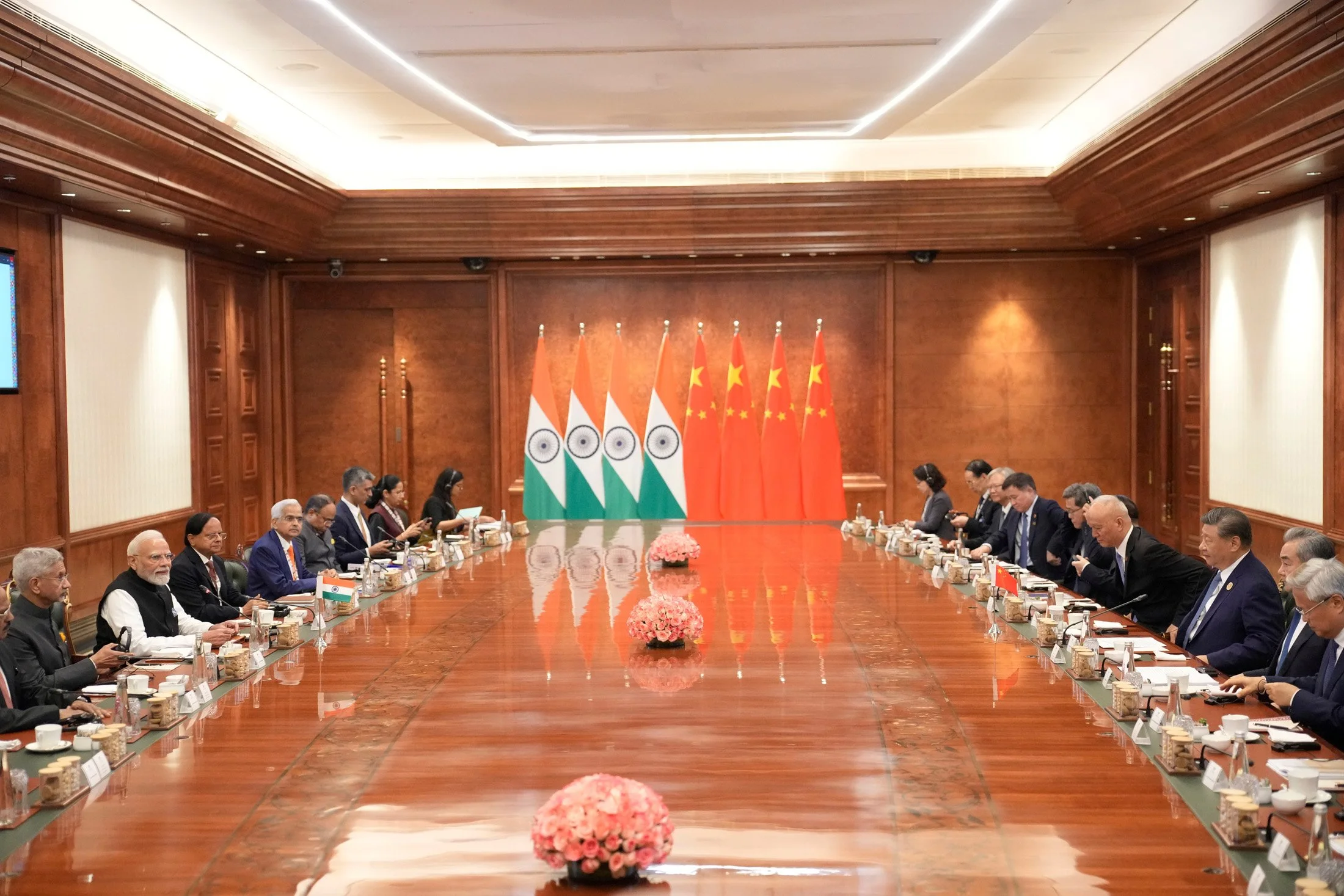
Since late 2024, when the two sides finalized disengagement at the last major friction point along their disputed Line of Actual Control (LAC), India and China have inched back towards economic, political, and social normalization. The issuance of visas, air connectivity, the resumption of media coverage, and religious pilgrimages have gradually resumed. Border talks between senior representatives have also been restarted. Chinese leader Xi Jinping’s visit to India for the BRICS Summit last month, his first in seven years, provided an opportunity for high-level political sanction for this gradual thaw.
But the India-China relationship remains structurally fraught and rests on a precarious foundation. Military infrastructure development on both sides of the LAC continues — as does large-scale Chinese dam building on the Brahmaputra River, an important waterway that flows to India. China also continues its rapid military and nuclear modernization efforts, albeit with more of an eye on the United States in the Pacific. India retains concerns about China’s growing naval presence in the Indian Ocean, its development of potentially dual-use ports and airfields, and predatory Chinese economic relations in the region. Meanwhile, China-Pakistan military relations continue to coalesce, with Chinese-origin equipment accounting for almost 80% of Pakistan’s military hardware and extensive Chinese support for Pakistan’s intelligence, surveillance, and reconnaissance (ISR) and navigation systems.
India-China economic relations are equally challenging, despite the large volume of bilateral goods trade. India confronts a $112 billion trade deficit with China and Indian firms that are competitive in most international markets continue to face barriers there. Beijing still places restrictions on outbound investment to India and has at times delayed the export of items such as tunnel-boring equipment, fertilizers, and rare earth metals. Some Chinese personnel have been prevented recently from traveling to India as part of efforts involving supply chain diversification (a so-called “China+1” strategy). China’s investment presence in Indian start-ups has also dwindled relative to the pre-2020 period.
For its part, India continues to ban Chinese apps and Chinese companies from some critical infrastructure. India has also not signed up to the China-led World Artificial Intelligence Cooperation Organization (WAICO). In March 2026, India slightly diluted investment restrictions it imposed in April 2020, enabling automatic approvals for investments with up to 10% of Chinese ownership and faster decisions in select sectors like capital goods, electronics, and polysilicon wafers.
Despite this tweak, the Indian government continues to monitor supply chain risks from China. For example, the Securities and Exchange Board of India has enhanced background verification of foreign portfolio investors from countries having a land border with India. The Ministry of Electronics and Information Technology has tightened certification requirements for close circuit television cameras, where Chinese companies account for almost one-third of the Indian market. The Ministry of New and Renewable Energy has increased cybersecurity requirements for rooftop solar inverters, 80% of which are Chinese-origin. And the Ministry of Defense has released a draft framework to test vulnerabilities in unmanned aerial vehicles and established a lab to enhance cyber security of specialized military electronics.
That these activities continue despite difficulties and trade uncertainty in India’s relations with the United States is revealing. India, like many other countries in Europe, the Middle East, and the Indo-Pacific — is caught between U.S. market access and unreliability on the one hand and Chinese overcapacity and assertiveness on the other. Remarkably, over the past year, only two countries (China and Canada, along with the European Union on some products) have imposed reciprocal tariffs on the United States while 52 of the world’s 70 largest economies — including those with few political differences with Beijing — have launched trade defense measures on Chinese goods.
India continues to diversify its economic partnerships beyond China and the United States. In 2026 alone, it concluded agreements on uranium supply with Australia and Canada, on rare earth magnets and elements with Indonesia and Vietnam, on shipbuilding with South Korea and Italy, and on semiconductors with Japan and Netherlands. It is also expanding collaboration in critical minerals as part of a new trilateral partnership with Australia and Canada (ACITI). The European Union remains vital for joint projects in clean technology, digital infrastructure, and telecommunications. Despite a political thaw with China, India will double-down on efforts to indigenize its own industrial capabilities in certain sectors, while seeking new markets for exports, new defense and technology partners, and new and diverse sources for raw materials, investment, and intermediary goods.
Dhruva Jaishankar is Executive Director at ORF America and Ammar Nainar is a Program Coordinator and Junior Fellow for the Foreign Policy & Security Program at ORF America.