
By: Jeffrey D. Bean
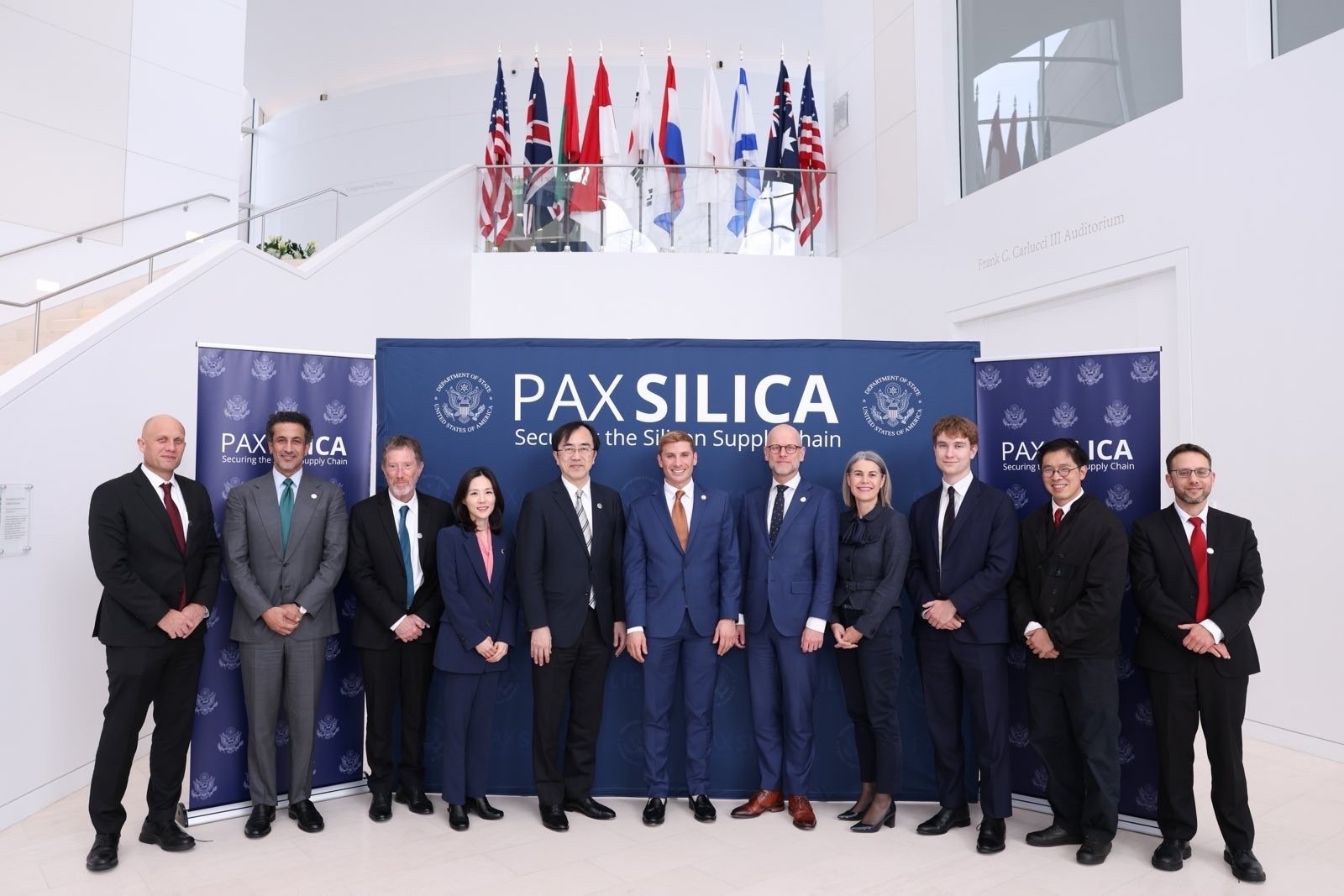
In June, the U.S. State Department hosted the second Pax Silica Summit. This grouping, established by President Trump’s administration, now includes 24 countries plus the European Union and Taiwan, with the purpose of sustaining U.S. efforts to manage, maintain, and sustain leadership in critical and emerging technologies. On the sidelines of the Summit, a total of 35 economies signed the corresponding Joint Statement on AI Opportunity Partnership. The initiative has been criticized for being non-binding, unfocused, U.S.-centric, and inconsistent in its membership by excluding important countries such as Canada and Mexico. But it is nonetheless the best-placed plurilateral initiative to advance what has been a bipartisan consensus in the United States on U.S. technological leadership. Its approach to AI supply chain resilience is driven by four clear-eyed realities.
First, the backbone of artificial intelligence remains physical hardware that enables advanced compute through AI chips and datacenters. Second, the connectivity and networking component via high-speed broadband and telecommunications connections through undersea cables, fiberoptic lines, and satellites is necessary to maintain access to and support the deployment of cloud services, online software, and AI applications amid new cyber and kinetic threats. Third, ensuring economic security requires securing the inputs for the above into complex ecosystems, including critical minerals and rare earth elements, intellectual property, and electricity and water. All these ingredients are necessary to enable researchers, scientists, and private sector firms to innovate, design, and manufacture more efficient, powerful, and cost-effective solutions. Fourth, no nation or organization can accomplish the above alone: not even the United States.
The flexibility of the hub-and-spoke model of the Pax Silica declaration and individual bilateral agreements is that the United States can seek to leverage the comparative advantage of each partner in the broader supply chain. Whether on critical minerals, semiconductor manufacturing, AI infrastructure, application deployment, logistics, cybersecurity, talent, or digital public infrastructure, the United States needs support, cooperation, and investment from partner governments and relevant private sector firms. The recognition from leading U.S. officials of these facts despite the “America First” ethos of the Trump administration underscores this sharp reality. At the same time, the United States appears keen to stave off the digital sovereignty trap in AI. Without like-minded countries assuming a complementary posture, many countries could be left behind or choose to leverage less secure AI options. Pax Silica’s approach to AI supply chain resilience and preventing authoritarian dominance of these technologies by China and Russia will be undercut if clear benefits are not available to partners.
For Pax Silica to remain relevant, the Trump administration must start to actualize the promise by implementing relevant projects and public-private partnerships. Aside from the aforementioned AI Opportunity Partnership, there are few tangible outcomes to date. But those few are notable. The Foundry School Initiative with Stanford University reflects the desperate need to provide curricula to better shape talent globally for AI. Ideally, this effort could be expanded to satisfy the substantial demand in the Global South — as described in the AI Impact Summit Declaration — for knowledge, skilling, and education tied to coding, programming, and engineering for critical and emerging technology and AI.
Similarly, the pilot Panama Pax Silica Artificial Intelligence Assistance Project (Pax Pass) addresses the need to advance the logistical and technological capabilities for ports, customs, and shipping hubs globally, but especially in the Global South. While the project will start in Panama because of the importance of the Panama Canal and the geographic proximity to the United States, the Notice of Funding Opportunity describes a global “Silicon Highway” of digital and physical compliance. Phase two of the project includes a focus on several key Global South economies including India and some in Latin America, but also some that are not yet party to Pax Silica, like Indonesia. In addition to clear opportunities for efficiency gains, real-time data tracking could aid export control enforcement for crucial inputs like critical minerals and finished products like AI chips. Requesting $50 billion in support from the U.S. Congress makes this initiative a highly valuable case to prove the viability of Pax Silica projects.
Despite some early stumbles, the Luzon Economic Corridor project and the proposed 40,000 acre AI innovation park in the Philippines provides a clear platform for public-private partnerships to address areas of vulnerability in the physical supply chain, including logistics, back-end packaging for semiconductors, critical mineral refining and processing, and advanced green-field AI-enabled manufacturing processes with lower labor costs. Yet these partnerships with the U.S. private sector and multinational companies need to be finalized to signal feasibility to other partners.
Finally, the Pax Silica fund isolates a standout issue in AI infrastructure more broadly: investment. Combining proposed investment via Japan’s SoftBank, Singapore's Temasek, and the United Arab Emirates’ Mubadala Investment Company needs to signal a few early wins and secure clear announcements aligned with Pax Silica objectives. Investments in networking and AI infrastructure, along with a variety of new energy production facilities, will be necessary to offset skyrocketing electricity demand from AI data centers.
All of these projects and initiatives are largely consistent with bipartisan U.S. objectives in national and economic security. So far, clear and practical public-private partnerships have not yet been announced to support these objectives. Elevating the credibility of Pax Silica by its one-year anniversary in December 2026 with some concrete investment announcements, specific critical mineral offtake agreements, tangible groundbreaking on specific projects, or even line-item commitments in U.S. Congressional appropriations will go a long way toward reinforcing the initiative’s durability.
Jeffrey D. Bean is a Fellow for the Technology Policy program and Editor at ORF America.