Piyush Verma
Senior Fellow
Piyush Verma
HIGHLIGHTS
2022-2025: Senior Advisor and Global Lead – Energy Governance, United Nations Development Programme, New York
2019-2022: Chair – Joint Task Force on Digitalization in Energy, United Nations Economic Commission for Europe, Geneva
2018-2022: Global Future Energy Leader, World Energy Council, London
2018-2021: Senior Energy Policy Analyst, International Energy Research Center, Cork
2011-2014: Policy Analyst, Bureau of Energy Efficiency, Government of India, New Delhi
Dr. Piyush Verma is a Senior Fellow at ORF America, where he leads the organization’s work on energy and climate policy. His research and advisory portfolio sits at the intersection of technology, economics, society, governance, and geopolitics, advancing policy solutions for a just and sustainable energy transition.
Prior to joining ORF America, Dr. Verma served as Chief Technical Advisor – Sustainable Energy at the UNDP Samoa Multi-Country Office, where he supported energy transition initiatives across the Pacific region. He also held the role of Senior Advisor – Energy Governance at UNDP New York, spearheading efforts to accelerate just energy transitions in over 170 countries.
Dr. Verma has contributed to the design and implementation of national energy and climate policies in India, New Zealand, Ireland, the United States, Vanuatu, and Niue. From 2021 to 2022, he chaired the Joint Task Force on Digitalization in Energy at the United Nations Economic Commission for Europe in Geneva, playing a pivotal role in establishing this platform to harness digital innovation for achieving net-zero ambitions across 54 countries in Europe and Central Asia.
Earlier, he was recognized as a Global Future Energy Leader by the World Energy Council in London — where he led and contributed to numerous international projects between 2018 and 2022 — earning a ‘Gold Badge’ for his collaborations that spanned over 50 countries.
A prolific author and commentator, Dr. Verma has published over 80 articles, reports, policy briefs, and op-eds on energy and climate policy. His insights have appeared in outlets such as The Times of India, DD News India, Irish Times, Irish Examiner, RTE Ireland, Irish Tech News, and The Sunday Times UK. He is a frequent speaker at high-level forums, having presented at major conferences and intergovernmental platforms in over 45 countries.
His contributions have been recognized with the Gold Level Leadership and Service Award from the University of Auckland in 2018 and the Young Achiever Alumnus Award from the National Institute of Technology, Jamshedpur in 2024. He is also a Senior Member of the Institute of Electrical and Electronic Engineers-USA.
Dr. Verma holds a PhD in Energy Technology and Policy from the University of Auckland, New Zealand; a Master in Public Administration as an Edward S. Mason Fellow from the Harvard Kennedy School of Government; a Master’s degree in Power System Engineering; and a Bachelor’s degree in Electrical Engineering from India.
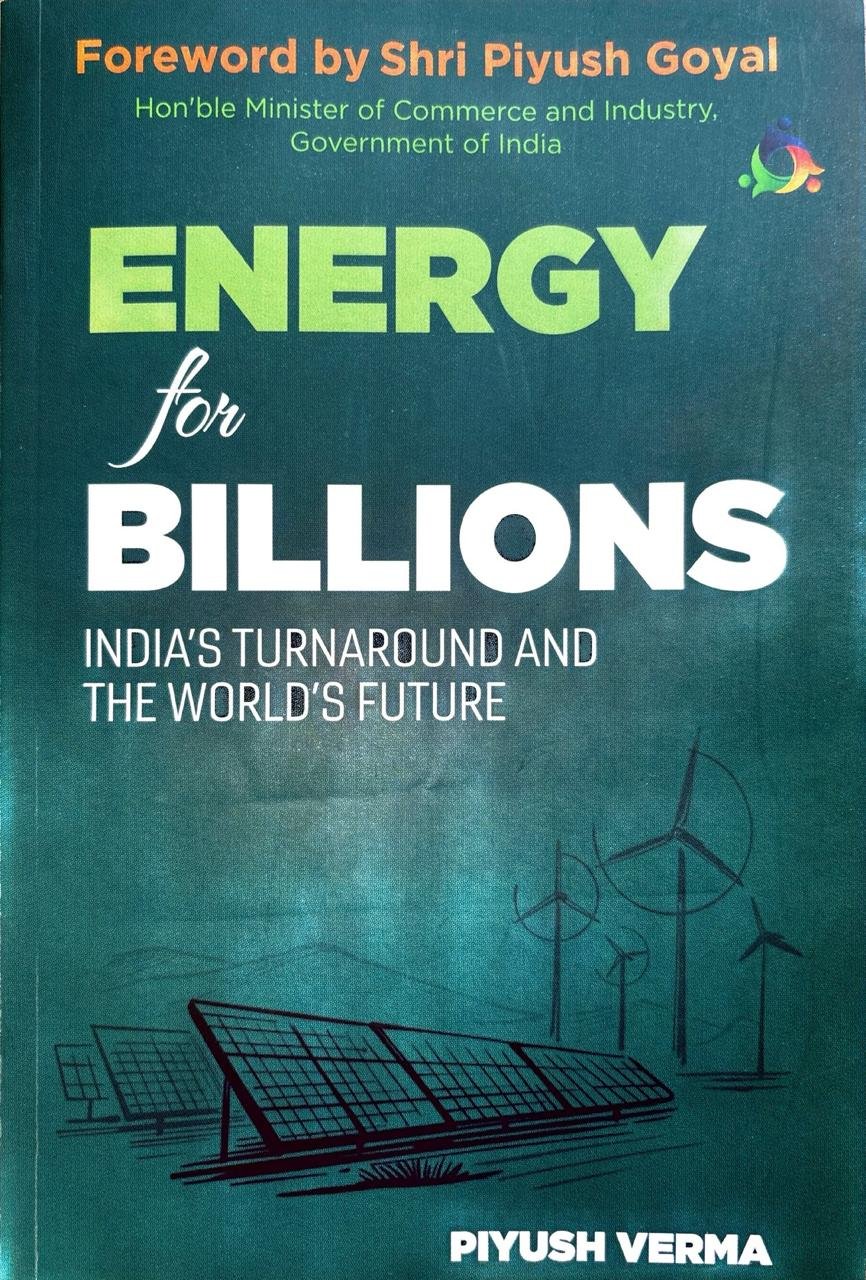
Energy for Billions: India’s Turnaround and the World’s FuturE
Available now
Energy for Billions: India’s Turnaround and the World’s Future is both a personal memoir and a national chronicle — the story of one man’s journey from a small, unelectrified home in a rural village in India to the global stage of energy and climate diplomacy, and of a nation’s extraordinary transformation from scarcity to leadership in clean energy.
In this deeply engaging narrative, Dr. Piyush Verma blends personal reflection with policy insight to tell the story of India’s energy revolution — a decade that redefined what is possible for emerging economies.
Recent events
Publications

By Mannat Jaspal, Parul Bakshi, Cauvery Ganapathy, Lydia Powell, and Piyush Verma
As we enter 2026, climate and energy policies are being shaped not only by decarbonization imperatives. Geopolitical upheaval, technological competition, economic transformation, supply chain resilience, and national security concerns are exerting influence over the future of energy and climate policies worldwide.
By Piyush Verma
India’s latest Union Budget marks a subtle but important shift in how the country is framing its energy priorities. Rather than centering the narrative solely on clean energy targets or renewable capacity additions and relevant policy support, the Budget signals a broader and more mature emphasis on energy security.
By Ashwini Thakre and Piyush Verma
No single country can efficiently develop the entire critical minerals value chain on its own, particularly for rare earths and battery materials. Cooperation among the United States, Australia, Japan, and other Indo-Pacific economies reflects a growing recognition that resilience lies not in isolation, but in diversified and trusted networks.
By Ashwini Thakre and Piyush Verma
China’s diplomatic control over sector may become the very trigger that unwinds its dominance. By weaponizing concentration, Beijing accelerated diversification efforts that many democracies had treated as optional. The shock exposed the liabilities of a system built on single-country dependence and encouraged a coordinated wave of investment across the United States, Europe, Japan, South Korea, and Australia.
By Piyush Verma
Strengthening the EU-India energy partnership would unlock significant economic opportunities for both regions, fostering innovation, job creation, and strengthening security. How India and the EU align their energy strategies through their trade agreement will have far-reaching consequences for the world’s future.
By Piyush Verma
By meeting clean energy targets ahead of schedule, expanding nuclear and hydrogen capacity, and securing critical mineral supply chains, India is positioning itself as a model for climate-conscious growth that does not compromise on economic or strategic goals.
By Piyush Verma
While challenges remain in terms of generation mix, grid integration, infrastructure resilience and storage capacity, India’s clean energy milestone sends a clear message: ambitious goals, backed by policy, innovation, and investment, can deliver real-world impact.
By Piyush Verma
Energy need not be a constraint on India's AI ambitions. It can be a competitive advantage. Encouraging data-centre locations that reflect grid readiness and renewable availability can reduce system stress while improving reliability. Expanding frameworks for round-the-clock clean power supported by storage and flexible resources can ensure AI growth strengthens climate goals rather than complicates them.
Special Report No. 9
By Medha Prasanna, Caroline Arkalji, and Piyush Verma
Special Report No. 7
By Piyush Verma, Medha Prasanna, Caroline Arkalji, Erlijn Van Genuchten, and Siddharth Sharma
By Piyush Verma and Telmen Altanshagai
Mongolia is not just a customer or supplier—but a co-partner in building new regional supply-chains, new corridors and new resource-alliances. It speaks to a future where India is not simply plugged into global energy markets, but co-creating them.
By Piyush Verma and Abhinav Jindal
India’s bid to host COP 33 is a clear signal of geopolitical intent. It positions the world’s largest democracy, the most populous nation and the fourth-largest economy as a bridge between developed and developing worlds.
By Piyush Verma
By working more closely with India, South Africa, and Indonesia, Brazil can move faster at home, bargain better abroad, and ensure the Global South is not just present but powerful at the table where tomorrow’s rules are written.
By Piyush Verma
At a time when multilateralism is under significant stress and global climate finance remains skewed and inequitably distributed, IBSA+Indonesia offers a fresh model of geopolitical collaboration on energy and climate – anchored in shared values and driven by practical action.